FabulousFusionFood's Beef-based Recipes 7th Page
 Image of an European cow (top left), African Zebu (top right) and
Indian bull (bottom left) along with a selection of beef cuts.
Welcome to FabulousFusionFood's Beef-based Recipes Page — The recipes presented here are all based on cow meat. Beef is the culinary name for meat from cattle (Bos taurus or Bos indicus). Beef can be prepared in various ways; cuts are often used for steak, which can be cooked to varying degrees of doneness, while trimmings are often ground or minced, as found in most hamburgers. Beef contains protein, iron, and vitamin B12. Along with other kinds of red meat, high consumption is associated with an increased risk of colorectal cancer and coronary heart disease, especially when processed. Beef has a high environmental impact, being a primary driver of deforestation with the highest greenhouse gas emissions of any agricultural product.
People have eaten the flesh of bovines since prehistoric times; some of the earliest known cave paintings, such as those of Lascaux, show aurochs in hunting scenes. People domesticated cattle to provide ready access to beef, milk, and leather. Cattle have been domesticated at least twice over the course of evolutionary history. The first domestication event occurred around 10,500 years ago with the evolution of Bos taurus. The second was more recent, around 7,000 years ago, with the evolution of Bos indicus in the Indian subcontinent. There is a possible third domestication event 8,500 years ago, with a potential third species Bos africanus arising in Africa.
Most beef can be used as is by merely cutting into certain parts, such as roasts, short ribs or steak (filet mignon, sirloin steak, rump steak, rib steak, rib eye steak, hanger steak, etc.), while other cuts are processed (corned beef or beef jerky). Trimmings, on the other hand, which are usually mixed with meat from older, leaner (therefore tougher) cattle, are ground, minced or used in sausages. The blood is used in some varieties called blood sausage. Other parts that are eaten include other muscles and offal, such as the oxtail, liver, tongue, tripe from the reticulum or rumen, glands (particularly the pancreas and thymus, referred to as sweetbread), the heart, the brain (although forbidden where there is a danger of bovine spongiform encephalopathy, BSE, commonly referred to as mad cow disease), the kidneys, and the tender testicles of the bull (known in the United States as calf fries, prairie oysters, or Rocky Mountain oysters). Some intestines are cooked and eaten as is, but are more often cleaned and used as natural sausage casings. The bones are used for making beef stock. Meat from younger cows (calves) is called veal. Beef from steers and heifers is similar.
he word beef is from the Latin word bōs, in contrast to cow which is from Middle English cou (both words have the same Indo-European root *gʷou-). This is one example of the common English dichotomy between the words for animals (with largely Germanic origins) and their meat (with Romanic origins) that is also found in such English word-pairs as pig/pork, deer/venison, sheep/mutton, and chicken/poultry (also the less common goat/chevon). Beef is cognate with bovine through the Late Latin bovīnus. The rarely used plural form of beef is beeves.
Cuts of Beef (British, Irish,Australian, South African and New Zealand terms):
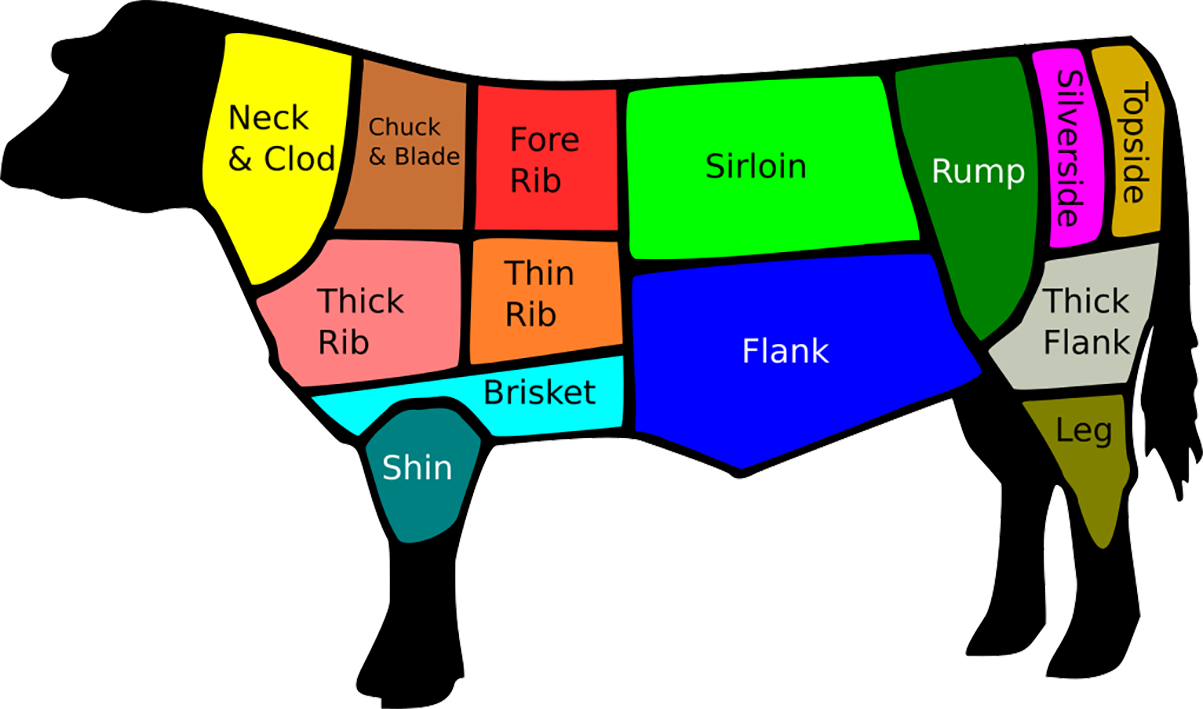 Cuts of Beef:
Tongue — boiling, pickling, roasting or braising
Necks and clod — stewing, slow smoking or braising
Chuck steak & blades — mincing, braising, slow roasting
Sirloin — Frying, roasting, barbecuing
Rump — Frying, barbecuing
Silverside — Roasting
Topside — Roasting, pies, air drying
Top rump — Roasting, barbecuing
Fore rib — Roasting
Rib eye steak — Frying
T-bone steak — Frying
Thick rib — Braising, barbecuing, roasting
Thin rib — Braising, barbecuing
Brisket (Skirt steak) — Baking, boiling, roasting, braising
Shin and leg — Mince, slow stewing, braising
Flank — Barbecued, grilled, braised
Thick flank — Barbecued, grilled, braised
Feather blade — Frying, braising
Fillet — Frying, tartare
Oxtail — Stew, braising
Offal — typically liver, heart, stomach, intestines and kidneys
The alphabetical list of all the beef-based recipes on this site follows, (limited to 100 recipes per page). There are 1151 recipes in total:
Page 7 of 12
| Macanese Minchi (Minced Meat Potato Hash) Origin: Macau | Medium Stock Origin: Britain | Mrs Beeton Barley Soup Origin: British |
| Machaca (Mexican Shredded Beef) Origin: Mexico | Methi Kalia (Spicy Fenugreek Meat) Origin: Bangladesh | Mrs Beeton Brown Gravy Origin: British |
| Madeira Prego Sandwich Origin: Portugal | Mexican Beef Quesadilla Origin: Mexico | Mrs Beeton Herodotus Pudding Origin: Britain |
| Madras-style Leftovers Curry Origin: India | Mexican Beef Tostada Origin: Mexico | Mshakiki (Comorian Kebabs) Origin: Comoros |
| Mafé Malienne (Malian Mafé) Origin: Mali | Mexican Carne Asada Street Tacos Origin: Mexico | Mtsolola à la viande (Bananas and Meat) Origin: Mayotte |
| Maffé Mauritanienne (Aubergines and Pumpkin) Origin: Mauritania | Mexican Crockpot Chili Origin: American | Mughlai Beef Biriani Origin: India |
| Maffe aux Legumes Arachide (Beef or Lamb in Peanut Butter) Origin: Senegal | Mexican-style Steaks with Avocado Salsa Origin: Britain | Muhogo ya andzi Na nyama (Cassava with Meat) Origin: Mayotte |
| Magatla (Oxtail Casserole) Origin: Botswana | Mici (Garlicky Skinless Grilled Sausages) Origin: Romania | Mullah Bamyah (Beef and Okra Stew) Origin: Sudan |
| Majadito (Bolivian Rice and Beef) Origin: Bolivia | Microwave Beef Spice Hotpot Origin: Britain | Mulligatawny Soup Origin: Anglo-Indian |
| Majoranas Tokany (Beef with Marjoram) Origin: Hungary | Microwave Christmas Pudding Origin: Britain | Muqmad (Djibouti Preserved Meat) Origin: Djibouti |
| Malawian Biltong Origin: Malawi | Microwave Hamburger Origin: Britain | Mustard Beef with Potato Gratin Origin: Australia |
| Malaysian Beriani Origin: Malaysia | Microwave Jam Roly-poly Pudding Origin: Britain | Musti Suktinukai (Lithuanian Beef Rolls) Origin: Lithuania |
| Mallow Leaf Stew II Origin: African Fusion | Microwave Meatballs in Chilli Sauce Origin: American | My Lady of Portlandàs Mince Pyes Origin: Britain |
| Mallow Stew Origin: Britain | Microwave Spicy Mid-winter Pie Origin: Britain | Nacho Cheese Sauce Origin: America |
| Manos de Cerdo a la Peruana (Peruvian-style Pig's Trotters) Origin: Peru | Milanesa Uruguaya Origin: Uruguay | Naengmyŏn Origin: North Korea |
| Manti (Meat-filled Boat-shaped Pastry) Origin: Armenia | Mince and Tatties Origin: Scotland | Naga Curry Origin: Fusion |
| Manx Pasties Origin: Manx | Mince Curry with Peas Origin: South Africa | Namibian Beef Stew With Potatoes And Carrots Origin: Namibia |
| Marrow Croustades Origin: Britain | Minchet Abish Wot Origin: Ethiopia | Nandji de Boeuf (Nandji of Beef) Origin: Cote dIvoire |
| Marrow Patties Origin: Britain | Minestra siciliana di Pasqua (Sicilian Easter Soup) Origin: Italy | Ndambé à la Sauce Tomateh (Bean and Meat Stew in Tomato Sauce) Origin: Senegal |
| Maschi Origin: Sudan | Minutal Terentinum (Terentine Ragout) Origin: Roman | Ndambé Blanc (White Bean and Meat Stew) Origin: Senegal |
| Massak'a (Egyptian Moussaka) Origin: Egypt | Mititei (Romanian Minced Meat Sausages) Origin: Romania | Ndizi na Nyama (Plantains with Meat) Origin: East Africa |
| Massaman Beef Curry Origin: Thailand | Miyan Kuka (Baobab Leaf Soup) Origin: Nigeria | Ndolé à la Viande (Bitterleaf with Meat) Origin: Cameroon |
| Massaman Nuea (Beef Masaman Curry) Origin: Thailand | Miyan Kuka II (Baobab Leaf Soup II) Origin: Nigeria | New noumbles of dere (Fresh Deer Offal) Origin: England |
| Massaman Nuea (Beef Massaman Curry) Origin: Thailand | Mock Turtle I Origin: British | New York Style Hotdogs Origin: American |
| Matambre Arrollado (Argentinan Stuffed Rolled Beef) Origin: Argentina | Mock Turtle II Origin: British | New Zealand Beef Curry Origin: New Zealand |
| Matura and Mahu Origin: Burundi | Mogatla (Oxtail Casserole) Origin: Botswana | New Zealand Meat Pie Origin: New Zealand |
| Mayotte Brochettes de Boeuf Origin: Mayotte | Mologothannie Origin: Sri Lanka | Ngunza et Boule de Manioc (Ngunza and Cassava Balls) Origin: Central African Republic |
| Meat and Potato Pasty Origin: England | Monkey Gland Steak Origin: Southern Africa | Nidi di Rondine (Swallows' Nests) Origin: San Marino |
| Meat Feast Pizza Origin: American | Montserratian Rice and Peas Origin: Montserrat | Nigerian Fried Rice II Origin: Nigeria |
| Meatball Brochettes Origin: Fusion | Mooli and Garlic Beef with Pine Nuts Origin: Australia | Nigerian Spiced Mixed Meat Pepper Soup Origin: Nigeria |
| Meatballs in Garlic Broth Origin: Algeria | Moretariaum (Country Sauce) Origin: Roman | Nigerian Uziza Ribs Origin: Nigeria |
| Meatballs in Yoghurt Sauce Origin: Uganda | Moussaka Origin: Greece | Nkrakra II (Ghanaian Light Soup) Origin: Ghana |
| Meatballs on Sticks Origin: Britain | Mozambican Prego no Pão (Mozambican Prego Rolls) Origin: Mozambique | |
| Meatloaf with Indian Seasonings Origin: Fusion | Mrs Beeton Asparagus Soup Origin: British |
Page 7 of 12