FabulousFusionFood's Africa Recipes Home Page
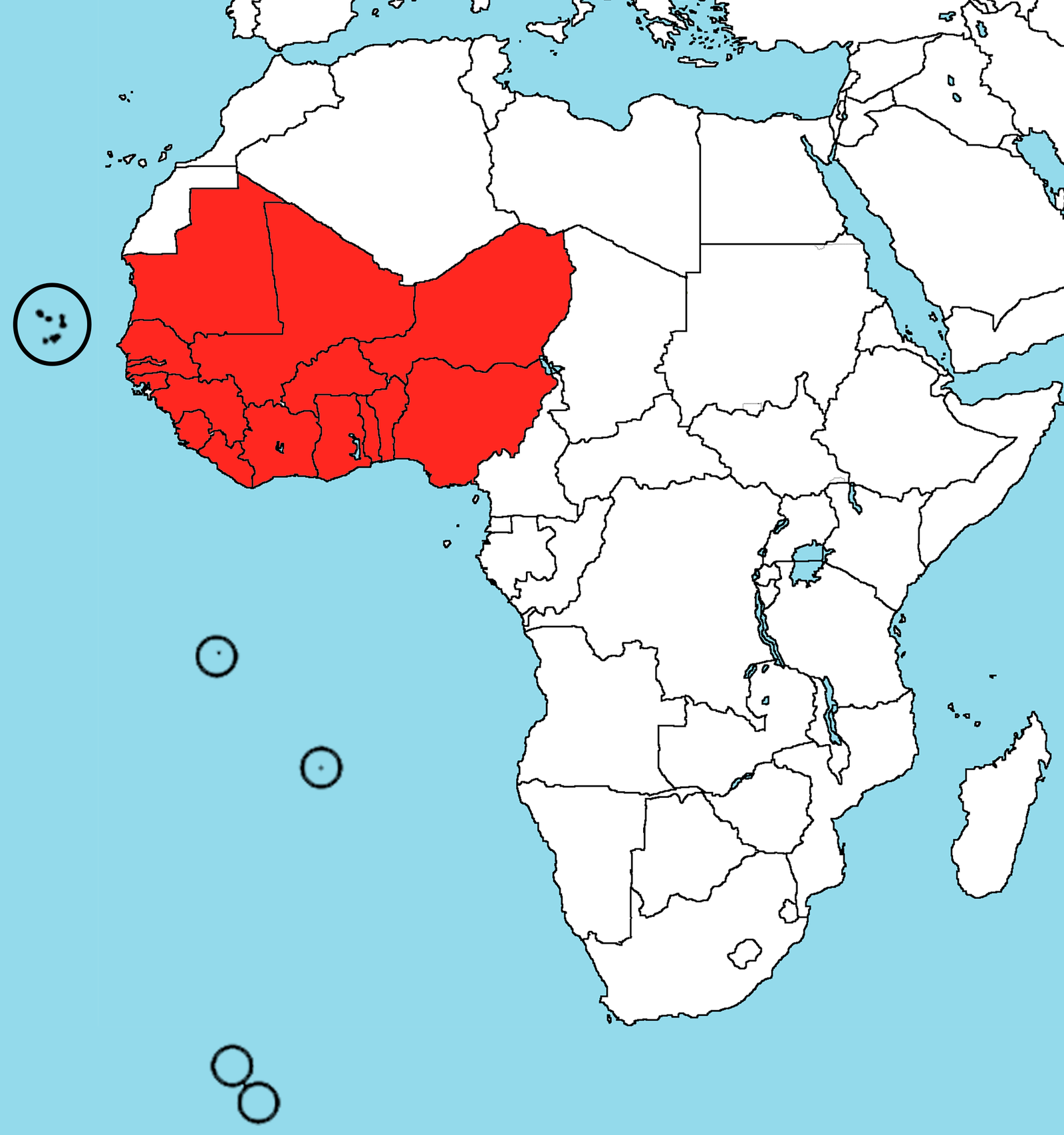 The map of Africa with the region of West Africa shown in red. To demonstrate the
extend of West Africa, the Cape Verde islands are circled top left.
Saint Helena, Ascension and Tristan da Cunha are shown by the two circles at the centre
and the two circles at the base of the map.
Welcome to the summary page for FabulousFusionFood's West Africa recipes. This page provides links to all the West Africa recipes presented on this site, with 1307 recipes in total.
Here each country in West Africa is listed with a collection of recipes from that country. Only a brief description of the country is given here. For a more detailed overview please use the links below to navigate to the full listing page for that country. Also, please note that only a maximum of 50 recipes is given for each country in the list given on this page. For the full recipes listing you need to navigate to the country's main page. However, this page also gives recipes that are common to all countries in West Africa, which are not found elsewhere on this site.
These recipes, for the major part, originate in West Africa. Otherwise they are fusion recipes with major West African influences.
West Africa or Western Africa is the westernmost region of Africa. The United Nations defines Western Africa as the 16 countries of Benin, Burkina Faso, Cape Verde, The Gambia, Ghana, Guinea, Guinea-Bissau, Ivory Coast, Liberia, Mali, Mauritania, Niger, Nigeria, Senegal, Sierra Leone, and Togo, as well as Saint Helena, Ascension and Tristan da Cunha (United Kingdom Overseas Territory). The population of West Africa is estimated at 419 million people as of 2021, and at 381,981,000 as of 2017, of which 189,672,000 were female and 192,309,000 male. The region is demographically and economically one of the fastest growing on the African continent.
Early history in West Africa included a number of prominent regional powers that dominated different parts of both the coastal and internal trade networks, such as the Mali and Gao Empires. West Africa sat at the intersection of trade routes between Arab-dominated North Africa and further south on the continent, the source of specialized goods such as gold, advanced iron-working, and ivory. After European exploration encountered rich local economies and kingdoms, the Atlantic slave trade built on already existing slave systems to provide labor for colonies in the Americas. After the end of the slave trade in the early 19th century, European nations, especially France and Britain, continued to exploit the region through colonial relationships. For example, they continued exporting a number of extractive goods, including labor-intensive agricultural crops like cocoa and coffee, forestry products like tropical timber, and mineral resources like gold. Since independence, many West African countries, like Ivory Coast, Ghana, Nigeria and Senegal, have played important roles in the regional and global economies.
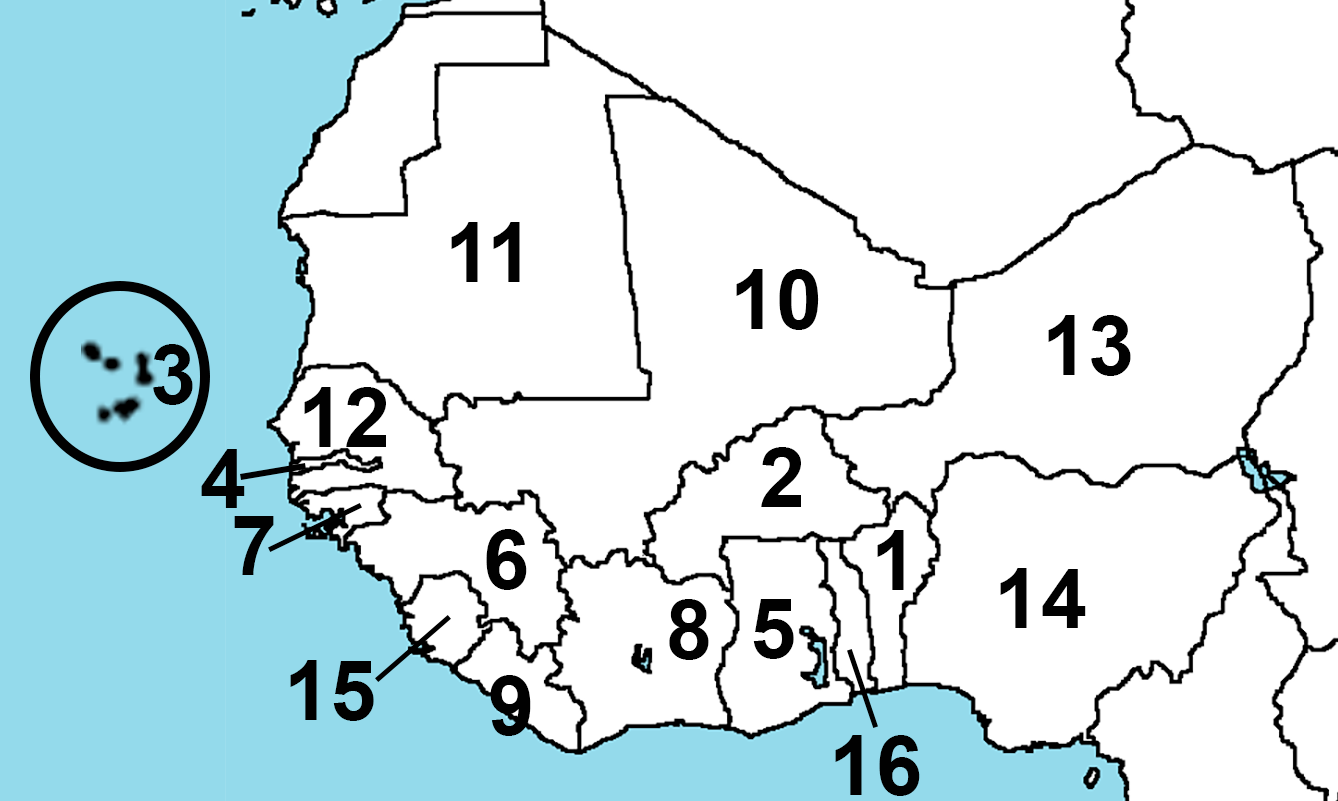 Map of West Africa with the 16 nations numbered. The corresponding
countries are : 1: Benin; 2: Burkina Faso; 3: Cape Verde; 4: The Gambia;
5: Ghana; 6: Guinea; 7: Guinea-Bissau; 8: Ivory Coast; 9: Liberia;
10: Mali, 11: Mauritania; 12: Niger; 13: Nigeria; 14: Senegal; 15: Sierra
Leone; 16: Togo.West Africa has a rich ecology, with strong biodiversity and several distinct regions. The area's climate and ecology are heavily influenced by the dry Sahara to the north and east, which provides dry winds during the Harmattan, as well as the Atlantic Ocean to the south and west, which provides seasonal monsoons. This mixture of climates gives West Africa a rich array of biomes, from biodiversity-rich tropical forests to drylands supporting rare and endangered fauna such as pangolins, rhinoceros, and elephants. Because of the pressure for economic development, many of these ecologies are threatened by processes like deforestation, biodiversity loss, overfishing, pollution from mining, plastics and other industries, and extreme changes resulting from climate change in West Africa.
The history of West Africa can be divided into five major periods: first, its prehistory, in which the first human settlers arrived, developed agriculture, and made contact with peoples to the north; the second, the Iron Age empires that consolidated both intra-Africa, and extra-Africa trade, and developed centralized states; third, major polities flourished, which would undergo an extensive history of contact with non-Africans; fourth, the colonial period, in which Great Britain and France controlled nearly the entire region; and fifth, the post-independence era, in which the current nations were formed.
Scores of foreign visitors to West African nations (e.g., traders, historians, emigrants, colonists, missionaries) have benefited from its citizens' generosity, and even left with a piece of its cultural heritage, via its foods. West African cuisines have had a significant influence on those of Western civilization for centuries; several dishes of West African origin are currently enjoyed in the Caribbean (e.g., the West Indies and Haiti); Australia; the USA (particularly Louisiana, Virginia, North and South Carolina); Italy; and other countries. Although some of these recipes have been altered to suit the sensibilities of their adopters, they retain a distinct West African essence.
West Africans cuisines include fish (especially among the coastal areas), meat, vegetables, and fruits—most of which are grown by the nations' local farmers. In spite of the obvious differences among the various local cuisines in this multinational region, the foods display more similarities than differences. The small difference may be in the ingredients used. Most foods are cooked via boiling or frying. Commonly featured, starchy vegetables include yams, plantains, cassava, and sweet potatoes. Rice is also a staple food, as is the Serer people's sorghum couscous (called 'Chereh' in Serer) particularly in Senegal and the Gambia. Jollof rice—originally from the Kingdom of Jolof (now part of modern-day Senegal) but has spread to the Wolofs of Gambia—is also enjoyed in many Western nations, as well; Mafé (proper: 'Tigh-dege-na' or Domodah) from Mali (via the Bambara and Mandinka)—a peanut-butter stew served with rice; Akara (fried bean balls seasoned with spices served with sauce and bread) from Nigeria is a favorite breakfast for Gambians and Senegalese, as well as a favorite side snack or side dish in Brazil and the Caribbean just as it is in West Africa. It is said that its exact origin may be from Yorubaland in Nigeria. Fufu (from the Twi language, a dough served with a spicy stew or sauce for example okra stew etc.) from Ghana is enjoyed throughout the region and beyond even in Central Africa with their own versions of it. Dishes such as taguella, eghajira, etc. are popular among the Tuareg people.
West Africa, as defined by the United Nations scheme of African regions is divided into 16 states and the United Kingdom Overseas Territory of Saint Helena, Ascension and Tristan da Cunha these are listed and defined below (it should be noted that due to Mauritania's increasingly close ties to the Arab World and its 1999 withdrawal from the Economic Community of West African States (ECOWAS), in modern times it is often considered, especially in Africa, as being part of western North Africa):
Here each country in West Africa is listed with a collection of recipes from that country. Only a brief description of the country is given here. For a more detailed overview please use the links below to navigate to the full listing page for that country. Also, please note that only a maximum of 50 recipes is given for each country in the list given on this page. For the full recipes listing you need to navigate to the country's main page. However, this page also gives recipes that are common to all countries in West Africa, which are not found elsewhere on this site.
These recipes, for the major part, originate in West Africa. Otherwise they are fusion recipes with major West African influences.
West Africa or Western Africa is the westernmost region of Africa. The United Nations defines Western Africa as the 16 countries of Benin, Burkina Faso, Cape Verde, The Gambia, Ghana, Guinea, Guinea-Bissau, Ivory Coast, Liberia, Mali, Mauritania, Niger, Nigeria, Senegal, Sierra Leone, and Togo, as well as Saint Helena, Ascension and Tristan da Cunha (United Kingdom Overseas Territory). The population of West Africa is estimated at 419 million people as of 2021, and at 381,981,000 as of 2017, of which 189,672,000 were female and 192,309,000 male. The region is demographically and economically one of the fastest growing on the African continent.
Early history in West Africa included a number of prominent regional powers that dominated different parts of both the coastal and internal trade networks, such as the Mali and Gao Empires. West Africa sat at the intersection of trade routes between Arab-dominated North Africa and further south on the continent, the source of specialized goods such as gold, advanced iron-working, and ivory. After European exploration encountered rich local economies and kingdoms, the Atlantic slave trade built on already existing slave systems to provide labor for colonies in the Americas. After the end of the slave trade in the early 19th century, European nations, especially France and Britain, continued to exploit the region through colonial relationships. For example, they continued exporting a number of extractive goods, including labor-intensive agricultural crops like cocoa and coffee, forestry products like tropical timber, and mineral resources like gold. Since independence, many West African countries, like Ivory Coast, Ghana, Nigeria and Senegal, have played important roles in the regional and global economies.
Map of West Africa with the 16 nations numbered. The correspondingcountries are : 1: Benin; 2: Burkina Faso; 3: Cape Verde; 4: The Gambia;
5: Ghana; 6: Guinea; 7: Guinea-Bissau; 8: Ivory Coast; 9: Liberia;
10: Mali, 11: Mauritania; 12: Niger; 13: Nigeria; 14: Senegal; 15: Sierra
Leone; 16: Togo.
The history of West Africa can be divided into five major periods: first, its prehistory, in which the first human settlers arrived, developed agriculture, and made contact with peoples to the north; the second, the Iron Age empires that consolidated both intra-Africa, and extra-Africa trade, and developed centralized states; third, major polities flourished, which would undergo an extensive history of contact with non-Africans; fourth, the colonial period, in which Great Britain and France controlled nearly the entire region; and fifth, the post-independence era, in which the current nations were formed.
The Cuisines of West Africa
Scores of foreign visitors to West African nations (e.g., traders, historians, emigrants, colonists, missionaries) have benefited from its citizens' generosity, and even left with a piece of its cultural heritage, via its foods. West African cuisines have had a significant influence on those of Western civilization for centuries; several dishes of West African origin are currently enjoyed in the Caribbean (e.g., the West Indies and Haiti); Australia; the USA (particularly Louisiana, Virginia, North and South Carolina); Italy; and other countries. Although some of these recipes have been altered to suit the sensibilities of their adopters, they retain a distinct West African essence.
West Africans cuisines include fish (especially among the coastal areas), meat, vegetables, and fruits—most of which are grown by the nations' local farmers. In spite of the obvious differences among the various local cuisines in this multinational region, the foods display more similarities than differences. The small difference may be in the ingredients used. Most foods are cooked via boiling or frying. Commonly featured, starchy vegetables include yams, plantains, cassava, and sweet potatoes. Rice is also a staple food, as is the Serer people's sorghum couscous (called 'Chereh' in Serer) particularly in Senegal and the Gambia. Jollof rice—originally from the Kingdom of Jolof (now part of modern-day Senegal) but has spread to the Wolofs of Gambia—is also enjoyed in many Western nations, as well; Mafé (proper: 'Tigh-dege-na' or Domodah) from Mali (via the Bambara and Mandinka)—a peanut-butter stew served with rice; Akara (fried bean balls seasoned with spices served with sauce and bread) from Nigeria is a favorite breakfast for Gambians and Senegalese, as well as a favorite side snack or side dish in Brazil and the Caribbean just as it is in West Africa. It is said that its exact origin may be from Yorubaland in Nigeria. Fufu (from the Twi language, a dough served with a spicy stew or sauce for example okra stew etc.) from Ghana is enjoyed throughout the region and beyond even in Central Africa with their own versions of it. Dishes such as taguella, eghajira, etc. are popular among the Tuareg people.
West Africa, as defined by the United Nations scheme of African regions is divided into 16 states and the United Kingdom Overseas Territory of Saint Helena, Ascension and Tristan da Cunha these are listed and defined below (it should be noted that due to Mauritania's increasingly close ties to the Arab World and its 1999 withdrawal from the Economic Community of West African States (ECOWAS), in modern times it is often considered, especially in Africa, as being part of western North Africa):
West Africa
| Arms | Flag | Name of Territory | Capital | Name in Official Language(s) |
|---|---|---|---|---|
 |
 |
Benin | Porto-Novo | Bénin |
 |
 |
Burkina Faso | Ouagadougou | Burkina Faso |
 |
 |
Cape Verde | Praia | Cabo Verde/Kabu Verdi |
 |
 |
The Gambia | Banjul | The Gambia |
 |
 |
Ghana | Accra | Ghana |
 |
 |
Guinea | Conakry | Guinée |
 |
 |
Guinea-Bissau | Bissau | Guiné-Bissau |
 |
 |
Ivory Coast | Abidjan, Yamoussoukro | Côte d'Ivoire |
 |
 |
Liberia | Monrovia | Liberia |
 |
 |
Mali | Bamoko | Mali/Maali/مالي (Mālī)/𞤃𞤢𞥄𞤤𞤭 (Maali)/ ߡߊߟߌ (Mali) |
 |
 |
Mauritania | Nouakchott | موريتانيا (Mūrītānyā) |
 |
 |
Niger | Niamey | Niger |
 |
 |
Nigeria | Abuja | Nigeria |
 |
 |
Saint Helena (United Kingdom) | Jamestown | Saint Helena |
 |
 |
Saint Helena, Ascension and Tristan da Cunha (United Kingdom) |
Jamestown | Saint Helena, Ascension and Tristan da Cunha |
 |
 |
Senegal | Dakar | Sénégal |
 |
 |
Sierra Leone | Freetown | Sierra Leone |
 |
 |
Togo | Lomé | Togo |
The alphabetical list of all the West African recipes on this site follows, (limited to 100 recipes per page). There are 1307 recipes in total:
Page 1 of 14
| Aadun Origin: Nigeria | Amala Origin: Nigeria | Bâton de Manioc (Cassava Sticks) Origin: Central Africa |
| Abacha Ncha (Dried Cassava with Garden Eggs) Origin: Nigeria | Amala and Ewedu Origin: Nigeria | Baked Beans with Nigerian Seasonings Origin: African Fusion |
| Abak (Palm Nut Soup) Origin: Nigeria | Amarula No-bake Cheesecake Origin: South Africa | Banana Curry Chutney Origin: South Africa |
| Abenkwan (Palm Oil Soup) Origin: Ghana | Amiwo (Beninese Maize Porridge) Origin: Benin | Banana Peel Flour Origin: South Africa |
| Ablo (Togolese Corn Bread) Origin: Togo | Amiwo au Poulet (Chicken Amiwo) Origin: Benin | Banane au Caramel (Caramel Bananas) Origin: Senegal |
| Accra Banana Peanut Cake Origin: Ghana | Amiwo au Poulet 2 (Amiwo with Chicken) Origin: Benin | Bananes Plantain au Gari (Plantains with Gari) Origin: Togo |
| Adalu (Bean and Sweetcorn Pottage) Origin: Nigeria | Ampesi with Kontomire Stew Origin: Ghana | Banani Loko (Aloko with Chilli Sauce) Origin: Guinea |
| Adowè (Mashed Beans) Origin: Togo | Angwa Mo (Ghanaian Rice Pilaf) Origin: Ghana | Banankou Fida (Sokossoko with Kidneys) Origin: Guinea |
| Adun Origin: Nigeria | Apple and Pear Harvest Pie Origin: South Africa | Banda (Smoked fish in Peanut Sauce) Origin: Chad |
| Afang Soup Origin: Nigeria | Apricot Blatjang Origin: South Africa | Banga Soup Origin: Nigeria |
| Afia Efere (White Soup) Origin: Nigeria | Asaro (Yam Pottage) Origin: Nigeria | Bangaou Origin: Chad |
| Afia Efere Unen (White Soup with Chicken) Origin: Nigeria | Asaro (Special Yam Pottage) Origin: Nigeria | Banku Origin: Ghana |
| African All Purpose Seasoning Origin: Nigeria | Asaro II (Yam Porridge) Origin: Nigeria | Baobab Cocktail Origin: Guinea |
| African Chicken Wings Origin: African Fusion | Ashanti Chicken Origin: Ghana | Barbecued Kibbeh Origin: African Fusion |
| African Fish Curry Powder Origin: West Africa | Askoek Origin: South Africa | Barokhé (Beef and Fish with Cassava Leaves) Origin: Mali |
| African Hot Sauce Origin: sub-Saharan Africa | Ataanme Nmliche (Tiger Nut Pudding) Origin: Ghana | Barracuda Farci au Feuille de Bissap (Barracuda Stuffed with Hibiscus Leaves) Origin: Senegal |
| African Stew Curry Powder Origin: West Africa | Atadwe Milkye (Silky Tigernut Pudding) Origin: Ghana | Baru Fida (Spinach Sauce with Peanuts and Beef Shank) Origin: Guinea |
| African-style Barbecue Sauce Origin: African Fusion | Atchar Origin: Southern Africa | Basic Jollof Rice Origin: Nigeria |
| Afrikaanse Yakhni Origin: South Africa | Attiéké Origin: Cote dIvoire | Bassi (Malian Couscous) Origin: Mali |
| Agbeli Kaaklo (Sweet Cassava Fritters) Origin: Ghana | Attiéké de Poisson (Attieke with Fried Fish) Origin: Cote dIvoire | Bean and Almond Salad Origin: South Africa |
| Agidi (Fermented Cornflour Pudding) Origin: Nigeria | Attiéké du Mali (Malian Attiéké) Origin: Mali | Bean and Gari Loaf Origin: Ghana |
| Agidi Jollof Origin: Nigeria | Attiéké et Aloko Poisson (Attieke and Fish Aloko) Origin: Niger | Beans Gravy Origin: Liberia |
| Agushi Soup (Ghanaian Egusi Soup) Origin: Ghana | Attiéké Origin: Cote dIvoire | Beef and Mushrooms in Peanut Sauce Origin: Central African Republic |
| Ailes de Poulet au Riz et Poivron (Chicken Wings with Rice and Chillies) Origin: Senegal | Attiéké et Aloko Poisson (Attiéké and Plantain with Fish) Origin: Cote dIvoire | Beef and Potato Soup Origin: South Africa |
| Akara (Black-eyed Pea Fritters) Origin: Nigeria | Atwemo (Twisted Cakes) Origin: Ghana | Beef Braised in Rooibos Tea with Sweet Potatoes Origin: South Africa |
| Akara Seke-pu (Bean and Melon Seed Fritters) Origin: Nigeria | Aubergine et Citrouille à la pâte d’arachides (Aubergine and Pumpkin with Peanut Paste) Origin: Senegal | Beef with Calabash Nutmegs Origin: Nigeria |
| Akassa Origin: Benin | Aubergine, Sweet Potato and Chickpea Balti Origin: South Africa | Beignet de Riz (Rice Fritters) Origin: Mali |
| Akkra Funfun Origin: Benin | Aubergines et au Potiron (Aubergines and Pumpkin) Origin: Mali | Beignet Malien (Malian Doughnuts) Origin: Mali |
| Akoumé Origin: Togo | Ayimonlou (Togolese Rice and Beans) Origin: Togo | Beignets aux Pommes (Apple Fritters) Origin: Togo |
| Akume with Ademe Sauce Origin: Togo | Ayimonlou et N'gbagba (Togolese Rice and Beans with N'gbagba) Origin: Togo | Beignets de Banane au Lait de Coco (Banana Fritters with Coconut Milk) Origin: Togo |
| Al Mechoui (Spit-roasted Baby Lamb) Origin: Mauritania | Azindéssi aux Boeuf (Beef in Peanut Sauce) Origin: Togo | Beignets de Banane Malienne (Malian Banana Fritters) Origin: Mali |
| Al-Aïch (Chicken, Beans and Couscous) Origin: Mauritania | Azindéssi aux Poisson (Peanut Sauce with Fish) Origin: Togo | Beignets de Bananes (Banana Fritters) Origin: Central African Republic |
| Alapa (Palm-oil Stew) Origin: Nigeria | Azindéssi aux Poulet (Peanut Sauce with Chicken) Origin: Togo | |
| Aloko Origin: Cote dIvoire | Azinkokoui aux Bloms (Azinkokoui with Blom Sausages) Origin: Togo |
Page 1 of 14