FabulousFusionFood's Nigerian recipes Home Page
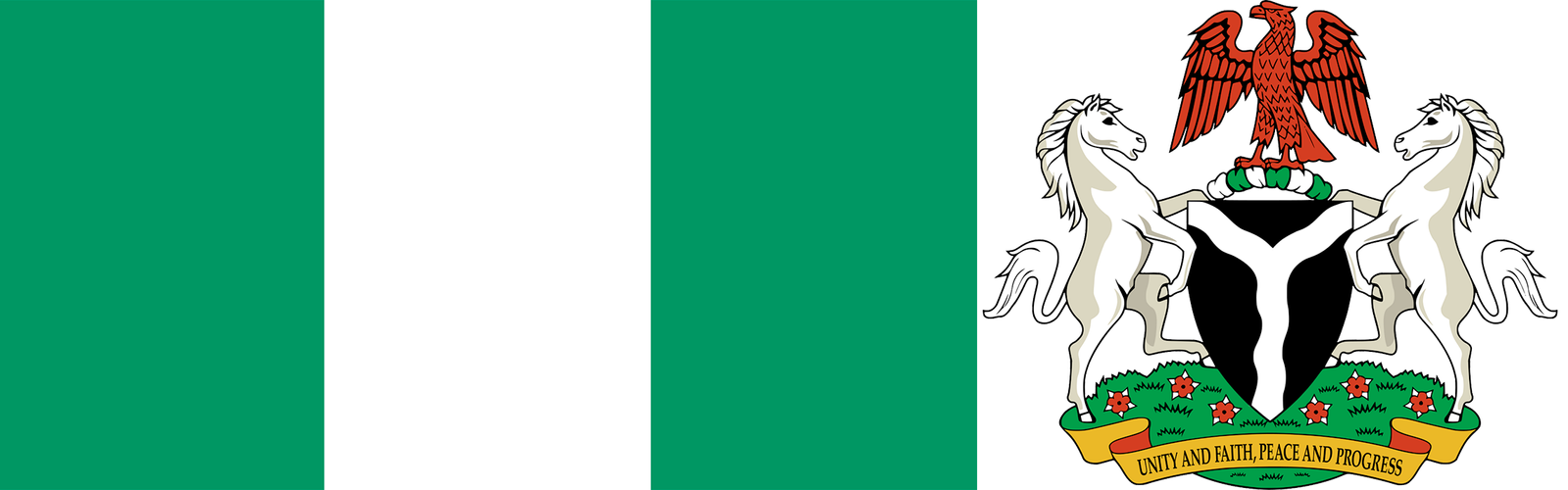 The flag of Nigeria (left) and the Coat of Arms (right).
Welcome to the summary page for FabulousFusionFood's Nigeria recipes, part of the African Continent. This page provides links to all the Nigerian recipes presented on this site, with 199 recipes in total.
Nigeria is a multinational state inhabited by more than 250 ethnic groups speaking 500 distinct languages, all identifying with a wide variety of cultures. The three largest ethnic groups are the Hausa in the north, Yoruba in the west, and Igbo in the east, together constituting over 60% of the total population. Enjoy...
Nigeria, officially the Federal Republic of Nigeria (Jamhuriyar Taraiyar Nijeriya (Hausa); Ọ̀hàńjíkọ̀ Ọ̀hànézè Naìjíríyà (Igbo) and Orílẹ̀-èdè Olómìnira àpapọ̀ ilẹ̀ Nàìjíríà (Yoruba)), is a country in West Africa. It is situated between the Sahel to the north and the Gulf of Guinea to the south in the Atlantic Ocean. It covers an area of 923,769 square kilometres (356,669 sq mi), and with a population of over 230 million, it is the most populous country in Africa, and the world's sixth-most populous country. Nigeria borders Niger in the north, Chad in the northeast, Cameroon in the east, and Benin in the west. Nigeria is a federal republic comprising 36 states and the Federal Capital Territory, where the capital, Abuja, is located. The largest city in Nigeria is Lagos, one of the largest metropolitan areas in the world and the largest in Africa.
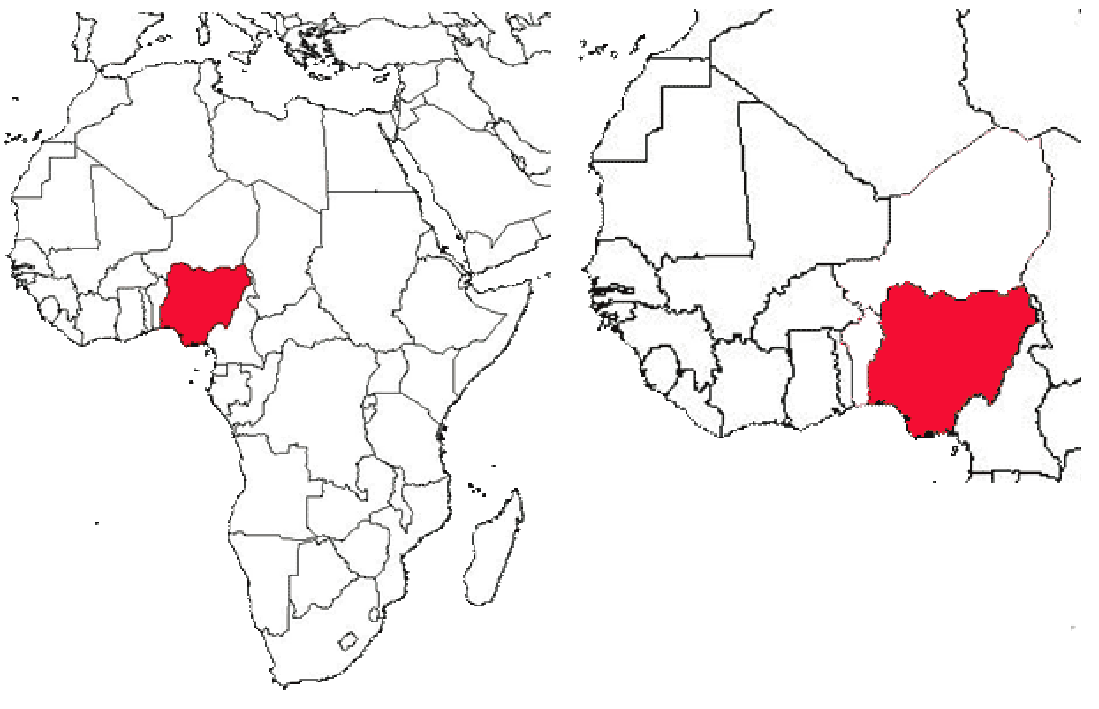 The image above shows Nigeria (red) in relation to Africa (left) and West Africa (right).Nigeria has been home to several indigenous pre-colonial states and kingdoms since the second millennium BC, with the Nok civilization in the 15th century BC marking the first internal unification. The modern state originated with British colonialization in the 19th century, taking its present territorial shape with the merging of the Southern Nigeria Protectorate and the Northern Nigeria Protectorate in 1914. The British set up administrative and legal structures while practising indirect rule through traditional chiefdoms. Nigeria became a formally independent federation on 1 October 1960. It experienced a civil war from 1967 to 1970, followed by a succession of military dictatorships and democratically elected civilian governments until achieving a stable government in the 1999 Nigerian presidential election, with the election of Olusegun Obasanjo of the Peoples Democratic Party. However, the country frequently experiences electoral fraud, and corruption is significantly present in all levels of Nigerian politics.
Nigeria gained independence from Britain on October 1, 1960 and became a republic on October 1, 1963. The capital then was the coastal city of Lagos, but since 1991, its capital has been the centrally-located city of Abuja. It is the most populous country in Africa and re-achieved democracy in 1999 after a sixteen-year interruption; from 1966 until 1999 when Nigeria was ruled by military dictators who seized power in coups d'état and counter-coups during the Nigerian military juntas of 1966–1979 and 1983–1998. Current estimates put the population of Nigeria at over 170 million (2012 estimate). Nigeria has more than 250 ethnic groups, with varying languages and customs, creating a country of rich ethnic diversity. The largest ethnic groups are the Fulani/Hausa, Yoruba, Igbo, accounting for 68% of population, while the Edo, Ijaw (10%), Kanuri, Ibibio, Nupe and Tiv comprise 27%; other minorities make up the remaining 7 percent. The middle belt of Nigeria is known for its diversity of ethnic groups, including the Pyem, Goemai, and Kofyar. The number of languages currently estimated and catalogued in Nigeria is 521. This number includes 510 living languages, two second languages without native speakers and 9 extinct languages. In many areas of Nigeria, ethnic groups speak more than one language. The official language of Nigeria, English, was chosen to facilitate the cultural and linguistic unity of the country (though most people speak a patois, locally known as 'Broken English' [colloquially: 'Broken']). However, Hausa, Igbo and Yoruba are also recognised as regional languages.
Nigeria is a multinational state inhabited by more than 250 ethnic groups speaking 500 distinct languages, all identifying with a wide variety of cultures. The three largest ethnic groups are the Hausa in the north, Yoruba in the west, and Igbo in the east, together constituting over 60% of the total population. The official language is English, chosen to facilitate linguistic unity at the national level. Nigeria's constitution ensures de jure freedom of religion, and it is home to some of the world's largest Muslim and Christian populations. Nigeria is divided roughly in half between Muslims, who live mostly in the north, and Christians, who live mostly in the south; indigenous religions, such as those native to the Igbo and Yoruba ethnicities, are in the minority.
Nigeria is a regional power in Africa and a middle power in international affairs. Nigeria's economy is the largest in Africa, the 39th-largest in the world by nominal GDP, and 27th-largest by PPP. Nigeria is often referred to as the Giant of Africa owing to its large population and economy, and is considered to be an emerging market by the World Bank. Nigeria is a founding member of the African Union and a member of many international organizations, including the United Nations, the Commonwealth of Nations, NAM, the Economic Community of West African States, Organisation of Islamic Cooperation and OPEC. It is also a member of the informal MINT group of countries and is one of the Next Eleven economies.
The name Nigeria derives from the Niger River running through the country. This name was coined on 8 January 1897, by the British journalist Flora Shaw. The neighbouring Republic of Niger takes its name from the same river. The origin of the name Niger, which originally applied to only the middle reaches of the Niger River, is uncertain. The word is likely an alteration of the Tuareg name egerew n-igerewen used by inhabitants along the middle reaches of the river around Timbuktu before 19th-century European colonialism. Before Flora Shaw suggested the name Nigeria, other proposed names included Royal Niger Company Territories, Central Sudan, Niger Empire, Niger Sudan, and Hausa Territories.
Many traditional Nigerian recipes are heavily grain-based with ground millet, sorghum, teff, Barley and cassava flour forming the classic staples of the diet. Pork and veal form a typical part of the diet in the northern part of the country, whilst fish stews, shrimp, crab and lobster are more common ingredients in the south. Hot chillies form a vital part of the country's cuisine and these provide the majority of the vitamin C in the diet. Many dishes are marinated in ginger, tomatoes and cayenne, and cooked in groundnut oil or red palm oil. Bush meat (wild game) remains an important part of the diet, when it can be obtained.
Nigerian cuisine, like West African cuisine in general, is known for its richness and variety. Many different spices, herbs and flavourings are used in conjunction with palm oil or groundnut oil to create deeply-flavoured sauces and soups often made very hot with chillies (tatashes, Scotch bonnets or habaneros). Use of local herbs, spices and greens is common: for example, bitterleaf, aidan fruit, alligator pepper and grains of paradise and Guinea pepper as well as Senegal pepper and irú (fermented locust beans). Nigerian feasts are colourful and lavish, while aromatic market and roadside snacks cooked on barbecues or fried in oil are plentiful and varied.
In Nigeria, much of what we would term a 'stew' is typically called a 'soup' whilst other stew-like dishes are called 'stews'. This distinction has to do with the carbohydrate staple that the dish is served with. Soups are typically served with pounded yam, porridge (pap) or fufu whilst stews are always served with rice.
Nigeria is a multinational state inhabited by more than 250 ethnic groups speaking 500 distinct languages, all identifying with a wide variety of cultures. The three largest ethnic groups are the Hausa in the north, Yoruba in the west, and Igbo in the east, together constituting over 60% of the total population. Enjoy...
Nigeria, officially the Federal Republic of Nigeria (Jamhuriyar Taraiyar Nijeriya (Hausa); Ọ̀hàńjíkọ̀ Ọ̀hànézè Naìjíríyà (Igbo) and Orílẹ̀-èdè Olómìnira àpapọ̀ ilẹ̀ Nàìjíríà (Yoruba)), is a country in West Africa. It is situated between the Sahel to the north and the Gulf of Guinea to the south in the Atlantic Ocean. It covers an area of 923,769 square kilometres (356,669 sq mi), and with a population of over 230 million, it is the most populous country in Africa, and the world's sixth-most populous country. Nigeria borders Niger in the north, Chad in the northeast, Cameroon in the east, and Benin in the west. Nigeria is a federal republic comprising 36 states and the Federal Capital Territory, where the capital, Abuja, is located. The largest city in Nigeria is Lagos, one of the largest metropolitan areas in the world and the largest in Africa.
The image above shows Nigeria (red) in relation to Africa (left) and West Africa (right).Nigeria gained independence from Britain on October 1, 1960 and became a republic on October 1, 1963. The capital then was the coastal city of Lagos, but since 1991, its capital has been the centrally-located city of Abuja. It is the most populous country in Africa and re-achieved democracy in 1999 after a sixteen-year interruption; from 1966 until 1999 when Nigeria was ruled by military dictators who seized power in coups d'état and counter-coups during the Nigerian military juntas of 1966–1979 and 1983–1998. Current estimates put the population of Nigeria at over 170 million (2012 estimate). Nigeria has more than 250 ethnic groups, with varying languages and customs, creating a country of rich ethnic diversity. The largest ethnic groups are the Fulani/Hausa, Yoruba, Igbo, accounting for 68% of population, while the Edo, Ijaw (10%), Kanuri, Ibibio, Nupe and Tiv comprise 27%; other minorities make up the remaining 7 percent. The middle belt of Nigeria is known for its diversity of ethnic groups, including the Pyem, Goemai, and Kofyar. The number of languages currently estimated and catalogued in Nigeria is 521. This number includes 510 living languages, two second languages without native speakers and 9 extinct languages. In many areas of Nigeria, ethnic groups speak more than one language. The official language of Nigeria, English, was chosen to facilitate the cultural and linguistic unity of the country (though most people speak a patois, locally known as 'Broken English' [colloquially: 'Broken']). However, Hausa, Igbo and Yoruba are also recognised as regional languages.
Nigeria is a multinational state inhabited by more than 250 ethnic groups speaking 500 distinct languages, all identifying with a wide variety of cultures. The three largest ethnic groups are the Hausa in the north, Yoruba in the west, and Igbo in the east, together constituting over 60% of the total population. The official language is English, chosen to facilitate linguistic unity at the national level. Nigeria's constitution ensures de jure freedom of religion, and it is home to some of the world's largest Muslim and Christian populations. Nigeria is divided roughly in half between Muslims, who live mostly in the north, and Christians, who live mostly in the south; indigenous religions, such as those native to the Igbo and Yoruba ethnicities, are in the minority.
Nigeria is a regional power in Africa and a middle power in international affairs. Nigeria's economy is the largest in Africa, the 39th-largest in the world by nominal GDP, and 27th-largest by PPP. Nigeria is often referred to as the Giant of Africa owing to its large population and economy, and is considered to be an emerging market by the World Bank. Nigeria is a founding member of the African Union and a member of many international organizations, including the United Nations, the Commonwealth of Nations, NAM, the Economic Community of West African States, Organisation of Islamic Cooperation and OPEC. It is also a member of the informal MINT group of countries and is one of the Next Eleven economies.
The name Nigeria derives from the Niger River running through the country. This name was coined on 8 January 1897, by the British journalist Flora Shaw. The neighbouring Republic of Niger takes its name from the same river. The origin of the name Niger, which originally applied to only the middle reaches of the Niger River, is uncertain. The word is likely an alteration of the Tuareg name egerew n-igerewen used by inhabitants along the middle reaches of the river around Timbuktu before 19th-century European colonialism. Before Flora Shaw suggested the name Nigeria, other proposed names included Royal Niger Company Territories, Central Sudan, Niger Empire, Niger Sudan, and Hausa Territories.
Nigerian Cuisine
Nigerian cuisine, like West African cuisine in general, is known for its richness and variety. Many different spices, herbs, and flavourings are used in conjunction with palm oil or groundnut oil to create deeply flavoured sauces and soups often made very hot with chilli peppers. Nigerian feasts are colourful and lavish, while aromatic market and roadside snacks cooked on barbecues or fried in oil are plentiful and varied. Hausa-based Suya is usually sold in urban areas especially during the night-time.Many traditional Nigerian recipes are heavily grain-based with ground millet, sorghum, teff, Barley and cassava flour forming the classic staples of the diet. Pork and veal form a typical part of the diet in the northern part of the country, whilst fish stews, shrimp, crab and lobster are more common ingredients in the south. Hot chillies form a vital part of the country's cuisine and these provide the majority of the vitamin C in the diet. Many dishes are marinated in ginger, tomatoes and cayenne, and cooked in groundnut oil or red palm oil. Bush meat (wild game) remains an important part of the diet, when it can be obtained.
Nigerian cuisine, like West African cuisine in general, is known for its richness and variety. Many different spices, herbs and flavourings are used in conjunction with palm oil or groundnut oil to create deeply-flavoured sauces and soups often made very hot with chillies (tatashes, Scotch bonnets or habaneros). Use of local herbs, spices and greens is common: for example, bitterleaf, aidan fruit, alligator pepper and grains of paradise and Guinea pepper as well as Senegal pepper and irú (fermented locust beans). Nigerian feasts are colourful and lavish, while aromatic market and roadside snacks cooked on barbecues or fried in oil are plentiful and varied.
In Nigeria, much of what we would term a 'stew' is typically called a 'soup' whilst other stew-like dishes are called 'stews'. This distinction has to do with the carbohydrate staple that the dish is served with. Soups are typically served with pounded yam, porridge (pap) or fufu whilst stews are always served with rice.
Nigeria's National Dishes:
Below are listed the dishes considered to be Nigeria's national foods along with links to the recipes for those dishes:| Basic Jollof Rice Origin: Nigeria | Nigerian Rice Flour FuFu Origin: Nigeria | Tuwo Shinkafa (Rice Flour Porridge) Origin: Nigeria |
| Egusi Soup Origin: Nigeria | Ofada-Ugba Jollof (Fermented Jollof Rice) Origin: Nigeria | |
| Iyan (Pounded Yam) Origin: Nigeria | Party Jollof Rice Origin: Nigeria |
The alphabetical list of all Nigerian recipes on this site follows, (limited to 100 recipes per page). There are 199 recipes in total:
Page 1 of 2
| Basic Jollof Rice Origin: Nigeria | Chicken Imoyo II Origin: Nigeria | Gbegiri (Bean Stew) Origin: Nigeria |
| Egusi Soup Origin: Nigeria | Chin Chin Origin: Nigeria | Goat Meat Pepper Soup with Calabash Nutmeg Origin: Nigeria |
| Iyan (Pounded Yam) Origin: Nigeria | Chin Chin II Origin: Nigeria | Goat Meat Suya Origin: Nigeria |
| Nigerian Rice Flour FuFu Origin: Nigeria | Coconut Bean Rice Origin: Nigeria | Green Stew Origin: Nigeria |
| Ofada-Ugba Jollof (Fermented Jollof Rice) Origin: Nigeria | Concoction Rice Origin: Nigeria | Home-made Kataifi Origin: Nigeria |
| Party Jollof Rice Origin: Nigeria | Dakua (Groundnut and Roast Maize Balls) Origin: Nigeria | Hot Eko (Hot Cornflour Gruel) Origin: Nigeria |
| Tuwo Shinkafa (Rice Flour Porridge) Origin: Nigeria | Dodo (Fried Plantain Accompaniment) Origin: Nigeria | Igbekere (Plantain Chips) Origin: Nigeria |
| Aadun Origin: Nigeria | Dodo Oni-yeri (Egg-coated Fried Plantain) Origin: Nigeria | Igbo MoinMoin Origin: Nigeria |
| Abacha Ncha (Dried Cassava with Garden Eggs) Origin: Nigeria | Dundu Oniyeri Origin: Nigeria | Ikokore Origin: Nigeria |
| Abak (Palm Nut Soup) Origin: Nigeria | Eba Origin: Nigeria | Ila (Okra) Origin: Nigeria |
| Adalu (Bean and Sweetcorn Pottage) Origin: Nigeria | Eba (Garri Swallow) Origin: Nigeria | Ila Alasepo (Okra and Spinach Soup) Origin: Nigeria |
| Adun Origin: Nigeria | Edikang Ikong Soup Origin: Nigeria | Imoyo Eba Origin: Nigeria |
| Afang Soup Origin: Nigeria | Editan Soup II Origin: Nigeria | Isi Ewu (Spiced Goat Head) Origin: Nigeria |
| Afia Efere (White Soup) Origin: Nigeria | Efere Usung Udia Origin: Nigeria | Isu (Boiled Yams) Origin: Nigeria |
| Afia Efere Unen (White Soup with Chicken) Origin: Nigeria | Efo Riro Origin: Nigeria | Iwuk Efere Origin: Nigeria |
| African All Purpose Seasoning Origin: Nigeria | Efo-riro (Vegetable Stew) Origin: Nigeria | Iyan (Pounded Yam) Origin: Nigeria |
| Agidi (Fermented Cornflour Pudding) Origin: Nigeria | Egusi Soup Origin: Nigeria | Jollof Rice without Tomato Purée Origin: Nigeria |
| Agidi Jollof Origin: Nigeria | Egusi with Efo Origin: Nigeria | Kekefia (Plantain Pottage) Origin: Nigeria |
| Akara (Black-eyed Pea Fritters) Origin: Nigeria | Ekpang Nkukwo Origin: Nigeria | Kilishi (Dried Sliced Beef) Origin: Nigeria |
| Akara Seke-pu (Bean and Melon Seed Fritters) Origin: Nigeria | Ekpang Nkukwo (Cocoyam Pottage) Origin: Nigeria | Koro Owu Soup (Cotton Seed Soup) Origin: Nigeria |
| Alapa (Palm-oil Stew) Origin: Nigeria | Ekuru with Ata Sauce (Steamed Savoury Beans with Ata Sauce) Origin: Nigeria | Korokoro (Cornmeal Sticks) Origin: Nigeria |
| Amala Origin: Nigeria | Elubo (Yam Flour) Origin: Nigeria | Kuka Soup Origin: Nigeria |
| Amala and Ewedu Origin: Nigeria | Ewedu Origin: Nigeria | Kuli-kuli (Groundnut Cakes) Origin: Nigeria |
| Asaro (Yam Pottage) Origin: Nigeria | Faten Doya (Nigerian Yam Pottage) Origin: Nigeria | Kulikuli (Peanut Balls) Origin: Nigeria |
| Asaro (Special Yam Pottage) Origin: Nigeria | Fermented Oil Beans Origin: Nigeria | Kunu Zaki (Millet Kunu Drink) Origin: Nigeria |
| Asaro II (Yam Porridge) Origin: Nigeria | Fish and Snail Sauce Origin: Nigeria | Kunun gyada Origin: Nigeria |
| Banga Soup Origin: Nigeria | Fonio Balls Origin: Nigeria | Kunun Kwakwa Origin: Nigeria |
| Basic Jollof Rice Origin: Nigeria | Fried Ata Sauce Origin: Nigeria | Mango Sauce Origin: Nigeria |
| Beef with Calabash Nutmegs Origin: Nigeria | Fried Pumpkin Origin: Nigeria | Miyan Kuka (Baobab Leaf Soup) Origin: Nigeria |
| Beju (Coconut and Cassava Biscuits) Origin: Nigeria | Fried Yam Chips Origin: Nigeria | Miyan Kuka II (Baobab Leaf Soup II) Origin: Nigeria |
| Black Fungus Okra Soup Origin: Nigeria | FuFu Origin: Nigeria | Miyan Wake (Beans soup) Origin: Nigeria |
| Black-eyed Beans and Plantain Pottage Origin: Nigeria | Funkaso (Millet Pancakes) Origin: Nigeria | Moi-Moi Origin: Nigeria |
| Bodi Origin: Nigeria | Fura Gero da Nono Origin: Nigeria | Moyin-Moyin Origin: Nigeria |
| Boli Origin: Nigeria | Gari Snack Origin: Nigeria | Nigeria's Mother Sauce Origin: Nigeria |
Page 1 of 2