FabulousFusionFood's Panamanian Recipes Home Page
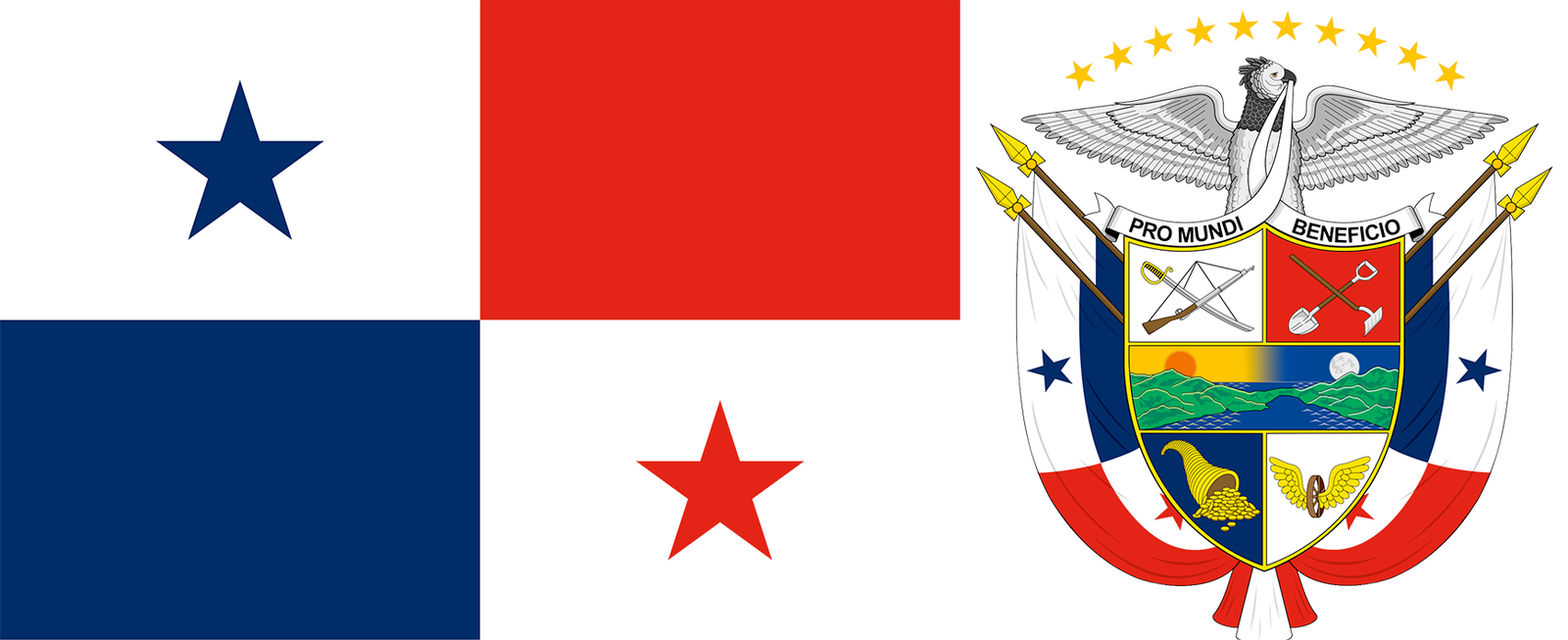 The flag of Panama (left) and the coat of
arms of Panama (right).
Welcome to the summary page for FabulousFusionFood's Panamanian recipes, part of the Caribbean. This page provides links to all the Panama recipes presented on this site, with 12 recipes in total.
This is a continuation of an entire series of pages that will, I hope, allow my visitors to better navigate this site. As well as displaying recipes by name, country and region of origin I am now planning a whole series of pages where recipes can be located by meal type and main ingredient. This page gives a listing of all the Panamanian recipes added to this site.
Panama is a country in Latin America at the southern end of Central America, bordering South America that also lies in the Caribbean region. Spanish is the official language (recognised regional languages are: Guaymí; Buglere; Emberá; Wounaan; Guna; Teribe and Bribri). The capital and largest city is Panama City.
Since Panama's cultural heritage is influenced by many ethnicities the traditional cuisine of the country includes ingredients from many cultures, from all over the world: a mix of African, Spanish, and Native American techniques, dishes, and ingredients, reflecting its diverse population. Since Panama is a land bridge between two continents, it has a large variety of tropical fruits, vegetables and herbs that are used in native cooking. The famous fish market known as the "Mercado de Mariscos" offers fresh seafood and Ceviche, a seafood dish. Small shops along the street which are called kiosco and Empanada, which is a typical latinamerican pastry, including a variety of different ingredients, either with meat or vegetarian, mostly fried. Another kind of pastry is the pastelito, with the only difference in comparison to empanadas is that they are bigger.
Panama officially the Republic of Panama (República de Panamá in Spanish) is a country in Latin America at the southern end of Central America, bordering South America that also lies within the Caribbean region. It is bordered by Costa Rica to the west, Colombia to the southeast, the Caribbean Sea to the north, and the Pacific Ocean to the south. Its capital and largest city is Panama City, whose metropolitan area is home to nearly half of the country's over 4 million inhabitants.
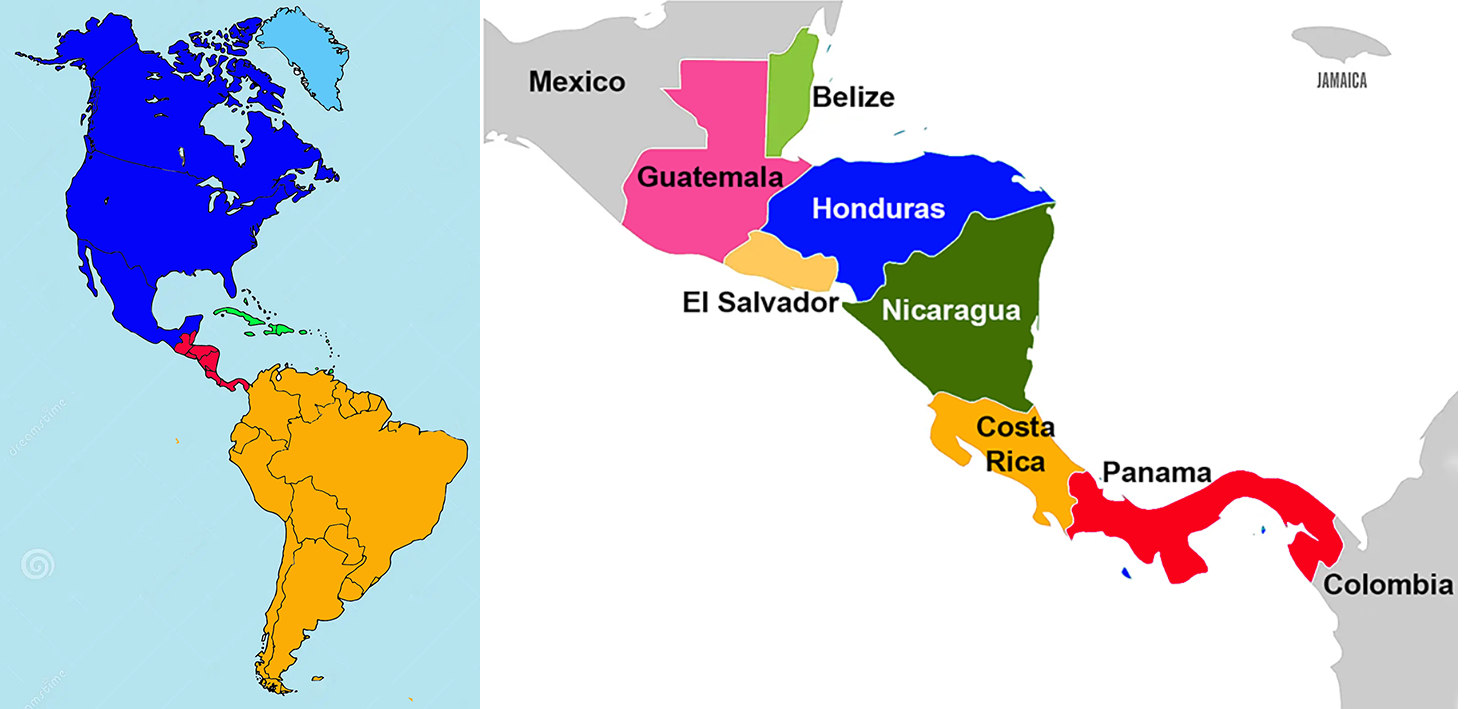 Image of Central America in relation to the Americas, with the location of Panama picked out in red.Before the arrival of Spanish colonists in the 16th century, Panama was inhabited by a number of different indigenous tribes. It broke away from Spain in 1821 and joined the Republic of Gran Colombia, a union of Nueva Granada, Ecuador, and Venezuela. After Gran Colombia dissolved in 1831, Panama and Nueva Granada eventually became the Republic of Colombia. With the backing of the United States, Panama seceded from Colombia in 1903, allowing the construction of the Panama Canal to be completed by the United States Army Corps of Engineers between 1904 and 1914. The 1977 Torrijos–Carter Treaties agreed to transfer the canal from the United States to Panama on December 31, 1999. The surrounding territory was returned first, in 1979.
Revenue from canal tolls has continued to represent a significant portion of Panama's GDP, especially after the Panama Canal expansion project (finished in 2016) doubled its capacity. Commerce, banking, and tourism are major sectors. Panama is regarded as having a high-income economy. In 2019, Panama ranked 57th in the world in terms of the Human Development Index. In 2018, Panama was ranked the seventh-most competitive economy in Latin America, according to the World Economic Forum's Global Competitiveness Index. Panama was ranked 82nd in the Global Innovation Index in 2024. Covering around 40 percent of its land area, Panama's jungles are home to an abundance of tropical plants and animals – some of them found nowhere else on Earth.
Etymology: The exact origin of the name 'Panama' remains uncertain, with several hypotheses have been proposed:
Sterculia apetala (Panama tree): One hypothesis suggests that the name derives from the Sterculia apetala tree, commonly known as the Panama tree, which is native to the region and holds national significance. This tree was declared the national tree of Panama by Cabinet Decree No. 371 on November 26, 1969.
'Many butterflies': Another theory posits that 'Panama' means 'many butterflies' in an indigenous language, possibly Guaraní or another native tongue. This interpretation is linked to the observation that early settlers arrived during August, a time when butterflies are particularly abundant in the area. Guna language 'bannaba': A further hypothesis is that 'Panama' is a Castilianization of the Guna word 'bannaba', meaning 'distant' or 'far away'.
A widely recounted legend holds that 'Panamá' was the name of a fishing village encountered by Spanish colonists, purportedly meaning 'abundance of fish'. While the precise location of this village is unknown, the legend is often associated with accounts from Spanish explorer Antonio Tello de Guzmán, who in 1515 described landing at an unnamed indigenous fishing village along the Pacific coast. Subsequently, in 1517, Spanish lieutenant Gaspar de Espinosa established a trading post at the site, and in 1519, Pedro Arias Dávila founded Panama City there, replacing the earlier settlement of Santa María la Antigua del Darién.
Maize-based dishes come from the kernel, cooked in water and then ground in order to obtain a dough (as opposed to using corn flour to obtain the dough). Fresh corn is also used in some dishes. Due to the multicultural background of the Panamanians, many of its dishes are heavily influenced by the cuisine of other Latin American countries and also the Caribbean as well as Europe.
The traditional Panamanian dish for Christmas usually includes chicken tamales, arroz con pollo (rice with chicken), puerco asado, pernil, pavo (turkey), and relleno (stuffing). Bowls of fruits and fruitcake are set out on the tables along with the dishes. Along with these foods and dessert, a traditional drink is served called ron ponche (eggnog).
This is a continuation of an entire series of pages that will, I hope, allow my visitors to better navigate this site. As well as displaying recipes by name, country and region of origin I am now planning a whole series of pages where recipes can be located by meal type and main ingredient. This page gives a listing of all the Panamanian recipes added to this site.
Panama is a country in Latin America at the southern end of Central America, bordering South America that also lies in the Caribbean region. Spanish is the official language (recognised regional languages are: Guaymí; Buglere; Emberá; Wounaan; Guna; Teribe and Bribri). The capital and largest city is Panama City.
Since Panama's cultural heritage is influenced by many ethnicities the traditional cuisine of the country includes ingredients from many cultures, from all over the world: a mix of African, Spanish, and Native American techniques, dishes, and ingredients, reflecting its diverse population. Since Panama is a land bridge between two continents, it has a large variety of tropical fruits, vegetables and herbs that are used in native cooking. The famous fish market known as the "Mercado de Mariscos" offers fresh seafood and Ceviche, a seafood dish. Small shops along the street which are called kiosco and Empanada, which is a typical latinamerican pastry, including a variety of different ingredients, either with meat or vegetarian, mostly fried. Another kind of pastry is the pastelito, with the only difference in comparison to empanadas is that they are bigger.
Panama officially the Republic of Panama (República de Panamá in Spanish) is a country in Latin America at the southern end of Central America, bordering South America that also lies within the Caribbean region. It is bordered by Costa Rica to the west, Colombia to the southeast, the Caribbean Sea to the north, and the Pacific Ocean to the south. Its capital and largest city is Panama City, whose metropolitan area is home to nearly half of the country's over 4 million inhabitants.
Image of Central America in relation to the Americas, with the location of Panama picked out in red.Revenue from canal tolls has continued to represent a significant portion of Panama's GDP, especially after the Panama Canal expansion project (finished in 2016) doubled its capacity. Commerce, banking, and tourism are major sectors. Panama is regarded as having a high-income economy. In 2019, Panama ranked 57th in the world in terms of the Human Development Index. In 2018, Panama was ranked the seventh-most competitive economy in Latin America, according to the World Economic Forum's Global Competitiveness Index. Panama was ranked 82nd in the Global Innovation Index in 2024. Covering around 40 percent of its land area, Panama's jungles are home to an abundance of tropical plants and animals – some of them found nowhere else on Earth.
Etymology: The exact origin of the name 'Panama' remains uncertain, with several hypotheses have been proposed:
Sterculia apetala (Panama tree): One hypothesis suggests that the name derives from the Sterculia apetala tree, commonly known as the Panama tree, which is native to the region and holds national significance. This tree was declared the national tree of Panama by Cabinet Decree No. 371 on November 26, 1969.
'Many butterflies': Another theory posits that 'Panama' means 'many butterflies' in an indigenous language, possibly Guaraní or another native tongue. This interpretation is linked to the observation that early settlers arrived during August, a time when butterflies are particularly abundant in the area. Guna language 'bannaba': A further hypothesis is that 'Panama' is a Castilianization of the Guna word 'bannaba', meaning 'distant' or 'far away'.
A widely recounted legend holds that 'Panamá' was the name of a fishing village encountered by Spanish colonists, purportedly meaning 'abundance of fish'. While the precise location of this village is unknown, the legend is often associated with accounts from Spanish explorer Antonio Tello de Guzmán, who in 1515 described landing at an unnamed indigenous fishing village along the Pacific coast. Subsequently, in 1517, Spanish lieutenant Gaspar de Espinosa established a trading post at the site, and in 1519, Pedro Arias Dávila founded Panama City there, replacing the earlier settlement of Santa María la Antigua del Darién.
Panamanian Cuisine:
Panamanian cuisine is a mix of Spanish, Indigenous, and African techniques, dishes, and ingredients, reflecting its diverse population. Since Panama is a land bridge between two continents, it has a large variety of tropical fruits, vegetables and herbs that are used in native cooking.Maize-based dishes come from the kernel, cooked in water and then ground in order to obtain a dough (as opposed to using corn flour to obtain the dough). Fresh corn is also used in some dishes. Due to the multicultural background of the Panamanians, many of its dishes are heavily influenced by the cuisine of other Latin American countries and also the Caribbean as well as Europe.
The traditional Panamanian dish for Christmas usually includes chicken tamales, arroz con pollo (rice with chicken), puerco asado, pernil, pavo (turkey), and relleno (stuffing). Bowls of fruits and fruitcake are set out on the tables along with the dishes. Along with these foods and dessert, a traditional drink is served called ron ponche (eggnog).
Panama's National Dishes:
Below are listed the dishes considered to be Panama's national foods along with links to the recipes for those dishes:| Panamanian Sancocho Origin: Panama |
The alphabetical list of all the Panamanian recipes on this site follows, (limited to 100 recipes per page). There are 12 recipes in total:
Page 1 of 1
| Panamanian Sancocho Origin: Panama | Ceviche de Corvina (Sea Bass Ceviche) Origin: Panama | Panamanian Sancocho Origin: Panama |
| Aji Chombo (Panamanian Hot Sauce) Origin: Panama | Ceviche de Corvina al Curry (Curried Sea Bass Ceviche) Origin: Panama | Panamanian Sazon Origin: Panama |
| Arroz Con Pollo Panameño (Panamanian Arroz con Pollo) Origin: Panama | Chicharrónes (Panamania Pork Rinds) Origin: Panama | Plantain Porridge Origin: Panama |
| Carne Guisada (Panamanian Beef Stew) Origin: Panama | Panamanian Adobo Seasoning Origin: Panama | Queki Biscuits Origin: Panama |
Page 1 of 1