FabulousFusionFood's Bolivian Recipes Home Page
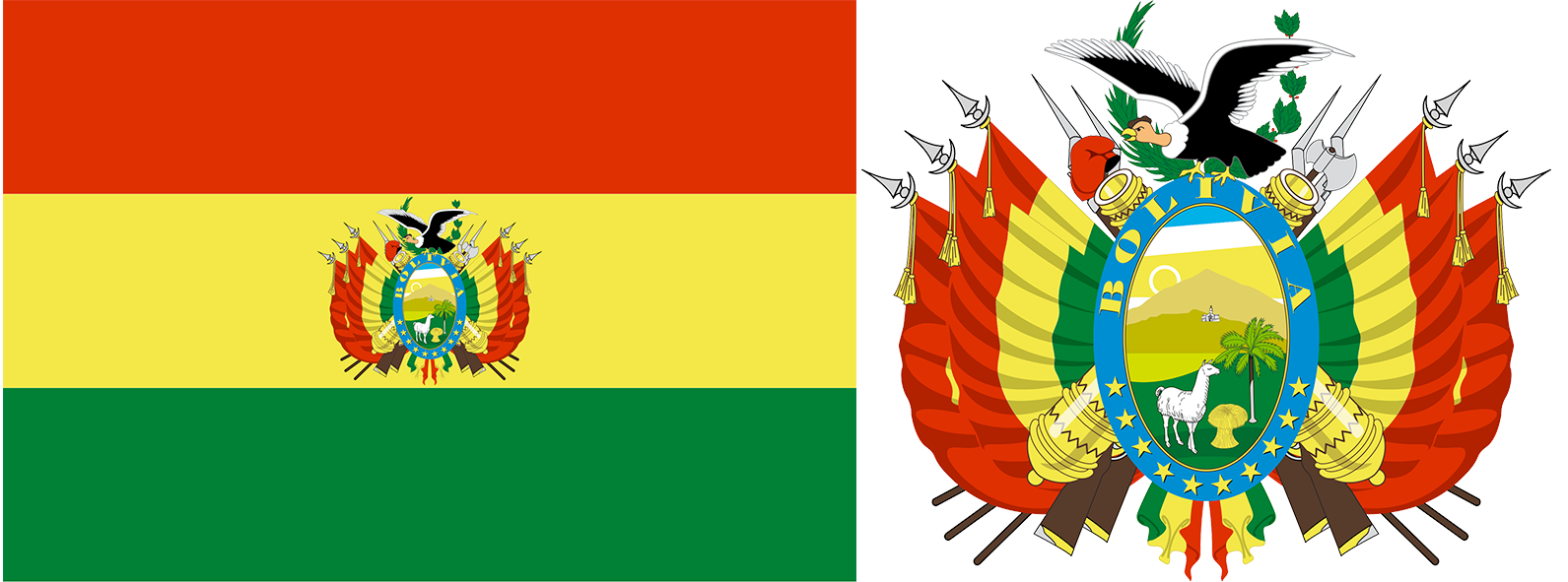 The flag of Bolivia (left) and the coat of arms of Bolivia (right).
Welcome to the summary page for FabulousFusionFood's Nicaraguan recipes, part of Central America. This page provides links to all the Bolivian recipes presented on this site, with 18 recipes in total.
This is a continuation of an entire series of pages that will, I hope, allow my visitors to better navigate this site. As well as displaying recipes by name, country and region of origin I am now planning a whole series of pages where recipes can be located by meal type and main ingredient. This page gives a listing of all the Bolivian recipes added to this site.
Bolivia (Estado Plurinacional de Bolivia in Spanish; Puliwya Achka Aylluska Mamallaqta in Quechua; Wuliwya Walja Ayllunakana Marka in Aymara and Tetã Hetate'ýigua Volívia in Guarani) s a landlocked country located in central South America. The capital is Sucre, the administrative centre is La Paz and the largest city is Santa Cruz de la Sierra.
Bolivian cuisine stems mainly from the combination of Spanish cuisine with traditional native Bolivian ingredients, with later influences from Germans, Italians, Basques, Croats, Russians, and Poles, due to the arrival of immigrants from those countries. The three traditional staples of Bolivian cuisine are maize, potatoes, and beans. These ingredients have been combined with a number of staples brought by the Europeans, such as rice, wheat, and meat, such as beef, pork, and chicken.
Boliviaa, officially the Plurinational State of Bolivia, is a landlocked country located in central South America. The country features diverse geography, including vast Amazonian plains, tropical lowlands, mountains, the Gran Chaco Province, warm valleys, high-altitude Andean plateaus, and snow-capped peaks, encompassing a wide range of climates and biomes across its regions and cities. It includes part of the Pantanal, the largest tropical wetland in the world, along its eastern border. It is bordered by Brazil to the north and east, Paraguay to the southeast, Argentina to the south, Chile to the southwest, and Peru to the west. The seat of government is La Paz, which contains the executive, legislative, and electoral branches of government, while the constitutional capital is Sucre, the seat of the judiciary. The largest city and principal industrial center is Santa Cruz de la Sierra, located on the Llanos Orientales (eastern tropical lowlands), a mostly flat region in the east of the country with a diverse non-Andean culture.
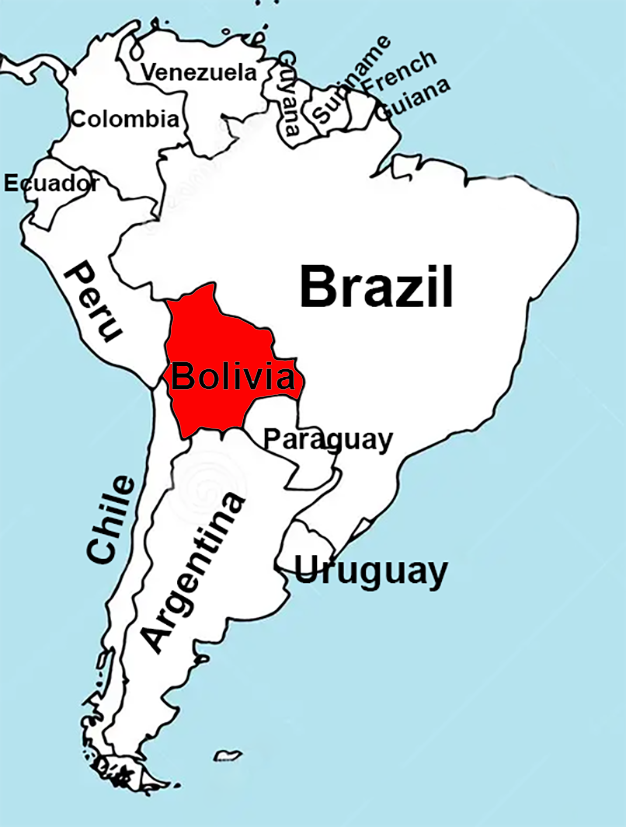 Location of Bolivia in Central America with Central America (in red) in
the Americas. The land mass of Bolivia is picked out in red.Centuries prior to Spanish colonization, much of what would become Andean Bolivia formed part of the Tiwanaku polity, which collapsed around 1000 AD. The Colla–Inca War of the 1440s marked the beginning of Inca rule in western Bolivia. The eastern and northern lowlands of Bolivia were inhabited by independent non-Andean Amazonian and Guaraní tribes. Spanish conquistadores, arriving from Cusco, Peru, forcibly took control of the region in the 16th century.
During the subsequent Spanish colonial period, Bolivia was administered by the Real Audiencia of Charcas. Spain built its empire in large part upon the silver that was extracted from Cerro Rico in Potosí. Following an unsuccessful rebellion in Sucre on May 25, 1809, sixteen years of fighting would follow before the establishment of the Republic, named for Simón Bolívar. Over the course of the 19th and early 20th centuries, Bolivia lost control of several peripheral territories to neighboring countries, such as Brazil's of the Acre territory, and the War of the Pacific (1879), in which Chile seized the country's Pacific coastal region.
20th century Bolivia experienced a succession of military and civilian governments until Hugo Banzer led a U.S.-backed coup d'état in 1971, replacing the socialist government of Juan José Torres with a military dictatorship. Banzer's regime cracked down on left-wing and socialist opposition parties, and other perceived forms of dissent, resulting in the torturing and murders of countless Bolivian citizens. Banzer was ousted in 1978 and, twenty years later, returned as the democratically elected President of Bolivia (1997–2001). Under the 2006–2019 presidency of Evo Morales, the country saw significant economic growth and political stability but was also accused of democratic backsliding, and was described as a competitive authoritarian regime. Freedom House classifies Bolivia as a partly-free democracy as of 2023, with a 66/100 score.
Modern Bolivia is a member of the Non-Aligned Movement (NAM), Organization of American States (OAS), Amazon Cooperation Treaty Organization (ACTO), Bank of the South, ALBA, the Union of South American Nations (USAN), and Southern Common Market (Mercosur). Bolivia remains a developing country, and the second-poorest in South America, though it has slashed poverty rates and now has one of the fastest-growing economies on the continent (in terms of GDP). Its main economic resources include agriculture, forestry, fishing, mining, and goods such as textiles and clothing, refined metals, and refined petroleum. Bolivia is very geologically rich, with mines producing tin, silver, lithium, and copper. The country is also known for its production of coca plants and refined cocaine.
Etymology: Bolivia is named after Simón Bolívar, a Venezuelan leader in the Spanish American wars of independence. The leader of Venezuela, Antonio José de Sucre, had been given the option by Bolívar to either unify Charcas (present-day Bolivia) with the newly formed Republic of Peru, to unify with the United Provinces of the Río de la Plata, or to formally declare its independence from Spain as a wholly independent state. Sucre opted to create a brand new state and on 6 August 1825, with local support, named it in honor of Simón Bolívar.
The original name was Republic of Bolívar. Some days later, congressman Manuel Martín Cruz proposed: 'If from Romulus, Rome, then from Bolívar, Bolivia' (Spanish: Si de Rómulo, Roma; de Bolívar, Bolivia). The name was approved by the Republic on 3 October 1825. In 2009, a new constitution changed the country's official name to 'Plurinational State of Bolivia' to reflect the multi-ethnic nature of the country and the strengthened rights of Bolivia's indigenous peoples under the new constitution.
Bolivian cuisine has been influenced by the Inca cuisine, Aymara cuisine, Spanish cuisine, and to a lesser extent the cuisines of other neighboring countries, like Argentina and Paraguay. European immigration to Bolivia is not as common when compared with other Latin American countries, and while German, Italian, Basque and other cuisines have influenced the cuisine of Bolivia, Spanish cuisine remains the primary influence.
This is a continuation of an entire series of pages that will, I hope, allow my visitors to better navigate this site. As well as displaying recipes by name, country and region of origin I am now planning a whole series of pages where recipes can be located by meal type and main ingredient. This page gives a listing of all the Bolivian recipes added to this site.
Bolivia (Estado Plurinacional de Bolivia in Spanish; Puliwya Achka Aylluska Mamallaqta in Quechua; Wuliwya Walja Ayllunakana Marka in Aymara and Tetã Hetate'ýigua Volívia in Guarani) s a landlocked country located in central South America. The capital is Sucre, the administrative centre is La Paz and the largest city is Santa Cruz de la Sierra.
Bolivian cuisine stems mainly from the combination of Spanish cuisine with traditional native Bolivian ingredients, with later influences from Germans, Italians, Basques, Croats, Russians, and Poles, due to the arrival of immigrants from those countries. The three traditional staples of Bolivian cuisine are maize, potatoes, and beans. These ingredients have been combined with a number of staples brought by the Europeans, such as rice, wheat, and meat, such as beef, pork, and chicken.
Boliviaa, officially the Plurinational State of Bolivia, is a landlocked country located in central South America. The country features diverse geography, including vast Amazonian plains, tropical lowlands, mountains, the Gran Chaco Province, warm valleys, high-altitude Andean plateaus, and snow-capped peaks, encompassing a wide range of climates and biomes across its regions and cities. It includes part of the Pantanal, the largest tropical wetland in the world, along its eastern border. It is bordered by Brazil to the north and east, Paraguay to the southeast, Argentina to the south, Chile to the southwest, and Peru to the west. The seat of government is La Paz, which contains the executive, legislative, and electoral branches of government, while the constitutional capital is Sucre, the seat of the judiciary. The largest city and principal industrial center is Santa Cruz de la Sierra, located on the Llanos Orientales (eastern tropical lowlands), a mostly flat region in the east of the country with a diverse non-Andean culture.
Location of Bolivia in Central America with Central America (in red) inthe Americas. The land mass of Bolivia is picked out in red.
During the subsequent Spanish colonial period, Bolivia was administered by the Real Audiencia of Charcas. Spain built its empire in large part upon the silver that was extracted from Cerro Rico in Potosí. Following an unsuccessful rebellion in Sucre on May 25, 1809, sixteen years of fighting would follow before the establishment of the Republic, named for Simón Bolívar. Over the course of the 19th and early 20th centuries, Bolivia lost control of several peripheral territories to neighboring countries, such as Brazil's of the Acre territory, and the War of the Pacific (1879), in which Chile seized the country's Pacific coastal region.
20th century Bolivia experienced a succession of military and civilian governments until Hugo Banzer led a U.S.-backed coup d'état in 1971, replacing the socialist government of Juan José Torres with a military dictatorship. Banzer's regime cracked down on left-wing and socialist opposition parties, and other perceived forms of dissent, resulting in the torturing and murders of countless Bolivian citizens. Banzer was ousted in 1978 and, twenty years later, returned as the democratically elected President of Bolivia (1997–2001). Under the 2006–2019 presidency of Evo Morales, the country saw significant economic growth and political stability but was also accused of democratic backsliding, and was described as a competitive authoritarian regime. Freedom House classifies Bolivia as a partly-free democracy as of 2023, with a 66/100 score.
Modern Bolivia is a member of the Non-Aligned Movement (NAM), Organization of American States (OAS), Amazon Cooperation Treaty Organization (ACTO), Bank of the South, ALBA, the Union of South American Nations (USAN), and Southern Common Market (Mercosur). Bolivia remains a developing country, and the second-poorest in South America, though it has slashed poverty rates and now has one of the fastest-growing economies on the continent (in terms of GDP). Its main economic resources include agriculture, forestry, fishing, mining, and goods such as textiles and clothing, refined metals, and refined petroleum. Bolivia is very geologically rich, with mines producing tin, silver, lithium, and copper. The country is also known for its production of coca plants and refined cocaine.
Etymology: Bolivia is named after Simón Bolívar, a Venezuelan leader in the Spanish American wars of independence. The leader of Venezuela, Antonio José de Sucre, had been given the option by Bolívar to either unify Charcas (present-day Bolivia) with the newly formed Republic of Peru, to unify with the United Provinces of the Río de la Plata, or to formally declare its independence from Spain as a wholly independent state. Sucre opted to create a brand new state and on 6 August 1825, with local support, named it in honor of Simón Bolívar.
The original name was Republic of Bolívar. Some days later, congressman Manuel Martín Cruz proposed: 'If from Romulus, Rome, then from Bolívar, Bolivia' (Spanish: Si de Rómulo, Roma; de Bolívar, Bolivia). The name was approved by the Republic on 3 October 1825. In 2009, a new constitution changed the country's official name to 'Plurinational State of Bolivia' to reflect the multi-ethnic nature of the country and the strengthened rights of Bolivia's indigenous peoples under the new constitution.
Bolivian Cuisine:
olivian cuisine is the indigenous cuisine of Bolivia from the Aymara and Inca cuisine traditions, among other Andean and Amazonian groups. Later influences stemmed from Spaniards, Germans, Italians, French, and Arabs due to the arrival of conquistadors and immigrants from those countries. The traditional staples of Bolivian cuisine are corn, potatoes, quinoa and beans. These ingredients have been combined with a number of staples brought by the Spanish, such as rice, wheat, beef, and pork. Bolivian cuisine differs by geographical locations. In Western Bolivia in the Altiplano, due to the high, cold climate, cuisine tends to use spices, whereas in the lowlands of Bolivia in the more Amazonian regions, dishes consist of products abundant in the region: fruits, vegetables, fish and yuca.Bolivian cuisine has been influenced by the Inca cuisine, Aymara cuisine, Spanish cuisine, and to a lesser extent the cuisines of other neighboring countries, like Argentina and Paraguay. European immigration to Bolivia is not as common when compared with other Latin American countries, and while German, Italian, Basque and other cuisines have influenced the cuisine of Bolivia, Spanish cuisine remains the primary influence.
Bolivia's National Dishes:
Below are listed the dishes considered to be Bolivia's national foods along with links to the recipes for those dishes:| Bolivian Salteñas Origin: Bolivia |
The alphabetical list of all the Bolivian recipes on this site follows, (limited to 100 recipes per page). There are 18 recipes in total:
Page 1 of 1
| Bolivian Salteñas Origin: Bolivia | Buñuelos (Sweet Fried Dough) Origin: Bolivia | Humintas (Bolivian Cornbread) Origin: Bolivia |
| Alfajores Rellenos de Arequipe y Coco (Alfajores with Arequipe and Coconut Filling) Origin: Bolivia | Charque (Bolivian Dried Beef) Origin: Bolivia | Majadito (Bolivian Rice and Beef) Origin: Bolivia |
| Anticuchos (Grilled Beef Heart Skewers) Origin: Bolivia | Charque (Bolivian Dried Meat) Origin: Bolivia | Pique a lo Macho Origin: Bolivia |
| Api con Pastel Origin: Bolivia | Chicharrónes (Bolivian Pork Rinds) Origin: Bolivia | Queso Fresco Origin: Bolivia |
| Arequipe Origin: Bolivia | Chuño Phuti Origin: Bolivia | Sajta de Pollo Origin: Bolivia |
| Bolivian Salteñas Origin: Bolivia | Galletas de quinua y chocolate (Quinoa and Chocolate Biscuits) Origin: Bolivia | Silpancho Origin: Bolivia |
Page 1 of 1