FabulousFusionFood's Saban Recipes Home Page
 The flag of Saba (left) and the coat of
arms of SAba (right).
Welcome to the summary page for FabulousFusionFood's Saban recipes, part of the Caribbean. This page provides links to all the Curaçao recipes presented on this site, with 18 recipes in total.
This is a continuation of an entire series of pages that will, I hope, allow my visitors to better navigate this site. As well as displaying recipes by name, country and region of origin I am now planning a whole series of pages where recipes can be located by meal type and main ingredient. This page gives a listing of all the Saban recipes added to this site.
Saba iis a Caribbean island and the smallest special municipality (officially "public body") of the Netherlands. English and Dutch are both official languages and the capital and largest city is The Bottom.
Saba's cuisine is a blend of native, Dutch and African. However, the presence of the dominant volcano has significantly reduced the availability of agricultural land and until the advent of international imports the islands were dependent on the staples of breadfruit, sugarcane, goat meat and fishing. Breadfruit is a staple and the sugarcane is made into local rum, which is flavoured with spices and botanicals, giving the island's speciality Saba Spice.
Saba is a Caribbean island and the smallest special municipality (officially 'public body') of the Netherlands. It consists largely of the dormant volcano Mount Scenery, which at 870 metres (2,854.3 ft) is the highest point of the entire Kingdom of the Netherlands. The island lies in the northern Leeward Islands portion of the West Indies, southeast of the Virgin Islands. Together with Bonaire and Sint Eustatius it forms the BES islands, also known as the Caribbean Netherlands. Saba, together with Sint Eustatius and Sint Maarten also form the SSS island group.
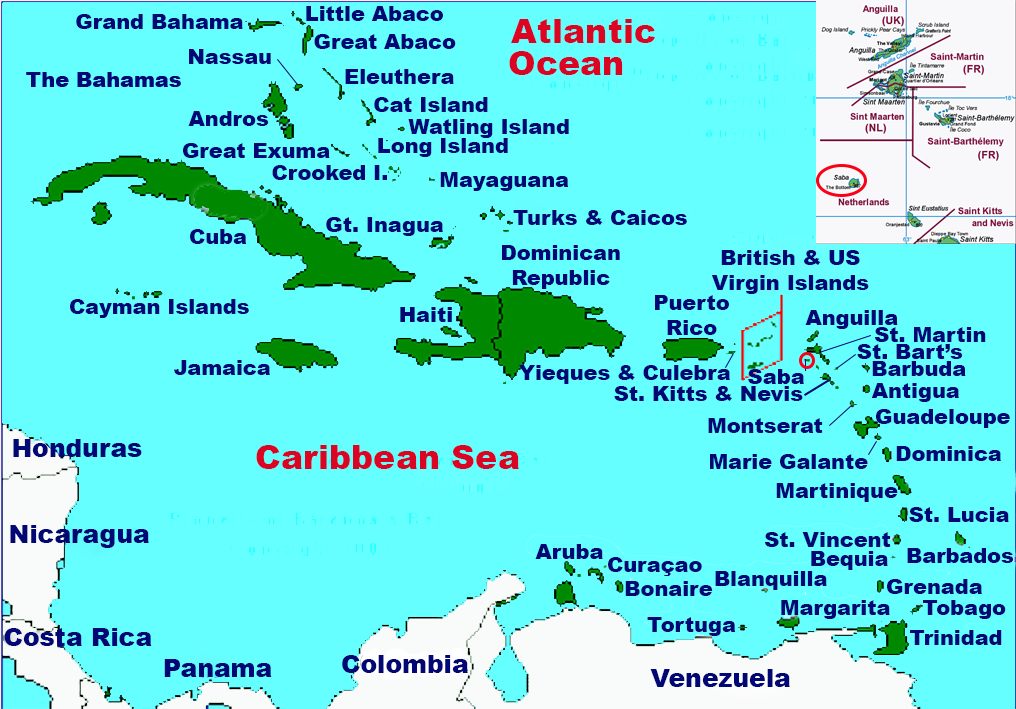 Image of the Caribbean with the location of Saba picked out
and circled, a blow-up map of Saba in relation to Sint Eustatius and Sint Maarten is show, inset.Saba has a land area of 13km2The population was 2,158 in January 2025, with a population density of 147 inhabitants per square kilometres. It is the smallest territory by permanent population in the Americas. Its towns and major settlements are The Bottom (the capital), Windwardside, Zion's Hill, and St. Johns.
Etymology: Theories about the origin of Saba's name include siba (the Arawakan word for 'rock'), sabot, sábado, and Sheba. The island was referred to by its present name, Saba, as early as 1595 when it appeared in a voyage account by John Hawkins. Before its present name, the island was designated 'St. Christopher' (San Cristóbal) by Christopher Columbus.
Saba's cuisine is a blend of native, Dutch and African. However, the presence of the dominant volcano has significantly reduced the availability of agricultural land and until the advent of international imports the islands were dependent on the staples of breadfruit, sugarcane, goat meat and fishing. Breadfruit is a staple and the sugarcane is made into local rum, which is flavoured with spices and botanicals, giving the island's speciality Saba Spice, which is used predominantly in the local cuisine. Curries are common and are often made with goat, seafood and breadfruit. Cakes and sweet dishes have a distinct Dutch flavour and Johnny cakes have been incorporated from neighbouring islands.
This is a continuation of an entire series of pages that will, I hope, allow my visitors to better navigate this site. As well as displaying recipes by name, country and region of origin I am now planning a whole series of pages where recipes can be located by meal type and main ingredient. This page gives a listing of all the Saban recipes added to this site.
Saba iis a Caribbean island and the smallest special municipality (officially "public body") of the Netherlands. English and Dutch are both official languages and the capital and largest city is The Bottom.
Saba's cuisine is a blend of native, Dutch and African. However, the presence of the dominant volcano has significantly reduced the availability of agricultural land and until the advent of international imports the islands were dependent on the staples of breadfruit, sugarcane, goat meat and fishing. Breadfruit is a staple and the sugarcane is made into local rum, which is flavoured with spices and botanicals, giving the island's speciality Saba Spice.
Saba is a Caribbean island and the smallest special municipality (officially 'public body') of the Netherlands. It consists largely of the dormant volcano Mount Scenery, which at 870 metres (2,854.3 ft) is the highest point of the entire Kingdom of the Netherlands. The island lies in the northern Leeward Islands portion of the West Indies, southeast of the Virgin Islands. Together with Bonaire and Sint Eustatius it forms the BES islands, also known as the Caribbean Netherlands. Saba, together with Sint Eustatius and Sint Maarten also form the SSS island group.
Image of the Caribbean with the location of Saba picked outand circled, a blow-up map of Saba in relation to Sint Eustatius and Sint Maarten is show, inset.
Etymology: Theories about the origin of Saba's name include siba (the Arawakan word for 'rock'), sabot, sábado, and Sheba. The island was referred to by its present name, Saba, as early as 1595 when it appeared in a voyage account by John Hawkins. Before its present name, the island was designated 'St. Christopher' (San Cristóbal) by Christopher Columbus.
Saban Cuisine:
Local food is called Krioyo (pronounced the same as criollo, the Spanish word for 'Creole') and boasts a blend of flavours and techniques best compared to Caribbean cuisine and Latin American cuisine. Dishes common in Curaçao are found in Aruba and Bonaire as well. Popular dishes include stobá (a stew made with various ingredients such as papaya, beef or goat), Guiambo (soup made from okra and seafood), kadushi (cactus soup), sopi mondongo (intestine soup), funchi (cornmeal paste similar to fufu, ugali and polenta) and fish and other seafood. The ubiquitous side dish is fried plantain. Local bread rolls are made according to a Portuguese recipe. All around the island, there are snèks which serve local dishes as well as alcoholic drinks in a manner akin to the English pub.Saba's cuisine is a blend of native, Dutch and African. However, the presence of the dominant volcano has significantly reduced the availability of agricultural land and until the advent of international imports the islands were dependent on the staples of breadfruit, sugarcane, goat meat and fishing. Breadfruit is a staple and the sugarcane is made into local rum, which is flavoured with spices and botanicals, giving the island's speciality Saba Spice, which is used predominantly in the local cuisine. Curries are common and are often made with goat, seafood and breadfruit. Cakes and sweet dishes have a distinct Dutch flavour and Johnny cakes have been incorporated from neighbouring islands.
Saba's National Dishes:
Below are listed the dishes considered to be Saba's national foods along with links to the recipes for those dishes:| Goat Meat With Peas and Rice Origin: Saba | Saban Pot Origin: Saba |
The alphabetical list of all the Saban recipes on this site follows, (limited to 100 recipes per page). There are 18 recipes in total:
Page 1 of 1
| Goat Meat With Peas and Rice Origin: Saba | Pastechi Galiña (Chicken Pastechi) Origin: Saba | Saba Peppasauce Origin: Saba |
| Saban Pot Origin: Saba | Saba Breadfruit Curry Origin: Saba | Saba Pigeon Pea Stew Origin: Saba |
| Breadfruit Puffs Origin: Saba | Saba Callaloo Origin: Saba | Saba Rice and Black Beans Origin: Saba |
| Cheese Pastechi Origin: Saba | Saba Curry Goat Origin: Saba | Saba Spice Cake Origin: Saba |
| Goat Meat With Peas and Rice Origin: Saba | Saba Johnny Cakes Origin: Saba | Saba Spice French Toast Origin: Saba |
| Kabritu Stobá (Goat Meat Stew) Origin: Saba | Saba Masala Chicken Origin: Saba | Saban Curry Conch (Saban Curry Conchs) Origin: Saba |
Page 1 of 1