FabulousFusionFood's Syrian Recipes Home Page
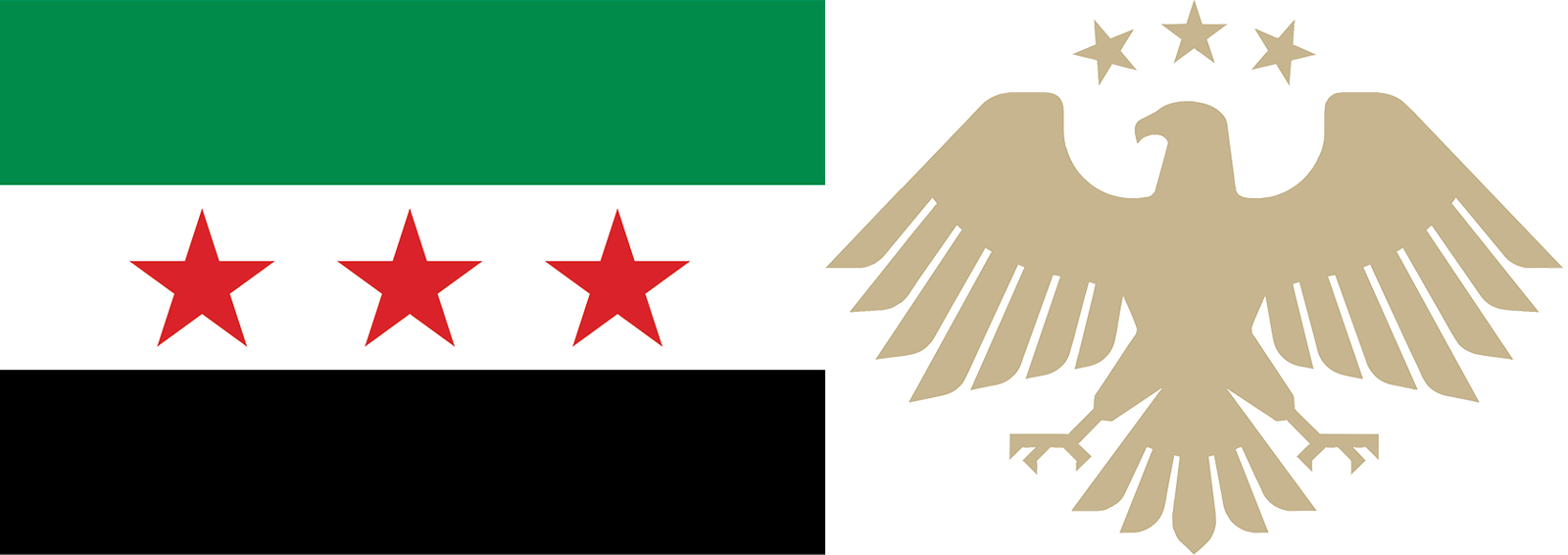 The flag of Syria (left) and the emblem of Syria (right).
Welcome to the summary page for FabulousFusionFood's Syrian recipes, part of Asia. This page provides links to all the Palestinian recipes presented on this site, with 15 recipes in total.
This is a continuation of an entire series of pages that will, I hope, allow my visitors to better navigate this site. As well as displaying recipes by name, country and region of origin I am now planning a whole series of pages where recipes can be located by meal type and main ingredient. This page gives a listing of all the Syrian recipes added to this site.
Syria (اَلْجُمْهُورِيَّةُ ٱلْعَرَبِيَّةُ ٱلْسُوْرِيَّة (al-Jumhūriyyah al-ʿArabiyyah as-Sūriyyah in Arabic)), is a country in West Asia located in the Eastern Mediterranean and the Levant. It borders the Mediterranean Sea to the west, Turkey to the north, Iraq to the east and southeast, Jordan to the south, and Israel and Lebanon to the southwest. Damascus is the capital and largest city.
Syrian cuisine is rich and varied in its ingredients, linked to the regions where a specific dish has originated. Syrian food mostly consists of southern Mediterranean, Greek, and Southwest Asian dishes. Some Syrian dishes also evolved from Turkish and French cooking: dishes like shish kebab, stuffed zucchini/courgette, and yabraʾ (stuffed grape leaves, the word yabraʾ deriving from the Turkish word yaprak, meaning leaf). The main dishes are kibbeh, hummus, tabbouleh, fattoush, labneh, shawarma, mujaddara, shanklish, pastırma, sujuk and baklava. Baklava is made of filo pastry filled with chopped nuts and soaked in honey. Syrians often serve selections of appetizers, known as meze, before the main course. Za'atar, minced beef, and cheese manakish are popular hors d'œuvres. The Arabic flatbread khubz is always eaten together with meze.
Syria officially the Syrian Arab Republic, is a country in West Asia located in the Eastern Mediterranean and the Levant. It borders the Mediterranean Sea to the west, Turkey to the north, Iraq to the east and southeast, Jordan to the south, and Israel and Lebanon to the southwest. It is a republic under a transitional government and comprises 14 governorates. Damascus is the capital and largest city. With a population of 25 million across an area of 185,180 square kilometres, it is the 57th-most populous and 87th-largest country.
 Location of Syria in West Asia with the land mass of Syria
picked out in redThe name 'Syria' historically referred to a wider region. The modern state encompasses the sites of several ancient kingdoms and empires, including the Eblan civilization. Damascus was the seat of the Umayyad Caliphate and a provincial capital under the Mamluk Sultanate. The modern Syrian state was established in the mid-20th century after centuries of Ottoman rule, as a French Mandate. The state represented the largest Arab state to emerge from the formerly Ottoman-ruled Syrian provinces. It gained de jure independence as a parliamentary republic in 1945 when the First Syrian Republic became a founding member of the United Nations, an act which legally ended the French Mandate. French troops withdrew in April 1946, granting the nation de facto independence. The post-independence period was tumultuous, with multiple coups and coup attempts between 1949 and 1971. In 1958, Syria entered a brief pan-Arab union with Egypt, which was terminated following a 1961 coup d'état. The 1963 coup d'état carried out by the military committee of the Ba'ath Party established a one-party state, which ran Syria under martial law from 1963 to 2011. Internal power-struggles within Ba'athist factions caused further coups in 1966 and 1970, the latter of which saw Hafez al-Assad come to power. Under Assad, Syria became a hereditary dictatorship. Assad died in 2000, and he was succeeded by his son, Bashar.
Since the Arab Spring in 2011, Syria has been embroiled in a multi-sided civil war with the involvement of several countries, leading to a refugee crisis in which more than 6 million refugees were displaced from the country. In response to rapid territorial gains made by the Islamic State during the civil war in 2014 and 2015, several countries intervened on behalf of various factions opposing it, leading to its territorial defeat in 2017 in both central and eastern Syria. Thereafter, three political entities—the Syrian Interim Government, Syrian Salvation Government, and the Democratic Autonomous Administration of North and East Syria—emerged in Syrian territory to challenge Assad's rule. In late 2024, a series of offensives from a coalition of opposition forces led to the capture of Damascus and the fall of Assad's regime. By 2025, the war had left Syria's economy in a poor state, following years of international sanctions that were later eased.
A country of fertile plains, high mountains, and deserts, Syria is home to diverse ethnic and religious groups. Arabs are the largest ethnic group, and Sunni Muslims are the largest religious group.
Etymology: Several sources indicate that the name Syria is derived from the 8th century BC Luwian term 'Sura/i', and the derivative ancient Greek name: Σύριοι, Sýrioi, or Σύροι, Sýroi, both of which originally derived from Aššūr (Assyria) in northern Mesopotamia (present-day Iraq and north-eastern Syria). However, from the Seleucid Empire (323–150 BC), this term was also applied to the Levant, and from this point the Greeks applied the term without distinction between the Assyrians of Mesopotamia and Arameans of the Levant. Mainstream modern academic opinion strongly favors the argument that the Greek word is related to the cognate Ἀσσυρία, Assyria, ultimately derived from the Akkadian Aššur. The Greek name appears to correspond to Phoenician ʾšr 'Assur', ʾšrym 'Assyrians', recorded in the 8th-century BC Çineköy inscription.
The area designated by the word has changed over time. Classically, Syria lies at the eastern end of the Mediterranean, between Arabia to the south and Asia Minor to the north, stretching inland to include parts of Iraq, and having an uncertain border to the northeast that Pliny the Elder describes as including, from west to east, Commagene, Sophene, and Adiabene.
By Pliny's time, however, this larger Syria had been divided into a number of provinces under the Roman Empire (but politically independent from each other): Judaea, later renamed Palaestina in AD 135 (the region corresponding to modern-day Israel, the Palestinian territories, and Jordan) in the extreme southwest; Phoenice (established in 194) corresponding to modern Lebanon, Damascus and Homs regions; Coele-Syria (or 'Hollow Syria') and south of the Eleutheris river.
The main dishes that form Syrian cuisine are kibbeh, hummus, tabbouleh, fattoush, labneh, shawarma, mujaddara, shanklish, pastırma, sujuk and baklava. Baklava is made of filo pastry filled with chopped nuts and soaked in honey. Syrians often serve selections of appetizers, known as meze, before the main course. Za'atar, minced beef, and cheese manakish are popular hors d'œuvres. The Arabic flatbread khubz is always eaten together with meze.
Syrians are also well known for their cheese. The very popular string cheese jibbneh mashallale is made of curd cheese and is pulled and twisted together. Syrians also make cookies/biscuits to usually accompany their cheese called ka'ak. These are made of farina and other ingredients, rolled out, shaped into rings and baked. Another form of a similar cookie is filled with crushed dates mixed with butter, to accompany jibbneh mashallale.
This is a continuation of an entire series of pages that will, I hope, allow my visitors to better navigate this site. As well as displaying recipes by name, country and region of origin I am now planning a whole series of pages where recipes can be located by meal type and main ingredient. This page gives a listing of all the Syrian recipes added to this site.
Syria (اَلْجُمْهُورِيَّةُ ٱلْعَرَبِيَّةُ ٱلْسُوْرِيَّة (al-Jumhūriyyah al-ʿArabiyyah as-Sūriyyah in Arabic)), is a country in West Asia located in the Eastern Mediterranean and the Levant. It borders the Mediterranean Sea to the west, Turkey to the north, Iraq to the east and southeast, Jordan to the south, and Israel and Lebanon to the southwest. Damascus is the capital and largest city.
Syrian cuisine is rich and varied in its ingredients, linked to the regions where a specific dish has originated. Syrian food mostly consists of southern Mediterranean, Greek, and Southwest Asian dishes. Some Syrian dishes also evolved from Turkish and French cooking: dishes like shish kebab, stuffed zucchini/courgette, and yabraʾ (stuffed grape leaves, the word yabraʾ deriving from the Turkish word yaprak, meaning leaf). The main dishes are kibbeh, hummus, tabbouleh, fattoush, labneh, shawarma, mujaddara, shanklish, pastırma, sujuk and baklava. Baklava is made of filo pastry filled with chopped nuts and soaked in honey. Syrians often serve selections of appetizers, known as meze, before the main course. Za'atar, minced beef, and cheese manakish are popular hors d'œuvres. The Arabic flatbread khubz is always eaten together with meze.
Syria officially the Syrian Arab Republic, is a country in West Asia located in the Eastern Mediterranean and the Levant. It borders the Mediterranean Sea to the west, Turkey to the north, Iraq to the east and southeast, Jordan to the south, and Israel and Lebanon to the southwest. It is a republic under a transitional government and comprises 14 governorates. Damascus is the capital and largest city. With a population of 25 million across an area of 185,180 square kilometres, it is the 57th-most populous and 87th-largest country.
Location of Syria in West Asia with the land mass of Syriapicked out in red
Since the Arab Spring in 2011, Syria has been embroiled in a multi-sided civil war with the involvement of several countries, leading to a refugee crisis in which more than 6 million refugees were displaced from the country. In response to rapid territorial gains made by the Islamic State during the civil war in 2014 and 2015, several countries intervened on behalf of various factions opposing it, leading to its territorial defeat in 2017 in both central and eastern Syria. Thereafter, three political entities—the Syrian Interim Government, Syrian Salvation Government, and the Democratic Autonomous Administration of North and East Syria—emerged in Syrian territory to challenge Assad's rule. In late 2024, a series of offensives from a coalition of opposition forces led to the capture of Damascus and the fall of Assad's regime. By 2025, the war had left Syria's economy in a poor state, following years of international sanctions that were later eased.
A country of fertile plains, high mountains, and deserts, Syria is home to diverse ethnic and religious groups. Arabs are the largest ethnic group, and Sunni Muslims are the largest religious group.
Etymology: Several sources indicate that the name Syria is derived from the 8th century BC Luwian term 'Sura/i', and the derivative ancient Greek name: Σύριοι, Sýrioi, or Σύροι, Sýroi, both of which originally derived from Aššūr (Assyria) in northern Mesopotamia (present-day Iraq and north-eastern Syria). However, from the Seleucid Empire (323–150 BC), this term was also applied to the Levant, and from this point the Greeks applied the term without distinction between the Assyrians of Mesopotamia and Arameans of the Levant. Mainstream modern academic opinion strongly favors the argument that the Greek word is related to the cognate Ἀσσυρία, Assyria, ultimately derived from the Akkadian Aššur. The Greek name appears to correspond to Phoenician ʾšr 'Assur', ʾšrym 'Assyrians', recorded in the 8th-century BC Çineköy inscription.
The area designated by the word has changed over time. Classically, Syria lies at the eastern end of the Mediterranean, between Arabia to the south and Asia Minor to the north, stretching inland to include parts of Iraq, and having an uncertain border to the northeast that Pliny the Elder describes as including, from west to east, Commagene, Sophene, and Adiabene.
By Pliny's time, however, this larger Syria had been divided into a number of provinces under the Roman Empire (but politically independent from each other): Judaea, later renamed Palaestina in AD 135 (the region corresponding to modern-day Israel, the Palestinian territories, and Jordan) in the extreme southwest; Phoenice (established in 194) corresponding to modern Lebanon, Damascus and Homs regions; Coele-Syria (or 'Hollow Syria') and south of the Eleutheris river.
Syrian Cuisine:
Syrian cuisine is rich and varied in its ingredients and is linked to the regions of Syria where a specific dish has originated. Syrian food mostly consists of Southern Mediterranean, Greek, and Southwest Asian dishes. Some Syrian dishes also evolved from Turkish and French cooking. Dishes like shish kebab, stuffed zucchini/courgette, yabra' (stuffed grape leaves, the word yapra' derives from the Turkish word 'yaprak' meaning leaf)..The main dishes that form Syrian cuisine are kibbeh, hummus, tabbouleh, fattoush, labneh, shawarma, mujaddara, shanklish, pastırma, sujuk and baklava. Baklava is made of filo pastry filled with chopped nuts and soaked in honey. Syrians often serve selections of appetizers, known as meze, before the main course. Za'atar, minced beef, and cheese manakish are popular hors d'œuvres. The Arabic flatbread khubz is always eaten together with meze.
Syrians are also well known for their cheese. The very popular string cheese jibbneh mashallale is made of curd cheese and is pulled and twisted together. Syrians also make cookies/biscuits to usually accompany their cheese called ka'ak. These are made of farina and other ingredients, rolled out, shaped into rings and baked. Another form of a similar cookie is filled with crushed dates mixed with butter, to accompany jibbneh mashallale.
Syria's National Dishes:
Below are listed the dishes considered to be Syria's national foods along with links to the recipes for those dishes:| Freekeh Mansaf Origin: Syria | Kibbeh Origin: Syria |
The alphabetical list of all the Syrian recipes on this site follows, (limited to 100 recipes per page). There are 15 recipes in total:
Page 1 of 1
| Freekeh Mansaf Origin: Syria | Freekeh Mansaf Origin: Syria | Ma'arouk Origin: Syria |
| Kibbeh Origin: Syria | Iflaghun Origin: Syria | Muhammara (Hot Pepper Dip) Origin: Syria |
| Barazek (Syrian Sesame Biscuits) Origin: Syria | Kafta with Argan Oil (Syrian Meatballs with Argan Oil) Origin: Syria | Muhammara (Syrian Sweet Pepper Spread) Origin: Syria |
| Cheese Baklava Origin: Syria | Khoubz Araby (Arabic Flatbread) Origin: Syria | Musakhan (Chicken with Sumac and Caramelized Onions) Origin: Syria |
| Dajaaj al Riz (Syrian Roast Chicken with Rice) Origin: Syria | Kibbeh Origin: Syria | Shish Tawuq (Chicken Kebab with Bharat Spices) Origin: Syria |
Page 1 of 1