FabulousFusionFood's Georgian Recipes Home Page
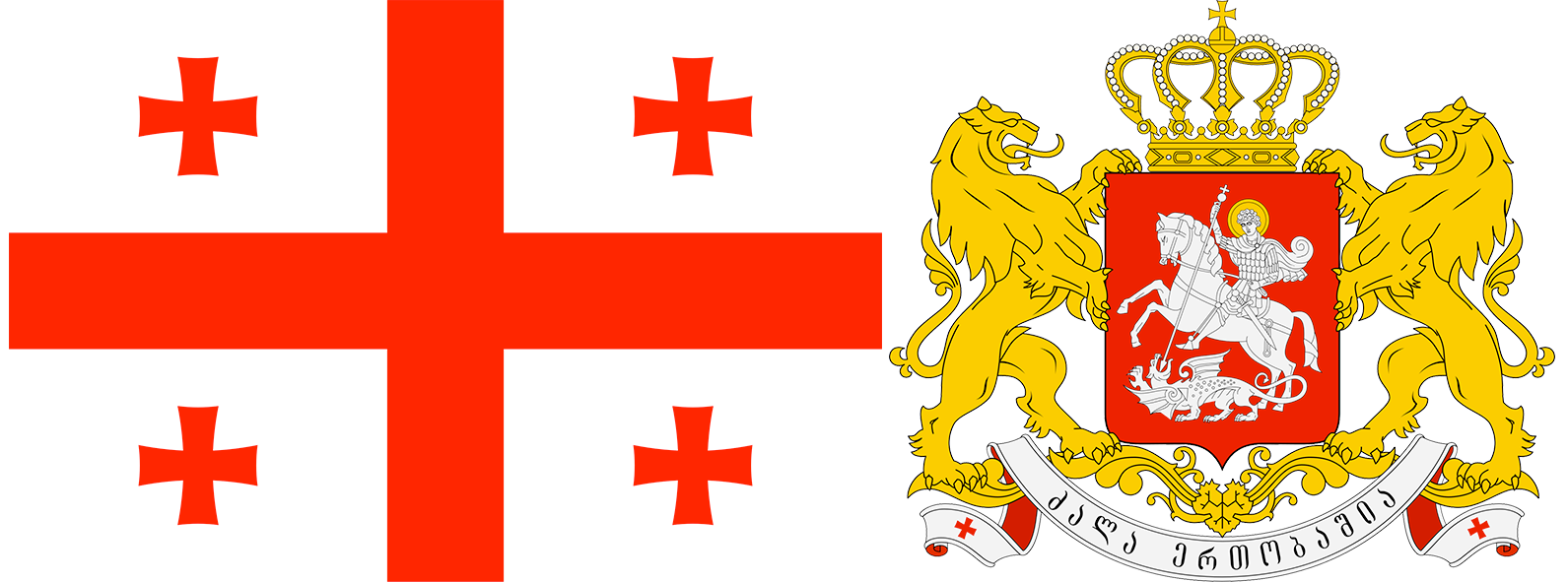 The flag of Georgia (left) and the arms of Georgia (right).
Welcome to the summary page for FabulousFusionFood's Georgian recipes, part Asia. This page provides links to all the Georgian recipes presented on this site, with 48 recipes in total.
This is a continuation of an entire series of pages that will, I hope, allow my visitors to better navigate this site. As well as displaying recipes by name, country and region of origin I am now planning a whole series of pages where recipes can be located by meal type and main ingredient. This page gives a listing of all the Georgian recipes added to this site.
Georgia (საქართველო (Sakartvelo in Georgian)), in the Caucasus region on the coast of the Black Sea. It is located at the intersection of Eastern Europe and West Asia. t has a population of 3.9 million,[d][9] of which over a third live in the capital and largest city, Tbilisi. Ethnic Georgians, who are native to the region, constitute a majority of the country's population and are its titular nation.
Georgian cuisine and wine have evolved through the centuries, adapting traditions in each era. One of the most unusual traditions of dining is supra, or Georgian table, which is also a way of socializing with friends and family. The head of supra is known as tamada. He also conducts the highly philosophical toasts, and makes sure that everyone is enjoying themselves. Various historical regions of Georgia are known for their particular dishes: for example, khinkali (meat dumplings), from eastern mountainous Georgia, and khachapuri, mainly from Imereti, Samegrelo and Adjara
Georgiais a country in the Caucasus region on the coast of the Black Sea. It is located at the intersection of Eastern Europe and West Asia, and is today generally regarded as part of Europe. It is bordered to the north and northeast by Russia, to the south by Turkey and Armenia, and to the southeast by Azerbaijan. Georgia covers an area of 69,700 square kilometres. It has a population of 3.9 million, of which over a third live in the capital and largest city, Tbilisi. Ethnic Georgians, who are native to the region, constitute a majority of the country's population and are its titular nation.
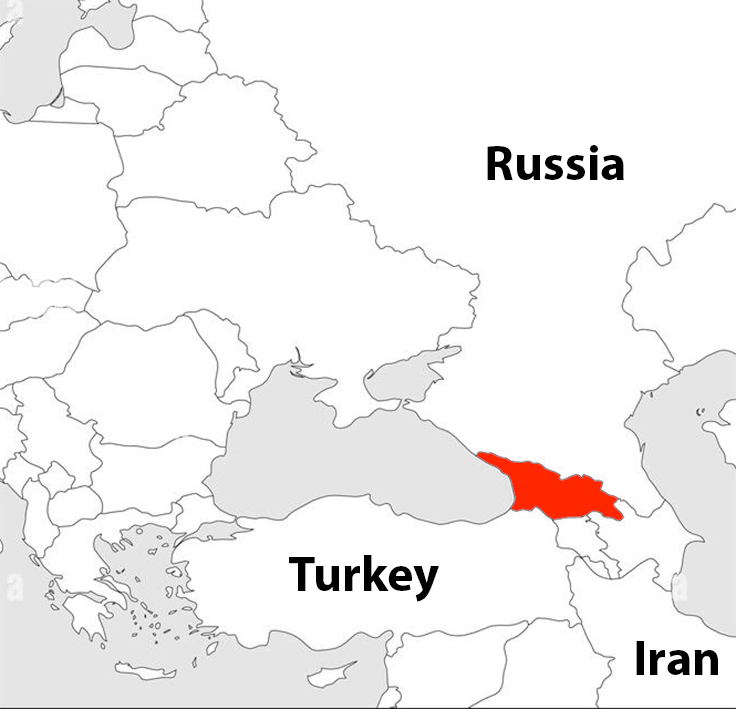 Location of Georgia in the Caucasus with the land mass of Georgia
picked out in red.Georgia has been inhabited since prehistory, hosting the world's earliest known sites of winemaking, gold mining, and textiles. The classical era saw the emergence of several kingdoms, such as Colchis and Iberia, that formed the nucleus of the modern Georgian state. In the early fourth century, Georgians officially adopted Christianity, which contributed to their unification under the Kingdom of Georgia. Georgia reached its Golden Age during the High Middle Ages under the reigns of King David IV and Queen Tamar. Beginning in the 15th century, the kingdom declined and disintegrated due to internal discord and pressure from various regional powers, including the Mongols, the Ottoman Empire, and Persia, before being gradually annexed into the Russian Empire starting in 1801
After the Russian Revolution in 1917, Georgia briefly emerged as an independent republic under German protection. However, the country was invaded and annexed by the Red Army in 1921; it then became one of the republics of the Soviet Union. In the 1980s, an independence movement grew quickly, leading to Georgia's secession from the Soviet Union in April 1991. For much of the subsequent decade, the country endured economic crises, political instability, and secessionist wars in Abkhazia and South Ossetia. Following the peaceful Rose Revolution in 2003, Georgia strongly pursued a pro-Western foreign policy, introducing a series of reforms aimed at integration into the European Union and NATO. This Western orientation led to worsening relations with Russia, culminating in the Russo-Georgian War of 2008 and continued Russian occupation of parts of Georgia.
Georgia is a representative democracy governed as a unitary parliamentary republic. It is a developing country with an emerging market economy. Sweeping economic reforms since 2003 have resulted in the country having one of the fastest rates of GDP growth. Georgia is a member of numerous international organizations, including the Council of Europe, Eurocontrol, BSEC, GUAM, and Energy Community. As part of the Association Trio, Georgia is an official candidate for membership in the European Union. Since October 2024, Georgia has been immersed in a deep political crisis.
Etymology: Ancient Greeks (Strabo, Herodotus, Plutarch, Homer, etc.) and Romans (Titus Livius, Tacitus, etc.) referred to early western Georgians as Colchians and eastern Georgians as Iberians (Iberoi, Ἰβηροι in some Greek sources). The first mention of the name Georgia is in Italian on the mappa mundi of Pietro Vesconte dated 1320. At the early stage of its appearance in the Latin world, the name was often spelled Jorgia. Lore-based theories were given by 13th-century traveller Jacques de Vitry, who explained the name's origin by the popularity of Saint George among Georgians. Jean Chardin thought that Georgia came from the Greek γεωργός ('tiller of the land').
Modern scholarship generally derives the name Georgia from the Persian term Gurj (گرج), a historical ethnonym for Georgians. The ultimate origin of this term is debated, though it may be connected to gurğān, a region name meaning 'land of wolves'. From Persian, the term was borrowed into Byzantine Greek, Slavic, and later Western European languages. The adoption of the term Georgia in Western Europe coincided with increased contact during the Crusades and trade through Black Sea ports controlled by Genoese merchants. The association with St. George, a popular figure in medieval Christendom, may have reinforced the exonym’s appeal in Latin Europe.
The native name is Sakartvelo (საქართველო; 'land of Kartvelians'), derived from the core central Georgian region of Kartli, recorded from the 9th century, and in extended usage referring to the entire medieval Kingdom of Georgia prior to the 13th century. The Georgian circumfix sa-X-o is a standard geographic construction designating 'the area where X dwell', where X is an ethnonym. The self-designation used by ethnic Georgians is Kartvelebi (ქართველები, i.e. 'Kartvelians'), first attested in the Umm Leisun inscription found in the Old City of Jerusalem, dated to the 5th or 6th century.
Georgia was one of the countries on the Silk Road, which resulted in travellers influencing Georgian cuisine. The Georgian love of family and friends is one of the reasons why the supra (feast) is so important in Georgia. Supra is offered spontaneously to relatives, friends or guests. Every supra has its tamada (toastmaster), who gives the toast and entertains the guests.
This is a continuation of an entire series of pages that will, I hope, allow my visitors to better navigate this site. As well as displaying recipes by name, country and region of origin I am now planning a whole series of pages where recipes can be located by meal type and main ingredient. This page gives a listing of all the Georgian recipes added to this site.
Georgia (საქართველო (Sakartvelo in Georgian)), in the Caucasus region on the coast of the Black Sea. It is located at the intersection of Eastern Europe and West Asia. t has a population of 3.9 million,[d][9] of which over a third live in the capital and largest city, Tbilisi. Ethnic Georgians, who are native to the region, constitute a majority of the country's population and are its titular nation.
Georgian cuisine and wine have evolved through the centuries, adapting traditions in each era. One of the most unusual traditions of dining is supra, or Georgian table, which is also a way of socializing with friends and family. The head of supra is known as tamada. He also conducts the highly philosophical toasts, and makes sure that everyone is enjoying themselves. Various historical regions of Georgia are known for their particular dishes: for example, khinkali (meat dumplings), from eastern mountainous Georgia, and khachapuri, mainly from Imereti, Samegrelo and Adjara
Georgiais a country in the Caucasus region on the coast of the Black Sea. It is located at the intersection of Eastern Europe and West Asia, and is today generally regarded as part of Europe. It is bordered to the north and northeast by Russia, to the south by Turkey and Armenia, and to the southeast by Azerbaijan. Georgia covers an area of 69,700 square kilometres. It has a population of 3.9 million, of which over a third live in the capital and largest city, Tbilisi. Ethnic Georgians, who are native to the region, constitute a majority of the country's population and are its titular nation.
Location of Georgia in the Caucasus with the land mass of Georgiapicked out in red.
After the Russian Revolution in 1917, Georgia briefly emerged as an independent republic under German protection. However, the country was invaded and annexed by the Red Army in 1921; it then became one of the republics of the Soviet Union. In the 1980s, an independence movement grew quickly, leading to Georgia's secession from the Soviet Union in April 1991. For much of the subsequent decade, the country endured economic crises, political instability, and secessionist wars in Abkhazia and South Ossetia. Following the peaceful Rose Revolution in 2003, Georgia strongly pursued a pro-Western foreign policy, introducing a series of reforms aimed at integration into the European Union and NATO. This Western orientation led to worsening relations with Russia, culminating in the Russo-Georgian War of 2008 and continued Russian occupation of parts of Georgia.
Georgia is a representative democracy governed as a unitary parliamentary republic. It is a developing country with an emerging market economy. Sweeping economic reforms since 2003 have resulted in the country having one of the fastest rates of GDP growth. Georgia is a member of numerous international organizations, including the Council of Europe, Eurocontrol, BSEC, GUAM, and Energy Community. As part of the Association Trio, Georgia is an official candidate for membership in the European Union. Since October 2024, Georgia has been immersed in a deep political crisis.
Etymology: Ancient Greeks (Strabo, Herodotus, Plutarch, Homer, etc.) and Romans (Titus Livius, Tacitus, etc.) referred to early western Georgians as Colchians and eastern Georgians as Iberians (Iberoi, Ἰβηροι in some Greek sources). The first mention of the name Georgia is in Italian on the mappa mundi of Pietro Vesconte dated 1320. At the early stage of its appearance in the Latin world, the name was often spelled Jorgia. Lore-based theories were given by 13th-century traveller Jacques de Vitry, who explained the name's origin by the popularity of Saint George among Georgians. Jean Chardin thought that Georgia came from the Greek γεωργός ('tiller of the land').
Modern scholarship generally derives the name Georgia from the Persian term Gurj (گرج), a historical ethnonym for Georgians. The ultimate origin of this term is debated, though it may be connected to gurğān, a region name meaning 'land of wolves'. From Persian, the term was borrowed into Byzantine Greek, Slavic, and later Western European languages. The adoption of the term Georgia in Western Europe coincided with increased contact during the Crusades and trade through Black Sea ports controlled by Genoese merchants. The association with St. George, a popular figure in medieval Christendom, may have reinforced the exonym’s appeal in Latin Europe.
The native name is Sakartvelo (საქართველო; 'land of Kartvelians'), derived from the core central Georgian region of Kartli, recorded from the 9th century, and in extended usage referring to the entire medieval Kingdom of Georgia prior to the 13th century. The Georgian circumfix sa-X-o is a standard geographic construction designating 'the area where X dwell', where X is an ethnonym. The self-designation used by ethnic Georgians is Kartvelebi (ქართველები, i.e. 'Kartvelians'), first attested in the Umm Leisun inscription found in the Old City of Jerusalem, dated to the 5th or 6th century.
Georgian Cuisine:
Georgian cuisine (Georgian: ქართული სამზარეულო, romanized: kartuli samzareulo) consists of cooking traditions, techniques, and practices of Georgia. Georgian cuisine has a distinct character, while bearing some similarities with various national cuisines of the South Caucasus, the Middle East and Eastern Europe. Every region of Georgia has its own distinct style of food preparation. Eating and drinking are important parts of Georgian culture.Georgia was one of the countries on the Silk Road, which resulted in travellers influencing Georgian cuisine. The Georgian love of family and friends is one of the reasons why the supra (feast) is so important in Georgia. Supra is offered spontaneously to relatives, friends or guests. Every supra has its tamada (toastmaster), who gives the toast and entertains the guests.
Georgia's National Dishes:
Below are listed the dishes considered to be Georgia's national foods along with links to the recipes for those dishes:| Adjarian Khachapuri (Georgian Cheese Pies) Origin: Georgia | Khinkali Origin: Georgia |
The alphabetical list of all the Georgian recipes on this site follows, (limited to 100 recipes per page). There are 48 recipes in total:
Page 1 of 1
| Adjarian Khachapuri (Georgian Cheese Pies) Origin: Georgia | Gozinaki (Walnut and Honey Crunch) Origin: Georgia | Luk Marinovannyi Origin: Georgia |
| Khinkali Origin: Georgia | Ikra Patrijani (Caviar Patrijani) Origin: Georgia | Nachinka iz Fasoli (Red Bean Paste) Origin: Georgia |
| Adjarian Khachapuri (Georgian Cheese Pies) Origin: Georgia | Katami Satsabeli Baga (Duck in Georgian Walnut Sauce) Origin: Georgia | Nachinyonaya Forel (Stuffed Trout) Origin: Georgia |
| Baklazhan Pkhali (Aubergine Pkhali) Origin: Georgia | Khachapuri (Georgian Cheese Pie) Origin: Georgia | Orikhova Masa (Walnut Filling) Origin: Georgia |
| Basturma (Spiced Dried Meat) Origin: Georgia | Khachapuri iz Fasoli (Georgian Bean Pie) Origin: Georgia | Parcha Bozbash II (Lamb Soup with Chestnuts, Quince, and Prunes) Origin: Georgia |
| Ceregi Origin: Georgia | Khalia (Georgian Spicy Beef Stew) Origin: Georgia | Pchali (Herb Fritters) Origin: Georgia |
| Chakapuli (Georgian Lamb and Tarragon Stew) Origin: Georgia | Kharcho (Georgian Beef and Rice Soup) Origin: Georgia | Phali (Young Beet Greens in Walnut Sauce) Origin: Georgia |
| Chemen Spice Mix Origin: Georgia | Kharcho Soup (Georgian Beef and Rice Soup) Origin: Georgia | Pierogies Origin: Georgia |
| Chicken tabaka with Plum Sauce (Georgian Spitted Chicken with Plum Sauce) Origin: Georgia | Khinkali Origin: Georgia | Pilav Limon (Lemon Pasta Pilaf) Origin: Georgia |
| Chikhirtma (Coriander and Onion Soup) Origin: Georgia | Khmeli-Suneli Origin: Georgia | Plov S Mindalyom, Izyumom I Apelsinovoy Tsedroy (Fruit Pilaf) Origin: Georgia |
| Forshmak (Georgian Minced Meat Soufflé) Origin: Georgia | Kotmis Satsivi (Roast Chicken with Walnut Sauce) Origin: Georgia | Ribnoye Kharcho (Salmon and Walnut Soup) Origin: Georgia |
| Georgian Fruit Buns Origin: Georgia | Kwerstkhi Nigozee Satsabelly (Egg Salad In Walnut Sauce) Origin: Georgia | Romee (Cornmeal Mush) Origin: Georgia |
| Georgian Potato Soup Origin: Georgia | Lamb Stew with Chestnuts and Pomegranates Origin: Georgia | Satatsuri (Georgian Asparagus Soup) Origin: Georgia |
| Georgian Walnut Sauce Origin: Georgia | Liula-kebab Origin: Georgia | Satsabeli Bazha (Poultry in Walnut Sauce) Origin: Georgia |
| Givech (Mixed Vegetable Caviar) Origin: Georgia | Lobio Supi (Red Bean Soup) Origin: Georgia | Setsamandi (Lamb, Rice and Herb Gruel) Origin: Georgia |
| Govjadina Tblisi i Griby (Tblisi Beef and Mushrooms) Origin: Georgia | Lobio Tkemali (Red Beans with Sour Plums and Balsamic Vinegar) Origin: Georgia | Svekla Pkhali (Beet Pkhali) Origin: Georgia |
Page 1 of 1