FabulousFusionFood's Armenian Recipes Home Page
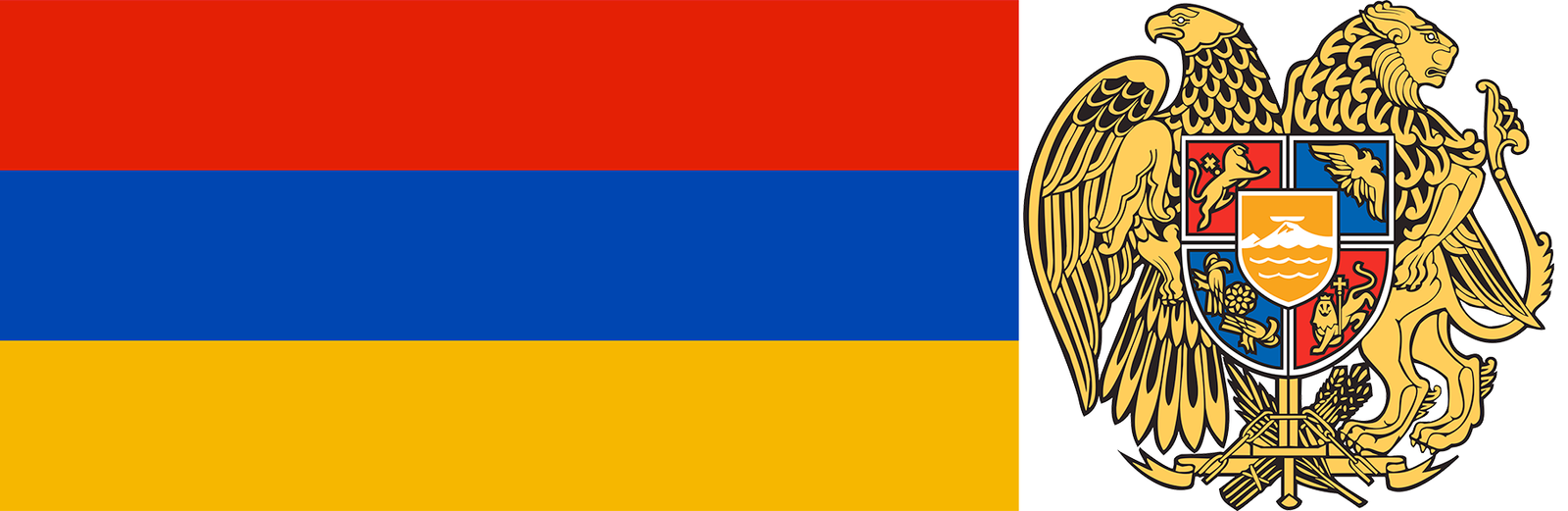 The flag of Armenia (left) and the arms of Armenia (right).
Welcome to the summary page for FabulousFusionFood's Armenian recipes, part Asia. This page provides links to all the Armenian recipes presented on this site, with 49 recipes in total.
This is a continuation of an entire series of pages that will, I hope, allow my visitors to better navigate this site. As well as displaying recipes by name, country and region of origin I am now planning a whole series of pages where recipes can be located by meal type and main ingredient. This page gives a listing of all the Armenian recipes added to this site.
Armenia (Հայաստանի Հանրապետություն (Hayastani Hanrapetut'yun in Armenian)), is a landlocked country in the Armenian highlands of West Asia. It is a part of the Caucasus region and is bordered by Turkey to the west, Georgia to the north and Azerbaijan to the east, and Iran and the Azerbaijani exclave Nakhchivan to the south. Yerevan is the capital, largest city and financial centre.
Armenian cuisine is closely related to eastern and Mediterranean cuisine; various spices, vegetables, fish, and fruits combine to present unique dishes. The main characteristics of Armenian cuisine are a reliance on the quality of the ingredients rather than heavily spicing food, the use of herbs, the use of wheat in a variety of forms, of legumes, nuts, and fruit (as a main ingredient as well as to sour food), and the stuffing of a wide variety of leaves. The pomegranate, with its symbolic association with fertility, represents the nation. The apricot is the national fruit.
Armeniaofficially the Republic of Armenia, is a landlocked country in the Armenian highlands of West Asia. It is a part of the Caucasus region and is bordered by Turkey to the west, Georgia to the north and Azerbaijan to the east, and Iran and the Azerbaijani exclave Nakhchivan to the south. Yerevan is the capital, largest city and financial centre.
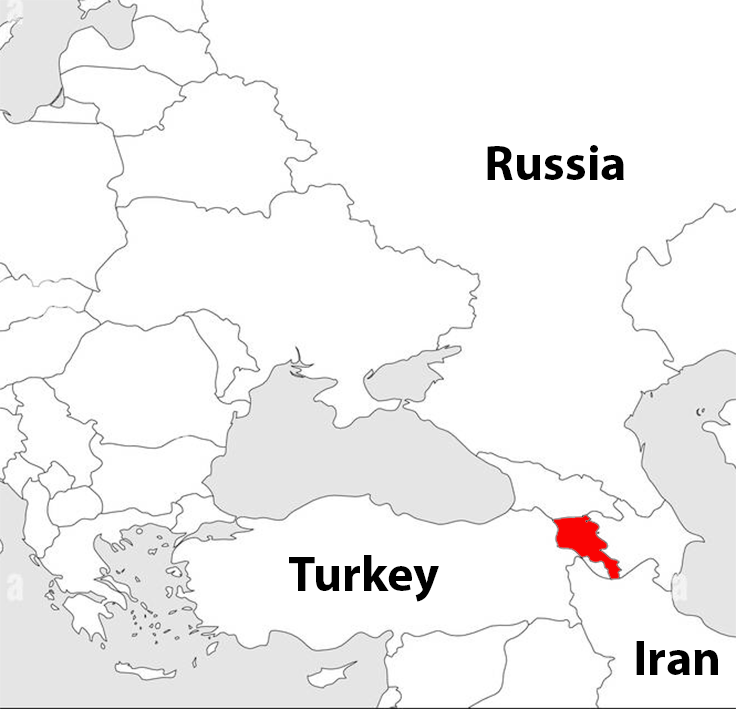 Location of Armenia in the Caucasus with the land mass of Armenia
picked out in red.The Armenian highlands have been home to the Hayasa-Azzi, Shupria and Nairi peoples. By at least 600 BC, an archaic form of Proto-Armenian, an Indo-European language, had diffused into the Armenian highlands. The first Armenian state of Urartu was established in 860 BC, and by the 6th century BC it was replaced by the Satrapy of Armenia. The Kingdom of Armenia reached its height under Tigranes the Great in the 1st century BC and in AD 301 became the first state in the world to adopt Christianity as its official religion. Armenia still recognises the Armenian Apostolic Church, the world's oldest national church, as the country's primary religious establishment. The ancient Armenian kingdom was split between the Byzantine and Sasanian Empires around the early 5th century. Under the Bagratuni dynasty, the Bagratid Kingdom of Armenia was restored in the 9th century before falling in 1045. Cilician Armenia, an Armenian principality and later a kingdom, was located on the coast of the Mediterranean Sea between the 11th and 14th centuries.
Between the 16th and 19th centuries, the traditional Armenian homeland composed of Eastern Armenia and Western Armenia came under the rule of the Ottoman and Persian empires, repeatedly ruled by either of the two over the centuries. By the 19th century, Eastern Armenia had been conquered by the Russian Empire while most of Western Armenia remained under Ottoman rule. During World War I up to 1.5 million Armenians were systematically exterminated in the Armenian genocide. In 1918, following the Russian Revolution, all non-Russian countries declared their independence after the Russian Empire ceased to exist, leading to the establishment of the First Republic of Armenia. By 1920, the state was incorporated into the Soviet Union as the Armenian Soviet Socialist Republic. Today's Republic of Armenia became independent in 1991 during the dissolution of the Soviet Union.
Modern Armenia is a unitary, multi-party, democratic nation-state. It is a developing country and ranks 69th on the Human Development Index as of 2023. Its economy is primarily based on industrial output and mineral extraction. While Armenia is geographically located in the South Caucasus, Armenia views itself as part of Europe and is generally considered geopolitically European. The country is a member of numerous European organisations including the Organization for Security and Co-Operation in Europe, the Council of Europe, the Eastern Partnership, Eurocontrol, the Assembly of European Regions, and the European Bank for Reconstruction and Development. Armenia is a member of certain regional groups throughout Eurasia, including the Asian Development Bank, the Collective Security Treaty Organization, the Eurasian Economic Union, and the Eurasian Development Bank. Armenia supported the once de facto independent Republic of Artsakh (Nagorno-Karabakh), which had seceded from Azerbaijan in 1991, until Azerbaijan reincorporated the region through a siege and military offensive in 2023.
Etymology: The original native Armenian name for the country was Հայք (Hayk'); however, it is currently rarely used. The contemporary name Հայաստան (Hayastan) became popular in the Middle Ages by addition of the Persian suffix -stan (place). However the origins of the name Hayastan trace back to much earlier dates and were first attested in c. 5th century in the works of Agathangelos, Faustus of Byzantium, Ghazar Parpetsi, Koryun, and Sebeos.
The name has traditionally been derived from Hayk (Հայկ), the legendary patriarch of the Armenians and a great-great-grandson of Noah, who, according to the 5th-century AD author Movsis Khorenatsi, defeated the Babylonian king Bel in 2492 BC and established his nation in the Ararat region. Further origin of the name is uncertain. It is postulated that the name Hay comes from one of the two confederated, Hittite vassal states – the Ḫayaša-Azzi (1600–1200 BC).
The exonym Armenia is attested in the Old Persian Behistun Inscription (515 BC) as Armina (𐎠𐎼𐎷𐎡𐎴). The Ancient Greek terms Ἀρμενία (Armenía) and Ἀρμένιοι (Arménioi, 'Armenians') are first mentioned by Hecataeus of Miletus (c. 550 BC – c. 476 BC). Xenophon, a Greek general serving in some of the Persian expeditions, describes many aspects of Armenian village life and hospitality in around 401 BC.
Some scholars have linked the name Armenia with the Early Bronze Age state of Armani (Armanum, Armi) or the Late Bronze Age state of Arme (Shupria). These connections are inconclusive as it is not known what languages were spoken in these kingdoms. Additionally, while it is agreed that Arme was located to the immediate west of Lake Van (probably in the vicinity of Sason, and therefore in the greater Armenia region), the location of the older site of Armani is a matter of debate. Some modern researchers have placed it near modern Samsat, and have suggested it was populated, at least partially, by an early Indo-European-speaking people. It is possible that the name Armenia originates in Armini, Urartian for 'inhabitant of Arme' or 'Armean country'. The Arme tribe of Urartian texts may have been the Urumu, who in the 12th century BC attempted to invade Assyria from the north with their allies the Mushki and the Kaskians. The Urumu apparently settled in the vicinity of Sason, lending their name to the regions of Arme and the nearby lands of Urme and Inner Urumu.[
The preparation of meat, fish, and vegetable dishes in an Armenian kitchen often requires stuffing, stewing, grilling, baking, boiling and puréeing. Lamb, eggplant, and bread (lavash) are basic features of Armenian cuisine. Armenians traditionally prefer cracked wheat to maize and rice. The flavor of the food often relies on the quality and freshness of the ingredients rather than on excessive use of spices.
Fresh herbs are used extensively, both in the food and as accompaniments. Dried herbs are used in the winter when fresh herbs are not available. Wheat is the primary grain and is found in a variety of forms, such as whole wheat, shelled wheat, bulgur (parboiled cracked wheat), semolina, farina, and flour (pokhindz). Historically, rice was used mostly in the cities and in certain rice-growing areas (such as Marash and the region around Yerevan). Legumes are used liberally, especially chick peas, lentils, white beans, green beans and kidney beans. Nuts are used both for texture and to add nutrition to Lenten dishes. Of primary usage are not only walnuts, almonds, and pine nuts, but also hazelnuts, pistachios (in Cilicia), and nuts from regional trees.
Vegetables used in Armenian dishes and popular amongst Armenians include bell peppers, cabbage, carrots, cucumbers, eggplants, mushrooms, radish, okra, zucchinis, olives, potatoes, pumpkins, tomatoes, onions and maize.
This is a continuation of an entire series of pages that will, I hope, allow my visitors to better navigate this site. As well as displaying recipes by name, country and region of origin I am now planning a whole series of pages where recipes can be located by meal type and main ingredient. This page gives a listing of all the Armenian recipes added to this site.
Armenia (Հայաստանի Հանրապետություն (Hayastani Hanrapetut'yun in Armenian)), is a landlocked country in the Armenian highlands of West Asia. It is a part of the Caucasus region and is bordered by Turkey to the west, Georgia to the north and Azerbaijan to the east, and Iran and the Azerbaijani exclave Nakhchivan to the south. Yerevan is the capital, largest city and financial centre.
Armenian cuisine is closely related to eastern and Mediterranean cuisine; various spices, vegetables, fish, and fruits combine to present unique dishes. The main characteristics of Armenian cuisine are a reliance on the quality of the ingredients rather than heavily spicing food, the use of herbs, the use of wheat in a variety of forms, of legumes, nuts, and fruit (as a main ingredient as well as to sour food), and the stuffing of a wide variety of leaves. The pomegranate, with its symbolic association with fertility, represents the nation. The apricot is the national fruit.
Armeniaofficially the Republic of Armenia, is a landlocked country in the Armenian highlands of West Asia. It is a part of the Caucasus region and is bordered by Turkey to the west, Georgia to the north and Azerbaijan to the east, and Iran and the Azerbaijani exclave Nakhchivan to the south. Yerevan is the capital, largest city and financial centre.
Location of Armenia in the Caucasus with the land mass of Armeniapicked out in red.
Between the 16th and 19th centuries, the traditional Armenian homeland composed of Eastern Armenia and Western Armenia came under the rule of the Ottoman and Persian empires, repeatedly ruled by either of the two over the centuries. By the 19th century, Eastern Armenia had been conquered by the Russian Empire while most of Western Armenia remained under Ottoman rule. During World War I up to 1.5 million Armenians were systematically exterminated in the Armenian genocide. In 1918, following the Russian Revolution, all non-Russian countries declared their independence after the Russian Empire ceased to exist, leading to the establishment of the First Republic of Armenia. By 1920, the state was incorporated into the Soviet Union as the Armenian Soviet Socialist Republic. Today's Republic of Armenia became independent in 1991 during the dissolution of the Soviet Union.
Modern Armenia is a unitary, multi-party, democratic nation-state. It is a developing country and ranks 69th on the Human Development Index as of 2023. Its economy is primarily based on industrial output and mineral extraction. While Armenia is geographically located in the South Caucasus, Armenia views itself as part of Europe and is generally considered geopolitically European. The country is a member of numerous European organisations including the Organization for Security and Co-Operation in Europe, the Council of Europe, the Eastern Partnership, Eurocontrol, the Assembly of European Regions, and the European Bank for Reconstruction and Development. Armenia is a member of certain regional groups throughout Eurasia, including the Asian Development Bank, the Collective Security Treaty Organization, the Eurasian Economic Union, and the Eurasian Development Bank. Armenia supported the once de facto independent Republic of Artsakh (Nagorno-Karabakh), which had seceded from Azerbaijan in 1991, until Azerbaijan reincorporated the region through a siege and military offensive in 2023.
Etymology: The original native Armenian name for the country was Հայք (Hayk'); however, it is currently rarely used. The contemporary name Հայաստան (Hayastan) became popular in the Middle Ages by addition of the Persian suffix -stan (place). However the origins of the name Hayastan trace back to much earlier dates and were first attested in c. 5th century in the works of Agathangelos, Faustus of Byzantium, Ghazar Parpetsi, Koryun, and Sebeos.
The name has traditionally been derived from Hayk (Հայկ), the legendary patriarch of the Armenians and a great-great-grandson of Noah, who, according to the 5th-century AD author Movsis Khorenatsi, defeated the Babylonian king Bel in 2492 BC and established his nation in the Ararat region. Further origin of the name is uncertain. It is postulated that the name Hay comes from one of the two confederated, Hittite vassal states – the Ḫayaša-Azzi (1600–1200 BC).
The exonym Armenia is attested in the Old Persian Behistun Inscription (515 BC) as Armina (𐎠𐎼𐎷𐎡𐎴). The Ancient Greek terms Ἀρμενία (Armenía) and Ἀρμένιοι (Arménioi, 'Armenians') are first mentioned by Hecataeus of Miletus (c. 550 BC – c. 476 BC). Xenophon, a Greek general serving in some of the Persian expeditions, describes many aspects of Armenian village life and hospitality in around 401 BC.
Some scholars have linked the name Armenia with the Early Bronze Age state of Armani (Armanum, Armi) or the Late Bronze Age state of Arme (Shupria). These connections are inconclusive as it is not known what languages were spoken in these kingdoms. Additionally, while it is agreed that Arme was located to the immediate west of Lake Van (probably in the vicinity of Sason, and therefore in the greater Armenia region), the location of the older site of Armani is a matter of debate. Some modern researchers have placed it near modern Samsat, and have suggested it was populated, at least partially, by an early Indo-European-speaking people. It is possible that the name Armenia originates in Armini, Urartian for 'inhabitant of Arme' or 'Armean country'. The Arme tribe of Urartian texts may have been the Urumu, who in the 12th century BC attempted to invade Assyria from the north with their allies the Mushki and the Kaskians. The Urumu apparently settled in the vicinity of Sason, lending their name to the regions of Arme and the nearby lands of Urme and Inner Urumu.[
Armenian Cuisine:
Armenian cuisine (Armenian: Հայկական խոհանոց) includes the foods and cooking techniques of the Armenian people, as well as traditional Armenian foods and drinks. The cuisine reflects the history and geography of where Armenians have lived and where Armenian empires existed. The cuisine also reflects the traditional crops and animals grown and raised in Armenian-populated, or controlled areas.The preparation of meat, fish, and vegetable dishes in an Armenian kitchen often requires stuffing, stewing, grilling, baking, boiling and puréeing. Lamb, eggplant, and bread (lavash) are basic features of Armenian cuisine. Armenians traditionally prefer cracked wheat to maize and rice. The flavor of the food often relies on the quality and freshness of the ingredients rather than on excessive use of spices.
Fresh herbs are used extensively, both in the food and as accompaniments. Dried herbs are used in the winter when fresh herbs are not available. Wheat is the primary grain and is found in a variety of forms, such as whole wheat, shelled wheat, bulgur (parboiled cracked wheat), semolina, farina, and flour (pokhindz). Historically, rice was used mostly in the cities and in certain rice-growing areas (such as Marash and the region around Yerevan). Legumes are used liberally, especially chick peas, lentils, white beans, green beans and kidney beans. Nuts are used both for texture and to add nutrition to Lenten dishes. Of primary usage are not only walnuts, almonds, and pine nuts, but also hazelnuts, pistachios (in Cilicia), and nuts from regional trees.
Vegetables used in Armenian dishes and popular amongst Armenians include bell peppers, cabbage, carrots, cucumbers, eggplants, mushrooms, radish, okra, zucchinis, olives, potatoes, pumpkins, tomatoes, onions and maize.
The alphabetical list of all the Armenian recipes on this site follows, (limited to 100 recipes per page). There are 49 recipes in total:
Page 1 of 1
| Armenian Bamiya (Okra Stew) Origin: Armenia | Havgitov Spanach (Baked Spinach with Eggs) Origin: Armenia | Spanagh Geragoor (Spinach and Rice Stew) Origin: Armenia |
| Armenian Basturma Origin: Armenia | Imam Bayildi (Baked Aubergine Casserole) Origin: Armenia | Spanagh-Banir Boerag (Cheese and Spinach Filo Bake) Origin: Armenia |
| Armjanskij sup chechevicy (Armenian Lentil Soup) Origin: Armenia | Joujookh (Spiced Armenian Sausages) Origin: Armenia | Spas (Yoghurt and Barley Soup with Herbs) Origin: Armenia |
| Baba Ghanoush Origin: Armenia | Kereviz Geragoor (Celery Stew) Origin: Armenia | Spring Dolma Origin: Armenia |
| Bahki Kufta (Chickpea and Wheat Balls Stuffed with Peanut Butter) Origin: Armenia | Khabourga (Stuffed Lamb Flank) Origin: Armenia | Squash Moussaka Origin: Armenia |
| Basterma (Spiced Dried Meat) Origin: Armenia | Khanum Budu (Egg-coated Meat Patty) Origin: Armenia | Tan Abour (Barley and Yoghurt Soup) Origin: Armenia |
| Chaimen (Armenian Mixed Spice) Origin: Armenia | Khorovats (Armenian Shish Kebabs) Origin: Armenia | Tanabour (Beef, Barley and Yoghurt Soup) Origin: Armenia |
| Chaimen Spice Mix Origin: Armenia | Kishmish Vashli Tolma Origin: Armenia | Tass Kebab (Fried Lamb in Tomato Sauce) Origin: Armenia |
| Cheoreg (Armenian Sweet Bread) Origin: Armenia | Lahmajoun Origin: Armenia | Tourlu (Armenian Vegetable Casserole) Origin: Armenia |
| Chuoereg (Armenian Easter Bread) Origin: Armenia | Lavash (Armenian Flatbread) Origin: Armenia | Türlü (Meat, Vegetable and Okra Stew) Origin: Armenia |
| Cucumber and Yoghurt Salad Origin: Armenia | Manti (Meat-filled Boat-shaped Pastry) Origin: Armenia | Türlüh (Mixed Vegetable Stew) Origin: Armenia |
| Dabcadz Patlijan (Fried Aubergines) Origin: Armenia | Midia Pilaf (Mussels Pilaf) Origin: Armenia | Tutumov Boerag (Courgette Cake) Origin: Armenia |
| Dabgadz Banir Boerag (Fried Cheese Turnovers) Origin: Armenia | Mushosh (Lentils with Apricots) Origin: Armenia | Vospov Khema (Lentil Dish) Origin: Armenia |
| Enguinar 2 (Stuffed Artichokes) Origin: Armenia | Parcha Bozbash (Lamb Soup with Chestnuts and Quince) Origin: Armenia | Vospov Pilaf (Lentil Pilaf) Origin: Armenia |
| Fassoulia (Green Bean Stew) Origin: Armenia | Prassa (Leek and Rice Stew) Origin: Armenia | Yalanchy Sarma (Armenian Stuffed Vine Leaves) Origin: Armenia |
| Harisa (Chicken and Wheat Porridge) Origin: Armenia | Serim (Baked Dough with Yoghurt) Origin: Armenia | |
| Havgitov Kufta (Bulgur Wheat with Eggs and Tomatoes) Origin: Armenia | Sou-Boerag (Cheese-filled Flaky Pastry) Origin: Armenia |
Page 1 of 1