FabulousFusionFood's Mongolian Recipes Home Page
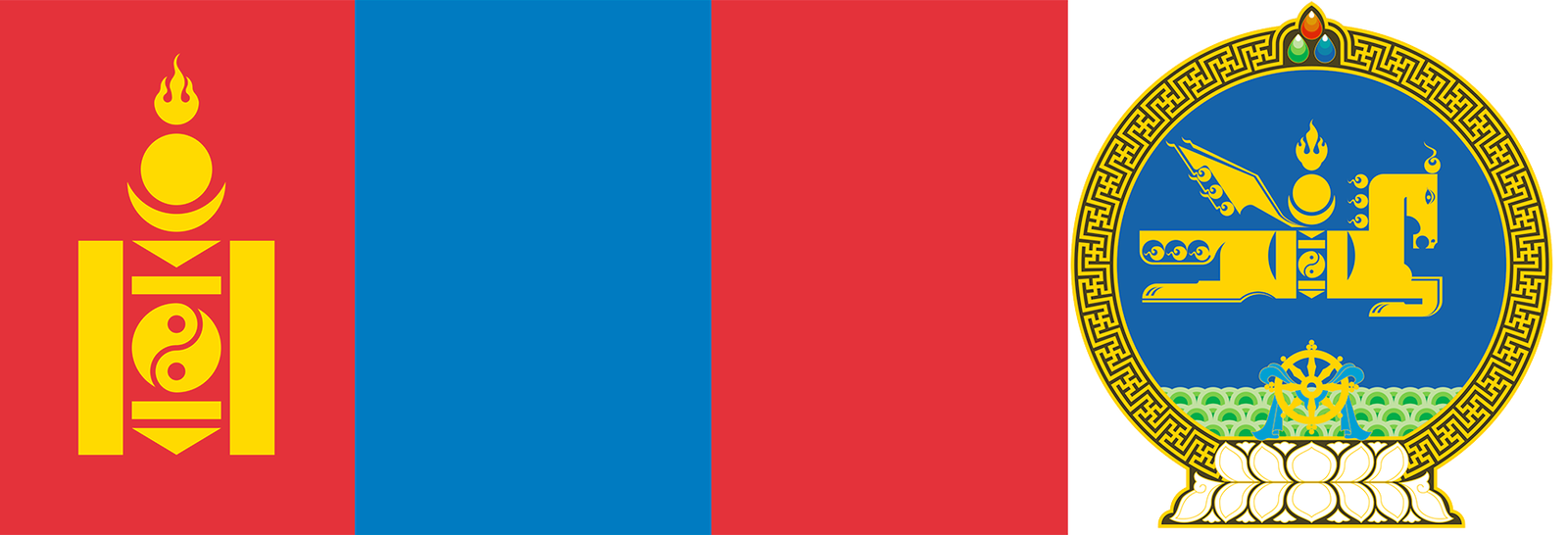 The flag of Mongolia (left) and the emblem of Mongolia (right).
Welcome to the summary page for FabulousFusionFood's Mongolian recipes, part of the Asian continent. This page provides links to all the Mongolian recipes presented on this site, with 10 recipes in total.
This is a continuation of an entire series of pages that will, I hope, allow my visitors to better navigate this site. As well as displaying recipes by name, country and region of origin I am now planning a whole series of pages where recipes can be located by meal type and main ingredient. This page gives a listing of all the Mongolian recipes added to this site.
These recipes, for the major part, originate in Mongolia. Otherwise they are fusion recipes with major Mongolian components.
Mongolia, s a landlocked country in East Asia, bordered by Russia to the north and China to the south and southeast. It covers an area of 1,564,116 square kilometres (603,909 square miles), with a population of 3.5 million, making it the world's most sparsely populated sovereign state. Mongolia is the world's largest landlocked country that does not border an inland sea, and much of its area is covered by grassy steppe, with mountains to the north and west and the Gobi Desert to the south. Ulaanbaatar, the capital and largest city, is home to roughly half of the country's population.
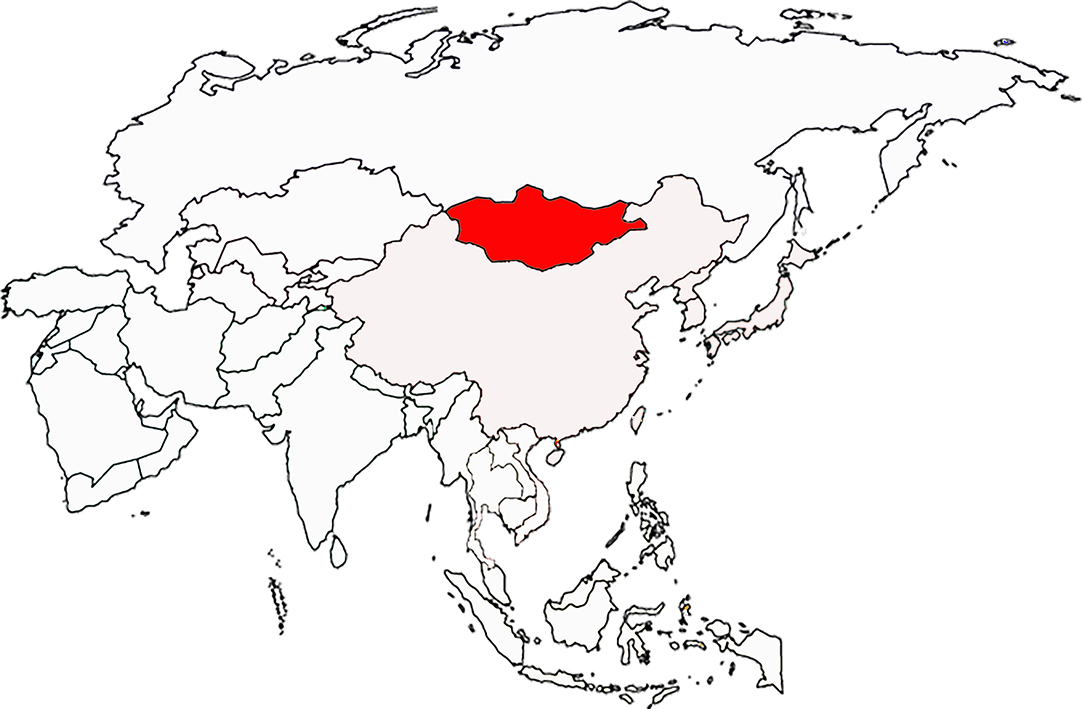 Location of Mongolia in Asia with Mongolia picked out in red.The territory of modern-day Mongolia has been ruled by various nomadic empires, including the Xiongnu, the Xianbei, the Rouran, the First Turkic Khaganate, the Second Turkic Khaganate, the Uyghur Khaganate and others. In 1206, Genghis Khan founded the Mongol Empire, which became the largest contiguous land empire in history. His grandson Kublai Khan conquered China proper and established the Yuan dynasty. After the collapse of the Yuan, the Mongols retreated to Mongolia and resumed their earlier pattern of factional conflict, except during the era of Dayan Khan and Tumen Zasagt Khan.
In the 16th century, Tibetan Buddhism spread to Mongolia, being further led by the Manchu-founded Qing dynasty, which absorbed the country in the 17th century. By the early 20th century, almost one-third of the adult male population were Buddhist monks. After the collapse of the Qing dynasty in 1911, Mongolia declared independence, and achieved actual independence from the Republic of China in 1921. Shortly thereafter, the country became a satellite state of the Soviet Union. In 1924, the Mongolian People's Republic was founded as a socialist state. After the anti-communist revolutions of 1989, Mongolia conducted its own peaceful democratic revolution in early 1990. This led to a multi-party system, a new constitution of 1992, and transition to a market economy.
Approximately 30% of the population is nomadic or semi-nomadic; horse culture remains integral. Buddhism is the majority religion (51.7%), with the nonreligious being the second-largest group (40.6%). Islam is the third-largest religious identification (3.2%), concentrated among ethnic Kazakhs. The vast majority of citizens are ethnic Mongols, with roughly 5% of the population being Kazakhs, Tuvans, and other ethnic minorities, who are especially concentrated in the western regions. Mongolia is a member of the United Nations, Asia Cooperation Dialogue, G77, Asian Infrastructure Investment Bank, Non-Aligned Movement and a NATO global partner. Mongolia joined the World Trade Organization in 1997 and seeks to expand its participation in regional economic and trade groups.
Etymology: The name Mongolia means the 'Land of the Mongols' in Latin. The Mongolian word 'Mongol' (монгол) is of uncertain etymology. Sükhbataar (1992) and de la Vaissière (2021) proposed it being a derivation from Mugulü, the 4th-century founder of the Rouran Khaganate, first attested as the 'Mungu', (Chinese: 蒙兀, Modern Chinese Měngwù, Middle Chinese Muwngu), a branch of the Shiwei in an 8th-century Tang dynasty list of northern tribes, presumably related to the Liao-era Mungku (Chinese: 蒙古, Modern Chinese Měnggǔ, Middle Chinese MuwngkuX).
After the fall of the Liao dynasty in 1125, the Khamag Mongols became a leading tribe on the Mongolian Plateau. However, their wars with the Jurchen-ruled Jin dynasty and the Tatar confederation had weakened them. The last head of the tribe was Yesügei, whose son Temüjin (Genghis Khan) eventually united all the Shiwei tribes as the Mongol Empire (Yekhe Monggol Ulus). In the thirteenth century, the word Mongol grew into an umbrella term for a large group of Mongolic-speaking tribes united under the rule of Genghis Khan.
Mongolia is one of few Asian countries where rice is not a main staple food. Instead, Mongolian people prefer to eat lamb as their staple food rather than rice. Wheat, barley, and buckwheat predominate more than rice in modern Mongolia.
The most common rural dish is cooked mutton, usually without any other ingredients, though potatoes and carrots are common accompaniments in more well-to-do families. To accompany the meat, vegetables and flour products may be used to create side dishes as well. In Ulaanbaatar, one can often see signs advertising buuz, steamed dumplings filled with meat. Other types of dumplings are boiled in water (bansh, manti), or deep-fried in mutton fat (khuushuur). Khuushuur is particularly popular during the Naadam festival, where a particular variety is made that is slightly different to common khuushuur. Other dishes combine the meat with rice or fresh noodles made into various stews (tsuivan, budaatai khuurga) or noodle soups (guriltai shöl). Sülen is a type of hot pot dish. Gambir (Mongolian: гамбир, pronounced [ɢæmʲbʲĭɾ]) is a flatbread that is commonly made from flour and ghee, served on its own or with sugar.
This is a continuation of an entire series of pages that will, I hope, allow my visitors to better navigate this site. As well as displaying recipes by name, country and region of origin I am now planning a whole series of pages where recipes can be located by meal type and main ingredient. This page gives a listing of all the Mongolian recipes added to this site.
These recipes, for the major part, originate in Mongolia. Otherwise they are fusion recipes with major Mongolian components.
Mongolia, s a landlocked country in East Asia, bordered by Russia to the north and China to the south and southeast. It covers an area of 1,564,116 square kilometres (603,909 square miles), with a population of 3.5 million, making it the world's most sparsely populated sovereign state. Mongolia is the world's largest landlocked country that does not border an inland sea, and much of its area is covered by grassy steppe, with mountains to the north and west and the Gobi Desert to the south. Ulaanbaatar, the capital and largest city, is home to roughly half of the country's population.
Location of Mongolia in Asia with Mongolia picked out in red.In the 16th century, Tibetan Buddhism spread to Mongolia, being further led by the Manchu-founded Qing dynasty, which absorbed the country in the 17th century. By the early 20th century, almost one-third of the adult male population were Buddhist monks. After the collapse of the Qing dynasty in 1911, Mongolia declared independence, and achieved actual independence from the Republic of China in 1921. Shortly thereafter, the country became a satellite state of the Soviet Union. In 1924, the Mongolian People's Republic was founded as a socialist state. After the anti-communist revolutions of 1989, Mongolia conducted its own peaceful democratic revolution in early 1990. This led to a multi-party system, a new constitution of 1992, and transition to a market economy.
Approximately 30% of the population is nomadic or semi-nomadic; horse culture remains integral. Buddhism is the majority religion (51.7%), with the nonreligious being the second-largest group (40.6%). Islam is the third-largest religious identification (3.2%), concentrated among ethnic Kazakhs. The vast majority of citizens are ethnic Mongols, with roughly 5% of the population being Kazakhs, Tuvans, and other ethnic minorities, who are especially concentrated in the western regions. Mongolia is a member of the United Nations, Asia Cooperation Dialogue, G77, Asian Infrastructure Investment Bank, Non-Aligned Movement and a NATO global partner. Mongolia joined the World Trade Organization in 1997 and seeks to expand its participation in regional economic and trade groups.
Etymology: The name Mongolia means the 'Land of the Mongols' in Latin. The Mongolian word 'Mongol' (монгол) is of uncertain etymology. Sükhbataar (1992) and de la Vaissière (2021) proposed it being a derivation from Mugulü, the 4th-century founder of the Rouran Khaganate, first attested as the 'Mungu', (Chinese: 蒙兀, Modern Chinese Měngwù, Middle Chinese Muwngu), a branch of the Shiwei in an 8th-century Tang dynasty list of northern tribes, presumably related to the Liao-era Mungku (Chinese: 蒙古, Modern Chinese Měnggǔ, Middle Chinese MuwngkuX).
After the fall of the Liao dynasty in 1125, the Khamag Mongols became a leading tribe on the Mongolian Plateau. However, their wars with the Jurchen-ruled Jin dynasty and the Tatar confederation had weakened them. The last head of the tribe was Yesügei, whose son Temüjin (Genghis Khan) eventually united all the Shiwei tribes as the Mongol Empire (Yekhe Monggol Ulus). In the thirteenth century, the word Mongol grew into an umbrella term for a large group of Mongolic-speaking tribes united under the rule of Genghis Khan.
Mongolian Cuisine:
Mongolian cuisine predominantly consists of dairy products, meat, and animal fats. The most common rural dish is cooked mutton. In the city, steamed dumplings filled with meat—'buuz'— are popular. The extreme continental climate of Mongolia and the lowest population density in the world of just 2.2 inhabitants/km2 has influenced the traditional diet. Use of vegetables and spices are limited. Due to geographic proximity and deep historic ties with China and Russia, Mongolian cuisine is also influenced by Chinese and Russian cuisine.Mongolia is one of few Asian countries where rice is not a main staple food. Instead, Mongolian people prefer to eat lamb as their staple food rather than rice. Wheat, barley, and buckwheat predominate more than rice in modern Mongolia.
The most common rural dish is cooked mutton, usually without any other ingredients, though potatoes and carrots are common accompaniments in more well-to-do families. To accompany the meat, vegetables and flour products may be used to create side dishes as well. In Ulaanbaatar, one can often see signs advertising buuz, steamed dumplings filled with meat. Other types of dumplings are boiled in water (bansh, manti), or deep-fried in mutton fat (khuushuur). Khuushuur is particularly popular during the Naadam festival, where a particular variety is made that is slightly different to common khuushuur. Other dishes combine the meat with rice or fresh noodles made into various stews (tsuivan, budaatai khuurga) or noodle soups (guriltai shöl). Sülen is a type of hot pot dish. Gambir (Mongolian: гамбир, pronounced [ɢæmʲbʲĭɾ]) is a flatbread that is commonly made from flour and ghee, served on its own or with sugar.
Mongolia's National Dishes:
Below are listed the dishes considered to be Mongolia's national foods along with links to the recipes for those dishes:| Buuz (Steamed Dumplings) Origin: Mongolia |
The alphabetical list of all Mongolian recipes on this site follows, (limited to 100 recipes per page). There are 10 recipes in total:
Page 1 of 1
| Buuz (Steamed Dumplings) Origin: Mongolia | Gambir (Mongolian Flatbreads) Origin: Mongolia | Muhammara (Fried Dumplings) Origin: Mongolia |
| Bantan (Flour Porridge and Meat Soup) Origin: Mongolia | Gambir (Sweet Flatbreads) Origin: Mongolia | Tasalsan Guril (Mongolian Fried Noodles) Origin: Mongolia |
| Budaatai Khuurga (Fried Rice, Meat and Vegetables) Origin: Mongolia | Guriltai Shul (Stewed Vegetables, Meat and Noodles) Origin: Mongolia | Tsuivan (Stewed Vegetables, Meat and Fresh Noodles) Origin: Mongolia |
| Buuz (Steamed Dumplings) Origin: Mongolia |
Page 1 of 1