FabulousFusionFood's Macanese Recipes Home Page
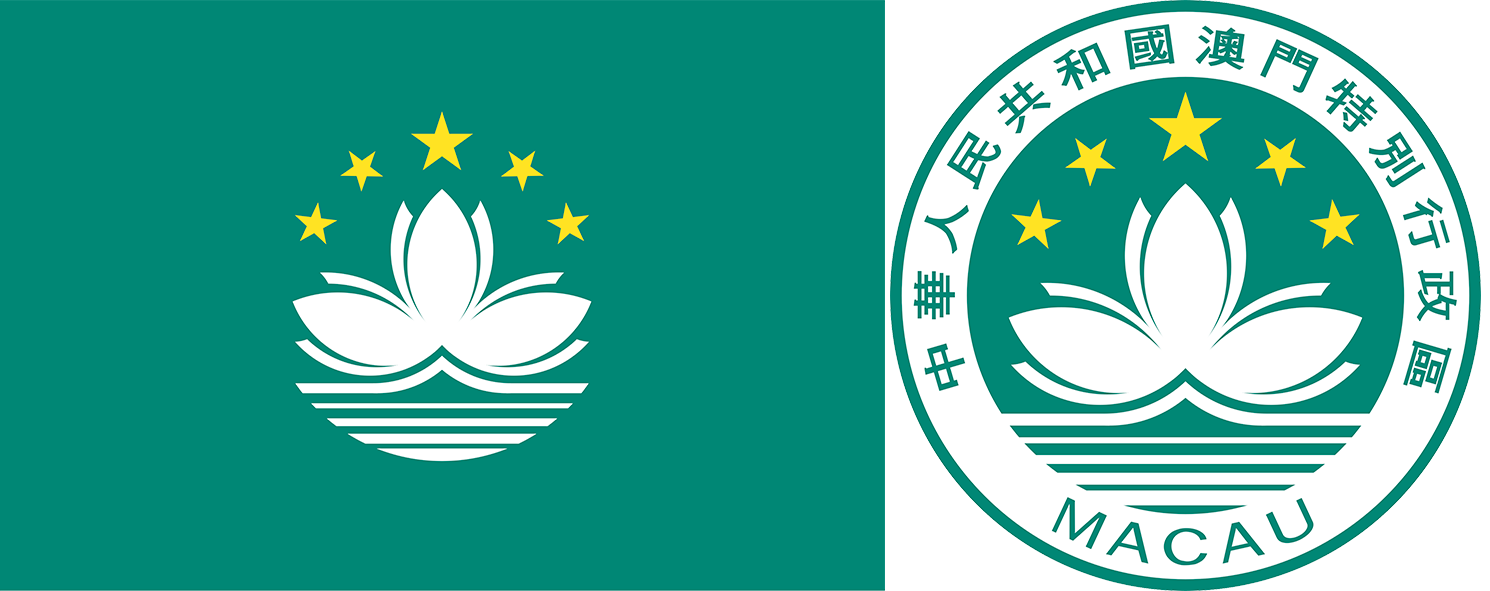 The flag of Macau (left) and the emblem of Macau (right).
Welcome to the summary page for FabulousFusionFood's Macanese recipes, part of Asia. This page provides links to all the Macanese recipes presented on this site, with 7 recipes in total.
This is a continuation of an entire series of pages that will, I hope, allow my visitors to better navigate this site. As well as displaying recipes by name, country and region of origin I am now planning a whole series of pages where recipes can be located by meal type and main ingredient. This page gives a listing of all the Macanese recipes added to this site.
Macau (澳門) is a special administrative region of China. Nossa Senhora de Fátima is the largest district. Chinese and Portuguese are the official languages. Food in Macau is mainly based on both Cantonese and Portuguese cuisine, drawing influences from Indian and Malay dishes as well, reflecting a unique cultural and culinary blend after centuries of colonial rule. Portuguese recipes were adapted to use local ingredients, such as fresh seafood, turmeric, coconut milk, and adzuki beans. These adaptations produced Macanese variations of traditional Portuguese dishes including caldo verde, minchee, and cozido à portuguesa. While many restaurants claim to serve traditional Portuguese or Macanese dishes, most serve a mix of Cantonese-Portuguese fusion cuisine. Galinha à portuguesa is an example of a Chinese dish that draws from Macanese influences, but is not part of Macanese cuisine. Cha chaan teng, a type of fast casual diner originating in Hong Kong that serves that region's interpretation of Western food, are also prevalent in Macau. Pastel de nata, pork chop buns, and almond biscuits are popular street food items
Macau, or Macao is a special administrative region of the People's Republic of China (PRC). With a population of about 710,000 people and a land area of 32.9 km2 (12.7 sq mi), it is the most densely populated region in the world.
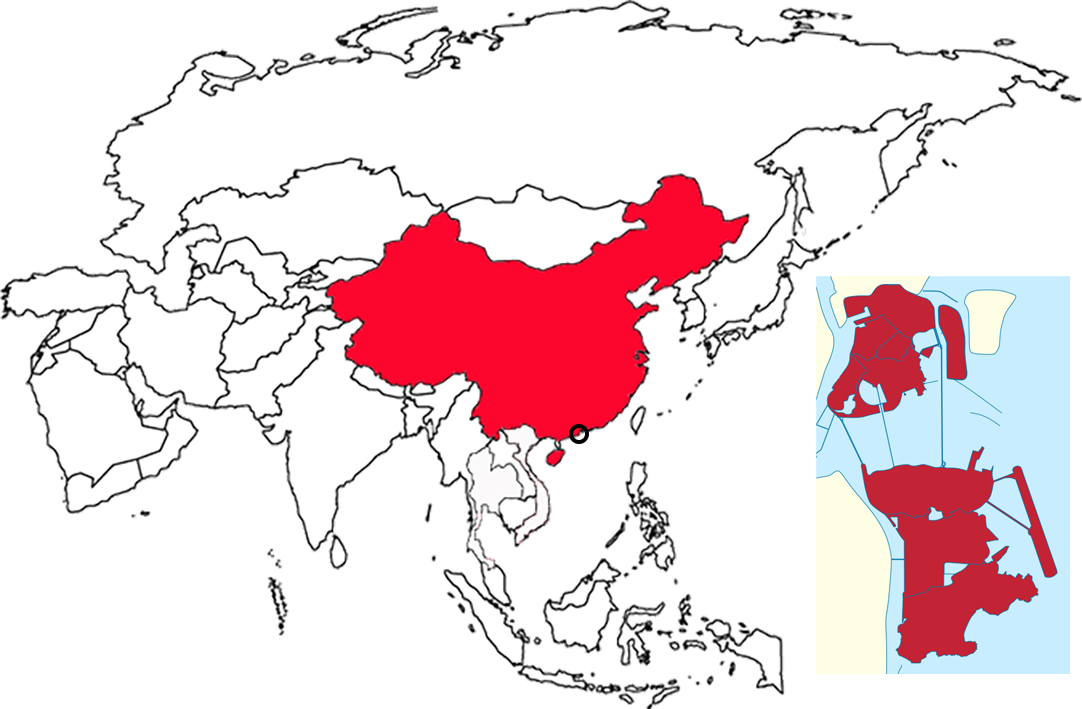 Location of Macau in relation to China in Asia with the exact
map of Macau shown, inset.Formerly a Portuguese colony, the territory of Portuguese Macau was first leased to Portugal by the Ming dynasty as a trading post in 1557. Portugal paid an annual rent and administered the territory under Chinese sovereignty until 1887, when Portugal gained perpetual colonial rights with the signing of the Sino-Portuguese Treaty of Peking. The colony remained under Portuguese rule until the 1999 handover to China. Macau is a special administrative region of China, which maintains separate governing and economic systems from those of mainland China under the principle of 'one country, two systems'. The unique blend of Portuguese and Chinese architecture in the city's historic centre has resulted in its designation as a UNESCO World Heritage Site in 2005.
The gambling industry of Macau is seven times larger than that of Las Vegas. The city has one of the highest GDPs per capita and GDPs per capita by purchasing power parity in the world
It has a very high Human Development Index of 0.934, as calculated by the Government of Macau, and has the third-highest life expectancy in the world. The territory is highly urbanised, holding the status of the most densely populated territory on Earth; two-thirds of the total land area is built on land reclaimed from the sea
Etymology: The first known written record of the name 'Macau', rendered as 'A Ma Gang' (亞/阿-媽/馬-港), is found in a letter dated 20 November 1555. The local inhabitants believed that the sea goddess Matsu (alternatively called A-Ma) had blessed and protected the harbour and referred to the waters around A-Ma Temple by her name. When Portuguese explorers first arrived in the area and asked for the place name, the locals thought they were asking about the temple and told them it was 'Ma Kok' (媽閣). The earliest Portuguese spelling for this was Amaquão. Multiple variations were used until Amacão / Amacao and Macão / Macao became common during the 17th century.
he 1911 reform of Portuguese orthography standardised the spelling as Macau; however, the use of Macao persisted in English and other European languages. The Macau Peninsula had many names in Chinese, including Jing'ao (井澳/鏡澳), Haojing (濠鏡), and Haojing'ao (濠鏡澳). The islands Taipa, Coloane, and Hengqin were collectively called Shizimen (十字門). These names would later become Oumún (澳門 'bay gate' or 'port gate', Mandarin Àomén), referring to the whole territory.
Food in Macau is mainly based on both Cantonese and Portuguese cuisine, drawing influences from Indian and Malay dishes as well, reflecting a unique cultural and culinary blend after centuries of colonial rule. Portuguese recipes were adapted to use local ingredients, such as fresh seafood, turmeric, coconut milk, and adzuki beans. These adaptations produced Macanese variations of traditional Portuguese dishes including caldo verde, minchee, and cozido à portuguesa. While many restaurants claim to serve traditional Portuguese or Macanese dishes, most serve a mix of Cantonese-Portuguese fusion cuisine. Galinha à portuguesa is an example of a Chinese dish that draws from Macanese influences, but is not part of Macanese cuisine. Cha chaan teng, a type of fast casual diner originating in Hong Kong that serves that region's interpretation of Western food, are also prevalent in Macau. Pastel de nata, pork chop buns, and almond biscuits are popular street food items.
Minchi, egg tarts, pork chop buns, ginger milk and almond cakes are some of the region's most common delicacies. Common cooking methods make use of various spices such as turmeric, coconut milk, and cinnamon to give dishes an extra kick of aroma and enhancement of taste. Many routinely consumed dishes in Macau belong to a subclass (Heungshan) of Cantonese cuisine. Many Macanese dishes resulted from the spice blends that the wives of Portuguese sailors used in an attempt to replicate European dishes with local Chinese ingredients and seasonings.
Typically, Macanese food is seasoned with various spices including turmeric, coconut milk, and cinnamon, and dried cod (bacalhau), giving special aromas and tastes. Popular dishes include galinha à Portuguesa, galinha à Africana (African chicken), bacalhau (traditional Portuguese salt cod), pato de cabidela, Macanese chili shrimps, minchi, stir-fried curry crab; pig's ear and papaya salad, and rabbit stewed in wine, cinnamon and star anise.
This is a continuation of an entire series of pages that will, I hope, allow my visitors to better navigate this site. As well as displaying recipes by name, country and region of origin I am now planning a whole series of pages where recipes can be located by meal type and main ingredient. This page gives a listing of all the Macanese recipes added to this site.
Macau (澳門) is a special administrative region of China. Nossa Senhora de Fátima is the largest district. Chinese and Portuguese are the official languages. Food in Macau is mainly based on both Cantonese and Portuguese cuisine, drawing influences from Indian and Malay dishes as well, reflecting a unique cultural and culinary blend after centuries of colonial rule. Portuguese recipes were adapted to use local ingredients, such as fresh seafood, turmeric, coconut milk, and adzuki beans. These adaptations produced Macanese variations of traditional Portuguese dishes including caldo verde, minchee, and cozido à portuguesa. While many restaurants claim to serve traditional Portuguese or Macanese dishes, most serve a mix of Cantonese-Portuguese fusion cuisine. Galinha à portuguesa is an example of a Chinese dish that draws from Macanese influences, but is not part of Macanese cuisine. Cha chaan teng, a type of fast casual diner originating in Hong Kong that serves that region's interpretation of Western food, are also prevalent in Macau. Pastel de nata, pork chop buns, and almond biscuits are popular street food items
Macau, or Macao is a special administrative region of the People's Republic of China (PRC). With a population of about 710,000 people and a land area of 32.9 km2 (12.7 sq mi), it is the most densely populated region in the world.
Location of Macau in relation to China in Asia with the exactmap of Macau shown, inset.
The gambling industry of Macau is seven times larger than that of Las Vegas. The city has one of the highest GDPs per capita and GDPs per capita by purchasing power parity in the world
It has a very high Human Development Index of 0.934, as calculated by the Government of Macau, and has the third-highest life expectancy in the world. The territory is highly urbanised, holding the status of the most densely populated territory on Earth; two-thirds of the total land area is built on land reclaimed from the sea
Etymology: The first known written record of the name 'Macau', rendered as 'A Ma Gang' (亞/阿-媽/馬-港), is found in a letter dated 20 November 1555. The local inhabitants believed that the sea goddess Matsu (alternatively called A-Ma) had blessed and protected the harbour and referred to the waters around A-Ma Temple by her name. When Portuguese explorers first arrived in the area and asked for the place name, the locals thought they were asking about the temple and told them it was 'Ma Kok' (媽閣). The earliest Portuguese spelling for this was Amaquão. Multiple variations were used until Amacão / Amacao and Macão / Macao became common during the 17th century.
he 1911 reform of Portuguese orthography standardised the spelling as Macau; however, the use of Macao persisted in English and other European languages. The Macau Peninsula had many names in Chinese, including Jing'ao (井澳/鏡澳), Haojing (濠鏡), and Haojing'ao (濠鏡澳). The islands Taipa, Coloane, and Hengqin were collectively called Shizimen (十字門). These names would later become Oumún (澳門 'bay gate' or 'port gate', Mandarin Àomén), referring to the whole territory.
Macanese Cuisine:
Macanese cuisine (Chinese: 澳門土生葡菜, Portuguese: culinária macaense) is mainly influenced by Chinese cuisine, especially Cantonese cuisine, and European cuisine, predominantly Portuguese cuisine, and influences from Southeast Asia and the Lusophone world, due to Macau's past as a Portuguese colony and long history of being an international tourist gambling centre.Food in Macau is mainly based on both Cantonese and Portuguese cuisine, drawing influences from Indian and Malay dishes as well, reflecting a unique cultural and culinary blend after centuries of colonial rule. Portuguese recipes were adapted to use local ingredients, such as fresh seafood, turmeric, coconut milk, and adzuki beans. These adaptations produced Macanese variations of traditional Portuguese dishes including caldo verde, minchee, and cozido à portuguesa. While many restaurants claim to serve traditional Portuguese or Macanese dishes, most serve a mix of Cantonese-Portuguese fusion cuisine. Galinha à portuguesa is an example of a Chinese dish that draws from Macanese influences, but is not part of Macanese cuisine. Cha chaan teng, a type of fast casual diner originating in Hong Kong that serves that region's interpretation of Western food, are also prevalent in Macau. Pastel de nata, pork chop buns, and almond biscuits are popular street food items.
Minchi, egg tarts, pork chop buns, ginger milk and almond cakes are some of the region's most common delicacies. Common cooking methods make use of various spices such as turmeric, coconut milk, and cinnamon to give dishes an extra kick of aroma and enhancement of taste. Many routinely consumed dishes in Macau belong to a subclass (Heungshan) of Cantonese cuisine. Many Macanese dishes resulted from the spice blends that the wives of Portuguese sailors used in an attempt to replicate European dishes with local Chinese ingredients and seasonings.
Typically, Macanese food is seasoned with various spices including turmeric, coconut milk, and cinnamon, and dried cod (bacalhau), giving special aromas and tastes. Popular dishes include galinha à Portuguesa, galinha à Africana (African chicken), bacalhau (traditional Portuguese salt cod), pato de cabidela, Macanese chili shrimps, minchi, stir-fried curry crab; pig's ear and papaya salad, and rabbit stewed in wine, cinnamon and star anise.
Macau's National Dishes:
Below are listed the dishes considered to be Macau's national foods along with links to the recipes for those dishes:| Macanese Minchi (Minced Meat Potato Hash) Origin: Macau |
The alphabetical list of all Macanese recipes on this site follows, (limited to 100 recipes per page). There are 7 recipes in total:
Page 1 of 1
| Macanese Minchi (Minced Meat Potato Hash) Origin: Macau | Galinha à Portuguesa (Macanese Portuguese Chicken) Origin: Macau | Macanese-style Portuguese Curry Chicken Origin: Macau |
| African Chicken (Macanese One-pan Chicken Curry) Origin: Macau | Macanese Choy Sum Origin: Macau | Macau Po Egg Tart (Pastéis de nata) Origin: Macau |
| Coconut Biscuits Origin: Macau | Macanese Minchi (Minced Meat Potato Hash) Origin: Macau |
Page 1 of 1