FabulousFusionFood's Saudi Arabian Recipes Home Page
 The flag of Saudi Arabia (left) and the emblem of Saudi Arabia (right).
Welcome to the summary page for FabulousFusionFood's Saudi Arabian recipes, part Asia. This page provides links to all the Saudi Arabian recipes presented on this site, with 23 recipes in total.
This is a continuation of an entire series of pages that will, I hope, allow my visitors to better navigate this site. As well as displaying recipes by name, country and region of origin I am now planning a whole series of pages where recipes can be located by meal type and main ingredient. This page gives a listing of all the Saudi Arabian recipes added to this site.
Saudi Arabia (المملكة العربية السعودية (al-Mamlaka al-ʿArabiyya as-Suʿūdiyya in Arabic), is a country in West Asia. Located in the centre of the Middle East, it covers the bulk of the Arabian Peninsula. The capital and largest city is Riyadh; other major cities include Jeddah and the two holiest cities in Islam, Mecca and Medina.
Saudi Arabian cuisine is similar to that of the surrounding countries in the Arabian Peninsula and the wider Arab world, and has influenced and been influenced by Turkish, Indian, Persian, and African food. Islamic dietary laws are enforced: pork is not allowed, and other animals are slaughtered in accordance with halal. Kebabs and falafel are popular, as is shawarma, a marinated grilled meat dish of lamb, mutton, or chicken. Kabsa, a rice dish with lamb, chicken, fish, or shrimp, is among the national dishes as is mandi. Saudi Arabia officially the Kingdom of Saudi Arabia (KSA), is a country in West Asia. Located in the centre of the Middle East, it covers the bulk of the Arabian Peninsula and has a land area of about 2,150,000 km2 (830,000 sq mi), making it the fifth-largest country in Asia, the largest in the Middle East, and the twelfth-largest in the world. It is bordered by the Red Sea to the west; Jordan, Iraq, and Kuwait to the north; the Persian Gulf, Bahrain, Qatar and the United Arab Emirates to the east; Oman to the southeast; and Yemen to the south. The Gulf of Aqaba in the northwest separates Saudi Arabia from Egypt and Israel. Saudi Arabia is the only country with a coastline along both the Red Sea and the Persian Gulf, and most of its terrain consists of arid desert, lowland, steppe, and mountains. The capital and largest city is Riyadh; other major cities include Jeddah and the two holiest cities in Islam, Mecca and Medina. With a population of almost 32.2 million, Saudi Arabia is the fourth most populous country in the Arab world
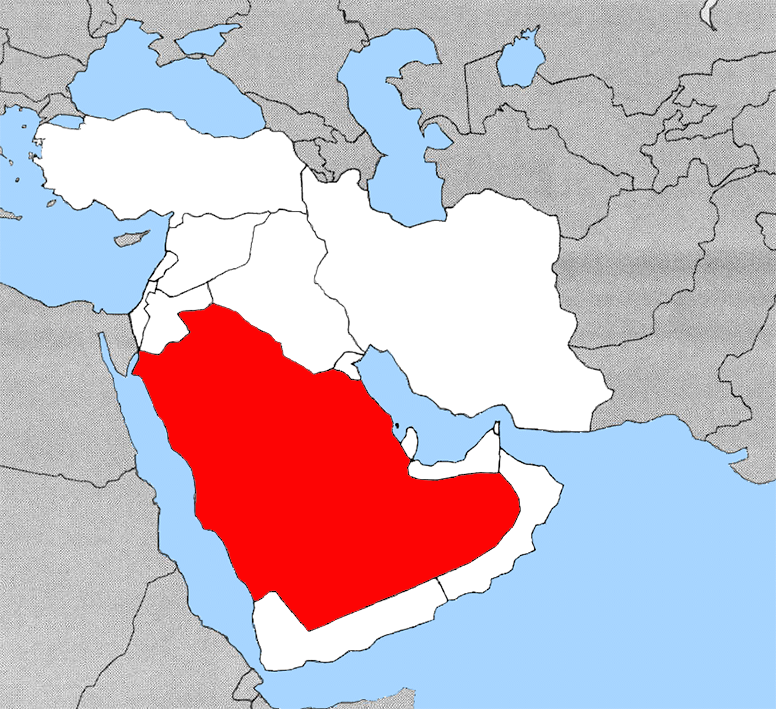 Location of Saaudi Arabia in West Asia with the land mass of Saudi Arabia
picked out in red.Pre-Islamic Arabia, the territory that constitutes modern-day Saudi Arabia, was the site of several ancient cultures and civilizations; the prehistory of Saudi Arabia shows some of the earliest traces of human activity outside Africa. Islam, the world's second-largest religion, emerged in what is now Saudi Arabia in the early seventh century. Islamic prophet Muhammad united the population of the Arabian Peninsula and created a single Islamic religious polity. Following his death in 632, his followers expanded Muslim rule beyond Arabia, conquering territories in North Africa, Central, South Asia and Iberia within decades. Arab dynasties originating from modern-day Saudi Arabia founded the Rashidun (632–661), Umayyad (661–750), Abbasid (750–1517), and Fatimid (909–1171) caliphates, as well as numerous other Muslim states in Asia, Africa, and Europe.
Saudi Arabia was founded in 1932 by King Abdulaziz (also known as Ibn Saud), who united the regions of Hejaz, Najd, parts of Eastern Arabia (Al-Ahsa) and South Arabia (Aseer) into a single state through a series of conquests, beginning in 1902 with the capture of Riyadh. Saudi Arabia has since been an absolute monarchy governed by an authoritarian regime without public input. In its Basic Law, Saudi Arabia defines itself as a sovereign Arab Islamic state with Islam as its official religion and Arabic as its official language. The ultraconservative Wahhabi religious movement within Sunni Islam was the prevailing political and cultural force in the country until the 2000s. The Saudi government has attracted criticism for various policies such as its intervention in the Yemeni Civil War and widespread use of capital punishment. In 2024, the Human Freedom Index compiled by the Cato Institute ranked Saudi Arabia 155 out of 165 countries.
Saudi Arabia is considered both a regional and middle power. Since petroleum was discovered in the country in 1938, the kingdom has become the world's second-largest oil producer and leading oil exporter, controlling the world's second-largest oil reserves and sixth-largest gas reserves. Saudi Arabia is categorized as a World Bank high-income economy and is the only Arab country among the G20 major economies. The Saudi economy is the largest in the Middle East and the world's nineteenth-largest by nominal GDP and seventeenth-largest by PPP. Ranking very high in the Human Development Index, Saudi Arabia offers free university tuition, no personal income tax, and free universal health care. With its dependence on foreign labour, Saudi Arabia has the world's third-largest immigrant population, with foreign-born residents comprising roughly 40% of the population. Saudi Arabians are among the world's youngest people, with approximately half being under 25 years old. Saudi Arabia is a member of the Gulf Cooperation Council, United Nations, Organisation of Islamic Cooperation, Arab League, and OPEC, as well as a dialogue partner of the Shanghai Cooperation Organisation.
Etymology: Following the amalgamation of the Kingdom of Hejaz and Nejd, Abdulaziz issued a royal decree on 23 September 1932 naming the new state al-Mamlaka al-ʿArabiyya as-Suʿūdiyya (Arabic المملكة العربية السعودية), which is normally translated as 'the Kingdom of Saudi Arabia' in English, but literally means 'the Saudi Arab Kingdom', or 'the Saudi Kingdom of Arabia' (compare with the Hashemite Kingdom of Jordan).
The word 'Saudi' is derived from the element as-Suʿūdīyya in the Arabic name of the country, which is a type of adjective known as a nisba, formed from the dynastic name of the Saudi royal family, the Al Saud (Arabic: آل سعود). Its inclusion expresses the view that the country is the personal possession of the royal family. Al Saud is an Arabic name formed by adding the word Al, meaning 'family of' or 'House of', to the personal name of an ancestor. In the case of Al Saud, this is Saud ibn Muhammad ibn Muqrin, the father of the dynasty's 18th-century founder, Muhammad bin Saud
Cooking in Saudi Arabia is influenced by the native Arab and the Islamic culture. Dates, for example, are associated with the tradition of breaking the fast after Ramadan. Most food ingredients, such as wheat, dates, ghee, meat, fish and vegetables, are sourced locally. Through these ingredients, dozens of delicious dishes have been created, which are closely linked to Saudi Arabian customs and traditions. These dishes are typically enjoyed during festive seasons, Hajj, special occasions, weddings, and the arrival of a newborn. Serving these dishes to guests is a way of expressing generosity and the renowned hospitality of the people of Saudi Arabia. Some of these traditions continue to be practiced to this day.
This is a continuation of an entire series of pages that will, I hope, allow my visitors to better navigate this site. As well as displaying recipes by name, country and region of origin I am now planning a whole series of pages where recipes can be located by meal type and main ingredient. This page gives a listing of all the Saudi Arabian recipes added to this site.
Saudi Arabia (المملكة العربية السعودية (al-Mamlaka al-ʿArabiyya as-Suʿūdiyya in Arabic), is a country in West Asia. Located in the centre of the Middle East, it covers the bulk of the Arabian Peninsula. The capital and largest city is Riyadh; other major cities include Jeddah and the two holiest cities in Islam, Mecca and Medina.
Saudi Arabian cuisine is similar to that of the surrounding countries in the Arabian Peninsula and the wider Arab world, and has influenced and been influenced by Turkish, Indian, Persian, and African food. Islamic dietary laws are enforced: pork is not allowed, and other animals are slaughtered in accordance with halal. Kebabs and falafel are popular, as is shawarma, a marinated grilled meat dish of lamb, mutton, or chicken. Kabsa, a rice dish with lamb, chicken, fish, or shrimp, is among the national dishes as is mandi. Saudi Arabia officially the Kingdom of Saudi Arabia (KSA), is a country in West Asia. Located in the centre of the Middle East, it covers the bulk of the Arabian Peninsula and has a land area of about 2,150,000 km2 (830,000 sq mi), making it the fifth-largest country in Asia, the largest in the Middle East, and the twelfth-largest in the world. It is bordered by the Red Sea to the west; Jordan, Iraq, and Kuwait to the north; the Persian Gulf, Bahrain, Qatar and the United Arab Emirates to the east; Oman to the southeast; and Yemen to the south. The Gulf of Aqaba in the northwest separates Saudi Arabia from Egypt and Israel. Saudi Arabia is the only country with a coastline along both the Red Sea and the Persian Gulf, and most of its terrain consists of arid desert, lowland, steppe, and mountains. The capital and largest city is Riyadh; other major cities include Jeddah and the two holiest cities in Islam, Mecca and Medina. With a population of almost 32.2 million, Saudi Arabia is the fourth most populous country in the Arab world
Location of Saaudi Arabia in West Asia with the land mass of Saudi Arabiapicked out in red.
Saudi Arabia was founded in 1932 by King Abdulaziz (also known as Ibn Saud), who united the regions of Hejaz, Najd, parts of Eastern Arabia (Al-Ahsa) and South Arabia (Aseer) into a single state through a series of conquests, beginning in 1902 with the capture of Riyadh. Saudi Arabia has since been an absolute monarchy governed by an authoritarian regime without public input. In its Basic Law, Saudi Arabia defines itself as a sovereign Arab Islamic state with Islam as its official religion and Arabic as its official language. The ultraconservative Wahhabi religious movement within Sunni Islam was the prevailing political and cultural force in the country until the 2000s. The Saudi government has attracted criticism for various policies such as its intervention in the Yemeni Civil War and widespread use of capital punishment. In 2024, the Human Freedom Index compiled by the Cato Institute ranked Saudi Arabia 155 out of 165 countries.
Saudi Arabia is considered both a regional and middle power. Since petroleum was discovered in the country in 1938, the kingdom has become the world's second-largest oil producer and leading oil exporter, controlling the world's second-largest oil reserves and sixth-largest gas reserves. Saudi Arabia is categorized as a World Bank high-income economy and is the only Arab country among the G20 major economies. The Saudi economy is the largest in the Middle East and the world's nineteenth-largest by nominal GDP and seventeenth-largest by PPP. Ranking very high in the Human Development Index, Saudi Arabia offers free university tuition, no personal income tax, and free universal health care. With its dependence on foreign labour, Saudi Arabia has the world's third-largest immigrant population, with foreign-born residents comprising roughly 40% of the population. Saudi Arabians are among the world's youngest people, with approximately half being under 25 years old. Saudi Arabia is a member of the Gulf Cooperation Council, United Nations, Organisation of Islamic Cooperation, Arab League, and OPEC, as well as a dialogue partner of the Shanghai Cooperation Organisation.
Etymology: Following the amalgamation of the Kingdom of Hejaz and Nejd, Abdulaziz issued a royal decree on 23 September 1932 naming the new state al-Mamlaka al-ʿArabiyya as-Suʿūdiyya (Arabic المملكة العربية السعودية), which is normally translated as 'the Kingdom of Saudi Arabia' in English, but literally means 'the Saudi Arab Kingdom', or 'the Saudi Kingdom of Arabia' (compare with the Hashemite Kingdom of Jordan).
The word 'Saudi' is derived from the element as-Suʿūdīyya in the Arabic name of the country, which is a type of adjective known as a nisba, formed from the dynastic name of the Saudi royal family, the Al Saud (Arabic: آل سعود). Its inclusion expresses the view that the country is the personal possession of the royal family. Al Saud is an Arabic name formed by adding the word Al, meaning 'family of' or 'House of', to the personal name of an ancestor. In the case of Al Saud, this is Saud ibn Muhammad ibn Muqrin, the father of the dynasty's 18th-century founder, Muhammad bin Saud
Saudi Arabian Cuisine:
Saudi Arabian cuisine (Arabic: المطبخ العربي السعودي) is the cooking styles and dishes of Saudi Arabia. Varying throughout the diverse landscapes and regions of the country, the environmental, geographic, and cultural differences have led to a wide variety of dishes. Saudi Arabia encompasses different regions, resulting in cuisines from the Central region, Eastern, Southern and Western regions. Furthermore, Saudi Arabia's position along global trade routes has led to the introduction of various spices.Cooking in Saudi Arabia is influenced by the native Arab and the Islamic culture. Dates, for example, are associated with the tradition of breaking the fast after Ramadan. Most food ingredients, such as wheat, dates, ghee, meat, fish and vegetables, are sourced locally. Through these ingredients, dozens of delicious dishes have been created, which are closely linked to Saudi Arabian customs and traditions. These dishes are typically enjoyed during festive seasons, Hajj, special occasions, weddings, and the arrival of a newborn. Serving these dishes to guests is a way of expressing generosity and the renowned hospitality of the people of Saudi Arabia. Some of these traditions continue to be practiced to this day.
Saudi Arabia's National Dishes:
Below are listed the dishes considered to be Saudi Arabia's national foods along with links to the recipes for those dishes:| Chicken Kabsa Origin: Saudi Arabia | Maqshush (Yeasted Mini Buns in Syrup) Origin: Saudi Arabia | Saudi Arabian Jareesh Origin: Saudi Arabia |
The alphabetical list of all the Saudi Arabian recipes on this site follows, (limited to 100 recipes per page). There are 23 recipes in total:
Page 1 of 1
| Chicken Kabsa Origin: Saudi Arabia | Chebeh Rubyan (Prawn Balls) Origin: Saudi Arabia | Ma'amool Bil Tamer (Date Cakes) Origin: Saudi Arabia |
| Maqshush (Yeasted Mini Buns in Syrup) Origin: Saudi Arabia | Chicken Kabsa Origin: Saudi Arabia | Maqshush (Yeasted Mini Buns in Syrup) Origin: Saudi Arabia |
| Saudi Arabian Jareesh Origin: Saudi Arabia | Dajaj bil Hamod (Lemon Chicken) Origin: Saudi Arabia | Salat Bzainjan Eswed bel-Filfil (Aubergine and Chilli Salad) Origin: Saudi Arabia |
| Aijet Beythat (Spiced Eggs) Origin: Saudi Arabia | Dukkous (Saudi Tomato Sauce) Origin: Saudi Arabia | Salata Ducos (Green Coriander Salad) Origin: Saudi Arabia |
| Aish bel-Lahm (Bread with Lamb) Origin: Saudi Arabia | Fasooleyah Khodra bi Zeit (Saudi Green Bean Salad) Origin: Saudi Arabia | Salata Hara Origin: Saudi Arabia |
| Al Rangina (Dates in Butter Sauce) Origin: Saudi Arabia | Kabsa Seasoning Origin: Saudi Arabia | Saudi Arabian Jareesh Origin: Saudi Arabia |
| Al-Motubug (Stuffed Pastry Squares) Origin: Saudi Arabia | Laban (Yoghurt Drink) Origin: Saudi Arabia | Saudi Baharat Origin: Saudi Arabia |
| Bayth Mashi (Stuffed Eggs) Origin: Saudi Arabia | Loomi (Black Limes) Origin: Saudi Arabia |
Page 1 of 1