FabulousFusionFood's Fish, Crustacean, Cephalopod and Shellfish based Recipes 15th Page
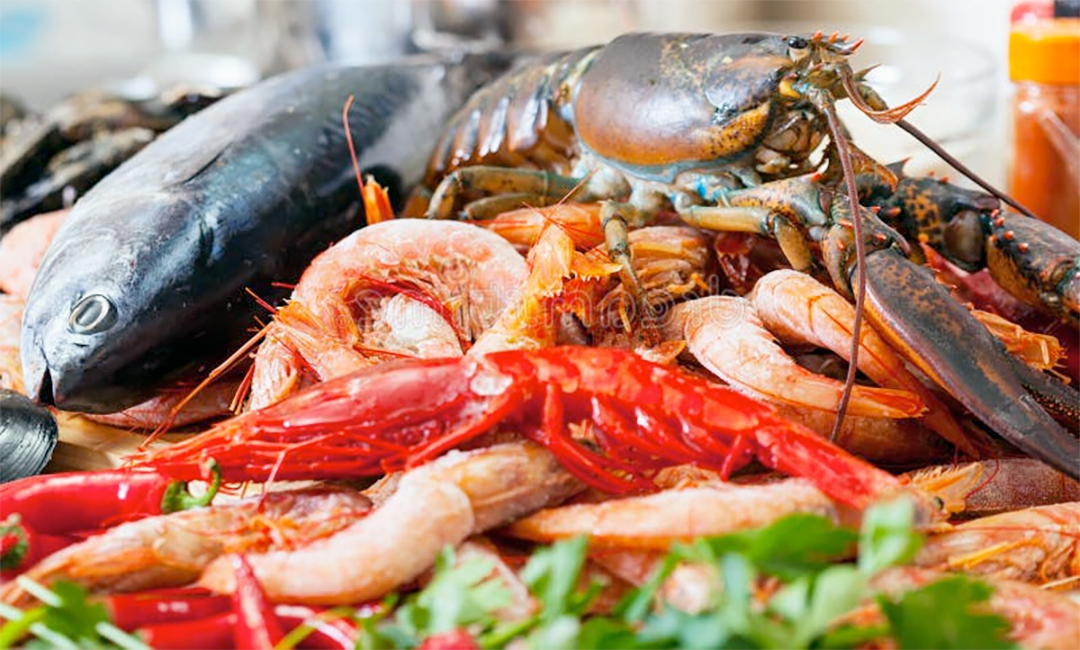 Still Life Photograph of mixed Fish and Seafood.
Welcome to FabulousFusionFood's Fish, Crustacean and Shellfish based Recipes Page — The recipes presented here are all based on aquatic animals: Fish (both sea-water and freshwater), crustaceans (crabs, lobsters, langoustine, crayfish and prawns) and shellfish of all kinds. These are still animals, and their flesh counts as 'meat', though I have removed these animals from the main Meat Recipes page.
Typically, a fish is defined as an aquatic, anamniotic, gill-bearing vertebrate animal with swimming fins and a hard skull, but lacking limbs with digits. Fish can be grouped into the more basal jawless fish and the more common jawed fish, the latter including all living cartilaginous and bony fish, as well as the extinct placoderms and acanthodians. In a break to the long tradition of grouping all fish into a single class (Pisces), modern phylogenetics views fish as a paraphyletic group. Here you will find historic recipes for jawless fishes as well as recipes for cartilaginous and bony jawed fish. For the separate list of fish-based recipes see the fish-based recipes page
For my definition of shellfish I'm including molluscs (ie shelled marine animals) as well as sea snails (that are actually gastropods) but I'm excluding crustaceans (eg prawns, lobsters, crayfish, crabs and barnacles) and cephalopod molluscs (squids, octopodes, cuttlefish) which have their own sections and are described below. Mollusca is a phylum of protostomic invertebrate animals, whose members are known as molluscs or mollusks. Molluscs are the largest marine phylum, comprising about 23% of all the named marine organisms. They are highly diverse, not just in size and anatomical structure, but also in behaviour and habitat, as numerous groups are freshwater and even terrestrial species. For the separate list of shellfish-based recipes see the shellfish-based recipes page.
Crustaceans (from Latin meaning: "those with shells" or "crusted ones") are invertebrate animals that constitute one group of arthropods that are traditionally a part of the subphylum Crustacea (/krəˈsteɪʃə/), a large, diverse group of mainly aquatic arthropods including decapods (shrimps, prawns, crabs, lobsters and crayfish), seed shrimp, branchiopods, fish lice, krill, remipedes, isopods, barnacles, copepods, opossum shrimps, amphipods and mantis shrimp. The vast majority of crustaceans consumed by humans are decapod crustaceans: crabs, lobsters, shrimp, crayfish, langoustine and prawns. Krill and barnacles are the only non-decapod crustaceans eaten regularly. For the separate list of crustacean-based recipes see the crustacean-based recipes page.
Cephalopods are members of the molluscan class Cephalopoda /sɛfəˈlɒpədə/ (Greek plural κεφαλόποδες, kephalópodes; "head-feet") such as a squid, octopus, cuttlefish, or nautilus. These exclusively marine animals are characterized by bilateral body symmetry, a prominent head, and a set of arms or tentacles (muscular hydrostats) modified from the primitive molluscan foot. Fishers sometimes call cephalopods "inkfish", referring to their common ability to squirt ink. They are all regularly consumed by humans, particularly squid and octopodes. For the separate list of caphalopod-based recipes see the cephalopod-based recipes page.
Here I'm using a broader definition of seafood to also include items such as sea anemones (that the Romans ate) as well as sea cucumbers (a common ingredient in sushi) and sea urchins (consumed by ancient Romans and Japanese). Essentially covering the range of aquatic animals consumed by humans.
As this site also includes historic recipes, there will be some unusual fish and shellfish in the lists (like weaver fish from ancient Roman cookery) as well as forms of cookery (like clay baking) that are not so commonly used any more. You will see many Ancient Roman recipes in the list, this is due to the Romans' extensive use of liquamen/garum (fish sauce) in their recipes which was typically fermented from marine fish. There are also many Mediaeval recipes presented, coming from when the Catholic church proscribed the eating of meat and there were more 'fish days' in the yearly calendar than there were days where meat could be eaten. This also explains the separation of aquatic animals from terrestrial animals, the former being classed as 'fish' and the latter as 'meat'.
The alphabetical list of all the fish-, crustacean- and shellfish-based recipes on this site follows, (limited to 100 recipes per page). There are 2561 recipes in total:
Page 15 of 26
| Maboké de Capitaine (Maboke of Nile Perch) Origin: Central African Republic | Málàjiàng (Mala Hotpot Paste) Origin: China | Masghouf (Iraqi Grilled Fish) Origin: Iraq |
| Maboke (Steamed Nile Perch) Origin: Central African Republic | Malay Chicken Curry with White Pumpkin Origin: Anglo-Indian | Masor Tenga (Assamese Red Fish Curry) Origin: India |
| Mach Bhaja (Bangladeshi Fish Fry) Origin: Bangladesh | Malaysian Chicken Curry Origin: Malaysia | Massalé de Dorade Origin: Reunion |
| Machali aur Daal (Fish and Lentil Curry) Origin: India | Malaysian Chicken Curry Origin: Cocos Islands | Massaman Curry Paste Origin: Thailand |
| Macher Jhol (Keralan Fish Curry) Origin: India | Malaysian Chicken Curry Origin: Christmas Island | Massaman Nuea (Beef Masaman Curry) Origin: Thailand |
| Macher Jhol (Bengali Carp Curry) Origin: India | Malaysian Goat Rendang Origin: Malaysia | Massaman Nuea (Beef Massaman Curry) Origin: Thailand |
| Machli aur Tamatar (Curried Halibut with Tomatoes) Origin: India | Malaysian Kapitan Chicken Origin: Malaysia | Mataba au Poisson (Mataba with Fish) Origin: Comoros |
| Machli ka Salna (Fish Steak Curry) Origin: India | Malaysian Laksa Origin: Malaysia | Matapa Origin: Mozambique |
| Mackerel and Samphire Stew Origin: Britain | Malaysian Lamb Rendang Origin: Malaysia | Matapa de Abóbora (Pumpkin Matapa) Origin: Mozambique |
| Mackerel and Seaweed Pâté Origin: Britain | Malaysian Murtabak (Mamak Omelette Pancake) Origin: Malaysia | Matata (Clam and Peanut Stew) Origin: Mozambique |
| Mackerel and Tamarind Noodle Soup Origin: Fusion | Mallow Leaf Gumbo Origin: Britain | Matata (Clam, Pumpkin and Peanut Stew) Origin: Sao Tome |
| Mackerel Burger with Sweet Potato Chips Origin: Fusion | Mallow-leaf Stew Origin: African Fusion | Matata (Clams Cooked in Port Wine) Origin: Sao Tome |
| Mackerel in Breadfruit Gravy Origin: Liberia | Malu Abulthiyal (Fish Curry with Fragrant Masala) Origin: Sri Lanka | Matsavo (Pumpkin Leaf and Peanut Flour Stew) Origin: Mozambique |
| Mackerel Pasty Origin: England | Malvani Fish Curry Origin: India | Mauritanian Thieboudienne Origin: Mauritius |
| Mackerel Run Down Origin: Jamaica | Malvas (Mallow Leaves) Origin: Roman | Mauritian Prawn Curry Origin: Mauritius |
| Mackerel Stuffed with Samphire and Seasoned with Alexanders and Wild Fennel Seeds Origin: Britain | Mandarin Prawns Origin: Fusion | Mayotte Mataba Origin: Mayotte |
| Mackerel Tartare with Pickled Dulse Origin: Britain | Mangalorean Prawn Sukka Origin: India | Mazavaroo Origin: Mauritius |
| Mackerel with currant sauce and radicchio Origin: Britain | Mangoé Rafalari (Spicy Mango Stew) Origin: Guinea | Mbakhal Origin: Senegal |
| Macrell Ceinewydd (New Quay Mackerel) Origin: Welsh | Manhattan Seafood Stew Origin: American | MBakhal aux Arachides (MBakhal with Peanuts) Origin: Senegal |
| Macrell gyda Ffenigl (Mackerel With Fennel) Origin: Welsh | Manx Potted Herring Origin: Manx | Mbanga Soup (Palm Nut Soup) Origin: Cameroon |
| Macrell wedi'i Grilio gyda Phiwrî Ffa a Garlleg a Iogwrt Bara Lawr (Mackerel Grilled with Broad Bean Puree, Garlic and Laver Bread Yoghurt) Origin: Welsh | Manx Queenies with Garlic and Bacon Origin: Manx | Mbaxal Dieune Origin: Senegal |
| Maelgi Rhost a Saws Bara Lawr (Roast Monkfish and Laverbread Sauce) Origin: Welsh | Manx Smoked Salmon with Kipper Pate Filling Origin: Manx | Mbolo Origin: Equatorial Guinea |
| mafè tatou nènn (Naked Peanut Stew) Origin: Mali | Maquereaux Braisés (Barbecued Mackerel) Origin: Cameroon | Mbongo Tjobi Origin: Cameroon |
| Maffi Hakko Origin: Guinea | Marake Kaloune (Fish in Sauce) Origin: Djibouti | Mboro Mboro (Sweet Potato Leaf and Palm Oil Stew) Origin: Senegal |
| Maffi Hakko Bangtura (Sweet Potato Leaf Sauce) Origin: Guinea | Maria Rundell's Bechamel or White Sauce Origin: Britain | Mboto à l'oseille (Fish with Sorrel) Origin: Congo |
| Magic Lamb Origin: Namibia | Marinara Pizza Origin: Italy | Mboto à la Feuilles de Manioc (Fish with Cassava Leaves) Origin: Gabon |
| Mahi Shekam Por (Persian Stuffed Fish) Origin: Iran | Marinated Mackerel Origin: Britain | Mboto aux Champignons (Fish with Mushrooms) Origin: Congo |
| Makerel in sauce (Mackerel in Sauce) Origin: England | Maryland Oyster Stew Origin: America | MBoume au Néverdaye (Senegalese Fish, Peanut and Cassava Stew with Millet Couscous) Origin: Senegal |
| Makher Taukari (Fish Curry) Origin: Bangladesh | Mas Huni Origin: Maldives | Mchuzi wa Kamba (Zanzibar Prawn Curry) Origin: Tanzania |
| Makher Taukari II (Fish Curry II) Origin: Bangladesh | Mas Riha (Maldives Tuna Curry) Origin: Maldives | Mchuzi wa Samaki (Fish Curry) Origin: Tanzania |
| Mala Long Xia (Chinese Spicy Crayfish) Origin: China | Masak Lemak (Cabbage in Coconut Milk Gravy) Origin: Malaysia | Mecryll mewn Saws (Mackerel in Sauce) Origin: Welsh |
| Mala Long Xia (Chinese Spicy Crayfish) Origin: China | Masala Fish Fried with Brinjals Origin: South Africa | Medallones de Congrio Frito (Fried Conger Eel Medallions) Origin: Easter Island |
| Mala Xiang Guo (Spicy Numbing Stir-fry Pot) Origin: China | Masala Snoek Origin: South Africa | |
| Malabar Peralan (Malabar Fish Roast) Origin: India | Masale Origin: Somalia |
Page 15 of 26