FabulousFusionFood's Fish, Crustacean, Cephalopod and Shellfish based Recipes 29th Page
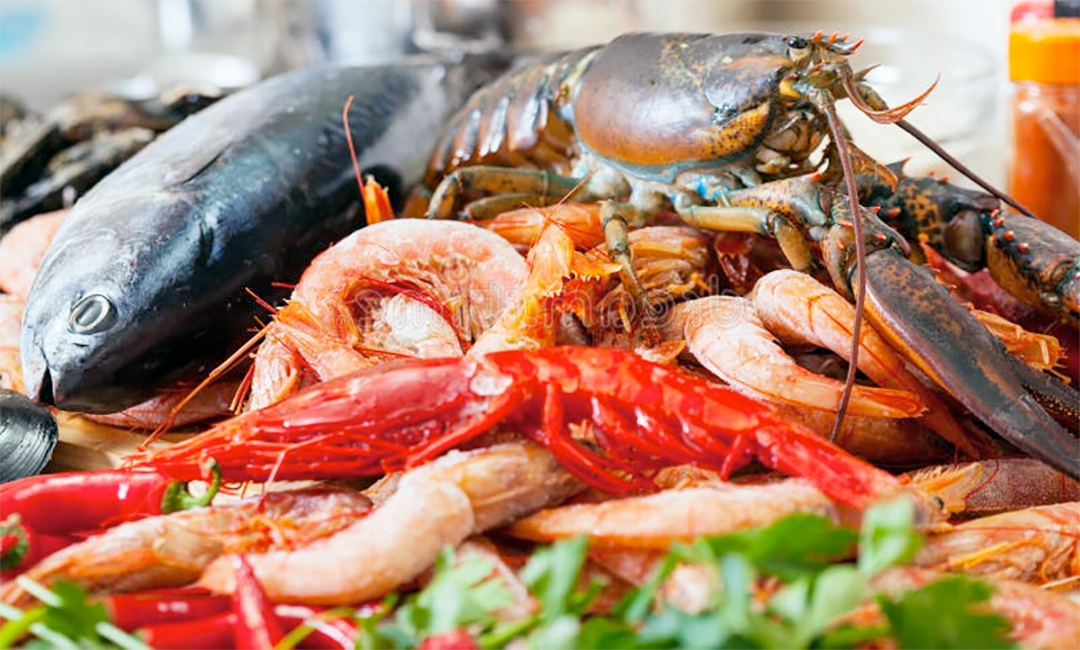 Still Life Photograph of mixed Fish and Seafood.
Welcome to FabulousFusionFood's Fish, Crustacean and Shellfish based Recipes Page — The recipes presented here are all based on aquatic animals: Fish (both sea-water and freshwater), crustaceans (crabs, lobsters, langoustine, crayfish and prawns) and shellfish of all kinds. These are still animals, and their flesh counts as 'meat', though I have removed these animals from the main Meat Recipes page.
Typically, a fish is defined as an aquatic, anamniotic, gill-bearing vertebrate animal with swimming fins and a hard skull, but lacking limbs with digits. Fish can be grouped into the more basal jawless fish and the more common jawed fish, the latter including all living cartilaginous and bony fish, as well as the extinct placoderms and acanthodians. In a break to the long tradition of grouping all fish into a single class (Pisces), modern phylogenetics views fish as a paraphyletic group. Here you will find historic recipes for jawless fishes as well as recipes for cartilaginous and bony jawed fish. For the separate list of fish-based recipes see the fish-based recipes page
For my definition of shellfish I'm including molluscs (ie shelled marine animals) as well as sea snails (that are actually gastropods) but I'm excluding crustaceans (eg prawns, lobsters, crayfish, crabs and barnacles) and cephalopod molluscs (squids, octopodes, cuttlefish) which have their own sections and are described below. Mollusca is a phylum of protostomic invertebrate animals, whose members are known as molluscs or mollusks. Molluscs are the largest marine phylum, comprising about 23% of all the named marine organisms. They are highly diverse, not just in size and anatomical structure, but also in behaviour and habitat, as numerous groups are freshwater and even terrestrial species. For the separate list of shellfish-based recipes see the shellfish-based recipes page.
Crustaceans (from Latin meaning: "those with shells" or "crusted ones") are invertebrate animals that constitute one group of arthropods that are traditionally a part of the subphylum Crustacea (/krəˈsteɪʃə/), a large, diverse group of mainly aquatic arthropods including decapods (shrimps, prawns, crabs, lobsters and crayfish), seed shrimp, branchiopods, fish lice, krill, remipedes, isopods, barnacles, copepods, opossum shrimps, amphipods and mantis shrimp. The vast majority of crustaceans consumed by humans are decapod crustaceans: crabs, lobsters, shrimp, crayfish, langoustine and prawns. Krill and barnacles are the only non-decapod crustaceans eaten regularly. For the separate list of crustacean-based recipes see the crustacean-based recipes page.
Cephalopods are members of the molluscan class Cephalopoda /sɛfəˈlɒpədə/ (Greek plural κεφαλόποδες, kephalópodes; "head-feet") such as a squid, octopus, cuttlefish, or nautilus. These exclusively marine animals are characterized by bilateral body symmetry, a prominent head, and a set of arms or tentacles (muscular hydrostats) modified from the primitive molluscan foot. Fishers sometimes call cephalopods "inkfish", referring to their common ability to squirt ink. They are all regularly consumed by humans, particularly squid and octopodes. For the separate list of caphalopod-based recipes see the cephalopod-based recipes page.
Here I'm using a broader definition of seafood to also include items such as sea anemones (that the Romans ate) as well as sea cucumbers (a common ingredient in sushi) and sea urchins (consumed by ancient Romans and Japanese). Essentially covering the range of aquatic animals consumed by humans.
As this site also includes historic recipes, there will be some unusual fish and shellfish in the lists (like weaver fish from ancient Roman cookery) as well as forms of cookery (like clay baking) that are not so commonly used any more. You will see many Ancient Roman recipes in the list, this is due to the Romans' extensive use of liquamen/garum (fish sauce) in their recipes which was typically fermented from marine fish. There are also many Mediaeval recipes presented, coming from when the Catholic church proscribed the eating of meat and there were more 'fish days' in the yearly calendar than there were days where meat could be eaten. This also explains the separation of aquatic animals from terrestrial animals, the former being classed as 'fish' and the latter as 'meat'.
The alphabetical list of all the fish-, crustacean- and shellfish-based recipes on this site follows, (limited to 100 recipes per page). There are 2873 recipes in total:
Page 29 of 29
| Venison Liver Pâté Origin: Britain | White Crab and Cabbage Shanghai Buns Origin: China | Yébésséssi (Fried Fish in Tomato and Onion Sauce) Origin: Togo |
| Victoria Sandwiches Origin: British | White Curry Origin: Fusion | Yétissé de Poulet (Chicken Yétissé) Origin: Guinea |
| Victorian Fish Molee Origin: Anglo-Indian | White Fish Fritters Origin: New Zealand | Yétissé de Tilapia (Tilapia in Aubergine Sauce) Origin: Guinea |
| Victorian Green Saag with Prawns Origin: Anglo-Indian | White Fish with Fennel Origin: Britain | Yambo Origin: Aruba |
| Vietnamese Fried Red Rice Origin: Fusion | White Matelotte Sauce Origin: Britain | Yangon Kyet Thar Hin (Yangon Chicken Curry) Origin: Myanmar |
| Vietnamese Pho Origin: Vietnam | White Nile Fish Origin: South Sudan | Yarmouth Bloaters Origin: British |
| Vincentian Buljol Origin: Saint Vincent | White Oyster Sauce Origin: Britain | Yebeh (Yam and Fish in Red Palm Oil) Origin: Sierra Leone |
| Vine Leaf Sarma Origin: North Macedonia | White Scotch Collops Origin: British | Yebeh (White Yam Porridge) Origin: Sierra Leone |
| Virgin Islands Steamed Fish Origin: British Virgin Islands | White Stewed Eels Origin: British | Yemeni hawaij Origin: Yemen |
| Virgin Islands Steamed Fish Origin: US Virgin Islands | Whitebait Origin: British | Yétissé de Poisson (Fish Yetisse) Origin: Mali |
| Viskop Kerrie Sop (Curried Snoek Soup) Origin: South Africa | Whiting au Gratin, or Baked Whiting Origin: British | Yoghurt Mint Dip Origin: Zimbabwe |
| Viskop Sop (Fish-head Soup) Origin: South Africa | Whiting aux Fine Herbes Origin: British | Ysgwydd Oen Mewn Dull Gwledig (Rustic Lamb Shoulder Roast) Origin: Welsh |
| Vulvae Steriles (Sterile Sows' Wombs) Origin: Roman | Whitings au Gratin Origin: British | Z'habitants (Martinique Callaloo) Origin: Martinique |
| Vulvae [et] Steriles (Sterile Sow's Womb) Origin: Roman | Wild Boar Liver Pâté Origin: British | Zafrani Murgh Origin: India |
| Vyannd Cypre of Samon (A Cypriot Dish of Salmon) Origin: England | Wild Food Tacacá Origin: Fusion | Zambezi Fish Bobotie Origin: Zimbabwe |
| Walnut Catsup Origin: Britain | Winter Mushroom and Smoked Fish Soup Origin: Fusion | Zamné Sauté (Fried Zamne) Origin: Burkina Faso |
| Walnut Ketchup I Origin: Britain | Wontons Origin: China | Zander Balaton (Poached Fillet of Zander) Origin: Hungary |
| Warm Salad of Oyster Mushrooms Origin: Britain | Worcestershire Wallfish Origin: England | Zanzibar Fish Curry Origin: Tanzania |
| Water Scouchy Origin: British | Wouré Burakhè Magilinri (Sweet Potato Leaf Sauce) Origin: Guinea | Zanzibar Pilau Origin: Tanzania |
| Water Souchet of Char Origin: British | Xarém Origin: Portugal | Zarzuela de Mariscos (Seafood Zarzuela) Origin: Spain |
| Watercress Sauce Origin: British | Xató (Salt Cod and Tuna Salad) Origin: Spain | Zavla (Dried Prawn Curry) Origin: India |
| Werewere Soup (Melon Seed Soup) Origin: Cameroon | Xerém Tradicional (Traditional Xerem) Origin: Cape Verde | Zupa di Pesce (Seafood Soup) Origin: Cayman Islands |
| West African Pizza Origin: African Fusion | Xiao Long Xia (Garlic-braised Crayfish) Origin: China | Žuvies kukuliai (Fish Dumplings) Origin: Lithuania |
| West African-style Barbecue Sauce Origin: African Fusion | Xinxim (Brazilian Chicken and Crayfish in Peanut Sauce) Origin: Brazil | |
| West Sumatran Fish Curry Origin: Sumatra | Xuyi Shisanxiang Longxia (Jiangsu Crayfish Cooked with Thirteen-Spice Powder) Origin: China |
Page 29 of 29