FabulousFusionFood's Fish, Crustacean, Cephalopod and Shellfish based Recipes 25th Page
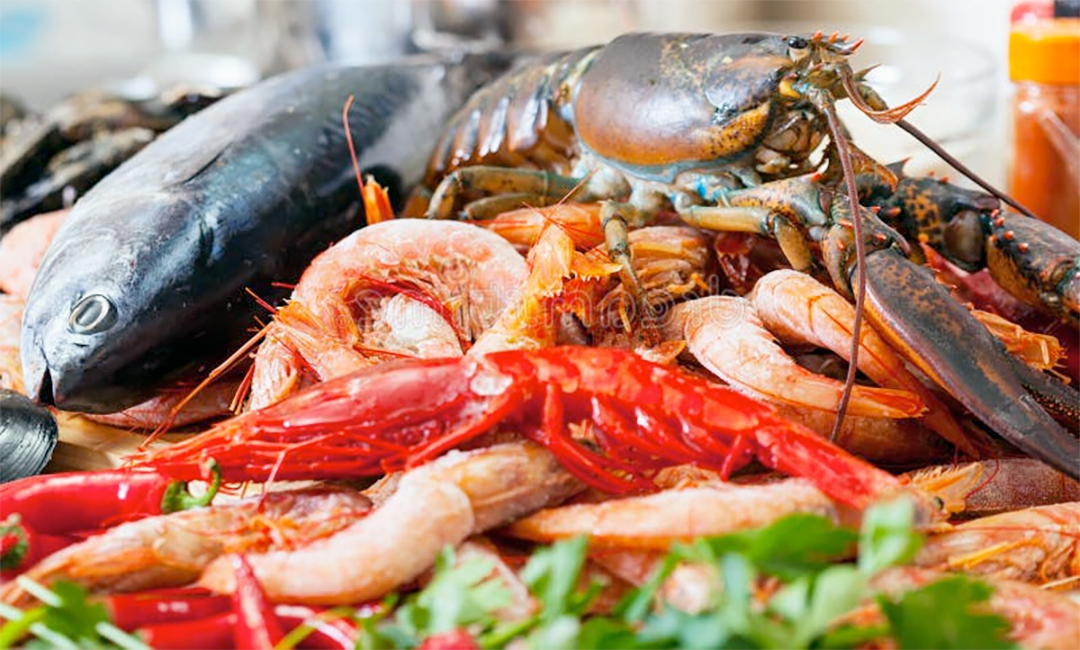 Still Life Photograph of mixed Fish and Seafood.
Welcome to FabulousFusionFood's Fish, Crustacean and Shellfish based Recipes Page — The recipes presented here are all based on aquatic animals: Fish (both sea-water and freshwater), crustaceans (crabs, lobsters, langoustine, crayfish and prawns) and shellfish of all kinds. These are still animals, and their flesh counts as 'meat', though I have removed these animals from the main Meat Recipes page.
Typically, a fish is defined as an aquatic, anamniotic, gill-bearing vertebrate animal with swimming fins and a hard skull, but lacking limbs with digits. Fish can be grouped into the more basal jawless fish and the more common jawed fish, the latter including all living cartilaginous and bony fish, as well as the extinct placoderms and acanthodians. In a break to the long tradition of grouping all fish into a single class (Pisces), modern phylogenetics views fish as a paraphyletic group. Here you will find historic recipes for jawless fishes as well as recipes for cartilaginous and bony jawed fish. For the separate list of fish-based recipes see the fish-based recipes page
For my definition of shellfish I'm including molluscs (ie shelled marine animals) as well as sea snails (that are actually gastropods) but I'm excluding crustaceans (eg prawns, lobsters, crayfish, crabs and barnacles) and cephalopod molluscs (squids, octopodes, cuttlefish) which have their own sections and are described below. Mollusca is a phylum of protostomic invertebrate animals, whose members are known as molluscs or mollusks. Molluscs are the largest marine phylum, comprising about 23% of all the named marine organisms. They are highly diverse, not just in size and anatomical structure, but also in behaviour and habitat, as numerous groups are freshwater and even terrestrial species. For the separate list of shellfish-based recipes see the shellfish-based recipes page.
Crustaceans (from Latin meaning: "those with shells" or "crusted ones") are invertebrate animals that constitute one group of arthropods that are traditionally a part of the subphylum Crustacea (/krəˈsteɪʃə/), a large, diverse group of mainly aquatic arthropods including decapods (shrimps, prawns, crabs, lobsters and crayfish), seed shrimp, branchiopods, fish lice, krill, remipedes, isopods, barnacles, copepods, opossum shrimps, amphipods and mantis shrimp. The vast majority of crustaceans consumed by humans are decapod crustaceans: crabs, lobsters, shrimp, crayfish, langoustine and prawns. Krill and barnacles are the only non-decapod crustaceans eaten regularly. For the separate list of crustacean-based recipes see the crustacean-based recipes page.
Cephalopods are members of the molluscan class Cephalopoda /sɛfəˈlɒpədə/ (Greek plural κεφαλόποδες, kephalópodes; "head-feet") such as a squid, octopus, cuttlefish, or nautilus. These exclusively marine animals are characterized by bilateral body symmetry, a prominent head, and a set of arms or tentacles (muscular hydrostats) modified from the primitive molluscan foot. Fishers sometimes call cephalopods "inkfish", referring to their common ability to squirt ink. They are all regularly consumed by humans, particularly squid and octopodes. For the separate list of caphalopod-based recipes see the cephalopod-based recipes page.
Here I'm using a broader definition of seafood to also include items such as sea anemones (that the Romans ate) as well as sea cucumbers (a common ingredient in sushi) and sea urchins (consumed by ancient Romans and Japanese). Essentially covering the range of aquatic animals consumed by humans.
As this site also includes historic recipes, there will be some unusual fish and shellfish in the lists (like weaver fish from ancient Roman cookery) as well as forms of cookery (like clay baking) that are not so commonly used any more. You will see many Ancient Roman recipes in the list, this is due to the Romans' extensive use of liquamen/garum (fish sauce) in their recipes which was typically fermented from marine fish. There are also many Mediaeval recipes presented, coming from when the Catholic church proscribed the eating of meat and there were more 'fish days' in the yearly calendar than there were days where meat could be eaten. This also explains the separation of aquatic animals from terrestrial animals, the former being classed as 'fish' and the latter as 'meat'.
The alphabetical list of all the fish-, crustacean- and shellfish-based recipes on this site follows, (limited to 100 recipes per page). There are 2561 recipes in total:
Page 25 of 26
| Thai Red Curry Paste Origin: Thailand | To make a Frose Origin: England | Tuna Ceviche Origin: Fusion |
| Thai Red Curry Paste Origin: Thailand | Tobago Curry Conch with Dumplings Origin: Trinidad | Tuna with Safran and Coconut Milk (Tuna with Cumin and Coconut Milk) Origin: Seychelles |
| Thai Shrimp Soup Origin: Thailand | Tobago Curry Crab and Dumplings Origin: India | Tuna-stuffed Tulips Origin: Britain |
| Thai Yellow Curry Paste Origin: Thailand | Toborgee Beans Origin: Liberia | Tunu Ahi Ika Origin: Easter Island |
| Thai-flavoured Pizza Origin: Fusion | Tom Yam Goong 1 Origin: Thailand | Tunu Supu (Tuna Soup) Origin: Vanuatu |
| Thai-style Nettle and Oyster Mushroom Curry Origin: Britain | Tom Yam Goong 2 Origin: Thailand | Turbot in Kerala Red Curry Sauce Origin: India |
| Thai-style Pollack Curry Origin: Fusion | Tom Yam Goong Maenam Origin: Thailand | Turdos Aponcomenos (Thrushes, Seasoned by the Throat) Origin: Roman |
| Thai-style Red Curry of Beef, Bamboo and Apple Origin: Asian Fusion | Tom Yum Gai (Hot and Sour Chicken Soup) Origin: Thailand | Turkey and Yam Pepper Soup Origin: Nigeria |
| Thai-style Red Rock Salmon Curry Origin: Britain | Tom Yum Hed (Mushroom Tom Yum) Origin: Thailand | Turks and Caicos Blackened Fish Origin: Turks Caicos |
| Thai-style Red Seafood Curry Origin: Fusion | Tom Yum Hed (Gang Som Pleug Tang Mo) Origin: Thailand | Turks and Caicos Boil Fish and Grits Origin: Turks Caicos |
| Thai-style Turkey Leftovers Curry Origin: Fusion | Tom Yum Pla (Hot and Sour Fish Soup) Origin: Thailand | Turtures (Turtledoves) Origin: Roman |
| Thakkali Meen Kari (Fish Tomato Curry) Origin: India | Tom Yum Talay (Fish Stew) Origin: Thailand | Tuvalu Tuna Curry Origin: Tuvalu |
| Tharoi Thongba (Water Snail Curry) Origin: India | Tomata Sauce Origin: Britain | Tuvaluan Crab Curry Origin: Tuvalu |
| The Prince of Wales' Sauce Origin: Britain | Tomates Monégasque (Monegasque Tomatoes) Origin: Monaco | Tuvaluan Fish Curry Origin: Tuvalu |
| Thiebou dieune (Street-style Senegalese Fish and Rice) Origin: Senegal | Tomato Sauce for Keeping I Origin: British | Tweed Kettle Origin: Scotland |
| Thiebou kéthiakh (Rice with Dried Fish and Tamarind) Origin: Senegal | Toshikoshi Soba (New Year's Eve Soba) Origin: Japan | Udang Masak Lemak Nenas (Pineapple Prawn Curry) Origin: Malaysia |
| Thiebou Kéthiakh (Rice with Dried Fish, Seafood and Vegetables) Origin: Senegal | Traditional Omelette Arnold Bennet Origin: British | Ugandan Matooke Origin: Uganda |
| Thieboudienne (Fish in the Manner of Dakar) Origin: Senegal | Traditional Thai Jungle Curry Origin: Thailand | Ugandan Smoked Fish Stew Origin: Uganda |
| Thiéré ak Mboum (Couscous with Moringa Sauce) Origin: Senegal | Trassie Trafasie (Suriname Shrimp Paste Sauce) Origin: Suriname | Ukaeb (Minced Crab with Coconut Cream) Origin: Palau |
| Thiou Tiir (White Rice and Fish with Palm Oil) Origin: Senegal | Traybake Keralan Fish Curry Origin: Fusion | Ukwa (Breadfruit Porridge) Origin: Nigeria |
| Thon Curry Moutarde à la Mauricienne (Mauritian-style Tuna Mustard Curry) Origin: Mauritius | Traybake Sea Bass with Asparagus and New Potatoes Origin: Britain | Ulkoy (Palauan Shrimp Patties) Origin: Palau |
| Thorion Tarikhous (Mackerel-stuffed Vine Leaves) Origin: Roman | Trey Cham Hoy Chia Mui Spee Chrout (Steamed Fish with Sour Mustard Greens) Origin: Cambodia | Ulkoy (Filipino Shrimp Patties) Origin: Philippines |
| Thunna (Tuna Steaks) Origin: Roman | Trey Kho Manor (Caramelized Fish with Pineapple) Origin: Cambodia | Umu Rapa Nui Origin: Easter Island |
| Tiep bou wekh (White Senegalese Rice and Fish) Origin: Senegal | Tri-Tri Cakes Origin: Saint Vincent | Unakkameen Thenga Chammanthy (Dry Fish Chutney) Origin: India |
| Tiga Dégué au Poisson Fumé (Smoked Fish in Peanut Sauce) Origin: Mali | Trini Curried Shrimp Patty Origin: Trinidad | Untú de Peixe (Deep-fried Fish Balls) Origin: Guinea-Bissau |
| Tilapia au Four (Baked Tilapia) Origin: Chad | Trinidad Crab and Callaloo Origin: Trinidad | Urap (Steamed Vegetables with Coconut) Origin: Brunei |
| Tilapia Braisée (Barbecued Tilapia) Origin: Cameroon | Trinidadian Crab Backs Origin: Trinidad | Urticae (Nettles) Origin: Roman |
| Tilapia grillé avec aloco (Grilled Tilapia with Aloco) Origin: Cameroon | Trinidadian Fried Wontons Origin: Trinidad | Usupu (Eddoe Purée with Fish) Origin: Equatorial Guinea |
| Tirk Prahok (Fish Pickle Sauce) Origin: Cambodia | Trondro Gasy (Tilapia in Tomato Sauce) Origin: Madagascar | Vadouvan Butter Halibut Origin: France |
| Tirk Trey Chu P'em (Sweet Fish Sauce) Origin: Cambodia | Trout Kedgeree Origin: Britain | Vary sy laoka malagasy (Malagasy Prawn Curry with Vanilla Rice) Origin: Madagascar |
| Tirk Umpel (Tamarind Sauce) Origin: Cambodia | Tteokbokki (Spicy Rice Cake) Origin: Korea | Velouté Marin (Velvety Marine Sauce) Origin: France |
| Tlayuda Origin: Mexico | Tuna alla Favignana (Favignana Tuna) Origin: Italy | Venison Liver Pâté Origin: Britain |
| To Dress a Hen, Mutton or Lamb the Indian Way Origin: England | Tuna and Caramelized Onion Pâté Origin: Britain | |
| To Dress Crab Origin: Britain | Tuna and Caramelized Onion Pâté Origin: Britain |
Page 25 of 26