FabulousFusionFood's Fish, Crustacean, Cephalopod and Shellfish based Recipes 23rd Page
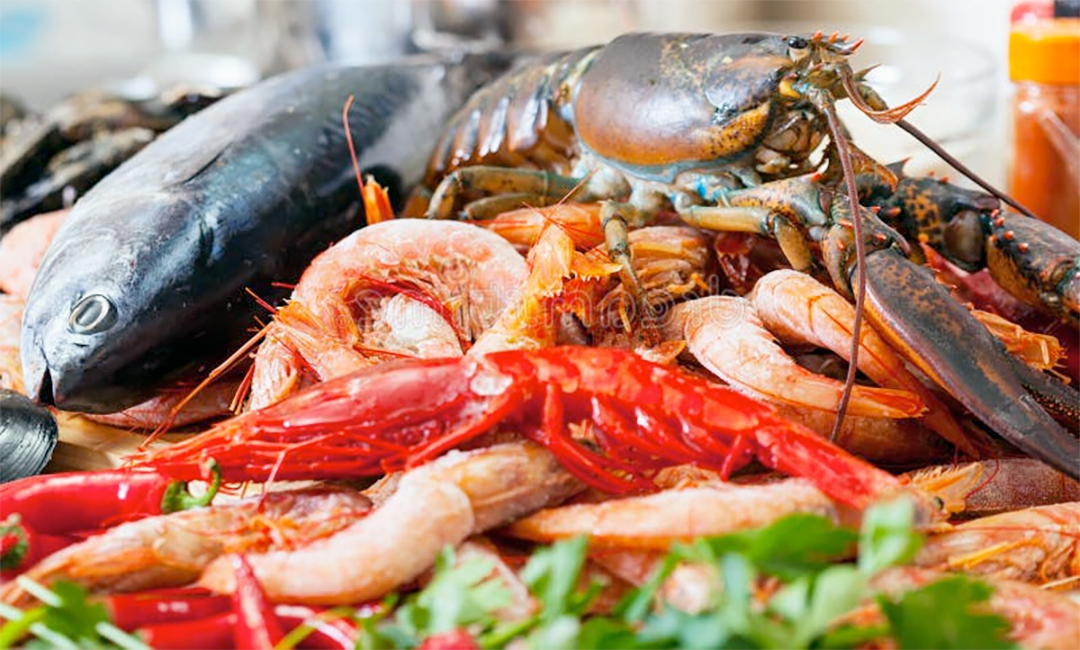 Still Life Photograph of mixed Fish and Seafood.
Welcome to FabulousFusionFood's Fish, Crustacean and Shellfish based Recipes Page — The recipes presented here are all based on aquatic animals: Fish (both sea-water and freshwater), crustaceans (crabs, lobsters, langoustine, crayfish and prawns) and shellfish of all kinds. These are still animals, and their flesh counts as 'meat', though I have removed these animals from the main Meat Recipes page.
Typically, a fish is defined as an aquatic, anamniotic, gill-bearing vertebrate animal with swimming fins and a hard skull, but lacking limbs with digits. Fish can be grouped into the more basal jawless fish and the more common jawed fish, the latter including all living cartilaginous and bony fish, as well as the extinct placoderms and acanthodians. In a break to the long tradition of grouping all fish into a single class (Pisces), modern phylogenetics views fish as a paraphyletic group. Here you will find historic recipes for jawless fishes as well as recipes for cartilaginous and bony jawed fish. For the separate list of fish-based recipes see the fish-based recipes page
For my definition of shellfish I'm including molluscs (ie shelled marine animals) as well as sea snails (that are actually gastropods) but I'm excluding crustaceans (eg prawns, lobsters, crayfish, crabs and barnacles) and cephalopod molluscs (squids, octopodes, cuttlefish) which have their own sections and are described below. Mollusca is a phylum of protostomic invertebrate animals, whose members are known as molluscs or mollusks. Molluscs are the largest marine phylum, comprising about 23% of all the named marine organisms. They are highly diverse, not just in size and anatomical structure, but also in behaviour and habitat, as numerous groups are freshwater and even terrestrial species. For the separate list of shellfish-based recipes see the shellfish-based recipes page.
Crustaceans (from Latin meaning: "those with shells" or "crusted ones") are invertebrate animals that constitute one group of arthropods that are traditionally a part of the subphylum Crustacea (/krəˈsteɪʃə/), a large, diverse group of mainly aquatic arthropods including decapods (shrimps, prawns, crabs, lobsters and crayfish), seed shrimp, branchiopods, fish lice, krill, remipedes, isopods, barnacles, copepods, opossum shrimps, amphipods and mantis shrimp. The vast majority of crustaceans consumed by humans are decapod crustaceans: crabs, lobsters, shrimp, crayfish, langoustine and prawns. Krill and barnacles are the only non-decapod crustaceans eaten regularly. For the separate list of crustacean-based recipes see the crustacean-based recipes page.
Cephalopods are members of the molluscan class Cephalopoda /sɛfəˈlɒpədə/ (Greek plural κεφαλόποδες, kephalópodes; "head-feet") such as a squid, octopus, cuttlefish, or nautilus. These exclusively marine animals are characterized by bilateral body symmetry, a prominent head, and a set of arms or tentacles (muscular hydrostats) modified from the primitive molluscan foot. Fishers sometimes call cephalopods "inkfish", referring to their common ability to squirt ink. They are all regularly consumed by humans, particularly squid and octopodes. For the separate list of caphalopod-based recipes see the cephalopod-based recipes page.
Here I'm using a broader definition of seafood to also include items such as sea anemones (that the Romans ate) as well as sea cucumbers (a common ingredient in sushi) and sea urchins (consumed by ancient Romans and Japanese). Essentially covering the range of aquatic animals consumed by humans.
As this site also includes historic recipes, there will be some unusual fish and shellfish in the lists (like weaver fish from ancient Roman cookery) as well as forms of cookery (like clay baking) that are not so commonly used any more. You will see many Ancient Roman recipes in the list, this is due to the Romans' extensive use of liquamen/garum (fish sauce) in their recipes which was typically fermented from marine fish. There are also many Mediaeval recipes presented, coming from when the Catholic church proscribed the eating of meat and there were more 'fish days' in the yearly calendar than there were days where meat could be eaten. This also explains the separation of aquatic animals from terrestrial animals, the former being classed as 'fish' and the latter as 'meat'.
The alphabetical list of all the fish-, crustacean- and shellfish-based recipes on this site follows, (limited to 100 recipes per page). There are 2561 recipes in total:
Page 23 of 26
| Sierra Leonean Fish Balls Origin: Sierra Leone | Smoked Salmon and Avocado Nori Rolls Origin: Japan | Somlar Mochu Sachko (Sour Beef Stew) Origin: Cambodia |
| Sierra Leonean White Okra Draw Soup Origin: Sierra Leone | Smoked Salmon and Cream Cheese Pâté Origin: Britain | Sōngshǔ Yú (Squirrel Fish) Origin: China |
| Sierra Leonian Egusi Soup Origin: Sierra Leone | Smoked Salmon and Haddock Pots Origin: Scotland | Sopa de Caracol (Honduran Conch Soup) Origin: Honduras |
| Sigá (Prawn and Okra Stew) Origin: Guinea-Bissau | Smoked Salmon and Horseradish Potato Farls Origin: Scotland | Sopa de Pescado Salvadoreña (Salvadorean Fish Head Soup) Origin: El Salvador |
| Sill Potatis (Pickled Herring with Boiled Potatoes and Sour Cream) Origin: Sweden | Smoked Salmon Cheesecake Origin: Ireland | Sopi di Piská (Fish Soup) Origin: Aruba |
| Simboro (Meat with Taro Leaves and Coconut Milk) Origin: Vanuatu | Smoked Salmon Mousse Origin: Scotland | Sopi di Piská (Fish Soup) Origin: Bonaire |
| Simple Prawn Laksa Origin: Fusion | Smoked Salmon Tartlets Origin: British | Sopi di Piská (Fish Soup) Origin: Curacao |
| Sing Mapan Singju (Ginger Flower and Water Dropwort Singju) Origin: India | Smoked Salmon with Pea Pancakes Origin: Britain | Sorrel Sarma Origin: North Macedonia |
| Singapore Hokkien Mee Origin: Singapore | Smoked Trout Pâté Origin: Britain | Soupa Canja (Okra and Palm Oil Soup) Origin: Gambia |
| Sint Maarten Crab Backs Origin: Sint Maarten | Smoked, Preserved, Mussels Origin: Britain | Soupe de Gombo, Sauce Poisson (Okra Soup, Fish Sauce) Origin: Benin |
| Sint Maarten Roe Accras Origin: Sint Maarten | Smoked, Preserved, Oysters Origin: Britain | Soupe Kandja Origin: Mali |
| Sint Maarten Stewed Saltfish Origin: Sint-Maarten | Smoked, Preserved, Scallops Origin: Britain | Soupou Konkoé (Smoked Fish Soup) Origin: Guinea |
| Sint Maarten Whelk Soup Origin: Sint Maarten | Smoky Fish Skewers Origin: Britain | Soused Cornish Sardines Origin: England |
| Siwin (Sewin) Origin: Welsh | Smoky Prawn Jollof Rice Origin: Nigeria | Soused Herrings Origin: Scotland |
| Siwin wedi'i serio gyda Stwns Bara Lawr, Samffir, Sbigoglys a Phys (Seared Sea Trout with Laver Mash, Samphire, Spinach and Peas) Origin: Welsh | Smoky Prawns with Tomato and Coriander Origin: Fusion | Sousi Pa (Fish with Coconut Cream) Origin: Laos |
| Sizzling Scallops Origin: Britain | Smoored Fish with Tomatoes Origin: South Africa | South African Potato Salad Origin: South Africa |
| Skate Curry Origin: Britain | Smoorsnoek with Cabbage Origin: South Africa | South African Tomato-hake Curry Origin: South Africa |
| Sliced Hilsa Fish Fried in Curry Condiments Origin: Anglo-Indian | Smörgåstårta (Swedish Savoury Sandwich Cake) Origin: Sweden | Spagetti biz-zalza tal-Qarnit (Spaghetti with Octopus Sauce) Origin: Malta |
| Slow Cooker Duck and Potato Massaman Curry Origin: Britain | Smørbrødterte (Norwegian Savoury Sandwich Cake) Origin: Norway | Spaghetti alla Puttanesca Origin: Italy |
| Slow-cooked Moorish Lamb with Buttermilk Dressing Origin: Fusion | Smørrebrød (Danish Open-faced Herring Sandwich) Origin: Denmark | Spaghetti alle vongole e Salicornia (Spaghetti with Clams and Samphire) Origin: Italy |
| Slow-cooked Octopus with Blanched Sea Blite or Marsh Samphire Salad Origin: Britain | Sneezewort Arroz de Jambú Origin: Britain | Spanish Prawns Origin: Britain |
| Slow-roasted Lamb Shanks with Tomatoes and Olives Origin: Australia | Snoek Bobotie Origin: South Africa | Special Efo Riro Origin: Nigeria |
| Smoked Baltic Sprats in Mustard Sauce Sandwich Origin: Fusion | Snoek Tacos Origin: South Africa | Speedy Italian Pizzas Origin: Britain |
| Smoked Catfish with Seashore Greens Origin: Fusion | Soba (Buckwheat Noodle Soup) Origin: Japan | Sphondyli Fricti (Fried Parsnips) Origin: Roman |
| Smoked Fish Fisherman's Pie Origin: England | Soepies (Cuttlefish) Origin: Roman | Spiced Guinea Fowl Peppersoup Origin: Nigeria |
| Smoked Fish Light Soup Origin: Ghana | Soft-wrapped Pork and Prawn Rolls Origin: Fusion | Spiced Mackerel with Horseradish Potato Salad Origin: Britain |
| Smoked Fish Stew Origin: Ancient | Sole avec La Sauce Joinville (Sole with Joinville Sauce) Origin: France | Spicy Cranberry Shrimp Origin: America |
| Smoked Haddock and Champ Cakes Origin: Northern Ireland | Sole Fillets Stuffed with Mixed Wild Mushrooms and Ricotta Cheese Origin: Britain | Spicy Mackerel Bruschetta Origin: Britain |
| Smoked Haddock Chowder Origin: Ireland | Solomon Islands Style Rice Origin: Solomon Islands | Spicy Prawns and Green Lentils Origin: Fusion |
| Smoked Haddock Curry with Butter Beans Origin: Fusion | Solomon Islands Tuna Curry Origin: Solomon Islands | Spicy Tuna and Herb Fried Rice Origin: Britain |
| Smoked haddock with Potato Mash Origin: Ireland | Solomon-a-Gundy Origin: Jamaica | Spider Crab Casserole Origin: Britain |
| Smoked Mackerel Pâté II Origin: Britain | Som Tam (Thai Green Papaya Salad) Origin: Thailand | Spider-crab Salad with Cornish Earlies Origin: Britain |
| Smoked Mackerel Pâté III Origin: Britain | Somlah Machou Khmer (Sour Soup with Tomato and Lotus Roots) Origin: Cambodia | |
| Smoked Mackerel Pâté IV Origin: Britain | Somlar Kari Saek Mouan (Chicken Red Curry) Origin: Cambodia |
Page 23 of 26