FabulousFusionFood's Fish, Crustacean, Cephalopod and Shellfish based Recipes 19th Page
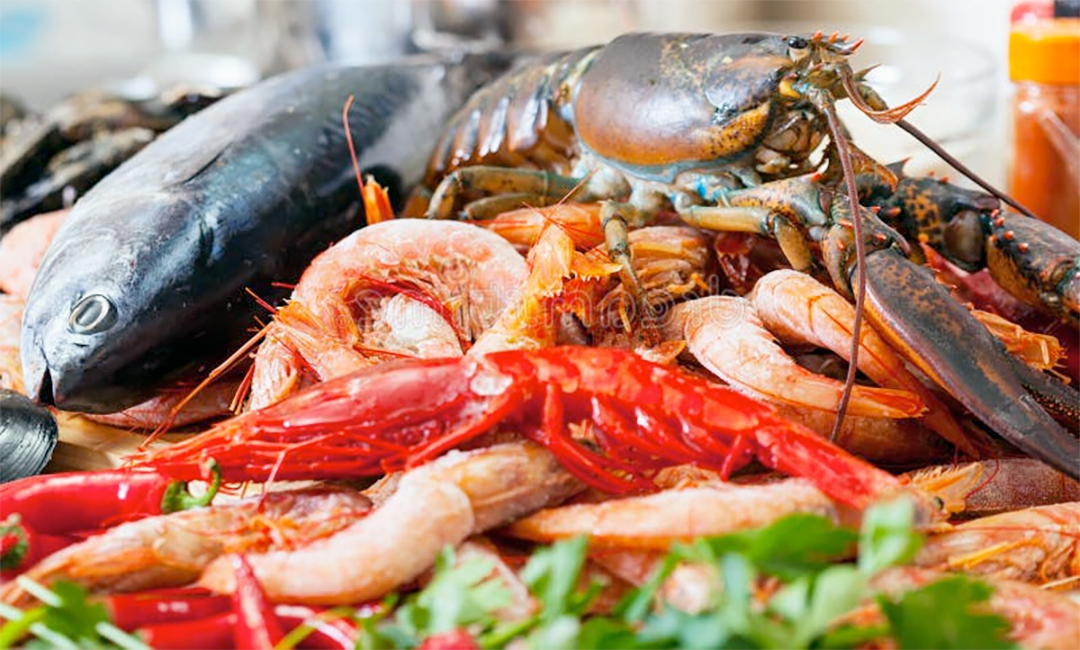 Still Life Photograph of mixed Fish and Seafood.
Welcome to FabulousFusionFood's Fish, Crustacean and Shellfish based Recipes Page — The recipes presented here are all based on aquatic animals: Fish (both sea-water and freshwater), crustaceans (crabs, lobsters, langoustine, crayfish and prawns) and shellfish of all kinds. These are still animals, and their flesh counts as 'meat', though I have removed these animals from the main Meat Recipes page.
Typically, a fish is defined as an aquatic, anamniotic, gill-bearing vertebrate animal with swimming fins and a hard skull, but lacking limbs with digits. Fish can be grouped into the more basal jawless fish and the more common jawed fish, the latter including all living cartilaginous and bony fish, as well as the extinct placoderms and acanthodians. In a break to the long tradition of grouping all fish into a single class (Pisces), modern phylogenetics views fish as a paraphyletic group. Here you will find historic recipes for jawless fishes as well as recipes for cartilaginous and bony jawed fish. For the separate list of fish-based recipes see the fish-based recipes page
For my definition of shellfish I'm including molluscs (ie shelled marine animals) as well as sea snails (that are actually gastropods) but I'm excluding crustaceans (eg prawns, lobsters, crayfish, crabs and barnacles) and cephalopod molluscs (squids, octopodes, cuttlefish) which have their own sections and are described below. Mollusca is a phylum of protostomic invertebrate animals, whose members are known as molluscs or mollusks. Molluscs are the largest marine phylum, comprising about 23% of all the named marine organisms. They are highly diverse, not just in size and anatomical structure, but also in behaviour and habitat, as numerous groups are freshwater and even terrestrial species. For the separate list of shellfish-based recipes see the shellfish-based recipes page.
Crustaceans (from Latin meaning: "those with shells" or "crusted ones") are invertebrate animals that constitute one group of arthropods that are traditionally a part of the subphylum Crustacea (/krəˈsteɪʃə/), a large, diverse group of mainly aquatic arthropods including decapods (shrimps, prawns, crabs, lobsters and crayfish), seed shrimp, branchiopods, fish lice, krill, remipedes, isopods, barnacles, copepods, opossum shrimps, amphipods and mantis shrimp. The vast majority of crustaceans consumed by humans are decapod crustaceans: crabs, lobsters, shrimp, crayfish, langoustine and prawns. Krill and barnacles are the only non-decapod crustaceans eaten regularly. For the separate list of crustacean-based recipes see the crustacean-based recipes page.
Cephalopods are members of the molluscan class Cephalopoda /sɛfəˈlɒpədə/ (Greek plural κεφαλόποδες, kephalópodes; "head-feet") such as a squid, octopus, cuttlefish, or nautilus. These exclusively marine animals are characterized by bilateral body symmetry, a prominent head, and a set of arms or tentacles (muscular hydrostats) modified from the primitive molluscan foot. Fishers sometimes call cephalopods "inkfish", referring to their common ability to squirt ink. They are all regularly consumed by humans, particularly squid and octopodes. For the separate list of caphalopod-based recipes see the cephalopod-based recipes page.
Here I'm using a broader definition of seafood to also include items such as sea anemones (that the Romans ate) as well as sea cucumbers (a common ingredient in sushi) and sea urchins (consumed by ancient Romans and Japanese). Essentially covering the range of aquatic animals consumed by humans.
As this site also includes historic recipes, there will be some unusual fish and shellfish in the lists (like weaver fish from ancient Roman cookery) as well as forms of cookery (like clay baking) that are not so commonly used any more. You will see many Ancient Roman recipes in the list, this is due to the Romans' extensive use of liquamen/garum (fish sauce) in their recipes which was typically fermented from marine fish. There are also many Mediaeval recipes presented, coming from when the Catholic church proscribed the eating of meat and there were more 'fish days' in the yearly calendar than there were days where meat could be eaten. This also explains the separation of aquatic animals from terrestrial animals, the former being classed as 'fish' and the latter as 'meat'.
The alphabetical list of all the fish-, crustacean- and shellfish-based recipes on this site follows, (limited to 100 recipes per page). There are 2561 recipes in total:
Page 19 of 26
| Peixe Seco Com Óleo de Amendoim (Dried Fish with Groundnut Oil) Origin: Mozambique | Pickled Ammassat Origin: Greenland | Poisson Andalouse (Fish Andalouse) Origin: France |
| Pem Pem Origin: Gambia | Pickled Bottled Sea Urchins Origin: Britain | Poisson au Fúmbwa (Fish with Fumbwa) Origin: Central African Republic |
| Pemahun Origin: Sierra Leone | Pickled Herring (Pennog Picl) Origin: Welsh | Poisson au Lait de Coco (Fish in Coconut Milk) Origin: Cote dIvoire |
| Penang Prawn Curry Origin: Thailand | Pickled Spruce Tips Rémoulade Sauce Origin: Canada | Poisson aux Coco (Coconut Fish) Origin: Tanzania |
| Penang-style Nyonya Fish Curry Origin: Malaysia | Picoroco Tempura Origin: Chile | Poisson aux Fines Herbes (Herbed Fish) Origin: Mauritius |
| Penfras Cymraeg Wedi Pobi (Welsh Cod Bake) Origin: Welsh | Pipián (Chicken in Peanut Sauce) Origin: Philippines | Poisson Capitaine en Feuille de Bananaier (White Grouper in Banana Leaves) Origin: Burkina Faso |
| Penhaearn Pob (Roast Gurnard) Origin: Welsh | Piquant Sauce Origin: Britain | Poisson Cru (Tahitian Raw Fish Salad) Origin: Tahiti |
| Pennog Ffres (Fresh Herring) Origin: Welsh | Pisam Adulteram Versatilem (Peas Turnover) Origin: Roman | Poisson Cru (Raw Fish) Origin: Gambier Islands |
| Penwaig Hallt (Salt Herring) Origin: Welsh | Pisca den Foil (Foil-cooked Fish) Origin: Aruba | Poisson Cru (Wallisian Raw Fish Salad) Origin: Wallis Futuna |
| Penwaig Nefyn (Nefyn Herring) Origin: Welsh | Pisca Hasa (Fried Fish) Origin: Aruba | Poisson Farci (Fish Stuffed with Forcemeat and Eggs) Origin: Senegal |
| Penwaig Wedi Stwffio (Stuffed Herring) Origin: Welsh | Pisca Stoba (Fish Stew) Origin: Puerto Rico | Poisson Farci à la Saint-Louisienne (Stuffed Fish, in the Manner of St Louis) Origin: Senegal |
| Penwaig wedi Stwffio (Stuffed Herring) Origin: Welsh | Pisces Assos (Baked Fish) Origin: Roman | Poisson Fumé aux Gombos (Smoked Fish with Okra) Origin: Cameroon |
| Penzance Grey Mullet Origin: Cornwall | Pisces Frixos Cuiusumque (Fried Fish, of Any Kind) Origin: Roman | Poisson Grillé (Grilled Fish) Origin: Seychelles |
| Pèpè Soupe (Ivorian Pepper Soup) Origin: Cote dIvoire | Pisces Scorpiones Rapulatos (Scorpion Fish with Turnips in Saffron Sauce) Origin: Roman | Poisson Salé (Salt Fish) Origin: Mauritius |
| Pepes Ikan (Fish in Curry Sauce) Origin: Indonesia | Pisces Scorpiones Rapulatos (Scorpion Fish with Turnips) Origin: Roman | Poisson sauce Claire (Fish with Clear Sauce) Origin: Burkina Faso |
| Pepes Ikan (Fish in Curry Sauce) Origin: East Timor | Pisces Zomoteganon (Fish Stewed in its Own Juices) Origin: Roman | Poisson Yassa (Fish Yassa) Origin: Senegal |
| Pépésup (Pepper Soup) Origin: Equatorial Guinea | Pisces Zomoteganon II (Fish Stewed in its Own Juice) Origin: Roman | Poisson Yassa Mauritanienne (Mauritanian Fish Yassa) Origin: Mauritania |
| Pepper Soup Origin: Liberia | Pisken Balyk (Boiled Fish) Origin: Kazakhstan | Poissons en sauce aux arachides (Fish in Groundnut Sauce) Origin: Gabon |
| Pepper Soupe de Poisson (Fish Pepper Soup) Origin: Cameroon | Pisum Indicum (Indigo Peas) Origin: Roman | Poivrade Sauce Origin: Britain |
| Pepre Watra Origin: Suriname | Pizza ai Fruiti di Mare (Seafood Pizza) Origin: Italy | Polbo á Feira (Galician Style Octopus) Origin: Spain |
| Percebes Tapas (Gooseneck Barnacles Tapas) Origin: Spain | Pizza Quattro Stagioni (Four Seasons Pizza) Origin: Italy | Pollack Pie with Crushed Potato Topping Origin: Britain |
| Perch Benachin Origin: Gambia | Pizza Tonno e Cipolla (Tuna and Onion Pizza) Origin: Italy | Polvo à São Tomé (Sao Tomean Octopus) Origin: Sao Tome |
| Peri Peri Kari Camarão (Fiery Prawn Curry) Origin: Mozambique | Plain Scots Fish and Sauce Soup Origin: Scotland | Polvo a Modo ze de Lino (Octopus Stew) Origin: Cape Verde |
| Peri-peri Prawn Pasta Origin: South Africa | Planked Trout Origin: American | Polypodium (Polypody Root Sauce) Origin: Roman |
| Perigeux Sauce Origin: Britain | Plantains and Fried Fish Origin: Liberia | Pondu Origin: Congo |
| Peruvian Ceviche Origin: Peru | Plasas Origin: Sierra Leone | Ponty Fuszermartassal (Deviled Carp) Origin: Hungary |
| Peruvian Seviche Origin: Peru | Plateau de Fruits de Mer (Seafood Platter) Origin: France | Poo Pad Pong Curry (Thai Crab Curry Recipe) Origin: Thailand |
| Pescado Frito (Fried Fish) Origin: Ecuador | Plays in Cynee (Plaice in Spiced Bread Sauce) Origin: England | Popcorn Shrimp Origin: Cajun |
| Pescado Frito (Puerto Rican Fried Red Snapper) Origin: Puerto Rico | Plays in cynee (Place in Spiced Bread Sauce) Origin: England | Porcellum Coriandratum (Suckling Pig with Coriander Sauce) Origin: Roman |
| Pesmol (Mackerel with Bell Pepper in a Coconut and Chilli Sauce) Origin: Indonesia | Plokkfiskur (Icelandic fish stew) Origin: Iceland | Porcellum Eo Irue (Suckling Pig with Thick Sauce) Origin: Roman |
| Pice Cocos (Cockle Pikelets) Origin: Welsh | Poached Bream in Mayonnaise Sauce Origin: Britain | Porcellum Iscellatum (Sauce for Suckling Pig) Origin: Roman |
| Pice Tatws, Cocos a Bara Lawr (Potato, Cockle and Laverbread Patties) Origin: Welsh | Poached Sea Trout with Green Mayonnaise Origin: Britain | Porcellum Lacte Pastum Elixum (Boiled Suckling Pig, Fed on Milk) Origin: Roman |
| Pick a Pepper Soup Origin: Equatorial Guinea | Point-and-kill Origin: Nigeria | |
| Pick-up Saltfish Origin: US Virgin Islands | Poison Braisé (Barbecued Fish) Origin: Senegal |
Page 19 of 26