FabulousFusionFood's Fish, Crustacean, Cephalopod and Shellfish based Recipes 13th Page
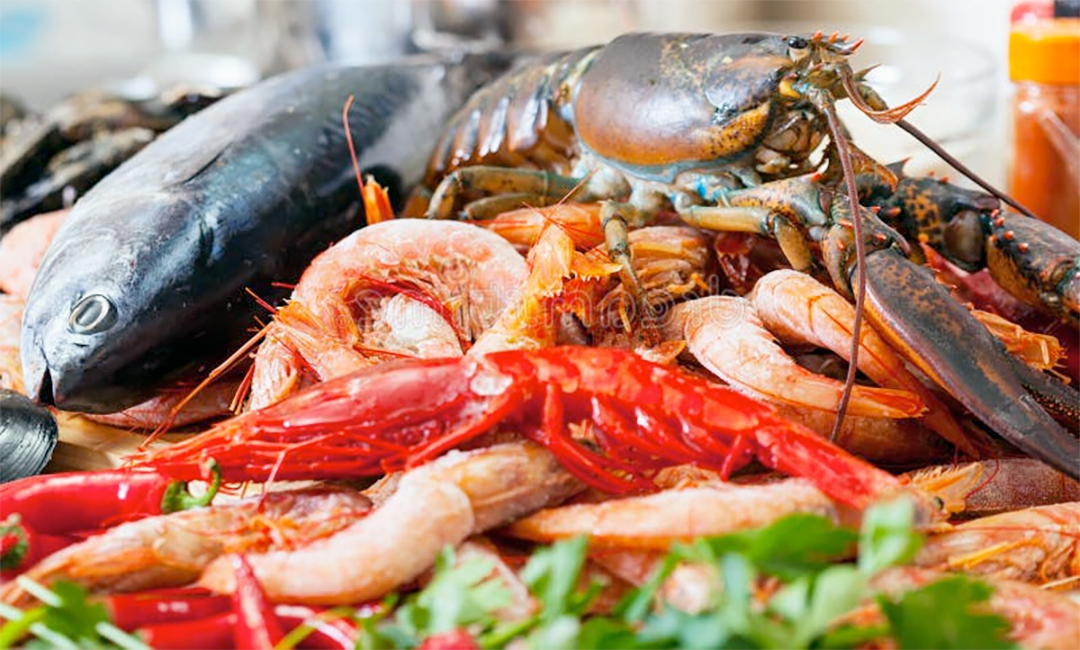 Still Life Photograph of mixed Fish and Seafood.
Welcome to FabulousFusionFood's Fish, Crustacean and Shellfish based Recipes Page — The recipes presented here are all based on aquatic animals: Fish (both sea-water and freshwater), crustaceans (crabs, lobsters, langoustine, crayfish and prawns) and shellfish of all kinds. These are still animals, and their flesh counts as 'meat', though I have removed these animals from the main Meat Recipes page.
Typically, a fish is defined as an aquatic, anamniotic, gill-bearing vertebrate animal with swimming fins and a hard skull, but lacking limbs with digits. Fish can be grouped into the more basal jawless fish and the more common jawed fish, the latter including all living cartilaginous and bony fish, as well as the extinct placoderms and acanthodians. In a break to the long tradition of grouping all fish into a single class (Pisces), modern phylogenetics views fish as a paraphyletic group. Here you will find historic recipes for jawless fishes as well as recipes for cartilaginous and bony jawed fish. For the separate list of fish-based recipes see the fish-based recipes page
For my definition of shellfish I'm including molluscs (ie shelled marine animals) as well as sea snails (that are actually gastropods) but I'm excluding crustaceans (eg prawns, lobsters, crayfish, crabs and barnacles) and cephalopod molluscs (squids, octopodes, cuttlefish) which have their own sections and are described below. Mollusca is a phylum of protostomic invertebrate animals, whose members are known as molluscs or mollusks. Molluscs are the largest marine phylum, comprising about 23% of all the named marine organisms. They are highly diverse, not just in size and anatomical structure, but also in behaviour and habitat, as numerous groups are freshwater and even terrestrial species. For the separate list of shellfish-based recipes see the shellfish-based recipes page.
Crustaceans (from Latin meaning: "those with shells" or "crusted ones") are invertebrate animals that constitute one group of arthropods that are traditionally a part of the subphylum Crustacea (/krəˈsteɪʃə/), a large, diverse group of mainly aquatic arthropods including decapods (shrimps, prawns, crabs, lobsters and crayfish), seed shrimp, branchiopods, fish lice, krill, remipedes, isopods, barnacles, copepods, opossum shrimps, amphipods and mantis shrimp. The vast majority of crustaceans consumed by humans are decapod crustaceans: crabs, lobsters, shrimp, crayfish, langoustine and prawns. Krill and barnacles are the only non-decapod crustaceans eaten regularly. For the separate list of crustacean-based recipes see the crustacean-based recipes page.
Cephalopods are members of the molluscan class Cephalopoda /sɛfəˈlɒpədə/ (Greek plural κεφαλόποδες, kephalópodes; "head-feet") such as a squid, octopus, cuttlefish, or nautilus. These exclusively marine animals are characterized by bilateral body symmetry, a prominent head, and a set of arms or tentacles (muscular hydrostats) modified from the primitive molluscan foot. Fishers sometimes call cephalopods "inkfish", referring to their common ability to squirt ink. They are all regularly consumed by humans, particularly squid and octopodes. For the separate list of caphalopod-based recipes see the cephalopod-based recipes page.
Here I'm using a broader definition of seafood to also include items such as sea anemones (that the Romans ate) as well as sea cucumbers (a common ingredient in sushi) and sea urchins (consumed by ancient Romans and Japanese). Essentially covering the range of aquatic animals consumed by humans.
As this site also includes historic recipes, there will be some unusual fish and shellfish in the lists (like weaver fish from ancient Roman cookery) as well as forms of cookery (like clay baking) that are not so commonly used any more. You will see many Ancient Roman recipes in the list, this is due to the Romans' extensive use of liquamen/garum (fish sauce) in their recipes which was typically fermented from marine fish. There are also many Mediaeval recipes presented, coming from when the Catholic church proscribed the eating of meat and there were more 'fish days' in the yearly calendar than there were days where meat could be eaten. This also explains the separation of aquatic animals from terrestrial animals, the former being classed as 'fish' and the latter as 'meat'.
The alphabetical list of all the fish-, crustacean- and shellfish-based recipes on this site follows, (limited to 100 recipes per page). There are 2561 recipes in total:
Page 13 of 26
| Jamaican Brown Fish Stew Origin: Jamaica | Kamuna Origin: Sierra Leone | Khanom Jeen Nam Ya (Khanom Jeen Noodles) Origin: Thailand |
| Jamaican Jerk Shirmp Origin: Jamaica | Kanamadhu Cake Origin: Maldives | Khao Pune (Chicken Curry Noodles) Origin: Laos |
| Jamaican Prawn Curry Origin: Jamaica | Kang Ped Pla-dook (Red Curry with Catfish) Origin: Thailand | Khayan thee Hnat (Burmese Stuffed Aubergine Curry) Origin: Myanmar |
| Jamaican Pumpkin Rice Origin: Jamaica | Kansiyé avec 'Mafe' (Smoked Chicken in Peanut Sauce with Mashed Plantains) Origin: Guinea | Khichiri Prawn Sauce Origin: India |
| Jamaican Rum Prawns Origin: Jamaica | Kansiyé de Poisson (Fish Kansiyé) Origin: Guinea | Khnom Jin Namya (Catfish Curry over Noodles) Origin: Thailand |
| Jamaican Salt Fish Origin: Jamaica | Kaoteriad (Breton Fish Stew) Origin: France | Kibeba (Cassava and Cuttlefish Stew) Origin: Mozambique |
| Jamaican Seafood Soup Origin: Jamaica | Kapenta Origin: Zambia | Kibeba de Angola Origin: Angola |
| Jambo (Okra Soup) Origin: Bonaire | Kapr na černo (Carp in Black Sauce) Origin: Czech | Kieler Sprotten in Teig (Battered Kiel Sprats) Origin: Germany |
| Jambo (Okra Soup) Origin: Curacao | Karahi Machhli (White Fish Curry) Origin: Pakistan | Kilo'a Origin: Tokelau |
| Janssons Frestelse (Janssons Temptation) Origin: Sweden | Kare Kare Origin: Philippines | King Prawn Dopiaza Curry Origin: Britain |
| Japanese-style Char-grilled Plaice Origin: Britain | Kari de lieu jaune au cidre (Pollack Curry with Cider) Origin: France | King Prawn Pathia Origin: Britain |
| Japanese-style Fish Finger Curry Origin: Britain | Kari Ikan (Fish Curry) Origin: Malaysia | King Scallop in Molee Sauce Origin: Manx |
| Javaanse Bami Origin: Suriname | Kari Ikan (Malaysian Fish Curry) Origin: Malaysia | Kingklip and Prawn Biryani Origin: South Africa |
| Javanese Sambal Bajak (Javanese Hot Sauce) Origin: Indonesia | Kari Koko (Seychellois King Prawn and Coconut Curry) Origin: Seychelles | Kipper Cream Origin: Scotland |
| Jerk-crusted Fish Fillet Origin: Jamaica | Kari Koko Zourit (Octopus Curry) Origin: Seychelles | Kippers with Marmalade Origin: Britain |
| Jersey Fried Conger Eel Origin: Jersey | Karko Stobá (Queen Conch Stew) Origin: Aruba | Kiribati Coconut Crab Curry Origin: Kiribati |
| Jersey Ormer Casserole Origin: Jersey | Karko Stobá (Queen Conch Stew) Origin: Bonaire | Kitharos (Turbot) Origin: Roman |
| John Dory Origin: British | Karko Stobá (Queen Conch Stew) Origin: Curacao | Kizaca (Cassava Leaf and Peanut Stew) Origin: Angola |
| John Dory with Cider, Apples and Cream Origin: Britain | Karrísúpa (Icelandic Curry Soup) Origin: Iceland | Kizaka with Palm Oil Origin: Angola |
| Jungle Curry Prawns Origin: Thailand | Katakou au Poisson Frais (Palm Soup Base with Fresh Fish) Origin: Cote dIvoire | Kocktail Yafo (Fish Cocktail) Origin: Israel |
| Kétoun (Stew of Tubers) Origin: Guinea | Ke'lagu'en Uhang (Prawns and Peppers) Origin: Guam | Kodoyo (Fish with Baobab Leaves) Origin: Togo |
| Kūpinātas Brētliņas Salāti (Latvian Smoked Sprat Salad) Origin: Latvia | Ke'lagu'en Uhang (Prawns and Peppers) Origin: Northern Mariana Islands | Kokam Fish Origin: India |
| Kaapse Kerrievis (Cape Malay Pickled Fish) Origin: South Africa | Kebbeh Kunda Benachin Origin: Gambia | Kokoda (Oceanian Ceviche) Origin: Fiji |
| Kaapse Kerrievis (Cape Malay Pickled Fish) Origin: South Africa | Kedgeree Origin: Anglo-Indian | Kokoda (Fijian Ceviche) Origin: Fiji |
| Kabura Mushi (Steamed Prawns, Mushrooms, Chicken and Ginkgo Nuts) Origin: Japan | Kedgeree Origin: Britain | Kokoda (Oceanian Ceviche) Origin: Papua New Guinea |
| Kaeng Khiao Wan (Thai Green Curry) Origin: Thailand | Kedgeree 2 Origin: Fusion | Kokoda (Oceanian Ceviche) Origin: Solomon Islands |
| Kaeng Phet Pet Yang (Thai Red Roast Duck Curry) Origin: Thailand | Kedgeree Fisherman's Pie with Winter Vegetable Topping Origin: Britain | Komprek Eromba (Water Dropwort Eromba) Origin: India |
| Kajaik (Sudanese fish stew) Origin: South Sudan | Kedjenou Origin: Cote dIvoire | Konkoé Turé Gbéli (Smoked Catfish Stew with Vegetables) Origin: Guinea |
| Kakrar Jhal (Bengali Crab Curry) Origin: India | Kejenou avec Agouti (Kejenou with Cane Rat) Origin: Cote dIvoire | Kontomire Stew (Cocoyam Leaf Stew) Origin: Ghana |
| Kalamar Tava (Turkish Fried Calamari) Origin: Turkey | Kekefia (Plantain Pottage) Origin: Nigeria | Korean Fish Cakes Origin: Korea |
| Kaldi (Algerian Crescent Pastries) Origin: Algeria | Kelenkelen (Fish with Cassava Leaves) Origin: Cameroon | Korean Style Dashi Origin: Korea |
| Kaldu (Senegalese Caldou) Origin: Senegal | Kenyan Mchuzi wa Samaki (Swahili Fish Curry) Origin: Kenya | Korean-inspired Pollock Stew with Gochujang and Wild Greens Origin: Korea |
| Kaluun iyo Bariis (Spicy Fish Sauce with Rice) Origin: Somalia | Ketoun (Guinean Root Vegetable Porridge) Origin: Guinea | |
| Kamaboko (Japanese fish cakes) Origin: Japan | Khanom Jeen Nam Ya (Khanom Jeen Noodles) Origin: Thailand |
Page 13 of 26