FabulousFusionFood's Fish, Crustacean, Cephalopod and Shellfish based Recipes 10th Page
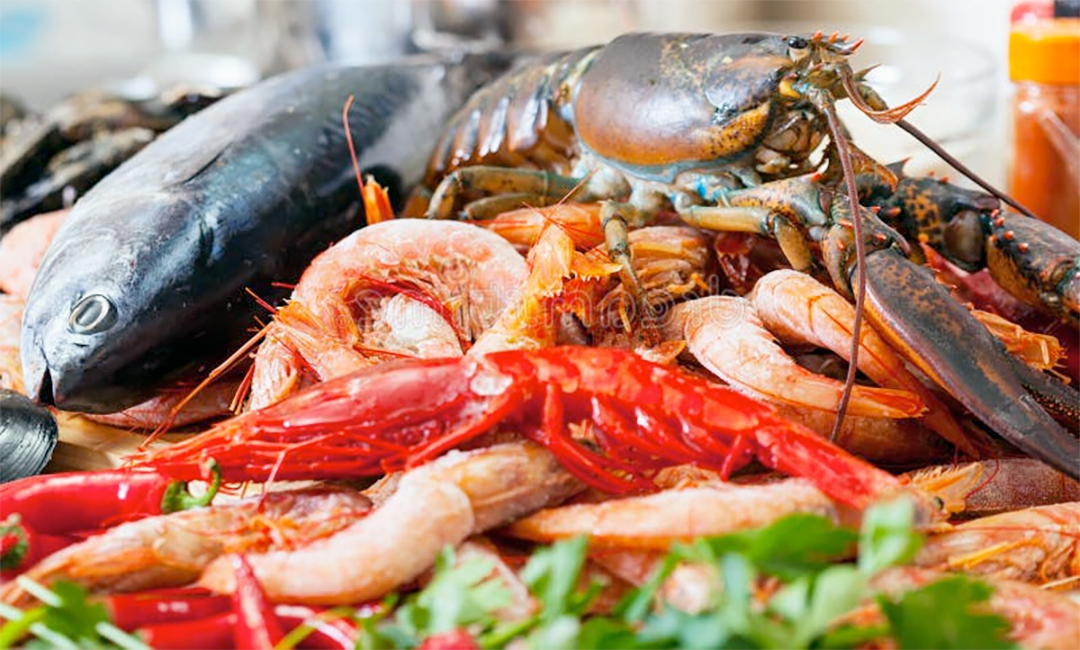 Still Life Photograph of mixed Fish and Seafood.
Welcome to FabulousFusionFood's Fish, Crustacean and Shellfish based Recipes Page — The recipes presented here are all based on aquatic animals: Fish (both sea-water and freshwater), crustaceans (crabs, lobsters, langoustine, crayfish and prawns) and shellfish of all kinds. These are still animals, and their flesh counts as 'meat', though I have removed these animals from the main Meat Recipes page.
Typically, a fish is defined as an aquatic, anamniotic, gill-bearing vertebrate animal with swimming fins and a hard skull, but lacking limbs with digits. Fish can be grouped into the more basal jawless fish and the more common jawed fish, the latter including all living cartilaginous and bony fish, as well as the extinct placoderms and acanthodians. In a break to the long tradition of grouping all fish into a single class (Pisces), modern phylogenetics views fish as a paraphyletic group. Here you will find historic recipes for jawless fishes as well as recipes for cartilaginous and bony jawed fish. For the separate list of fish-based recipes see the fish-based recipes page
For my definition of shellfish I'm including molluscs (ie shelled marine animals) as well as sea snails (that are actually gastropods) but I'm excluding crustaceans (eg prawns, lobsters, crayfish, crabs and barnacles) and cephalopod molluscs (squids, octopodes, cuttlefish) which have their own sections and are described below. Mollusca is a phylum of protostomic invertebrate animals, whose members are known as molluscs or mollusks. Molluscs are the largest marine phylum, comprising about 23% of all the named marine organisms. They are highly diverse, not just in size and anatomical structure, but also in behaviour and habitat, as numerous groups are freshwater and even terrestrial species. For the separate list of shellfish-based recipes see the shellfish-based recipes page.
Crustaceans (from Latin meaning: "those with shells" or "crusted ones") are invertebrate animals that constitute one group of arthropods that are traditionally a part of the subphylum Crustacea (/krəˈsteɪʃə/), a large, diverse group of mainly aquatic arthropods including decapods (shrimps, prawns, crabs, lobsters and crayfish), seed shrimp, branchiopods, fish lice, krill, remipedes, isopods, barnacles, copepods, opossum shrimps, amphipods and mantis shrimp. The vast majority of crustaceans consumed by humans are decapod crustaceans: crabs, lobsters, shrimp, crayfish, langoustine and prawns. Krill and barnacles are the only non-decapod crustaceans eaten regularly. For the separate list of crustacean-based recipes see the crustacean-based recipes page.
Cephalopods are members of the molluscan class Cephalopoda /sɛfəˈlɒpədə/ (Greek plural κεφαλόποδες, kephalópodes; "head-feet") such as a squid, octopus, cuttlefish, or nautilus. These exclusively marine animals are characterized by bilateral body symmetry, a prominent head, and a set of arms or tentacles (muscular hydrostats) modified from the primitive molluscan foot. Fishers sometimes call cephalopods "inkfish", referring to their common ability to squirt ink. They are all regularly consumed by humans, particularly squid and octopodes. For the separate list of caphalopod-based recipes see the cephalopod-based recipes page.
Here I'm using a broader definition of seafood to also include items such as sea anemones (that the Romans ate) as well as sea cucumbers (a common ingredient in sushi) and sea urchins (consumed by ancient Romans and Japanese). Essentially covering the range of aquatic animals consumed by humans.
As this site also includes historic recipes, there will be some unusual fish and shellfish in the lists (like weaver fish from ancient Roman cookery) as well as forms of cookery (like clay baking) that are not so commonly used any more. You will see many Ancient Roman recipes in the list, this is due to the Romans' extensive use of liquamen/garum (fish sauce) in their recipes which was typically fermented from marine fish. There are also many Mediaeval recipes presented, coming from when the Catholic church proscribed the eating of meat and there were more 'fish days' in the yearly calendar than there were days where meat could be eaten. This also explains the separation of aquatic animals from terrestrial animals, the former being classed as 'fish' and the latter as 'meat'.
The alphabetical list of all the fish-, crustacean- and shellfish-based recipes on this site follows, (limited to 100 recipes per page). There are 2561 recipes in total:
Page 10 of 26
| Flancitos Origin: Chile | Fried Herring Origin: Scotland | Gbékui (Spinach Sauce) Origin: Togo |
| Flying Fish with Cou Cou Origin: Barbados | Fried Kway Teow Origin: Malaysia | Gbegiri (Bean Stew) Origin: Nigeria |
| Folon Origin: Cameroon | Fried Kway Teow Origin: Christmas Island | Gefilte Fish Pate Origin: Jewish |
| Fonio, Sauce Gombo et Crevettes (Fonio, Okra Sauce and Prawns) Origin: Mali | Fried Kway Teow Origin: Cocos Islands | Gehackte Herring Origin: South Africa |
| Foolproof Pie Crust Origin: American | Fried Mackerel with Gooseberries Origin: England | Gelee of fysche (Fish in Jelly) Origin: England |
| For to make noumbles in lent (Stewed Fish Intestines for Lent) Origin: England | Fried Perch Origin: British | Gemfish in Chermoula Marinade Origin: New Zealand |
| Forei (Trout) Origin: Kyrgyzstan | Fried Tench Origin: British | Genoese Sauce Origin: Britain |
| Forshmak (Georgian Minced Meat Soufflé) Origin: Georgia | Friture (Fried Small River Fish) Origin: Luxembourg | Gentleman's Relish Origin: Britain |
| Foufou de Banane à la Sauce Claire (Plantain Fufu with Clear Sauce) Origin: Mali | FSM Tinola Origin: Federated States Micronesia | Gepekelde Haring (Soused Herring) Origin: Netherlands |
| Foufou Dessi (White Sauce for Fufu) Origin: Togo | Fukusazushi Origin: Japan | Gesmoorde Vis (Salt Cod and Potatoes in Tomato Sauce) Origin: South Africa |
| Fouti Lafidi Origin: Guinea | Full-flavoured Fish Stock Origin: Britain | Gezouten haring met ui en augurken (soused herring with onion and pickles) Origin: Netherlands |
| Francatelli's Anchovy Sauce Origin: Britain | Furmente with porpays (Grain Pottage with Porpoise) Origin: England | Ghanaian Groundnut Soup Origin: Ghana |
| French Bean and Duck Green Thai Curry Origin: Thailand | Gadang Pit (Red Curry Chicken) Origin: Laos | Ghanaian Ripe Plantain Ice Cream Origin: Ghana |
| French Coconut Fish Curry Origin: France | Gaeng Karee Gai (Yellow Curry With Chicken) Origin: Thailand | Ghanaian Spaghetti Jollof Origin: Ghana |
| Fresh Fish Pepper Soup Origin: West Africa | Gaeng Ki Lek (Northern Thai Pork and Ki Lek Curry with Fingerroot) Origin: Thailand | Ginger Prawns with Oyster Mushrooms Origin: China |
| Fricassé de chatrou (Chatrou Fricassee) Origin: Guadeloupe | Gaeng Ki Lek (Northern Thai Pork and Ki Lek Curry with Fingerroot) Origin: Thailand | Ginger Soy Fish en Papillote Origin: Fusion |
| Fricassé de lambis (Queen Conch Fricassee) Origin: Guadeloupe | Gaeng Pa (Jungle Curry Paste) Origin: Thailand | Ginger, Chicken and Coconut Soup Origin: Fusion |
| Fricassé de ouassous (Fricassée of Freshwater Prawns) Origin: Guadeloupe | Gaeng Som (Thai Sour Curry) Origin: Thailand | Gnocchi alla Puttanesca al Forno (Puttanesca Baked Gnocchi) Origin: Italy |
| Fricassée de Lambi (Queen Conch Fricassee) Origin: Martinique | Gaeng Som (Thai Sour Curry) Origin: Thailand | Go-ferwi Eog (Poaching Salmon) Origin: Welsh |
| Fried Anchovies Origin: British | Gaeng Som (Thai Sour Orange Curry) Origin: Thailand | Goan Crab Claw Curry Origin: India |
| Fried Ata Sauce Origin: Nigeria | Gai Pad King (Ginger and Chicken Stir Fry) Origin: Thailand | Goan Fish Curry Origin: India |
| Fried Bistort Greens Origin: African Fusion | Gai Yang (Thai Grilled Chicken) Origin: Thailand | Goan Mackerel Masala Origin: India |
| Fried Brinjal Sambal Origin: Myanmar | Galician-style Goose Barnacles Origin: Spain | Goat Meat Pepper Soup with Calabash Nutmeg Origin: Nigeria |
| Fried Brnijal Sambal Origin: Myanmar | Galo Soup Origin: Liberia | Golwyth Bacwn, Bara Lawr a Chocos (Bacon Chop with Laver Bread and Cockles) Origin: Welsh |
| Fried Cod Roe Origin: Scotland | Gambas ou langoustines au pastis (Prawns or Langoustines with Pastis) Origin: Monaco | Gombos de Poisson Sec (Dried Fish with Okra) Origin: Chad |
| Fried Conch Fritters Origin: Turks Caicos | Gambian Fish Pepper Soup Origin: Gambia | Gonos (Fried Whitebait) Origin: Roman |
| Fried Crabmeat Flautas Origin: American | Gambian Fish Yassa Origin: Gambia | Good Friday Fish Pie Origin: Britain |
| Fried Eels Origin: British | Gambian-style Okro Soup Origin: Gambia | Grain Mustard Based Fish Curry Origin: India |
| Fried Fish Roe Origin: Saint Lucia | Garba (Cassava Fried Tuna) Origin: Cote dIvoire | Gratin de fruits de mer (Seafood Gratin) Origin: Monaco |
| Fried Fish with Fungi Origin: British Virgin Islands | Garden Eggs Stew Origin: Ghana | Gratin de galettes aux crevettes (Gratin of Pancakes with Prawns and Mushrooms) Origin: France |
| Fried Fish with Fungi and Creole Sauce Origin: US Virgin Islands | Gari aux Crevettes (Gari with Prawns) Origin: Cameroon | Gratin de Morue (Salt Cod Gratin) Origin: Mauritius |
| Fried Fish with Pine Kernels Origin: China | Gari Foto Origin: Ghana | Gravadlax Smørrebrød (Danish Smoked Salmon Open Sandwich) Origin: Denmark |
| Fried Fish with Sea Lettuce Oatmeal Crust Origin: England | Garum (Fish Sauce) Origin: Roman | |
| Fried Flounders Origin: British | Gâteau Michel (Michel's cake) Origin: Saint Pierre |
Page 10 of 26