FabulousFusionFood's Fish, Crustacean, Cephalopod and Shellfish based Recipes 22tn Page
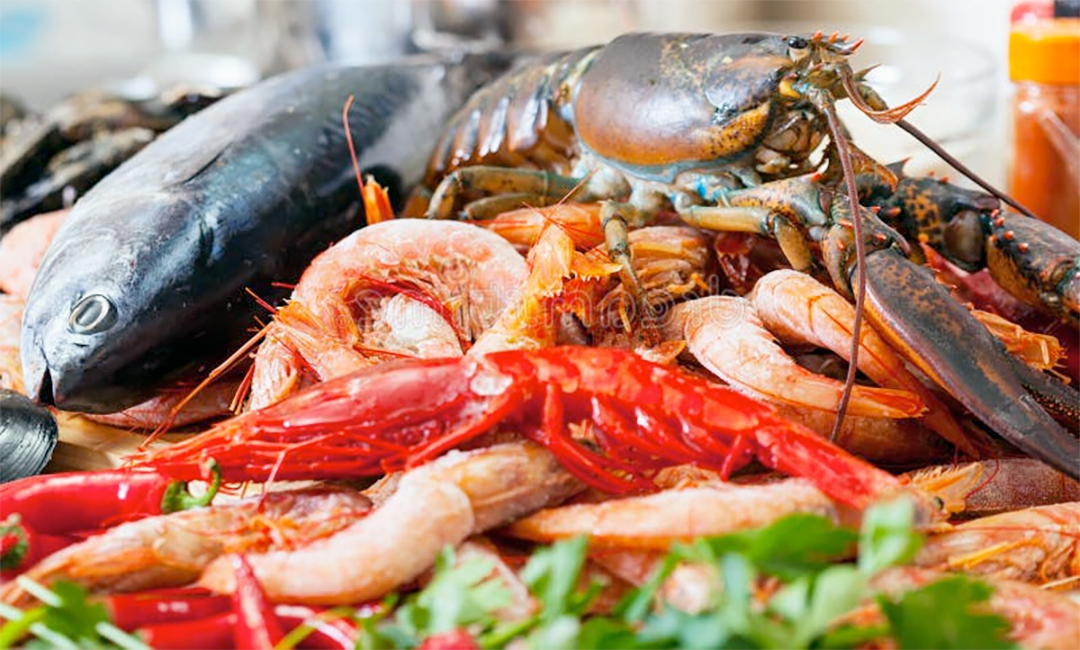 Still Life Photograph of mixed Fish and Seafood.
Welcome to FabulousFusionFood's Fish, Crustacean and Shellfish based Recipes Page — The recipes presented here are all based on aquatic animals: Fish (both sea-water and freshwater), crustaceans (crabs, lobsters, langoustine, crayfish and prawns) and shellfish of all kinds. These are still animals, and their flesh counts as 'meat', though I have removed these animals from the main Meat Recipes page.
Typically, a fish is defined as an aquatic, anamniotic, gill-bearing vertebrate animal with swimming fins and a hard skull, but lacking limbs with digits. Fish can be grouped into the more basal jawless fish and the more common jawed fish, the latter including all living cartilaginous and bony fish, as well as the extinct placoderms and acanthodians. In a break to the long tradition of grouping all fish into a single class (Pisces), modern phylogenetics views fish as a paraphyletic group. Here you will find historic recipes for jawless fishes as well as recipes for cartilaginous and bony jawed fish. For the separate list of fish-based recipes see the fish-based recipes page
For my definition of shellfish I'm including molluscs (ie shelled marine animals) as well as sea snails (that are actually gastropods) but I'm excluding crustaceans (eg prawns, lobsters, crayfish, crabs and barnacles) and cephalopod molluscs (squids, octopodes, cuttlefish) which have their own sections and are described below. Mollusca is a phylum of protostomic invertebrate animals, whose members are known as molluscs or mollusks. Molluscs are the largest marine phylum, comprising about 23% of all the named marine organisms. They are highly diverse, not just in size and anatomical structure, but also in behaviour and habitat, as numerous groups are freshwater and even terrestrial species. For the separate list of shellfish-based recipes see the shellfish-based recipes page.
Crustaceans (from Latin meaning: "those with shells" or "crusted ones") are invertebrate animals that constitute one group of arthropods that are traditionally a part of the subphylum Crustacea (/krəˈsteɪʃə/), a large, diverse group of mainly aquatic arthropods including decapods (shrimps, prawns, crabs, lobsters and crayfish), seed shrimp, branchiopods, fish lice, krill, remipedes, isopods, barnacles, copepods, opossum shrimps, amphipods and mantis shrimp. The vast majority of crustaceans consumed by humans are decapod crustaceans: crabs, lobsters, shrimp, crayfish, langoustine and prawns. Krill and barnacles are the only non-decapod crustaceans eaten regularly. For the separate list of crustacean-based recipes see the crustacean-based recipes page.
Cephalopods are members of the molluscan class Cephalopoda /sɛfəˈlɒpədə/ (Greek plural κεφαλόποδες, kephalópodes; "head-feet") such as a squid, octopus, cuttlefish, or nautilus. These exclusively marine animals are characterized by bilateral body symmetry, a prominent head, and a set of arms or tentacles (muscular hydrostats) modified from the primitive molluscan foot. Fishers sometimes call cephalopods "inkfish", referring to their common ability to squirt ink. They are all regularly consumed by humans, particularly squid and octopodes. For the separate list of caphalopod-based recipes see the cephalopod-based recipes page.
Here I'm using a broader definition of seafood to also include items such as sea anemones (that the Romans ate) as well as sea cucumbers (a common ingredient in sushi) and sea urchins (consumed by ancient Romans and Japanese). Essentially covering the range of aquatic animals consumed by humans.
As this site also includes historic recipes, there will be some unusual fish and shellfish in the lists (like weaver fish from ancient Roman cookery) as well as forms of cookery (like clay baking) that are not so commonly used any more. You will see many Ancient Roman recipes in the list, this is due to the Romans' extensive use of liquamen/garum (fish sauce) in their recipes which was typically fermented from marine fish. There are also many Mediaeval recipes presented, coming from when the Catholic church proscribed the eating of meat and there were more 'fish days' in the yearly calendar than there were days where meat could be eaten. This also explains the separation of aquatic animals from terrestrial animals, the former being classed as 'fish' and the latter as 'meat'.
The alphabetical list of all the fish-, crustacean- and shellfish-based recipes on this site follows, (limited to 100 recipes per page). There are 2561 recipes in total:
Page 22 of 26
| Sambol Telur (Egg Sambol) Origin: Maldives | Sauce Nantua Origin: France | Seafood Pastechi Origin: Curacao |
| Samia' Metchou Peng Pa (Khmer Fish Stew with Lemongrass) Origin: Cambodia | Sauce Oseille (Sorrel Sauce) Origin: Burkina Faso | Seafood-stuffed Morel Mushrooms Origin: America |
| Samilolo (Fermented Coconut Sauce) Origin: Samoa | Sauce Rouille (Rouille Sauce) Origin: France | Sepias Elixas a Balineo (Boiled Cuttlefish from the Tank) Origin: Roman |
| Samilolo (Fermented Coconut Sauce) Origin: American Samoa | Sauce Verde Origin: Italy | Serekunda Fish Benachin Origin: Gambia |
| Samlar Machu (Cambodian Sour Soup) Origin: Cambodia | Sauci Yohss (Gambian Mussel Meats in Tomato Sauce with Potatoes) Origin: Gambia | Sewin Gyda Saws Perlysiau (Sea Trout with Herb Sauce) Origin: Welsh |
| Samlor Korko (Cambodian 'Mixing Soup') Origin: Cambodia | Savoury Fish Steaks Origin: New Zealand | Sewin with Samphire and Laver Purée Origin: Britain |
| Samlor Machu Trey (Sweet and Sour Soup with Fish) Origin: Cambodia | Savoury Party Bites Origin: Britain | Sewin yn y Badell (Pan-fried Sea Trout) Origin: Welsh |
| Samusa aux Crevettes Réunionaise (Reunion Shrimp Samosas) Origin: Reunion | Saws Rhython (Cockle Sauce) Origin: Welsh | Seychelles Fish Curry Origin: Seychelles |
| Sankara Meen Kuzhambu (Red Snapper Shallot Curry) Origin: India | Sayadieh Samak (Baked Fish with Rice) Origin: Saudi Arabia | Seychelles Fish Curry II Origin: Seychelles |
| Sao Tomean Calulu Origin: Sao Tome | Scallop and Mushroom Pie Origin: Ireland | Sfincione Palermitano (Palermo Pizza) Origin: Italy |
| Saramura (Grilled Carp Fillets) Origin: Hungary | Scallop and Prawn Chu Chee Origin: Thailand | Sgadan Hallt (Salted HerringSalted Herring) Origin: Welsh |
| Sarda ita Fit (Bonito are Prepared Thus) Origin: Roman | Scallop Broth with Cornish Earlies Origin: England | Shacha Sauce Origin: China |
| Sarda ita fit (Stuffed Bonito) Origin: Roman | Scallop Devils on Horseback with Prunes Origin: Britain | Shacha Sauce Origin: Taiwan |
| Sardas sic Facies (Sardines are Prepared Thus) Origin: Roman | Scallop Pie Origin: Northern Ireland | Shark and Bake Origin: Trinidad |
| Sardine Kelaguen Origin: Northern Mariana Islands | Scallops with Onion Cream Sauce Origin: Scotland | Shattoo Water Origin: Dominica |
| Sardine Kelaguen Origin: Guam | Scarus (Dentex) Origin: Roman | Shellfish and Leek Roly-poly Origin: Britain |
| Sardines à la bretonne (Breton-style sardines) Origin: France | Scillas (King Prawns) Origin: Roman | Shellfish Forcemeats Origin: Roman |
| Sardines with Chermoula Origin: Western Sahara | Scotch Woodcock Origin: Scotland | Shellfish Seaweed Pudding Origin: Ancient |
| Sardinhas Assadas (Grilled Sardines) Origin: Portugal | Scottish Battered Fish Origin: Scotland | Shime Saba (Mackerel in Vinegar Dressing) Origin: Japan |
| Sareng Thongba (Manipuri Catfish Curry) Origin: India | Scottish Kedgeree Origin: Scotland | Shin Ngoa Lap (Spicy Beef Salad) Origin: Laos |
| Sargos (Cuttlefish) Origin: Roman | Scottish Pickled Herring Origin: Scotland | Shito (Dark Chilli Sambal) Origin: Ghana |
| Sashimi Origin: Japan | Scottish Potted Herring Origin: Scotland | Shito (Ghanaian Black Chilli Sauce) Origin: Ghana |
| Satay Origin: Indonesia | Scottish Smokies in Hot Cream Sauce Origin: Scotland | Shitor Din Origin: Ghana |
| Sauce Arachide de Burkina Faso (Burkinabe Peanut Sauce) Origin: Burkina Faso | Sea Bass a la Grecque Origin: France | Shorshe Chingri (Bengali Prawns and Sea Blite) Origin: Bangladesh |
| Sauce au Breton Kari (Breton Kari Sauce) Origin: France | Sea Bass with Sea Beet and Marsh Samphire Origin: Britain | Shrimp and Corn Chowder Origin: American |
| Sauce d'Adémé aux Fruits de Mer (Seafood with Adémé Sauce) Origin: Togo | Sea Blite with Crab and Vanilla Mayonnaise Origin: Britain | Shrimp Sauce Origin: Britain |
| Sauce Feuilles de Manioc Camerounaise (Cameroonian Cassava Leaf Sauce) Origin: Cameroon | Seafood Amok Origin: Cambodia | Shrimp Sauce Origin: Britain |
| Sauce Gbanbouda (Tô with Okra Sauce and Peanuts) Origin: Guinea | Seafood and Bacon Kebabs Origin: Britain | Shuba (Herring and Beet Salad) Origin: Moldova |
| Sauce Genevoise Origin: France | Seafood Chili Origin: American | Si Byan (Burmese Fish Curry) Origin: Myanmar |
| Sauce Genevoise II Origin: France | Seafood Chowder Origin: Ireland | Sic Farcies eam Sepiam Coctam (Stuffed and Cooked Cuttlefish) Origin: Roman |
| Sauce Gombo et Boeuf (Okra Sauce with Beef) Origin: Burkina Faso | Seafood Curry Origin: Scotland | Sicilian Fish Sauce Origin: Italy |
| Sauce Gombo Togolaise (Togolese Okra Sauce) Origin: Togo | Seafood Pastechi Origin: Sint Eustatius | Sierra Leone Fish Cake Origin: Sierra Leone |
| Sauce Légume Origin: Benin | Seafood Pastechi Origin: Saba | |
| Sauce Moundourou (Moundourou Leaf Sauce) Origin: Chad | Seafood Pastechi Origin: Aruba |
Page 22 of 26