FabulousFusionFood's Fish, Crustacean, Cephalopod and Shellfish based Recipes 21st Page
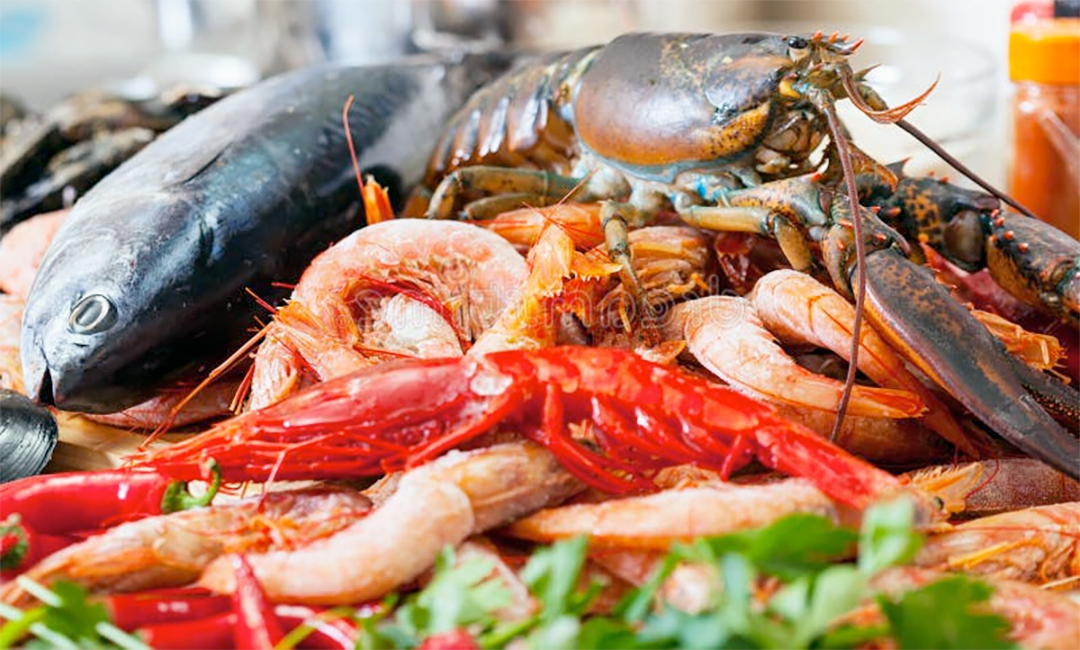 Still Life Photograph of mixed Fish and Seafood.
Welcome to FabulousFusionFood's Fish, Crustacean and Shellfish based Recipes Page — The recipes presented here are all based on aquatic animals: Fish (both sea-water and freshwater), crustaceans (crabs, lobsters, langoustine, crayfish and prawns) and shellfish of all kinds. These are still animals, and their flesh counts as 'meat', though I have removed these animals from the main Meat Recipes page.
Typically, a fish is defined as an aquatic, anamniotic, gill-bearing vertebrate animal with swimming fins and a hard skull, but lacking limbs with digits. Fish can be grouped into the more basal jawless fish and the more common jawed fish, the latter including all living cartilaginous and bony fish, as well as the extinct placoderms and acanthodians. In a break to the long tradition of grouping all fish into a single class (Pisces), modern phylogenetics views fish as a paraphyletic group. Here you will find historic recipes for jawless fishes as well as recipes for cartilaginous and bony jawed fish. For the separate list of fish-based recipes see the fish-based recipes page
For my definition of shellfish I'm including molluscs (ie shelled marine animals) as well as sea snails (that are actually gastropods) but I'm excluding crustaceans (eg prawns, lobsters, crayfish, crabs and barnacles) and cephalopod molluscs (squids, octopodes, cuttlefish) which have their own sections and are described below. Mollusca is a phylum of protostomic invertebrate animals, whose members are known as molluscs or mollusks. Molluscs are the largest marine phylum, comprising about 23% of all the named marine organisms. They are highly diverse, not just in size and anatomical structure, but also in behaviour and habitat, as numerous groups are freshwater and even terrestrial species. For the separate list of shellfish-based recipes see the shellfish-based recipes page.
Crustaceans (from Latin meaning: "those with shells" or "crusted ones") are invertebrate animals that constitute one group of arthropods that are traditionally a part of the subphylum Crustacea (/krəˈsteɪʃə/), a large, diverse group of mainly aquatic arthropods including decapods (shrimps, prawns, crabs, lobsters and crayfish), seed shrimp, branchiopods, fish lice, krill, remipedes, isopods, barnacles, copepods, opossum shrimps, amphipods and mantis shrimp. The vast majority of crustaceans consumed by humans are decapod crustaceans: crabs, lobsters, shrimp, crayfish, langoustine and prawns. Krill and barnacles are the only non-decapod crustaceans eaten regularly. For the separate list of crustacean-based recipes see the crustacean-based recipes page.
Cephalopods are members of the molluscan class Cephalopoda /sɛfəˈlɒpədə/ (Greek plural κεφαλόποδες, kephalópodes; "head-feet") such as a squid, octopus, cuttlefish, or nautilus. These exclusively marine animals are characterized by bilateral body symmetry, a prominent head, and a set of arms or tentacles (muscular hydrostats) modified from the primitive molluscan foot. Fishers sometimes call cephalopods "inkfish", referring to their common ability to squirt ink. They are all regularly consumed by humans, particularly squid and octopodes. For the separate list of caphalopod-based recipes see the cephalopod-based recipes page.
Here I'm using a broader definition of seafood to also include items such as sea anemones (that the Romans ate) as well as sea cucumbers (a common ingredient in sushi) and sea urchins (consumed by ancient Romans and Japanese). Essentially covering the range of aquatic animals consumed by humans.
As this site also includes historic recipes, there will be some unusual fish and shellfish in the lists (like weaver fish from ancient Roman cookery) as well as forms of cookery (like clay baking) that are not so commonly used any more. You will see many Ancient Roman recipes in the list, this is due to the Romans' extensive use of liquamen/garum (fish sauce) in their recipes which was typically fermented from marine fish. There are also many Mediaeval recipes presented, coming from when the Catholic church proscribed the eating of meat and there were more 'fish days' in the yearly calendar than there were days where meat could be eaten. This also explains the separation of aquatic animals from terrestrial animals, the former being classed as 'fish' and the latter as 'meat'.
The alphabetical list of all the fish-, crustacean- and shellfish-based recipes on this site follows, (limited to 100 recipes per page). There are 2561 recipes in total:
Page 21 of 26
| Red snapper with Coconut Curry Sauce Origin: Kiribati | Rygh in sauce (Ruffe in Sauce) Origin: England | Salmon Brochettes Origin: Britain |
| Red-red Origin: Ghana | Ræst fisk med mos (Fermented Fish with Mash) Origin: Greenland | Salmon Devilled Eggs Origin: Britain |
| Reform Sauce Origin: England | Saba Callaloo Origin: Saba | Salmon Durban Curry Origin: Fusion |
| Reform Sauce Origin: Britain | Sabah Tempoyak (Durian Tempoyak) Origin: Malaysia | Salmon in a Mushroom and Pernod Sauce Origin: France |
| Rendang Daging (Malaysian Beef Rendang) Origin: Malaysia | Saban Curry Conch (Saban Curry Conchs) Origin: Saba | Salmon Kalia in Panch Phoron Sauce Origin: India |
| Rendang Fish Curry Origin: Fusion | Saban Pot Origin: Saba | Salmon Tostadas Origin: Fusion |
| Renga Renga (Burundi Sweet Potato Leaf Stew) Origin: Burundi | Sabzi Polo ba Mahi (Fried Fish with Saffron and Herb Rice) Origin: Iran | Salmon with Acacia Seed and Tasmanian Pepper Berry Rub Origin: Australia |
| Restaurant-style Monkfish Curry Origin: Britain | Sach Ko Tirk Prahok (Beef in Fish Sauce) Origin: Cambodia | Salmon with Hot Beetroot Relish Origin: Britain |
| Rhiwbob Rhost â Iogwrt (Limpets) Origin: Welsh | Sach Mon Chha Khnei (Stir-fried Chicken with Ginger) Origin: Cambodia | Salmon Yakitori Origin: Fusion |
| Rholiau Lleden gyda Saws Madarch Hufennog (Flatfish Rolls with Creamy Mushroom Sauce) Origin: Welsh | Sacha Sauce Origin: Taiwan | Salone-style Kibbeh Origin: Sierra Leone |
| Ribnoye Kharcho (Salmon and Walnut Soup) Origin: Georgia | Saffe (Mutton and Cassava Leaf Stew) Origin: Sierra Leone | Salone-style Scotch Eggs Origin: Sierra Leone |
| Rillette de maquereau (Mackerel Rillette) Origin: France | Saffron Mussel Sauce Origin: Britain | Salsa de Cacahuete con Pollo (Peanut Sauce with Chicken) Origin: Equatorial Guinea |
| Risoto Cranc Celtaidd a Chorgimychiaid Bae Ceredigion (Risotto of Celtic Crab and Cardigan Bay Prawns) Origin: Welsh | Saffron Prawn Both Origin: Britain | Salsa de Espinacosas (Spinach Salsa) Origin: Equatorial Guinea |
| Risotto al Tonno (Risotto with Tuna) Origin: Italy | Sage and Onion Stuffed Monkfish Origin: Britain | Salt and Pepper Squid Rings Origin: South Africa |
| Risotto alla Paesana (Risotto with Beans and Bacon) Origin: Italy | Saimin (Hawaiian Noodle Soup) Origin: Hawaii | Salt Cod Origin: Britain |
| Riz des Iles (Island Rice) Origin: Comoros | Saint jacques poêlées au lait de coco avec sa purée de patate douce (Scallops in Coconut Milk with Mashed Sweet Potatoes) Origin: Togo | Salt Cod and Potatoes Origin: Bermuda |
| Riz Soumbala (Soumbala Rice) Origin: Burkina Faso | Saint Kitts Stewed Saltfish Origin: Saint Kitts | Salt Cod and Sweet Potato Fish Cakes Origin: Bahamas |
| Riz Wolof (Wolof Rice) Origin: Guinea | Saint Lucia Lambi Soup with Dumplings Origin: Saint Lucia | Salt Cod Fish Cakes Origin: Bahamas |
| Roast Cod with Sea Beans and Oyster Origin: Canada | Saint Lucian Accras Origin: Saint Lucia | Salted Pilchard and Leek Pie Origin: Britain |
| Roast Megrim with Parsley and Caper Butter Origin: England | Saint Vincent Curry Conch with Dumplings Origin: Saint Vincent | Saltfish Accra Origin: Trinidad |
| Roast Monkfish Tail with Garlic and Rosemary Origin: British | Saint-Martin Whelk Soup Origin: Saint-Martin | Saltfish Accra Origin: Barbados |
| Roast Rump of Lamb with Lamb's Lettuce Origin: Britain | Saka Saka du Mali (Malian Sweet Potato Leaf Sauce) Origin: Mali | Saltfish And Breadfruit Hash Origin: Saint Kitts |
| Roast Salmon Chowder Origin: Britain | Saka-saka (Mutton and Cassava Leaf Stew) Origin: Guinea | Saltfish Buljol with Avocado and Cucumber Origin: Aruba |
| Roasted Breadfruit and Fried Jackfish Origin: Saint Vincent | Salad Gwydrwymon gyda Ffenigl ac Oren (Gutweed Salad with Fennel and Orange) Origin: Welsh | Saltfish Buljolde Origin: Antigua |
| Roasted breadfruit and smoked herring Origin: Saint Lucia | Salad Madarch, Cennin ac Eog (Salmon, Mushroom and Leek Salad) Origin: Welsh | Saltfish Buljolde Origin: British Virgin Islands |
| Roasted fish with Eluit el Tuu Origin: Palau | Salada de Logosta à Moda de Cabo Verde (Cape Verdean Lobster Salad) Origin: Cape Verde | Saltfish Salad Origin: Anguilla |
| Roasted Kalettes with Basa Fillets and Anchovies Origin: Britain | Salade de la mer (Seafood Salad) Origin: France | Saltsa gia Psari (Red Sauce for Fish) Origin: Greece |
| Robert Sauce Origin: Britain | Salade de morue (Salt Cod Salad) Origin: Saint-Martin | Samaki wa Kakuango (Fried Fish with Onions) Origin: Tanzania |
| Rock Samphire Salsa Verde Origin: Britain | Salata od hobotnice na Prigorski (Prigorski-style octopus salad) Origin: Croatia | Samaki wa Kapaka (Zanzibar Grilled Fish) Origin: Tanzania |
| Rossolye (Salad with Herring and Beetroot) Origin: Estonia | Sallets for fish daies (Fish-day Salad) Origin: Britain | Sambal Belacan Origin: Malaysia |
| Rougaille de Poisson Salé (Salted Fish Rougaille) Origin: Mauritius | Salmagundi with Herby Rack of Lamb Origin: Britain | Sambal Telur Origin: Malaysia |
| Rukau Origin: Cook Islands | Salmon à la Génévese Origin: British | Sambal Tomat (Tomato Sambal) Origin: Aruba |
| Rukau Origin: Tuvalu | Salmon and Couscous en Papillote Origin: Britain | |
| Rukau Origin: Tokelau | Salmon and Dulse Fishcakes Origin: Scotland |
Page 21 of 26