FabulousFusionFood's Fish, Crustacean, Cephalopod and Shellfish based Recipes 9th Page
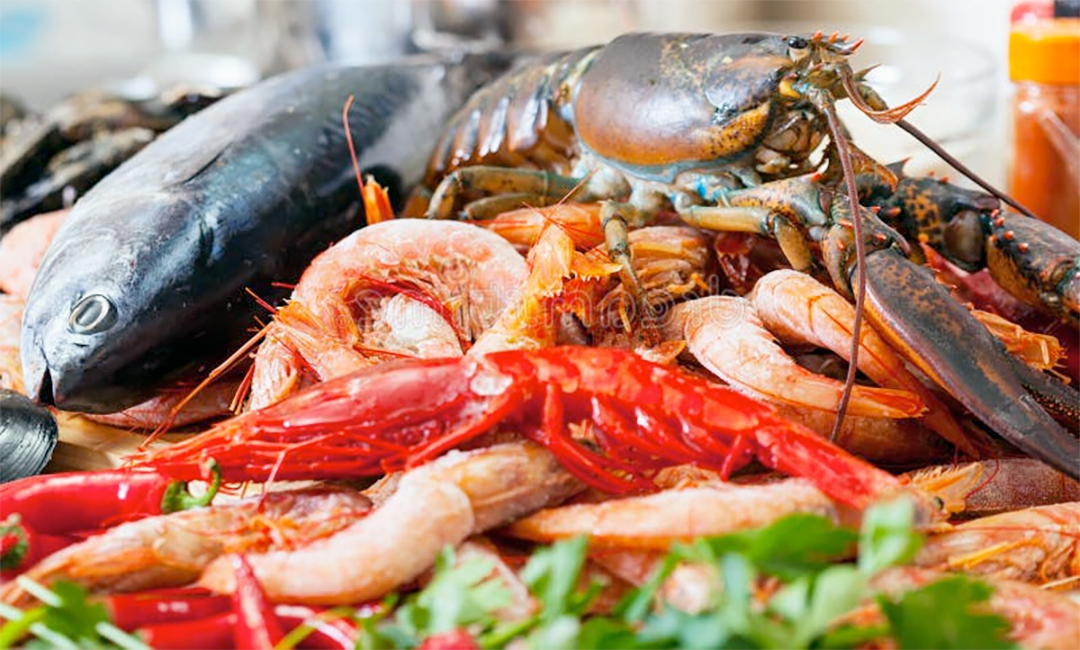 Still Life Photograph of mixed Fish and Seafood.
Welcome to FabulousFusionFood's Fish, Crustacean and Shellfish based Recipes Page — The recipes presented here are all based on aquatic animals: Fish (both sea-water and freshwater), crustaceans (crabs, lobsters, langoustine, crayfish and prawns) and shellfish of all kinds. These are still animals, and their flesh counts as 'meat', though I have removed these animals from the main Meat Recipes page.
Typically, a fish is defined as an aquatic, anamniotic, gill-bearing vertebrate animal with swimming fins and a hard skull, but lacking limbs with digits. Fish can be grouped into the more basal jawless fish and the more common jawed fish, the latter including all living cartilaginous and bony fish, as well as the extinct placoderms and acanthodians. In a break to the long tradition of grouping all fish into a single class (Pisces), modern phylogenetics views fish as a paraphyletic group. Here you will find historic recipes for jawless fishes as well as recipes for cartilaginous and bony jawed fish. For the separate list of fish-based recipes see the fish-based recipes page
For my definition of shellfish I'm including molluscs (ie shelled marine animals) as well as sea snails (that are actually gastropods) but I'm excluding crustaceans (eg prawns, lobsters, crayfish, crabs and barnacles) and cephalopod molluscs (squids, octopodes, cuttlefish) which have their own sections and are described below. Mollusca is a phylum of protostomic invertebrate animals, whose members are known as molluscs or mollusks. Molluscs are the largest marine phylum, comprising about 23% of all the named marine organisms. They are highly diverse, not just in size and anatomical structure, but also in behaviour and habitat, as numerous groups are freshwater and even terrestrial species. For the separate list of shellfish-based recipes see the shellfish-based recipes page.
Crustaceans (from Latin meaning: "those with shells" or "crusted ones") are invertebrate animals that constitute one group of arthropods that are traditionally a part of the subphylum Crustacea (/krəˈsteɪʃə/), a large, diverse group of mainly aquatic arthropods including decapods (shrimps, prawns, crabs, lobsters and crayfish), seed shrimp, branchiopods, fish lice, krill, remipedes, isopods, barnacles, copepods, opossum shrimps, amphipods and mantis shrimp. The vast majority of crustaceans consumed by humans are decapod crustaceans: crabs, lobsters, shrimp, crayfish, langoustine and prawns. Krill and barnacles are the only non-decapod crustaceans eaten regularly. For the separate list of crustacean-based recipes see the crustacean-based recipes page.
Cephalopods are members of the molluscan class Cephalopoda /sɛfəˈlɒpədə/ (Greek plural κεφαλόποδες, kephalópodes; "head-feet") such as a squid, octopus, cuttlefish, or nautilus. These exclusively marine animals are characterized by bilateral body symmetry, a prominent head, and a set of arms or tentacles (muscular hydrostats) modified from the primitive molluscan foot. Fishers sometimes call cephalopods "inkfish", referring to their common ability to squirt ink. They are all regularly consumed by humans, particularly squid and octopodes. For the separate list of caphalopod-based recipes see the cephalopod-based recipes page.
Here I'm using a broader definition of seafood to also include items such as sea anemones (that the Romans ate) as well as sea cucumbers (a common ingredient in sushi) and sea urchins (consumed by ancient Romans and Japanese). Essentially covering the range of aquatic animals consumed by humans.
As this site also includes historic recipes, there will be some unusual fish and shellfish in the lists (like weaver fish from ancient Roman cookery) as well as forms of cookery (like clay baking) that are not so commonly used any more. You will see many Ancient Roman recipes in the list, this is due to the Romans' extensive use of liquamen/garum (fish sauce) in their recipes which was typically fermented from marine fish. There are also many Mediaeval recipes presented, coming from when the Catholic church proscribed the eating of meat and there were more 'fish days' in the yearly calendar than there were days where meat could be eaten. This also explains the separation of aquatic animals from terrestrial animals, the former being classed as 'fish' and the latter as 'meat'.
The alphabetical list of all the fish-, crustacean- and shellfish-based recipes on this site follows, (limited to 100 recipes per page). There are 2561 recipes in total:
Page 9 of 26
| Eog Cothi Pob (Baked Cothi Salmon) Origin: Welsh | Fijian Suruwa (Fijian Fish Curry) Origin: Fiji | Fish Newberg Origin: Britain |
| Eog Gyda Saws Corgimychiaid (Salmon with Prawn Sauce) Origin: Welsh | Filé Gumbo Origin: Louisiana | Fish Padha (Sri Lankan Fish Pickle) Origin: Sri Lanka |
| Eog Wedi Crasu Gyda Bara Lawr â Chaws (Baked Salmon with Laver Bread and Cheese) Origin: Welsh | Filedi Pysgod a Chaws Pob (Fish Fillet Rarebit) Origin: Welsh | Fish Pathia Origin: India |
| Eog wedi ei Bobi gyda Thatws a Teim (Salmon Baked with Potatoes and Thyme) Origin: Welsh | Filet de Lotte au Cury (Curried Monkfish Fillet) Origin: Senegal | Fish Pie with Dulse Origin: Scotland |
| Eru avec Garri (Eru with Garri) Origin: Cameroon | Filets de Morue au Fromage (Cod Fillets with Cheese) Origin: Canada | Fish Puffs Origin: Britain |
| Escabeche Nga Isdab (Sweet and Sour Skate Escabeche) Origin: Philippines | Filipino Chicken Curry Origin: Philippines | Fish Sausages Origin: Scotland |
| Esparregados de Bacalhau (Cod Esparregados) Origin: Angola | Filipino Chicken Curry 2 Origin: Philippines | Fish Serre Origin: Belize |
| Ewa Dodo (Black-eyed peas with Plantains) Origin: Niger | Filipino Fish Curry Origin: Philippines | Fish Slice Origin: Britain |
| F'rell am Rèisleck (Trout in Riesling Sauce) Origin: Luxembourg | Fillet of Salmon with Green Couscous Origin: Fusion | Fish Soup Origin: Scotland |
| Fänkålssoppa med strimlad lax (Fennel Soup with Smoked Salmon Shreds) Origin: Sweden | Fillets of John Dory with Sage Origin: Britain | Fish Steaks with Barbecue Sauce Origin: Anguilla |
| Fúti (Mixed Fula Dish) Origin: Guinea-Bissau | Finnan Haddie Origin: Scotland | Fish Stew Origin: Guinea-Bissau |
| Fabaciae Frictae (Fried Green Beans) Origin: Roman | Finnan Haddock with Cheese Origin: Scotland | Fish Stock Origin: British |
| Faenum Graecum (Fenugreek) Origin: Roman | FionFion Origin: Togo | Fish Tacos Origin: Britain |
| Fāfaru (Fermented Coconut Sauce) Origin: Tahiti | Firecracker Barbecued Salmon Origin: American | Fish Terrine Origin: Britain |
| Fāfaru (Fermented Coconut Sauce) Origin: Wallis Futuna | Firire (Fried Fish) Origin: Senegal | Fish Tikka Origin: Britain |
| Fāfaru (Fermented Coconut Sauce) Origin: Austral Islands | Fish and Breadfruit Casserole Origin: Nauru | Fish Tikka Kebabs Origin: India |
| Fanesca ecuatoriana (Ecuadorian Easter soup) Origin: Ecuador | Fish and Dried Mallow Leaf Stew Origin: African Fusion | Fish Tikka Masala Origin: India |
| Fante-Fante (Ghanaian Fisherman's Stew) Origin: Ghana | Fish and Fennel Sauté Origin: Britain | Fish Vindaye Origin: Mauritius |
| Faten Doya (Nigerian Yam Pottage) Origin: Nigeria | Fish and Mula Red Curry (Fish and Mooli Red Curry) Origin: Bangladesh | Fish Waterzooï Origin: Belgium |
| Fermented Krill Sauce Origin: Japan | Fish and Oyster Pie Origin: British | Fish with Orange Curry Sauce Origin: Fusion |
| Fermented Krill/Shrimp Paste Origin: Japan | Fish and Snail Sauce Origin: Nigeria | Fish-in-bata Origin: Sierra Leone |
| Féroce d'Avocat Origin: Martinique | Fish Balls with Green Bananas Origin: Pitcairn Islands | Fish-Stuffed Mushrooms Origin: Britain |
| Féroce d'Avocat Origin: Guadeloupe | Fish Bhuna (Bengali-Style Fried Fish in Onion and Tomato Curry) Origin: Bangladesh | Fisherman's Brewis Origin: Ireland |
| Feuilles de Manioc (Central African Cassava Leaves) Origin: Central Africa | Fish Breyani Origin: South Africa | Fishie Tatties Origin: Scotland |
| Feuilles de Manioc Malienne (Malian Cassava Leaf Stew) Origin: Mali | Fish Cake Origin: British | Fisk och paprikasoppa (Fish and Bell Pepper Soup) Origin: Sweden |
| Ffiledi Cegddu wedi eu Llenwi (Stuffed Fillets of Hake) Origin: Welsh | Fish Creole Origin: Louisiana | Fisk på grönsakspytt (Ham Cakes) Origin: Sweden |
| Ffiledi Gorbenfras wedi eu Llenwi (Stuffed Fillets of Haddock) Origin: Welsh | Fish Doopeaja Origin: Bangladesh | Fiskgryta (Fish Stew) Origin: Sweden |
| Ffiledi Gwyniad wedi eu Llenwi (Stuffed Fillets of Whiting) Origin: Welsh | Fish Dopeaja Origin: Bangladesh | Fiskgryta med citron och gräslök (Fish Stew with Lemon and Chives) Origin: Sweden |
| Ffiledi Môr-leisiad wedi eu Llenwi (Stuffed Fillets of Pollack) Origin: Welsh | Fish in Barley Bread Origin: Ancient | Fiskibollur (Fish Balls) Origin: Iceland |
| Ffiledi Penfras wedi eu Llenwi (Stuffed Fillets of Cod) Origin: Welsh | Fish in Orange and Caraway Sauce Origin: Mediterranean | Fiskibollur (Icelandic Fish Balls with Curry Sauce) Origin: Iceland |
| Fideos con Atun (Spaghetti with Tuna) Origin: Gibraltar | Fish in Vine Leaves Origin: Greece | Fisksoppa (Swedish Fish Soup) Origin: Sweden |
| Fijian Crab Curry Origin: Fiji | Fish Kebabs Origin: Britain | Flaming Eggs Origin: Thailand |
| Fijian Goat Curry 2 Origin: Fiji | Fish Kofta Curry Origin: Anglo-Indian | |
| Fijian Indian Tomato Chutney Origin: Fiji | Fish Molee (Keralan Fish Stew) Origin: India |
Page 9 of 26