FabulousFusionFood's Fish, Crustacean, Cephalopod and Shellfish based Recipes 24th Page
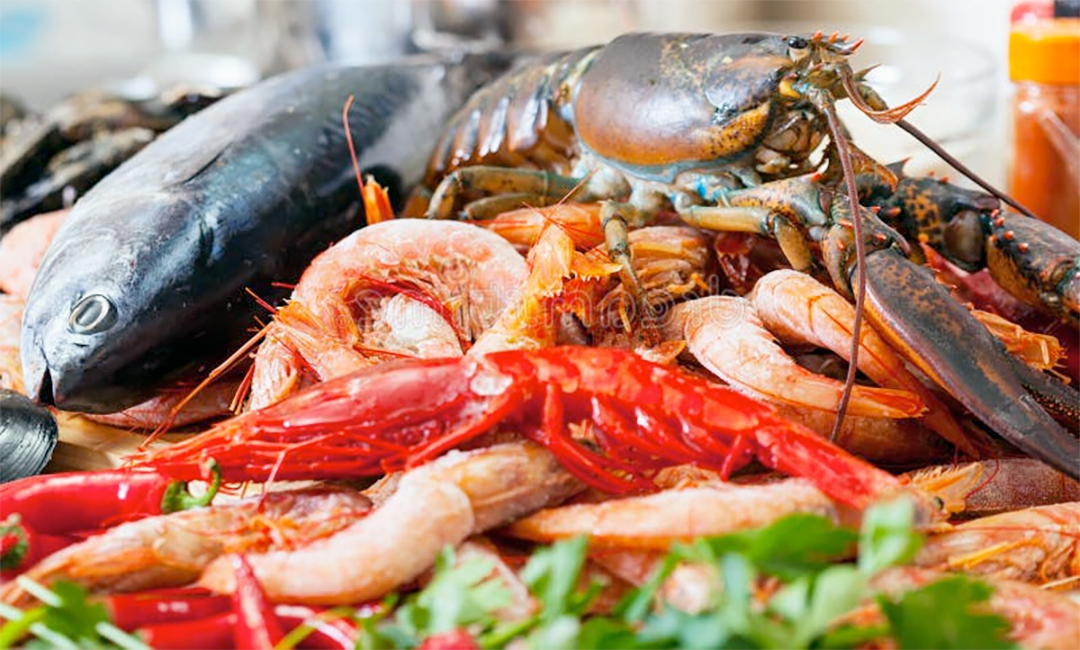 Still Life Photograph of mixed Fish and Seafood.
Welcome to FabulousFusionFood's Fish, Crustacean and Shellfish based Recipes Page — The recipes presented here are all based on aquatic animals: Fish (both sea-water and freshwater), crustaceans (crabs, lobsters, langoustine, crayfish and prawns) and shellfish of all kinds. These are still animals, and their flesh counts as 'meat', though I have removed these animals from the main Meat Recipes page.
Typically, a fish is defined as an aquatic, anamniotic, gill-bearing vertebrate animal with swimming fins and a hard skull, but lacking limbs with digits. Fish can be grouped into the more basal jawless fish and the more common jawed fish, the latter including all living cartilaginous and bony fish, as well as the extinct placoderms and acanthodians. In a break to the long tradition of grouping all fish into a single class (Pisces), modern phylogenetics views fish as a paraphyletic group. Here you will find historic recipes for jawless fishes as well as recipes for cartilaginous and bony jawed fish. For the separate list of fish-based recipes see the fish-based recipes page
For my definition of shellfish I'm including molluscs (ie shelled marine animals) as well as sea snails (that are actually gastropods) but I'm excluding crustaceans (eg prawns, lobsters, crayfish, crabs and barnacles) and cephalopod molluscs (squids, octopodes, cuttlefish) which have their own sections and are described below. Mollusca is a phylum of protostomic invertebrate animals, whose members are known as molluscs or mollusks. Molluscs are the largest marine phylum, comprising about 23% of all the named marine organisms. They are highly diverse, not just in size and anatomical structure, but also in behaviour and habitat, as numerous groups are freshwater and even terrestrial species. For the separate list of shellfish-based recipes see the shellfish-based recipes page.
Crustaceans (from Latin meaning: "those with shells" or "crusted ones") are invertebrate animals that constitute one group of arthropods that are traditionally a part of the subphylum Crustacea (/krəˈsteɪʃə/), a large, diverse group of mainly aquatic arthropods including decapods (shrimps, prawns, crabs, lobsters and crayfish), seed shrimp, branchiopods, fish lice, krill, remipedes, isopods, barnacles, copepods, opossum shrimps, amphipods and mantis shrimp. The vast majority of crustaceans consumed by humans are decapod crustaceans: crabs, lobsters, shrimp, crayfish, langoustine and prawns. Krill and barnacles are the only non-decapod crustaceans eaten regularly. For the separate list of crustacean-based recipes see the crustacean-based recipes page.
Cephalopods are members of the molluscan class Cephalopoda /sɛfəˈlɒpədə/ (Greek plural κεφαλόποδες, kephalópodes; "head-feet") such as a squid, octopus, cuttlefish, or nautilus. These exclusively marine animals are characterized by bilateral body symmetry, a prominent head, and a set of arms or tentacles (muscular hydrostats) modified from the primitive molluscan foot. Fishers sometimes call cephalopods "inkfish", referring to their common ability to squirt ink. They are all regularly consumed by humans, particularly squid and octopodes. For the separate list of caphalopod-based recipes see the cephalopod-based recipes page.
Here I'm using a broader definition of seafood to also include items such as sea anemones (that the Romans ate) as well as sea cucumbers (a common ingredient in sushi) and sea urchins (consumed by ancient Romans and Japanese). Essentially covering the range of aquatic animals consumed by humans.
As this site also includes historic recipes, there will be some unusual fish and shellfish in the lists (like weaver fish from ancient Roman cookery) as well as forms of cookery (like clay baking) that are not so commonly used any more. You will see many Ancient Roman recipes in the list, this is due to the Romans' extensive use of liquamen/garum (fish sauce) in their recipes which was typically fermented from marine fish. There are also many Mediaeval recipes presented, coming from when the Catholic church proscribed the eating of meat and there were more 'fish days' in the yearly calendar than there were days where meat could be eaten. This also explains the separation of aquatic animals from terrestrial animals, the former being classed as 'fish' and the latter as 'meat'.
The alphabetical list of all the fish-, crustacean- and shellfish-based recipes on this site follows, (limited to 100 recipes per page). There are 2561 recipes in total:
Page 24 of 26
| Sprats Moju Origin: Sri Lanka | Stuffat Tal-Qarnit (Octopus Stew) Origin: Malta | Tandoori Monkfish Origin: Britain |
| Spring Rolls Origin: Fusion | Stuffed Grilled Fish Origin: Liberia | Tannia and Pineapple Fritters Origin: Saint Kitts |
| Spring Rolls with Pork and Shrimp Origin: China | Stuffed Hake with Mushroom Gravy Origin: African Fusion | Tapado (Seafood Soup) Origin: Guatemala |
| Squid Salad with Chicory, Anchovies and Sun-dried Tomatoes Origin: Britain | Stuffed Morels Origin: American | Tapenade Origin: Spain |
| Sri Lankan Fish Curry Origin: Sri Lanka | Stuffed Plaice Swirls Origin: Britain | Tapenade Monegasque (Monaco-style Tapenade) Origin: Monaco |
| St Helena Crab Soup Origin: St Helena | Stuffed Sardines Origin: Britain | Taramasalata Origin: Greece |
| St Helena Fishcakes Origin: St Helena | Sumen Plenum (Stuffed Sow's Belly) Origin: Roman | Taro aux Fruits de Mer (Taro with Seafood) Origin: Cote dIvoire |
| St Kitts Saltfish And Breadfruit Pie Origin: Saint Kitts | Suomen Kalakeitto (Finnish Fish Soup) Origin: Finland | Tart de ffruyte (A Fruit Pie) Origin: England |
| St Kitts Stewed Fish Origin: Saint Kitts | Superkanja Origin: Gambia | Tartar Sauce Origin: Britain |
| St. Lucia Jerk Fish with Banana Salsa Origin: Saint Lucia | Surf and Turf Kebabs Origin: Britain | Tarten Sawrus Eog (Savoury Salmon Tart) Origin: Welsh |
| Stargazy Pasty Origin: England | Surinamese Nasi Goreng Origin: Suriname | Tataki Gobo Origin: Japan |
| Steak Sauce Origin: American | Sushi-Meshi (Sushi Rice) Origin: Japan | Tatties an' Herrin' Origin: Scotland |
| Steamed Black-eyed Bean Dumplings Origin: Ghana | Sweet and Sour Fish Patia Origin: India | Teisennau Cocos (Cockle Cakes) Origin: Welsh |
| Steamed Cantonese-style fish with spicy noodles Origin: China | Sweet Chilli Sauce Origin: New Zealand | Teisennau Cranc wedi'u Grilio (Barbecued Crab Cakes) Origin: Welsh |
| Steamed Crawfish Origin: Liberia | Sweet Chilli Sauce Origin: New Caledonia | Teisennau Eog Dyfrdwy (Dee Salmon Fish Cakes) Origin: Welsh |
| Steamed Prawns with Wolfberries Origin: Singapore | Sweet Potato Pottage Origin: Nigeria | Telo met Bakkeljauw (Fried Cassava with Salt Cod) Origin: Suriname |
| Steamed Sole with Black Bean Sauce Origin: China | Sweetbread Croquets Origin: British | Tempura Origin: Japan |
| Stewed Carp Origin: British | Swordfish Steaks with Chermoula Origin: South Africa | Terrine de Congue aux Algues (Conger Terrine with Seaweed) Origin: France |
| Stewed Char Origin: British | Swper 'Sgadan (Welsh Herring Supper) Origin: Welsh | Terrine de la mer (Seafood terrine) Origin: France |
| Stewed Chubb Origin: British | Tacos di Pesce (Fish Tacos) Origin: Mexico | Terrine de saumoun aux Quatre algues (Terrine of Salmon with Quatre Algues) Origin: France |
| Stewed Dace Origin: British | Tadjine Zdef (Mutton and Cheese Tagine) Origin: Benin | Terung Saus Santan (Fried Aubergines with Coconut Milk) Origin: Papua |
| Stewed Eels I Origin: British | Tagine de Daurade (Tagine of Sea Bream) Origin: Morocco | Thai Chicken Soup with Ginger and Lime Origin: Thailand |
| Stewed Eels II Origin: British | Tagliarini with Gurnard, Parsley, Garlic and Sea Spaghetti Origin: England | Thai Crab and Sea-blite Curry Origin: Thailand |
| Stewed Roach Origin: British | Tagliatelles aux sardines et aux artichauts de Bretagne (Tagliatelle with Sardines and Breton Artichokes) Origin: France | Thai Green Curried Cod Origin: Fusion |
| Stewed saltfish with spicy plantains and coconut dumplings Origin: Saint Kitts | Tahitian Fish Origin: Norfolk Island | Thai Green Curry of Prawn and Fish Origin: Thailand |
| Stewed Scallops in Milk Origin: Britain | Tähroro (Fermented Coconut Sauce) Origin: Rotuma | Thai Green Curry Paste Origin: Thailand |
| Stewed Smoked, Sun-dried Fish Origin: Montenegro | Tai Monomono (Fermented Coconut Sauce) Origin: Cook Islands | Thai Green Curry Paste II Origin: Thailand |
| Stir-fried Clams in Black Bean Sauce Origin: Hong Kong | Taioro Origin: Tahiti | Thai Green Curry with Chicken of the Woods Origin: Britain |
| Stir-fried Scallops Origin: Fusion | Taiwanese Hot Pot Origin: Taiwan | Thai Hake Bites Origin: South Africa |
| Stir-fried Squid with Herbs and Sea Aster Origin: Fusion | Tam Mak Hoong (Laotian Papaya Salad) Origin: Laos | Thai Mango Fish Curry Origin: Thailand |
| Stiw Pysgotwr (Fisherman's Stew) Origin: Welsh | Tam Som (Lao Green Papaya Salad) Origin: Laos | Thai Peanut Coconut Curry with Pheasant and Squash Origin: Fusion |
| Stockfish Stew Origin: Nigeria | Tandoori Fish Origin: India | Thai Pork Curry in the Burmese Style Origin: Myanmar |
| Street Food Pad Thai Origin: Thailand | Tandoori King Prawns Origin: India | |
| Stufato del Pescatore (Italian Fisherman's Stew) Origin: Italy | Tandoori King Prawns Origin: Britain |
Page 24 of 26