FabulousFusionFood's Fish-based Recipes 4th Page
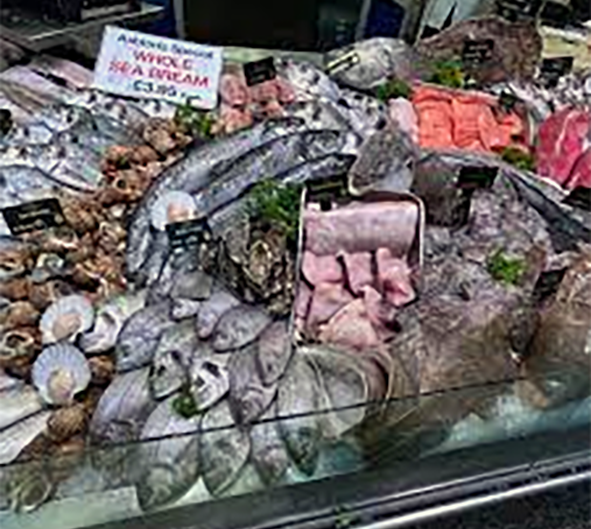 Fish displayed at a fishmonger's stall.
Welcome to FabulousFusionFood's Fish-based Recipes Page — The recipes presented here are all based on Fish (both sea-water and freshwater).
A fish (pl.: fish or fishes) is an aquatic, anamniotic, gill-bearing vertebrate animal with swimming fins and a hard skull, but lacking limbs with digits. Fish can be grouped into the more basal jawless fish and the more common jawed fish, the latter including all living cartilaginous and bony fish, as well as the extinct placoderms and acanthodians. In a break to the long tradition of grouping all fish into a single class (Pisces), contemporary phylogenetics views fish as a paraphyletic group (in that all vertebrates evolved from fishes, so tetrapods, can be classified as belonging to the lobe-finned fish but are not considered such).
Most fish are cold-blooded, their body temperature varying with the surrounding water, though some large active swimmers like white shark and tuna can hold a higher core temperature. Many fish can communicate acoustically with each other, such as during courtship displays. The study of fish is known as ichthyology.
Bony fish, distinguished by the presence of swim bladders and later ossified endoskeletons, emerged as the dominant group of fish after the end-Devonian extinction wiped out the apex predators, the placoderms. Bony fish are further divided into the lobe-finned and ray-finned fish. About 96% of all living fish species today are teleosts, a crown group of ray-finned fish that can protrude their jaws. The tetrapods, a mostly terrestrial clade of vertebrates that have dominated the top trophic levels in both aquatic and terrestrial ecosystems since the Late Paleozoic, evolved from lobe-finned fish during the Carboniferous, developing air-breathing lungs homologous to swim bladders. Despite the cladistic lineage, tetrapods are usually not considered to be fish.
Fish account for more than half of vertebrate species. As of 2016, there are over 33,000 described species of bony fish, over 1,100 species of cartilaginous fish, and over 100 hagfish and lampreys. A third of these fall within the nine largest families; from largest to smallest, these are Cyprinidae, Gobiidae, Cichlidae, Characidae, Loricariidae, Balitoridae, Serranidae, Labridae, and Scorpaenidae. About 64 families are monotypic, containing only one species.
Throughout history, humans have used fish as a food source for dietary protein. Historically and today, most fish harvested for human consumption has come by means of catching wild fish. However, fish farming, which has been practiced since about 3,500 BCE in ancient China, is becoming increasingly important in many nations. Overall, about one-sixth of the world's protein is estimated to be provided by fish. Fishing is accordingly a large global business which provides income for millions of people. The Environmental Defense Fund has a guide on which fish are safe to eat, given the state of pollution in today's world, and which fish are obtained in a sustainable way.
The word fish is inherited from Proto-Germanic, and is related to German Fisch, the Latin piscis, Old Irish īasc and Welsh pysgod, though the exact root is unknown; some authorities reconstruct a Proto-Indo-European root *peysk-, attested only in Italic, Celtic, and Germanic.
Though often used interchangeably, in biology fish and fishes have different meanings. Fish is used as a singular noun, or as a plural to describe multiple individuals from a single species. Fishes is used to describe different species or species groups.
The alphabetical list of all the fish-based recipes on this site follows, (limited to 100 recipes per page). There are 2195 recipes in total:
Page 4 of 22
| Brithyll mewn Cig Moch (Trout in Bacon) Origin: Welsh | Caesar Salad Origin: Mexico | Caper Sauce for Fish Origin: Britain |
| Brithyll Mewn Crwst Cnau Cyll â Pherlysiau (Trout in a Hazelnut Crust with Herbs) Origin: Welsh | Cajun Blackened Fish/Meat Origin: Cajun | Capitaine and Pili-Pili in Palm Oil Origin: Congo |
| Brithyll wedi eu Llenwi (Stuffed Trout) Origin: Welsh | Cajun Crayfish Bread Origin: Cajun | Capitaine, Sauce aux Agrumes (Steamed Catfish with Citrus Sauce) Origin: Mali |
| Brithyll wedi'i serio gyda Stwnsh Bara Lawr, Samffir, Sbigoglys a Phys (Seared Trout with Laver Mash, Samphire, Spinach and Peas) Origin: Welsh | Cajun Crayfish Cornbread Origin: Cajun | Caponata Origin: Italy |
| Brochette de Poisson Tchadienne (Chadian Fish Kebabs) Origin: Chad | Cajun Shrimp-stuffed Pistolettes Origin: Cajun | Caranguejo Grelhado (Grilled Crabs) Origin: Guinea-Bissau |
| Brochettes à la Normande (Normandy Brochettes) Origin: France | Cake sarrasin au blé noir, aux (Savoury cake with buckwheat, seaweed and trout) Origin: France | Carapachos Rellenos (Stuffed Crab Shells) Origin: Ecuador |
| Brodet na Dalmatinski Nacin (Fish, Dalmatian Style) Origin: Serbia | Calalou Origin: French Guiana | Carapaus Fritos (Portuguese Fried Mackerel) Origin: Portugal |
| Broiled Whiting Origin: Britain | Calco Stoba (Conch Stew) Origin: Aruba | Cardinal Sauce Origin: Britain |
| Broudou bil Hout (Tunisian Fish Soup) Origin: Tunisia | Caldeirada de Lulas a Madeirense (Madeira Squid Stew) Origin: Portugal | Cari de Morue (Cod Curry) Origin: Saint Pierre |
| Brown Butter Sauce Origin: Britain | Caldo Branco (White Stew) Origin: Guinea-Bissau | Cari de Thon (Tuna Curry) Origin: Reunion |
| Brown Caper Sauce Origin: Britain | Caldo de Bagre (Catfish Soup) Origin: Ecuador | Cari Dholl (Yellow Split Pea Curry) Origin: Mauritius |
| Brown Matelotte Sauce Origin: Britain | Caldo de Bicuda (Barracuda Stew) Origin: Guinea-Bissau | Cari Langoustes (Lobster Curry) Origin: Reunion |
| Brown Oyster Sauce Origin: Britain | Caldo de Chabéu (Palm Nut Stew) Origin: Guinea-Bissau | Cari Ourite (Octopus Curry) Origin: Mauritius |
| Brunei Cutlets Origin: Brunei | Caldo de Citi (Red Palm oil Stew) Origin: Guinea-Bissau | Cari Poisson (Fish Curry) Origin: Reunion |
| Bucatini con Rana Pescatrice (Bucatini with Monkfish) Origin: Italy | Caldo de Peixe (Cape Verdean Fish Soup) Origin: Cape Verde | Cari Poisson (Mauritian Fish Curry) Origin: Mauritius |
| Budu Sauce (Fermented Anchovy Sauce) Origin: East Timor | Caldo de Peixe de Guiné-Bissau (Guinea-Bissau Style Fish Stew) Origin: Guinea-Bissau | Cari Poisson (Fish Curry) Origin: Mauritius |
| Budu Sauce (Grilled Tamarind Fish) Origin: Malaysia | Caldo de Pescado (Aruban Fish Soup) Origin: Aruba | Caribbean-style Fish Kebabs Origin: Fusion |
| Bulbos (Bulbs) Origin: Roman | Caldou au Bissap (Flatfish with Hibiscus Flowers) Origin: Senegal | Caril de Caranguejo (Crab Curry) Origin: Mozambique |
| Bulgur Wan Pot Origin: Sierra Leone | Calulu Origin: Sao Tome | Caril de Marisco (Seafood Curry) Origin: Mozambique |
| Buljawou Origin: Sint Maarten | Calulu de Peixe (Fish Calulu) Origin: Angola | Caril de peixe (Fish curry) Origin: Sao Tome |
| Bunuelitos de Bacalao (Cod Fritters) Origin: Spain | Camarâes à Guineense (Guinean Prawns) Origin: Guinea-Bissau | Caril de Tubarão (Azorean Tope Shark Curry) Origin: Portugal |
| Burmese grilled chicken with sticky and crispy rice Origin: Myanmar | Camarão na Abóbora (Prawns in Pumpkin Shells) Origin: Mozambique | Carne de Porco à Alentejana (Pork in the style of Alentejo) Origin: Portugal |
| Burrida Ligure (Genoese Fish Stew) Origin: Italy | Camarones Salteados (Sautéed Prawns) Origin: Ecuador | Carne de Porco em Vinho D'alhos (Pork in Vinegar) Origin: Portugal |
| Bushmeat Skewers with Cashew Nut Satay Origin: Namibia | Camel Chubbagin Origin: Mauritania | Carne Porco Vinho D'alhos (Pork in Garlic and Wine) Origin: Portugal |
| Butter-roasted Megrim Sole with Mussels and Cider Origin: Northern Ireland | Cameroon Fried Rice Origin: Cameroon | Carroo Fuinnt (Baked Carp ) Origin: Manx |
| Buttered Crab Origin: England | Cameroonian Burning Fish Origin: Cameroon | Casado Origin: Costa Rica |
| Butterflied Lamb Shoulder with Salsa Verde Origin: Britain | Cameroonian Egusi Pudding Origin: Cameroon | Cassava Leaf Soup Origin: Liberia |
| Butterfly Chops with Redcurrant Glaze Origin: Britain | Canh Chua Gà (Chicken Sour Soup) Origin: Vietnam | Cassava Leaf Stew Origin: Sierra Leone |
| Cà Ri Gá (Chicken Curry) Origin: Vietnam | Cantonese Braised Pomelo Skin with Fish Stock Origin: China | Cath Fôr gyda Oren a Chennin (Skate with Orange and Leeks) Origin: Welsh |
| Cëebu Jen II Origin: Senegal | Cantonese Lap Cheong (Home-made Chinese Sausages) Origin: Hong Kong | Caudel of Muskels (Caudle of Mussels) Origin: England |
| Cabbage Mallung (Curried Cabbage) Origin: Sri Lanka | Cape Kedgeree Origin: South Africa | Cauliflower Curry with Scallops Origin: Fusion |
| Cabiche de Pescado (Fish Ceviche) Origin: Ecuador | Cape Malay Mutton Curry Origin: South Africa | Cawdel of Samoun (Caudle of Salmon) Origin: England |
| Cacenni Corgimwch ac Eog â Iogwrt Mintys (Prawn and Salmon Fishcakes with Minted Yoghurt) Origin: Welsh | Cape Malay Pickled Fish Origin: South Africa | |
| Cacenni Cranc ac Eog â Iogwrt Mintys (Crab and Salmon Fishcakes with Minted Yoghurt) Origin: Welsh | Cape Malay Seafood Curry Origin: South Africa |
Page 4 of 22