FabulousFusionFood's Fish-based Recipes 9th Page
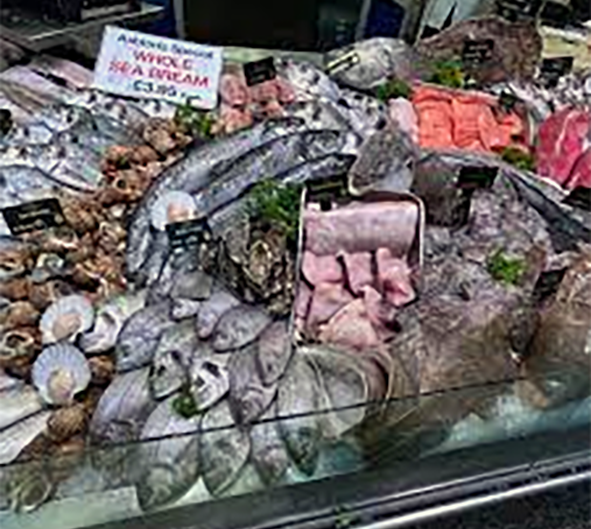 Fish displayed at a fishmonger's stall.
Welcome to FabulousFusionFood's Fish-based Recipes Page — The recipes presented here are all based on Fish (both sea-water and freshwater).
A fish (pl.: fish or fishes) is an aquatic, anamniotic, gill-bearing vertebrate animal with swimming fins and a hard skull, but lacking limbs with digits. Fish can be grouped into the more basal jawless fish and the more common jawed fish, the latter including all living cartilaginous and bony fish, as well as the extinct placoderms and acanthodians. In a break to the long tradition of grouping all fish into a single class (Pisces), contemporary phylogenetics views fish as a paraphyletic group (in that all vertebrates evolved from fishes, so tetrapods, can be classified as belonging to the lobe-finned fish but are not considered such).
Most fish are cold-blooded, their body temperature varying with the surrounding water, though some large active swimmers like white shark and tuna can hold a higher core temperature. Many fish can communicate acoustically with each other, such as during courtship displays. The study of fish is known as ichthyology.
Bony fish, distinguished by the presence of swim bladders and later ossified endoskeletons, emerged as the dominant group of fish after the end-Devonian extinction wiped out the apex predators, the placoderms. Bony fish are further divided into the lobe-finned and ray-finned fish. About 96% of all living fish species today are teleosts, a crown group of ray-finned fish that can protrude their jaws. The tetrapods, a mostly terrestrial clade of vertebrates that have dominated the top trophic levels in both aquatic and terrestrial ecosystems since the Late Paleozoic, evolved from lobe-finned fish during the Carboniferous, developing air-breathing lungs homologous to swim bladders. Despite the cladistic lineage, tetrapods are usually not considered to be fish.
Fish account for more than half of vertebrate species. As of 2016, there are over 33,000 described species of bony fish, over 1,100 species of cartilaginous fish, and over 100 hagfish and lampreys. A third of these fall within the nine largest families; from largest to smallest, these are Cyprinidae, Gobiidae, Cichlidae, Characidae, Loricariidae, Balitoridae, Serranidae, Labridae, and Scorpaenidae. About 64 families are monotypic, containing only one species.
Throughout history, humans have used fish as a food source for dietary protein. Historically and today, most fish harvested for human consumption has come by means of catching wild fish. However, fish farming, which has been practiced since about 3,500 BCE in ancient China, is becoming increasingly important in many nations. Overall, about one-sixth of the world's protein is estimated to be provided by fish. Fishing is accordingly a large global business which provides income for millions of people. The Environmental Defense Fund has a guide on which fish are safe to eat, given the state of pollution in today's world, and which fish are obtained in a sustainable way.
The word fish is inherited from Proto-Germanic, and is related to German Fisch, the Latin piscis, Old Irish īasc and Welsh pysgod, though the exact root is unknown; some authorities reconstruct a Proto-Indo-European root *peysk-, attested only in Italic, Celtic, and Germanic.
Though often used interchangeably, in biology fish and fishes have different meanings. Fish is used as a singular noun, or as a plural to describe multiple individuals from a single species. Fishes is used to describe different species or species groups.
The alphabetical list of all the fish-based recipes on this site follows, (limited to 100 recipes per page). There are 2195 recipes in total:
Page 9 of 22
| Gaeng Ki Lek (Northern Thai Pork and Ki Lek Curry with Fingerroot) Origin: Thailand | Gnocchi alla Puttanesca al Forno (Puttanesca Baked Gnocchi) Origin: Italy | Guinean Fish Grill with Three Sauces Origin: Equatorial Guinea |
| Gaeng Ki Lek (Northern Thai Pork and Ki Lek Curry with Fingerroot) Origin: Thailand | Go-ferwi Eog (Poaching Salmon) Origin: Welsh | Guinean Spinach Sauce Origin: Equatorial Guinea |
| Gaeng Som (Thai Sour Curry) Origin: Thailand | Goan Crab Claw Curry Origin: India | Guisado de carne de porco com Amêijoas (Pork Stew with Cockles) Origin: Angola |
| Gaeng Som (Thai Sour Curry) Origin: Thailand | Goan Fish Curry Origin: India | Gujarati-style Monkfish Curry Origin: Fusion |
| Gaeng Som (Thai Sour Orange Curry) Origin: Thailand | Goan Mackerel Masala Origin: India | Gulai Ikan Karibia (Caribbean Fish Stew) Origin: Turks Caicos |
| Gai Pad King (Ginger and Chicken Stir Fry) Origin: Thailand | Goat Meat Pepper Soup with Calabash Nutmeg Origin: Nigeria | Gulha (Fried Fish Balls) Origin: Maldives |
| Gai Yang (Thai Grilled Chicken) Origin: Thailand | Golwyth Bacwn, Bara Lawr a Chocos (Bacon Chop with Laver Bread and Cockles) Origin: Welsh | Gulha Riha (Maldives Fish Ball Curry) Origin: Maldives |
| Galo Soup Origin: Liberia | Gombos de Poisson Sec (Dried Fish with Okra) Origin: Chad | Gurnard Curry Origin: Britain |
| Gambas ou langoustines au pastis (Prawns or Langoustines with Pastis) Origin: Monaco | Gonos (Fried Whitebait) Origin: Roman | Gurnard Fillets Steamed on a Bed of Wrack Origin: England |
| Gambian Fish Pepper Soup Origin: Gambia | Good Friday Fish Pie Origin: Britain | Gurnard in Tamarind Sauce Origin: Fusion |
| Gambian Fish Yassa Origin: Gambia | Grain Mustard Based Fish Curry Origin: India | Gurnard with Porthilly Sauce Origin: British |
| Gambian-style Okro Soup Origin: Gambia | Gratin de fruits de mer (Seafood Gratin) Origin: Monaco | Gurnard with Tomato and Mint Sauce Origin: British |
| Garba (Cassava Fried Tuna) Origin: Cote dIvoire | Gratin de Morue (Salt Cod Gratin) Origin: Mauritius | Gutweed Salad with Fennel and Orange Origin: Britain |
| Garden Eggs Stew Origin: Ghana | Gravadlax Smørrebrød (Danish Smoked Salmon Open Sandwich) Origin: Denmark | Gwichiaid (Periwinkles) Origin: Welsh |
| Gari aux Crevettes (Gari with Prawns) Origin: Cameroon | Green Fig and Saltfish Origin: Saint Lucia | Gwrachen Fraith gyda Menyn a Ffenigl (Ballan Wrasse with Butter and Fennel) Origin: Welsh |
| Garum (Fish Sauce) Origin: Roman | Green Fish Curry Origin: Fusion | Gynggaudy Origin: England |
| Gâteau Michel (Michel's cake) Origin: Saint Pierre | Green Mix with Indian Ocean Seafood Origin: Tanzania | Haailey dy Brick Spottagh (Pickled Mackerel) Origin: Manx |
| Gbékui (Spinach Sauce) Origin: Togo | Green Ravigotte Sauce Origin: Britain | Haddock Supper Origin: Ireland |
| Gbegiri (Bean Stew) Origin: Nigeria | Grillades de Thon Mariné (Grilled Marinated Tuna) Origin: Togo | Haedum Laseratum (Kid Goat Seasoned with Laser) Origin: Roman |
| Gefilte Fish Pate Origin: Jewish | Grilled Mackerel Two Ways Origin: Fusion | Hákarl (Fermented Shark) Origin: Iceland |
| Gehackte Herring Origin: South Africa | Grilled Mackerel with Spicy Dahl Origin: South Africa | Hake and Chorizo Stew Origin: Britain |
| Gelee of fysche (Fish in Jelly) Origin: England | Grilled Orange Roughy Origin: New Zealand | Hake in Chermoula Marinade Origin: Morocco |
| Gemfish in Chermoula Marinade Origin: New Zealand | Grilled Oysters with Fennel Crumbs Origin: South Africa | Halászlé (Fisherman's Soup) Origin: Hungary |
| Genoese Sauce Origin: Britain | Grilled Red Snapper Origin: Sint Eustatius | Halibut and Tomato Curry Origin: Britain |
| Gentleman's Relish Origin: Britain | Grilled Salmon Balmoral Origin: Scotland | Halibut with Pine Nut and Parmesan Crust Origin: Britain |
| Gepekelde Haring (Soused Herring) Origin: Netherlands | Grilled Salmon in Red Wine and Wild Mushroom Sauce Origin: Britain | Halltu Penwaig (Salting Herring) Origin: Welsh |
| Gesmoorde Vis (Salt Cod and Potatoes in Tomato Sauce) Origin: South Africa | Grilled Sea Bass and Marsh Samphire Origin: Britain | Ham and Haddie Pie Origin: Scotland |
| Gezouten haring met ui en augurken (soused herring with onion and pickles) Origin: Netherlands | Grilled, Gingered, Swordfish Origin: American | Harvey's Sauce Origin: Britain |
| Ghanaian Groundnut Soup Origin: Ghana | Grima Fish Curry Origin: Kenya | Hedgehog Fungus and Filo Parcels Origin: Britain |
| Ghanaian Ripe Plantain Ice Cream Origin: Ghana | Gruzinchiki (Siberian Fish Rolls) Origin: Siberia | Heicht mat Kraïderzooss (Pike in Green Sauce) Origin: Luxembourg |
| Ghanaian Spaghetti Jollof Origin: Ghana | Guadeloupe Cod Accras (Cod Fritters) Origin: Guadeloupe | Hekele (Herring Starter) Origin: Poland |
| Ginger Prawns with Oyster Mushrooms Origin: China | Guai Daun Singlong Tumbuk (Grilled Fish with Greens) Origin: Sumatra | Herb Crusted Cod Origin: Britain |
| Ginger Soy Fish en Papillote Origin: Fusion | Gudgeons Origin: British | |
| Ginger, Chicken and Coconut Soup Origin: Fusion | Guernsey Conger Soup Origin: Guernsey |
Page 9 of 22