FabulousFusionFood's Fish-based Recipes 6th Page
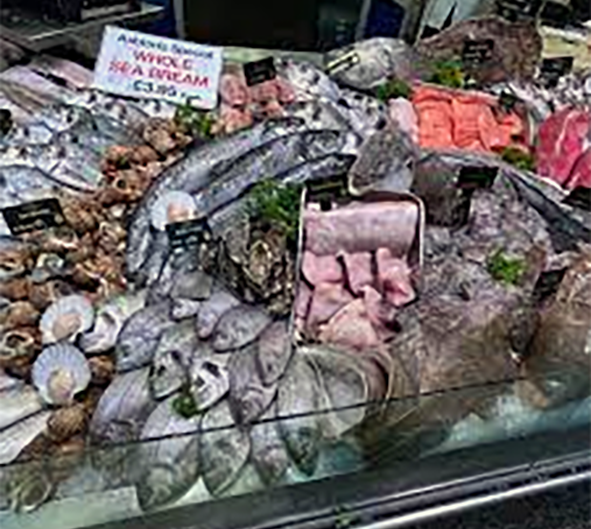 Fish displayed at a fishmonger's stall.
Welcome to FabulousFusionFood's Fish-based Recipes Page — The recipes presented here are all based on Fish (both sea-water and freshwater).
A fish (pl.: fish or fishes) is an aquatic, anamniotic, gill-bearing vertebrate animal with swimming fins and a hard skull, but lacking limbs with digits. Fish can be grouped into the more basal jawless fish and the more common jawed fish, the latter including all living cartilaginous and bony fish, as well as the extinct placoderms and acanthodians. In a break to the long tradition of grouping all fish into a single class (Pisces), contemporary phylogenetics views fish as a paraphyletic group (in that all vertebrates evolved from fishes, so tetrapods, can be classified as belonging to the lobe-finned fish but are not considered such).
Most fish are cold-blooded, their body temperature varying with the surrounding water, though some large active swimmers like white shark and tuna can hold a higher core temperature. Many fish can communicate acoustically with each other, such as during courtship displays. The study of fish is known as ichthyology.
Bony fish, distinguished by the presence of swim bladders and later ossified endoskeletons, emerged as the dominant group of fish after the end-Devonian extinction wiped out the apex predators, the placoderms. Bony fish are further divided into the lobe-finned and ray-finned fish. About 96% of all living fish species today are teleosts, a crown group of ray-finned fish that can protrude their jaws. The tetrapods, a mostly terrestrial clade of vertebrates that have dominated the top trophic levels in both aquatic and terrestrial ecosystems since the Late Paleozoic, evolved from lobe-finned fish during the Carboniferous, developing air-breathing lungs homologous to swim bladders. Despite the cladistic lineage, tetrapods are usually not considered to be fish.
Fish account for more than half of vertebrate species. As of 2016, there are over 33,000 described species of bony fish, over 1,100 species of cartilaginous fish, and over 100 hagfish and lampreys. A third of these fall within the nine largest families; from largest to smallest, these are Cyprinidae, Gobiidae, Cichlidae, Characidae, Loricariidae, Balitoridae, Serranidae, Labridae, and Scorpaenidae. About 64 families are monotypic, containing only one species.
Throughout history, humans have used fish as a food source for dietary protein. Historically and today, most fish harvested for human consumption has come by means of catching wild fish. However, fish farming, which has been practiced since about 3,500 BCE in ancient China, is becoming increasingly important in many nations. Overall, about one-sixth of the world's protein is estimated to be provided by fish. Fishing is accordingly a large global business which provides income for millions of people. The Environmental Defense Fund has a guide on which fish are safe to eat, given the state of pollution in today's world, and which fish are obtained in a sustainable way.
The word fish is inherited from Proto-Germanic, and is related to German Fisch, the Latin piscis, Old Irish īasc and Welsh pysgod, though the exact root is unknown; some authorities reconstruct a Proto-Indo-European root *peysk-, attested only in Italic, Celtic, and Germanic.
Though often used interchangeably, in biology fish and fishes have different meanings. Fish is used as a singular noun, or as a plural to describe multiple individuals from a single species. Fishes is used to describe different species or species groups.
The alphabetical list of all the fish-based recipes on this site follows, (limited to 100 recipes per page). There are 2195 recipes in total:
Page 6 of 22
| Conchiclam de Pisa Simplici (A Dish of Plain Peas) Origin: Roman | Crappit Heid Origin: Scotland | Curried Fishcakes Origin: Zimbabwe |
| Concoction Rice Origin: Nigeria | Crayfish Origin: British | Curried Salmon Origin: Britain |
| Confiture de Poivrons (Confit of Peppers) Origin: Monaco | Crayfish Curry Origin: South Africa | Curried Scallops in Coconut Milk with Stevia Origin: American |
| Congee with Fish Fillet Origin: China | Crayfish Soup Origin: British | Curry de Lotte au Citron Vert (Monkfish Curry with Lime) Origin: Senegal |
| Conger in sawce (Conger Eels in Sauce) Origin: England | Cream of Salsify Soup Origin: Britain | Curry de Lotte Bretonne (Breton Monkfish Curry) Origin: France |
| Conger Pie Origin: Britain | Cream-less Quiche Origin: Fusion | Curry de Poulet aux Bananes Plantain (Chicken and Plantain Curry) Origin: Cote dIvoire |
| Congre à la bretonne (Breton-style Conger Eel) Origin: France | Creamy Monkfish and Shellfish Potpie Origin: Britain | Curry en Poudre (Cameroonian Curry Spice Blend) Origin: Cameroon |
| Congrejo al Coco (Coconut Crab) Origin: Ecuador | Cregyn Bylchog wedi Gradellu (Grilled Scallops) Origin: Welsh | Curry Mouan (Chicken Curry) Origin: Cambodia |
| Coquilles Saint Jacques, sauce au cidre (Scallops in Cider Sauce) Origin: France | Cregyn Cylchog wedi Grilio (Grilled Scallops) Origin: Welsh | Curry of Cod Origin: Britain |
| Coquilles Saint-Jaques à la Bretonne (Breton Scallops) Origin: France | Crème de sardine au citron et cornichons (Sardine Cream with Lemon and Cornichons) Origin: France | Curry Trey Ruah (Curried Snapper) Origin: Cambodia |
| Corgimwch dell Patagonia (Prawn Patagonia) Origin: Welsh (Patagonia) | Crème ou chaudrée de moules aux agrumes (Mussel Chowder in Citrus Cream) Origin: Saint Pierre | Curry Vert avec Poisson, Cuit à Vapeur (Steamed Green Curry with Fish) Origin: France |
| Cornbread Stuffed Mussels Origin: South Africa | Crempogau Cocos Brecwast (Breakfast Cockle Pancakes) Origin: Welsh | Cyri Cocos a Dail Gwyrdd (Cockle and Greens Curry) Origin: Welsh |
| Cornish Baked Herring Origin: Britain | Creole Fried Fish with Green Seasoning Origin: Trinidad | Cyrri Morgi (Dogfish Curry) Origin: Welsh |
| Cornish Cod with Samphire Origin: Britain | Crevettes au Curry (Malagasy Prawn Curry) Origin: Madagascar | Cyw Iâr â Bwyd Môr (Chicken with Seafood) Origin: Welsh |
| Cornish Fish Cakes Origin: Britain | Crimped Cod Origin: Britain | Dékoudéssi aux Poisson Fumé (Palm Soup with Smoked Fish) Origin: Togo |
| Cornish Fish Pie Origin: England | Crimped Skate Origin: Britain | Dékoudéssi aux Poulet (Palm Soup with Chicken) Origin: Togo |
| Cornish Fish Soup Origin: England | Criollo de los Mordedores (Snapper Criollo) Origin: Venezuela | Daello Thiyal (Sri Lankan Cuttlefish Curry) Origin: Sri Lanka |
| Cornish Fisherman's Stew Origin: England | Crisp Paupiette of Sea Bass in Red-wine Sauce Origin: France | Dagaa (Dried Fish with Tomatoes) Origin: Tanzania |
| Cornish Pollack Curry Origin: England | Crispy Bay Bolete Caps Origin: Britain | Dahinou Saloum Origin: Senegal |
| Cornish Roast Sea Bass Origin: England | Crispy Miso Mackerel and Chinese-style Noodles Origin: Fusion | Dahomey Fish Stew Origin: Benin |
| Cornish Saffron Buns Origin: England | Crispy Tilapia Origin: American | Dakhine Origin: Senegal |
| Cornish Seaside Chowder with Saffron Origin: England | Crocodile Curry Origin: Zambia | Dashi Keema Karē (Dashi Keema Curry) Origin: Japan |
| Cornish Sole Curry with Cauliflower Rice Origin: England | Crocodile Sandakkan Origin: Malaysia | Daube de chevreuil (Venison Daube) Origin: France |
| Cornish Wrasse with Spring Onions, Cream and White Wine Origin: England | Croquets of Meat or Fish Origin: Britain | Daube de Provençale (Provençal Daube) Origin: France |
| Court-bouillon de Poisson à la Créole (Creole-style Fish Court-bouillon) Origin: Guadeloupe | Croquette de poisson et manioc (Fish and Cassava Croquettes) Origin: New Caledonia | Daube de Thon (Tuna Daube) Origin: Mauritius |
| Couscous alla Trapanese Origin: Italy | Croquettes de Samoun (Salmon Croquettes) Origin: Canada | Daurade Grillée Sénégalaise (Grilled Sea Bream, Senegalese Style) Origin: Senegal |
| Couscous with Camel Origin: Mauritania | Cucurbitas Frictas (Fried Gourds) Origin: Roman | Dawadawa Jollof Rice with Guinea Fowl Origin: Ghana |
| Cowl Bysk (Bisque Broth) Origin: England | Cullen Skink Origin: Scotland | Debal Curry Origin: Malaysia |
| Crab and Potato Soup Origin: Scotland | Cuminatum in ostrea et conchylia (Cumin Sauce for Shellfish) Origin: Roman | Deep Fried Coconut King Prawns Origin: Britain |
| Crab and Watercress Quiche Origin: Britain | Cuminatum in ostrea et conchylia II (Cumin-cinnamon Sauce for Shellfish) Origin: Roman | Deep-fried River Fish with Chilli Bean Sauce Origin: China |
| Crab Fried Rice Origin: China | Curried Baked Cod with Cauliflower and Chickpeas Origin: Fusion | Dessi Lamoumou (Fresh Fish Sauce) Origin: Togo |
| Crab with Devil Sauce Origin: England | Curried Baked Hake with Cauliflower and Chickpeas Origin: South Africa | Dhallo Black Curry (Cuttlefish Black Curry) Origin: Sri Lanka |
| Crabes Épicées (Pepper Crabs) Origin: Guinea | Curried Cod Origin: Britain | |
| Cracked Conch Origin: Bahamas | Curried Crumbed Fish Origin: Britain |
Page 6 of 22