FabulousFusionFood's Fish-based Recipes 19th Page
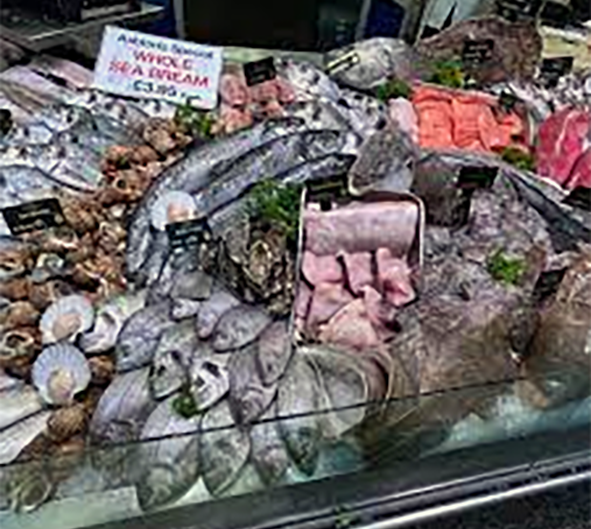 Fish displayed at a fishmonger's stall.
Welcome to FabulousFusionFood's Fish-based Recipes Page — The recipes presented here are all based on Fish (both sea-water and freshwater).
A fish (pl.: fish or fishes) is an aquatic, anamniotic, gill-bearing vertebrate animal with swimming fins and a hard skull, but lacking limbs with digits. Fish can be grouped into the more basal jawless fish and the more common jawed fish, the latter including all living cartilaginous and bony fish, as well as the extinct placoderms and acanthodians. In a break to the long tradition of grouping all fish into a single class (Pisces), contemporary phylogenetics views fish as a paraphyletic group (in that all vertebrates evolved from fishes, so tetrapods, can be classified as belonging to the lobe-finned fish but are not considered such).
Most fish are cold-blooded, their body temperature varying with the surrounding water, though some large active swimmers like white shark and tuna can hold a higher core temperature. Many fish can communicate acoustically with each other, such as during courtship displays. The study of fish is known as ichthyology.
Bony fish, distinguished by the presence of swim bladders and later ossified endoskeletons, emerged as the dominant group of fish after the end-Devonian extinction wiped out the apex predators, the placoderms. Bony fish are further divided into the lobe-finned and ray-finned fish. About 96% of all living fish species today are teleosts, a crown group of ray-finned fish that can protrude their jaws. The tetrapods, a mostly terrestrial clade of vertebrates that have dominated the top trophic levels in both aquatic and terrestrial ecosystems since the Late Paleozoic, evolved from lobe-finned fish during the Carboniferous, developing air-breathing lungs homologous to swim bladders. Despite the cladistic lineage, tetrapods are usually not considered to be fish.
Fish account for more than half of vertebrate species. As of 2016, there are over 33,000 described species of bony fish, over 1,100 species of cartilaginous fish, and over 100 hagfish and lampreys. A third of these fall within the nine largest families; from largest to smallest, these are Cyprinidae, Gobiidae, Cichlidae, Characidae, Loricariidae, Balitoridae, Serranidae, Labridae, and Scorpaenidae. About 64 families are monotypic, containing only one species.
Throughout history, humans have used fish as a food source for dietary protein. Historically and today, most fish harvested for human consumption has come by means of catching wild fish. However, fish farming, which has been practiced since about 3,500 BCE in ancient China, is becoming increasingly important in many nations. Overall, about one-sixth of the world's protein is estimated to be provided by fish. Fishing is accordingly a large global business which provides income for millions of people. The Environmental Defense Fund has a guide on which fish are safe to eat, given the state of pollution in today's world, and which fish are obtained in a sustainable way.
The word fish is inherited from Proto-Germanic, and is related to German Fisch, the Latin piscis, Old Irish īasc and Welsh pysgod, though the exact root is unknown; some authorities reconstruct a Proto-Indo-European root *peysk-, attested only in Italic, Celtic, and Germanic.
Though often used interchangeably, in biology fish and fishes have different meanings. Fish is used as a singular noun, or as a plural to describe multiple individuals from a single species. Fishes is used to describe different species or species groups.
The alphabetical list of all the fish-based recipes on this site follows, (limited to 100 recipes per page). There are 2136 recipes in total:
Page 19 of 22
| Scarus (Dentex) Origin: Roman | Sic Farcies eam Sepiam Coctam (Stuffed and Cooked Cuttlefish) Origin: Roman | Smoked Salmon and Avocado Nori Rolls Origin: Japan |
| Scotch Woodcock Origin: Scotland | Sicilian Fish Sauce Origin: Italy | Smoked Salmon and Cream Cheese Pâté Origin: Britain |
| Scottish Battered Fish Origin: Scotland | Sierra Leone Fish Cake Origin: Sierra Leone | Smoked Salmon and Haddock Pots Origin: Scotland |
| Scottish Kedgeree Origin: Scotland | Sierra Leonean Fish Balls Origin: Sierra Leone | Smoked Salmon and Horseradish Potato Farls Origin: Scotland |
| Scottish Pickled Herring Origin: Scotland | Sierra Leonean White Okra Draw Soup Origin: Sierra Leone | Smoked Salmon Cheesecake Origin: Ireland |
| Scottish Potted Herring Origin: Scotland | Sierra Leonian Egusi Soup Origin: Sierra Leone | Smoked Salmon Mousse Origin: Scotland |
| Scottish Smokies in Hot Cream Sauce Origin: Scotland | Sigá (Prawn and Okra Stew) Origin: Guinea-Bissau | Smoked Salmon with Pea Pancakes Origin: Britain |
| Sea Bass a la Grecque Origin: France | Sill Potatis (Pickled Herring with Boiled Potatoes and Sour Cream) Origin: Sweden | Smoked Trout Pâté Origin: Britain |
| Sea Bass with Sea Beet and Marsh Samphire Origin: Britain | Simboro (Meat with Taro Leaves and Coconut Milk) Origin: Vanuatu | Smoked, Preserved, Mussels Origin: Britain |
| Seafood Amok Origin: Cambodia | Sing Mapan Singju (Ginger Flower and Water Dropwort Singju) Origin: India | Smoked, Preserved, Oysters Origin: Britain |
| Seafood and Bacon Kebabs Origin: Britain | Singapore Hokkien Mee Origin: Singapore | Smoked, Preserved, Scallops Origin: Britain |
| Seafood Chili Origin: American | Sint Maarten Roe Accras Origin: Sint Maarten | Smoky Fish Skewers Origin: Britain |
| Seafood Chowder Origin: Ireland | Sint Maarten Stewed Saltfish Origin: Sint-Maarten | Smoky Prawn Jollof Rice Origin: Nigeria |
| Seafood Curry Origin: Scotland | Sint Maarten Whelk Soup Origin: Sint Maarten | Smoored Fish with Tomatoes Origin: South Africa |
| Seafood-stuffed Morel Mushrooms Origin: America | Siwin (Sewin) Origin: Welsh | Smoorsnoek with Cabbage Origin: South Africa |
| Sepias Elixas a Balineo (Boiled Cuttlefish from the Tank) Origin: Roman | Siwin wedi'i serio gyda Stwns Bara Lawr, Samffir, Sbigoglys a Phys (Seared Sea Trout with Laver Mash, Samphire, Spinach and Peas) Origin: Welsh | Smörgåstårta (Swedish Savoury Sandwich Cake) Origin: Sweden |
| Serekunda Fish Benachin Origin: Gambia | Sizzling Scallops Origin: Britain | Smørbrødterte (Norwegian Savoury Sandwich Cake) Origin: Norway |
| Sewin Gyda Saws Perlysiau (Sea Trout with Herb Sauce) Origin: Welsh | Skate Curry Origin: Britain | Smørrebrød (Danish Open-faced Herring Sandwich) Origin: Denmark |
| Sewin with Samphire and Laver Purée Origin: Britain | Sliced Hilsa Fish Fried in Curry Condiments Origin: Anglo-Indian | Snoek Bobotie Origin: South Africa |
| Sewin yn y Badell (Pan-fried Sea Trout) Origin: Welsh | Slow Cooker Duck and Potato Massaman Curry Origin: Britain | Snoek Tacos Origin: South Africa |
| Seychelles Fish Curry Origin: Seychelles | Slow-cooked Moorish Lamb with Buttermilk Dressing Origin: Fusion | Soba (Buckwheat Noodle Soup) Origin: Japan |
| Seychelles Fish Curry II Origin: Seychelles | Slow-roasted Lamb Shanks with Tomatoes and Olives Origin: Australia | Soepies (Cuttlefish) Origin: Roman |
| Sgadan Hallt (Salted HerringSalted Herring) Origin: Welsh | Smoked Baltic Sprats in Mustard Sauce Sandwich Origin: Fusion | Sole avec La Sauce Joinville (Sole with Joinville Sauce) Origin: France |
| Shark and Bake Origin: Trinidad | Smoked Catfish with Seashore Greens Origin: Fusion | Sole Fillets Stuffed with Mixed Wild Mushrooms and Ricotta Cheese Origin: Britain |
| Shellfish and Leek Roly-poly Origin: Britain | Smoked Fish Fisherman's Pie Origin: England | Solomon Islands Style Rice Origin: Solomon Islands |
| Shellfish Forcemeats Origin: Roman | Smoked Fish Light Soup Origin: Ghana | Solomon Islands Tuna Curry Origin: Solomon Islands |
| Shellfish Seaweed Pudding Origin: Ancient | Smoked Fish Stew Origin: Ancient | Solomon-a-Gundy Origin: Jamaica |
| Shime Saba (Mackerel in Vinegar Dressing) Origin: Japan | Smoked Haddock and Champ Cakes Origin: Northern Ireland | Som Tam (Thai Green Papaya Salad) Origin: Thailand |
| Shin Ngoa Lap (Spicy Beef Salad) Origin: Laos | Smoked Haddock Chowder Origin: Ireland | Somlah Machou Khmer (Sour Soup with Tomato and Lotus Roots) Origin: Cambodia |
| Shito (Dark Chilli Sambal) Origin: Ghana | Smoked Haddock Curry with Butter Beans Origin: Fusion | Somlar Kari Saek Mouan (Chicken Red Curry) Origin: Cambodia |
| Shito (Ghanaian Black Chilli Sauce) Origin: Ghana | Smoked haddock with Potato Mash Origin: Ireland | Somlar Mochu Sachko (Sour Beef Stew) Origin: Cambodia |
| Shrimp Sauce Origin: Britain | Smoked Mackerel Pâté II Origin: Britain | Sōngshǔ Yú (Squirrel Fish) Origin: China |
| Shuba (Herring and Beet Salad) Origin: Moldova | Smoked Mackerel Pâté III Origin: Britain | |
| Si Byan (Burmese Fish Curry) Origin: Myanmar | Smoked Mackerel Pâté IV Origin: Britain |
Page 19 of 22