FabulousFusionFood's Beef-based Recipes 11th Page
 Image of an European cow (top left), African Zebu (top right) and
Indian bull (bottom left) along with a selection of beef cuts.
Welcome to FabulousFusionFood's Beef-based Recipes Page — The recipes presented here are all based on cow meat. Beef is the culinary name for meat from cattle (Bos taurus or Bos indicus). Beef can be prepared in various ways; cuts are often used for steak, which can be cooked to varying degrees of doneness, while trimmings are often ground or minced, as found in most hamburgers. Beef contains protein, iron, and vitamin B12. Along with other kinds of red meat, high consumption is associated with an increased risk of colorectal cancer and coronary heart disease, especially when processed. Beef has a high environmental impact, being a primary driver of deforestation with the highest greenhouse gas emissions of any agricultural product.
People have eaten the flesh of bovines since prehistoric times; some of the earliest known cave paintings, such as those of Lascaux, show aurochs in hunting scenes. People domesticated cattle to provide ready access to beef, milk, and leather. Cattle have been domesticated at least twice over the course of evolutionary history. The first domestication event occurred around 10,500 years ago with the evolution of Bos taurus. The second was more recent, around 7,000 years ago, with the evolution of Bos indicus in the Indian subcontinent. There is a possible third domestication event 8,500 years ago, with a potential third species Bos africanus arising in Africa.
Most beef can be used as is by merely cutting into certain parts, such as roasts, short ribs or steak (filet mignon, sirloin steak, rump steak, rib steak, rib eye steak, hanger steak, etc.), while other cuts are processed (corned beef or beef jerky). Trimmings, on the other hand, which are usually mixed with meat from older, leaner (therefore tougher) cattle, are ground, minced or used in sausages. The blood is used in some varieties called blood sausage. Other parts that are eaten include other muscles and offal, such as the oxtail, liver, tongue, tripe from the reticulum or rumen, glands (particularly the pancreas and thymus, referred to as sweetbread), the heart, the brain (although forbidden where there is a danger of bovine spongiform encephalopathy, BSE, commonly referred to as mad cow disease), the kidneys, and the tender testicles of the bull (known in the United States as calf fries, prairie oysters, or Rocky Mountain oysters). Some intestines are cooked and eaten as is, but are more often cleaned and used as natural sausage casings. The bones are used for making beef stock. Meat from younger cows (calves) is called veal. Beef from steers and heifers is similar.
he word beef is from the Latin word bōs, in contrast to cow which is from Middle English cou (both words have the same Indo-European root *gʷou-). This is one example of the common English dichotomy between the words for animals (with largely Germanic origins) and their meat (with Romanic origins) that is also found in such English word-pairs as pig/pork, deer/venison, sheep/mutton, and chicken/poultry (also the less common goat/chevon). Beef is cognate with bovine through the Late Latin bovīnus. The rarely used plural form of beef is beeves.
Cuts of Beef (British, Irish,Australian, South African and New Zealand terms):
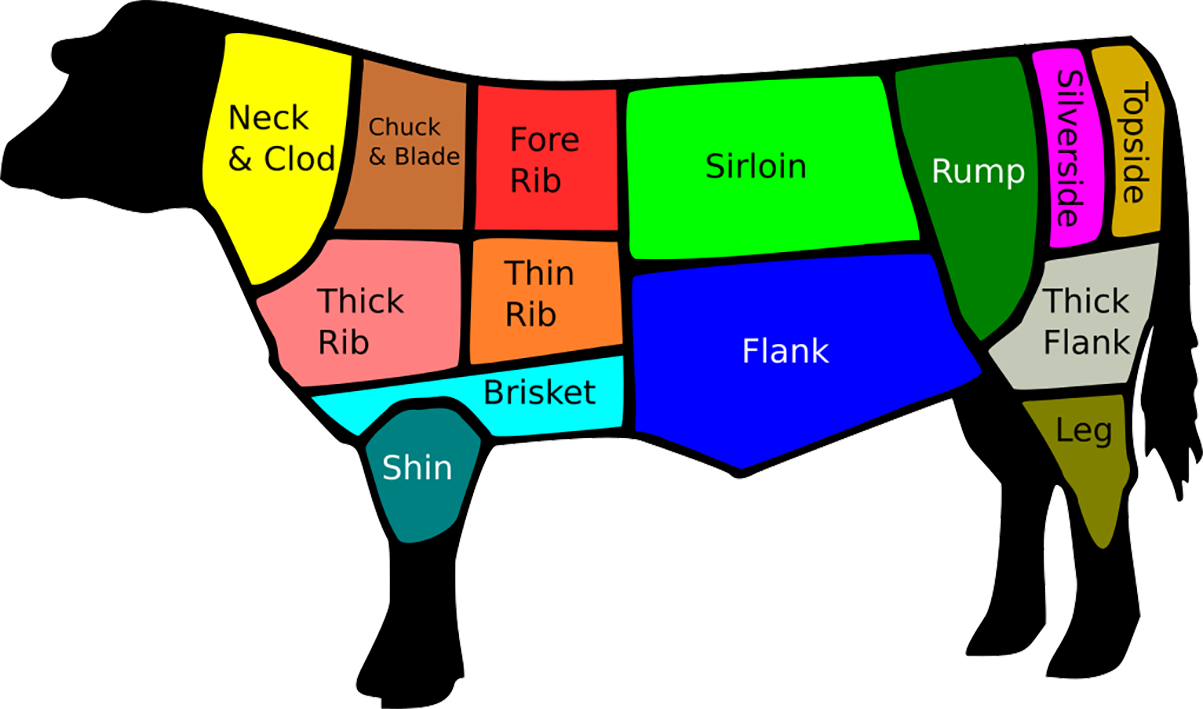 Cuts of Beef:
Tongue — boiling, pickling, roasting or braising
Necks and clod — stewing, slow smoking or braising
Chuck steak & blades — mincing, braising, slow roasting
Sirloin — Frying, roasting, barbecuing
Rump — Frying, barbecuing
Silverside — Roasting
Topside — Roasting, pies, air drying
Top rump — Roasting, barbecuing
Fore rib — Roasting
Rib eye steak — Frying
T-bone steak — Frying
Thick rib — Braising, barbecuing, roasting
Thin rib — Braising, barbecuing
Brisket (Skirt steak) — Baking, boiling, roasting, braising
Shin and leg — Mince, slow stewing, braising
Flank — Barbecued, grilled, braised
Thick flank — Barbecued, grilled, braised
Feather blade — Frying, braising
Fillet — Frying, tartare
Oxtail — Stew, braising
Offal — typically liver, heart, stomach, intestines and kidneys
The alphabetical list of all the beef-based recipes on this site follows, (limited to 100 recipes per page). There are 1151 recipes in total:
Page 11 of 12
| Steak au Poivre Origin: France | Tamarillo and Beef Curry Origin: Fusion | To make a Haggas Pudding. Origin: Britain |
| Steak Cooked in Milk Origin: Malawi | Tanabour (Beef, Barley and Yoghurt Soup) Origin: Armenia | Toad-in-the-Hole Origin: Britain |
| Steak Diane Origin: Australia | Tanzanian Meat Stew Origin: Tanzania | Tocco (Genoese Meat Sauce) Origin: Italy |
| Steak Frites (Steak and Chips) Origin: France | Tapioca Soup Origin: British | Tomatillo and Beef Curry Origin: Fusion |
| Steak Tartare Origin: France | Tarten Eidion Tun (Corned Beef Pie) Origin: Welsh | Tomato and Lettuce Soup Origin: Britain |
| Steak with Prego Sauce Origin: Portugal | Tartlettes/Tartletes (Tartlets) Origin: England | Tomato Keema (Tomato and Beef Curry) Origin: Pakistan |
| Stew Peas Origin: Jamaica | Tattie Hash Origin: England | Tomato-less Jollof Rice Origin: Nigeria |
| Stew Soup I Origin: British | Tatws Popty Eidion (Beef and Potatoes in the Oven) Origin: Welsh | Topcheta Corba (Meatball Soup) Origin: Bulgaria |
| Stew Soup of Salt Meat Origin: British | Tausug Beef Kulma Origin: Philippines | Topside Pot Roast with Port and Root Vegetables Origin: Britain |
| Stewed Beef in Coconut Milk with Dumplings Origin: Trinidad | Te Bua Toro Ni Baukin (Pumpkin, Cabbage and Corned Beef Bake) Origin: Kiribati | Tortellini di Natale (Christmas Tortellini) Origin: Italy |
| Stewed Beeff (Stewed Beef) Origin: England | Tepsi kebabı (Turkish Tray Kebab) Origin: Turkey | Toto-kena Misy Anana sy Voanjo (Greens with Peanuts and Minced Beef) Origin: Madagascar |
| Stewed Oxtail Origin: Zimbabwe | Teviotdale Pie Origin: Scotland | Tournedos Rossini (Fillet Rossini) Origin: France |
| Sticky Stout-glazed Salt Beef with Chimichurri Origin: South Africa | Tex-Mex Beef Tacos Origin: America | Tournedos Rossini Origin: France |
| Stir-fried Beef with Spring Onions Origin: China | Tex-Mex Meatball Tacos Origin: America | Traditional Cornish Pasty Origin: Cornwall |
| Stiw Eidion Cymreig (Welsh Beef Stew) Origin: Welsh | Texas Chili Origin: American | Traditional Kitfo (Ethiopian Steak Tartar) Origin: Ethiopia |
| Stovies II Origin: Scotland | Texas Red Chili Origin: America | Traditional Pot Roast Origin: Britain |
| Stracotto alla Romana Origin: Italy | Texas-style Pork and Beef Chili Origin: American | Traditional Salisbury Steak Origin: America |
| Stuffed Breadfruit Origin: Dominica | Thai-style Red Curry of Beef, Bamboo and Apple Origin: Asian Fusion | Traditional Sloppy Joes Origin: American |
| Stuffed Breadfruit II Origin: Trinidad | The Author's Christmas Pudding Origin: Britain | Traditional Spaghetti Bolognese Origin: Italy |
| Stuffed Cabbage Rolls Origin: American | The Stock-pot Origin: Britain | Trimlestown Roast Sirloin Origin: Ireland |
| Suaasat Origin: Greenland | The Ultimate American Diner Burger Origin: America | Trini Meat Patties Origin: Trinidad |
| Sunday Stew Origin: Nigeria | The Ultimate Chilli Con Carne Origin: Fusion | Trinidadian Pepper Pot Origin: Trinidad |
| Superlative Mincemeat Origin: Britain | The Ultimate Sharing Nachos Origin: Fusion | Tripe and Onions Origin: England |
| Suqaar (Somali Beef Stew) Origin: Somalia | Thiébouyapp Origin: Senegal | Tripe Soup Origin: Britain |
| Surf and Turf Kebabs Origin: Britain | Thiou a la Viande (Senegalese Beef Stew) Origin: Senegal | Tsebhi Sega (Spicy Minced Meat) Origin: Eritrea |
| Suya Beef Heart Curry with Beans and Wild Greens Origin: Fusion | Thiou Curry au Boeuf (Senegalese Beef Curry) Origin: Senegal | Tsiren Dakakken Nama (Spicy Mince Meat Kebabs) Origin: Nigeria |
| Svíčková na smetaně Origin: Czech | Tibs Wet Origin: Ethiopia | Tteokguk (Korean Rice Cake Soup) Origin: Korea |
| T'fina Aricha (Beef and Wheat Stew) Origin: Tunisia | Tick-Keeah Kebab Origin: India | Turkmen Kebap Origin: Turkmenistan |
| Tabasco Steaks with Watercress Butter Origin: Fusion | Tiepbouyape Origin: Senegal | Türlü (Meat, Vegetable and Okra Stew) Origin: Armenia |
| Taco Casserole Origin: America | Tiga Dégué (Beef in Peanut Sauce) Origin: Mali | Ugandan Kabobs Origin: Uganda |
| Tacos de Comida Callejera (Mexican Street-food Tacos) Origin: Mexico | Timpana (Baked Macaroni Pie) Origin: Malta | Ugandan Matooke Origin: Uganda |
| Tagin Lisan 'asfur (Orzo Casserole) Origin: Egypt | To bake an Olyve-Pye Origin: Britain | Ukrainian Borscht Origin: Ukraine |
| Taiwanese Beef Noodle Soup Origin: Taiwan | To Cure Tongues I Origin: Britain | |
| Tajine el Bey (Spinach and Rocotta Tagine) Origin: Algeria | To Cure Tongues II Origin: Britain |
Page 11 of 12