FabulousFusionFood's Beef-based Recipes 8th Page
 Image of an European cow (top left), African Zebu (top right) and
Indian bull (bottom left) along with a selection of beef cuts.
Welcome to FabulousFusionFood's Beef-based Recipes Page — The recipes presented here are all based on cow meat. Beef is the culinary name for meat from cattle (Bos taurus or Bos indicus). Beef can be prepared in various ways; cuts are often used for steak, which can be cooked to varying degrees of doneness, while trimmings are often ground or minced, as found in most hamburgers. Beef contains protein, iron, and vitamin B12. Along with other kinds of red meat, high consumption is associated with an increased risk of colorectal cancer and coronary heart disease, especially when processed. Beef has a high environmental impact, being a primary driver of deforestation with the highest greenhouse gas emissions of any agricultural product.
People have eaten the flesh of bovines since prehistoric times; some of the earliest known cave paintings, such as those of Lascaux, show aurochs in hunting scenes. People domesticated cattle to provide ready access to beef, milk, and leather. Cattle have been domesticated at least twice over the course of evolutionary history. The first domestication event occurred around 10,500 years ago with the evolution of Bos taurus. The second was more recent, around 7,000 years ago, with the evolution of Bos indicus in the Indian subcontinent. There is a possible third domestication event 8,500 years ago, with a potential third species Bos africanus arising in Africa.
Most beef can be used as is by merely cutting into certain parts, such as roasts, short ribs or steak (filet mignon, sirloin steak, rump steak, rib steak, rib eye steak, hanger steak, etc.), while other cuts are processed (corned beef or beef jerky). Trimmings, on the other hand, which are usually mixed with meat from older, leaner (therefore tougher) cattle, are ground, minced or used in sausages. The blood is used in some varieties called blood sausage. Other parts that are eaten include other muscles and offal, such as the oxtail, liver, tongue, tripe from the reticulum or rumen, glands (particularly the pancreas and thymus, referred to as sweetbread), the heart, the brain (although forbidden where there is a danger of bovine spongiform encephalopathy, BSE, commonly referred to as mad cow disease), the kidneys, and the tender testicles of the bull (known in the United States as calf fries, prairie oysters, or Rocky Mountain oysters). Some intestines are cooked and eaten as is, but are more often cleaned and used as natural sausage casings. The bones are used for making beef stock. Meat from younger cows (calves) is called veal. Beef from steers and heifers is similar.
he word beef is from the Latin word bōs, in contrast to cow which is from Middle English cou (both words have the same Indo-European root *gʷou-). This is one example of the common English dichotomy between the words for animals (with largely Germanic origins) and their meat (with Romanic origins) that is also found in such English word-pairs as pig/pork, deer/venison, sheep/mutton, and chicken/poultry (also the less common goat/chevon). Beef is cognate with bovine through the Late Latin bovīnus. The rarely used plural form of beef is beeves.
Cuts of Beef (British, Irish,Australian, South African and New Zealand terms):
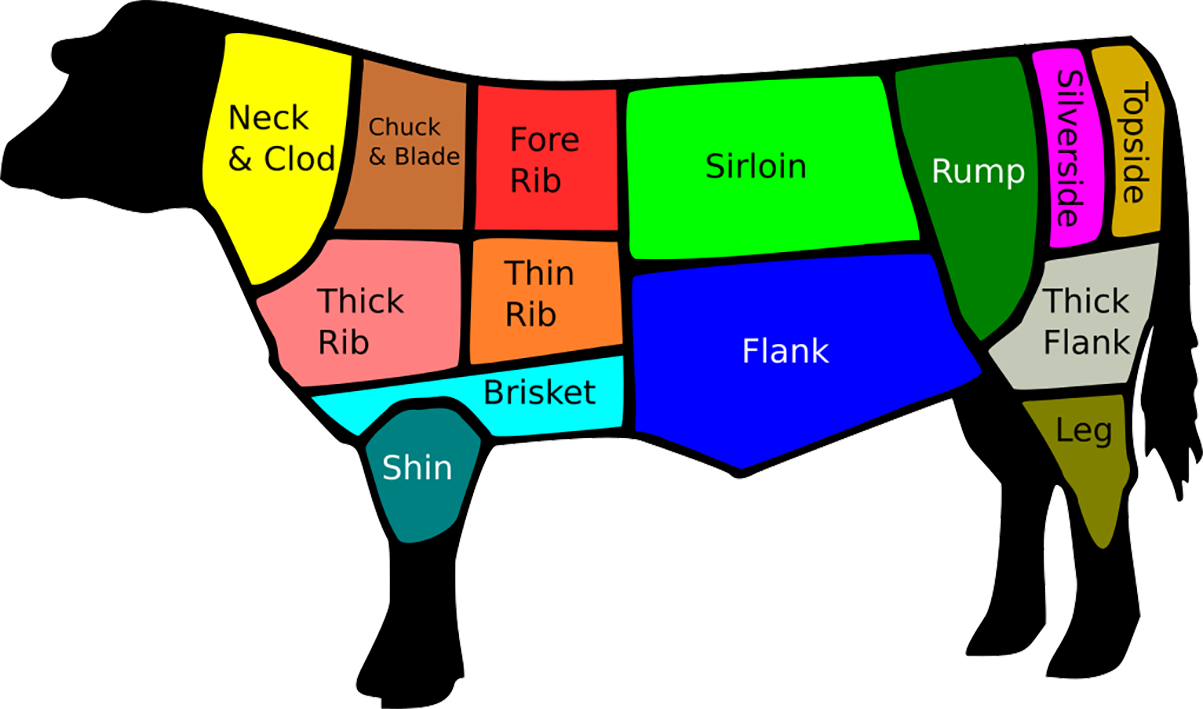 Cuts of Beef:
Tongue — boiling, pickling, roasting or braising
Necks and clod — stewing, slow smoking or braising
Chuck steak & blades — mincing, braising, slow roasting
Sirloin — Frying, roasting, barbecuing
Rump — Frying, barbecuing
Silverside — Roasting
Topside — Roasting, pies, air drying
Top rump — Roasting, barbecuing
Fore rib — Roasting
Rib eye steak — Frying
T-bone steak — Frying
Thick rib — Braising, barbecuing, roasting
Thin rib — Braising, barbecuing
Brisket (Skirt steak) — Baking, boiling, roasting, braising
Shin and leg — Mince, slow stewing, braising
Flank — Barbecued, grilled, braised
Thick flank — Barbecued, grilled, braised
Feather blade — Frying, braising
Fillet — Frying, tartare
Oxtail — Stew, braising
Offal — typically liver, heart, stomach, intestines and kidneys
The alphabetical list of all the beef-based recipes on this site follows, (limited to 100 recipes per page). There are 1151 recipes in total:
Page 8 of 12
| Nkrakrakwam (Ghanaian Light Soup) Origin: Ghana | Ox-tail Soup Origin: British | Pastelón de Papa (Dominican Cottage Pie) Origin: Dominican Republic |
| Nori-crusted Sirloin with Shiitake Mushrooms and Wasabi Origin: Fusion | Oxford Sausages Origin: England | Pašticada (Dalmatian Beef Stew with Prunes and Apples) Origin: Croatia |
| Northern Irish Beef Stew Origin: Northern Ireland | Oxtail Pot Pies Origin: South Africa | Pašticada (Croatian Beef Stew) Origin: Croatia |
| Nuernberger Rostbratwuerste (Nuremberg Grilled Sausage) Origin: Germany | Pašticada II (Veal Stew with Tomatoes) Origin: Montenegro | Pasties Boiled in Beef Broth Origin: Cornwall |
| Nwa Mee Hinga (Oxtail and Watercress) Origin: Myanmar | Pabellón Criollo (Venezuelan Shredded Beef with Rice and Beans) Origin: Venezuela | Pastourmas Loucanico (Beef and Garlic Sausages) Origin: Cyprus |
| Nyama na Irio (Meat with Corn) Origin: Kenya | Packet and Tripe Origin: Ireland | Patina Cotidiana (Everyday Dish) Origin: Roman |
| Nyama ya Figo (Beef and Kidneys) Origin: Tanzania | Pad Gra Prow (Holy Basil Beef) Origin: Thailand | Patina Fusilis (A Fluid Dish) Origin: Roman |
| Nyeleng (Beef and Peanut Gumbo) Origin: Senegal | Pad Kra Pao (Thai Holy Basil Stir Fry with Beef) Origin: Thailand | Patinam ex Lacte (Milk Casserole) Origin: Roman |
| Nyma Choma (Roast Meat) Origin: East Africa | Pakistani Seekh Kebab Origin: Pakistan | Patychyk (Breaded Kebabs) Origin: Ukraine |
| Nyma Choma (Roast Meat) Origin: Kenya | Palusami (Corned Beef, Taro Greens and Coconut Milk) Origin: Solomon Islands | Peanut Soup Origin: West Africa |
| Obe Ata (Nigerian Pepper Soup) Origin: Nigeria | Palusami Origin: Fiji | Pelau Origin: Saint Kitts |
| Obe Efo Elegusi (Egusi Soup) Origin: Nigeria | Palusami (Coconut Cream and Tinned Meat in Taro Leaves) Origin: Nauru | Pelmeni (Siberian Beef Dumplings) Origin: Siberia |
| Oenogarum cum Thymum et Satureiam in Tubera (Truffles in Savory-thyme Wine Sauce) Origin: Roman | Palusami Origin: Samoa | Pepperpot Origin: Antigua |
| Oenogarum et Coriandrum in Tubera (Truffles in Coriander Wine Sauce) Origin: Roman | Palusami (Corned Beef, Taro Greens and Coconut Milk) Origin: Tuvalu | Perro Caliente (Hot Dog) Origin: American |
| Ofadà (Green Soup) Origin: Nigeria | Palusami (Corned Beef, Taro Greens and Coconut Milk) Origin: Kiribati | Pety parnant (Small Patties) Origin: England |
| Ofe Ugba (Ugba Soup) Origin: Nigeria | Palusami Origin: American Samoa | Pho Bo Noodle Soup (Pho Bo Soup) Origin: Vietnam |
| Ofellas Ostienses (Ostian-style Starters) Origin: Roman | Palusami (Corned Beef, Taro Greens and Coconut Milk) Origin: Marshall Islands | Picadillo Origin: Cuba |
| Ogbono Soup Origin: Nigeria | Palusami II Origin: Kiribati | Picadillo de Vainicas (Green Bean Picadillo) Origin: Costa Rica |
| Ogbono Soup with Ugwu Origin: Nigeria | Pan Haggis Origin: Scotland | Picado à Madeirense (Beef Tips, Madeiran Style) Origin: Portugal |
| Ogbono Soup with Waterleaf Origin: Nigeria | Pappardelle with Slow-cooked Beef and Mushrooms Origin: Britain | Pieds de zébu et haricots blancse (Zebu Feet with White Beans) Origin: Madagascar |
| Ojojo Meat Balls Origin: Nigeria | Passatelli in Brodo (Passatelli in Broth) Origin: Italy | Pigeon Peas and Rice Origin: Barbados |
| Olla de Carne Origin: Costa Rica | Passatelli in Brodo (Passatelli in Broth) Origin: San Marino | Pigeon Peas and Rice Origin: Anguilla |
| Olusatra (Alexanders with Raisin Sauce) Origin: Roman | Pastırma Origin: Turkey | Pigeon Pie Origin: Britain |
| Oluwombo Origin: Uganda | Pastai Briwgig Eidion a Nionod (Welsh Beef Mince and Onion Pies) Origin: Welsh | Pilau Boeuf de Comores (Comorian Beef Pilau) Origin: Comoros |
| Onion Gravy Origin: Britain | Pastai Cig Llo (Veal Pie) Origin: Welsh | Pique a lo Macho Origin: Bolivia |
| Onions Stuffed with Meat and Mushrooms Origin: Czech | Pastai Cwnhingen (Rabbit Pie) Origin: Welsh | Piroshki Origin: Russia |
| Oodkac (Somali Preserved Meat) Origin: Somalia | Pastai Nadolig Eidion a Chlementin (Christmas Beef and Clementine Pie) Origin: Welsh | Pisam Adulteram Versatilem (Peas Turnover) Origin: Roman |
| Or Lam Origin: Laos | Pastechi de Boeuf (Beef Pastechi) Origin: Saint-Martin | Pisupo Origin: Samoa |
| Oshi Palov (Beef and Vegetable Pilau) Origin: Tajikistan | Pastechi Karni (Aruban Meat Empanadas) Origin: Aruba | Pizza Rustica (Italian Easter Ham Pie) Origin: Ghana |
| Osso Bucco alla Milanese Origin: Italy | Pastei Arennau ac Eidion (Steak and Kidney Pie) Origin: Welsh | Plat Tradicional Fula (Traditional Fulani Dish) Origin: Guinea-Bissau |
| Otong Soup Origin: Nigeria | Pastel de Choclo Origin: Chile | Pljeskavica Origin: Serbia |
| Ox-cheek Soup Origin: British | Pastelón (Sweet Plantain Lasagna) Origin: Puerto Rico | Plo Origin: St Helena |
| Ox-heart Black Curry Origin: Sri Lanka | Pastelón de Arroz (Cheesy Beef and Rice Casserole) Origin: Dominican Republic | |
| Ox-heart Haggis Origin: Scotland | Pastelón de Harina de Maíz (Cornmeal and Beef Casserole) Origin: Dominican Republic |
Page 8 of 12