FabulousFusionFood's Stew Recipes 27th Page
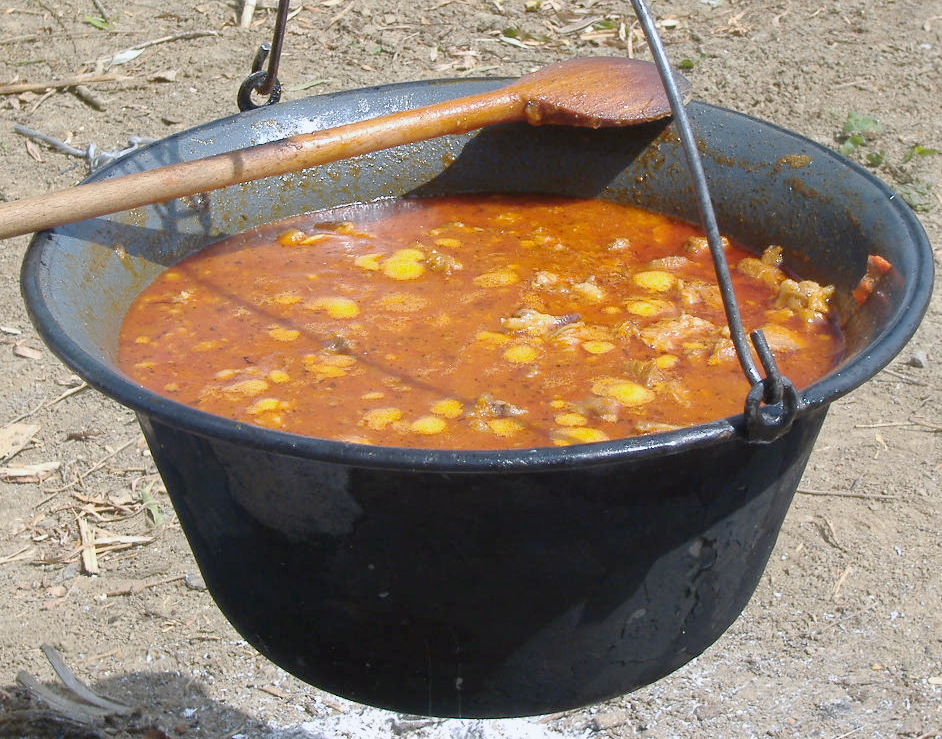 Classic goulash cooking outdoors in a traditional bogrács.
Welcome to FabulousFusionFood's Stew Recipes Page — Stews represent a combination of solid food ingredients that have been cooked in liquid and served in the resultant gravy. Ingredients can include any combination of vegetables and may include meat, especially tougher meats suitable for slow-cooking, such as beef, pork, venison, rabbit, lamb, poultry, sausages, and seafood. While water can be used as the stew-cooking liquid, stock is also common. A small amount of red wine or other alcohol is sometimes added for flavour. Seasonings and flavourings may also be added. Stews are typically cooked at a relatively low temperature (simmered, not boiled), allowing flavours to mingle.
Stews have been around almost nearly as long as humans have been cooking. All you need is a vessel to hold your ingredients and water and a means of heating that vessel. It can be as simple as a leather bag with stones heated in a fire dropped into it. So stews were almost certainly prepared during the Paleolithic and Neolithic periods, if not earlier. Once you have clay or metal pots you can prepare stews next to or set directly over a fire. Stews are low-maintenance cookery, generally not requiring that the cooking pot be observed continuously. The slow cooking is also ideal for tenderizing tougher cuts of meat (neck, shin, tail etc). As these also tend to be the most flavoursome parts of animals, this also means that stews can be extremely flavourful. Stews also pair well with the local staple: potatoes, rice, bread, yams, cassava etc.
Even in hunter-gatherer societies stews are useful in that the slow cooking can make the most of tough meat and it can be combined with foraged grains, leafy greens, nuts and starchy tubers to yield a flavourful, low maintenance and nutritious meal. With the advent of agriculture almost all grains are amenable to stewing and combining grains and legumes in a stew provides a ready way to gain all the essential amino acids that humans (particularly children) require.
The boiling process of making stews also helps sterilize the ingredients, killing harmful bacteria and viruses. It can also help neutralize harmful chemicals, such as the cyanogenic compounds in bitter cassava and helps reduce bitterness in leafy greens, making the food both safer to eat and more palatable. The addition of flavouring ingredients (fruit, spices, herbs) during the cooking process can also alter the flavours of stews, making them more palatable and more appealing. This is particularly the case when adding components with high umami content (certain fish, seaweed, cruciferous vegetables, beans, soy sauce, mushrooms etc).
It is little wonder that, taken globally, the list of stews presented on this site is a long one.
Some stews border on soups and the definition of whether a dish is a soup or a stew. A good example of this is Welsh cawl which can be served with more liquid as a soup or can be thickened as a stew and served with bread and/or potatoes. Most curries, due to their long, slow cooking and blend of ingredients can also be considered a subtype of stew.
Pretty much every culture on earth has a classic stew that's a major part of its cultural culinary repertoire. I have viewed and collected recipes for many of these on my travels. These and other classic stews from around the world are collected and presented here.
The alphabetical list of all the stew recipes on this site follows, (limited to 100 recipes per page). There are 2702 recipes in total:
Page 27 of 28
| V'sachy (Pumpkin Leaf Stew) Origin: Zambia | Vine Leaf Sarma Origin: North Macedonia | Xiao Long Xia (Garlic-braised Crayfish) Origin: China |
| Végétarien Kansiyé (Vegetarian Kansiyé) Origin: Guinea | Vodhino Stfadho (Grilled Pork Cutlets) Origin: Cyprus | Xinjiang Lamb Casserole Origin: China |
| Vaca Atolada (Beef Ribs with Cassava) Origin: Brazil | Vospov Khema (Lentil Dish) Origin: Armenia | Yétissé de Chèvre (Yétissé of Goat) Origin: Guinea |
| Valentine Pork au Poivre Origin: Britain | Vospov Pilaf (Lentil Pilaf) Origin: Armenia | Yétissé de Poulet (Chicken Yétissé) Origin: Guinea |
| Vary Amin'anana (Rice with Greens and Minced Beef) Origin: Madagascar | Vryonoye Miaso Po-Russki (Boiled Beef Russian Style) Origin: Russia | Yam and Beans Origin: Nigeria |
| Vary Amin'Anana (Hot Pepper Beef) Origin: Madagascar | Vulvae Steriles (Sterile Sows' Wombs) Origin: Roman | Yam Curry Origin: Vanuatu |
| Veal Curry with Bananas Origin: Uganda | Vulvae [et] Steriles (Sterile Sow's Womb) Origin: Roman | Yam with Greens, Onion, and Okra Origin: Nigeria |
| Veal in Tomato Sauce Origin: Andorra | Vulvae [et] Steriles (Sterile Sow's Womb) Origin: Roman | Yambo Origin: Aruba |
| Veal Pilaf Origin: Fusion | Vyannd Cypre of Samon (A Cypriot Dish of Salmon) Origin: England | Yangon Kyet Thar Hin (Yangon Chicken Curry) Origin: Myanmar |
| Vegetable Alecha Origin: Ethiopia | Vyne Grace Origin: England | Yassa Poulet (Chicken Yassa) Origin: Senegal |
| Vegetable Curry Origin: Kenya | Vyolette (Violet Pudding) Origin: England | Yataklete Kilkili (Ethiopian Ginger Vegetables) Origin: Ethiopia |
| Vegetable Curry II Origin: Britain | Waakye Origin: Ghana | Yebeh (Yam and Fish in Red Palm Oil) Origin: Sierra Leone |
| Vegetable Curry III Origin: Britain | Wagasi in Sauce Origin: Benin | Yebeh (White Yam Porridge) Origin: Sierra Leone |
| Vegetable Ndiwo Origin: Malawi | Wara Enab (Egyptian Stuffed Vine Leaves) Origin: Egypt | Yebeh Stew Origin: Sierra Leone |
| Vegetable Pilau Origin: India | Wardonys in syryp (Pears in Syrup) Origin: England | Yellow Coconut Rice Origin: Tanzania |
| Vegetable Potjie Origin: Botswana | Waterzooï of Chicken Origin: Belgium | Yellow Rice with Raisins Origin: Southern Africa |
| Vegetable Tagine Origin: North Africa | Waykaab (Milk with Okra Powder) Origin: Sudan | Yemiser W'et (Spicy Lentil Stew) Origin: Ethiopia |
| Vegetarian Chili Beans Origin: American | Werewere Soup (Melon Seed Soup) Origin: Cameroon | Yetakelt W'et (Spiced Vegetable Stew) Origin: Djibouti |
| Vegetarian Jollof Rice Origin: Fusion | West Sumatran Fish Curry Origin: Sumatra | Yétissé de Poisson (Fish Yetisse) Origin: Mali |
| Vegetarian Somerset Stew Origin: Britain | Wet Thar Hin (Pork Curry) Origin: Myanmar | Ysgwydd Cig Oen Cymreig wedi ei bobi'n araf â chyri (Slow-cooked curried shoulder of Welsh Lamb) Origin: Welsh |
| Vele in Bokenade (Veal in Sauce) Origin: England | White Chili Origin: America | Yuk Gae Jang (Spicy Beef and Vegetable Soup) Origin: Korea |
| Velvet Shank and Burdock Soup Origin: Fusion | White Nile Fish Origin: South Sudan | Zürcher Eintopf (Zürich Style Hotpot) Origin: Switzerland |
| Venison and Chestnut Casserole Origin: Scotland | Wieprozowina w Smietanie (Baked Pork Chops in Sour Cream) Origin: Poland | Zürcher Geschnetzeltes (Cut Meat, Zürich Style) Origin: Switzerland |
| Venison and Dark Chocolate Chili Origin: Fusion | Wild Food Tacacá Origin: Fusion | Zamé Origin: Mali |
| Venison Stew with Elcampane Origin: France | Wild Greens Gnocci in Tomato Sauce Origin: Britain | Zama Origin: Moldova |
| Venison, Potato and Mushroom Stew Origin: Britain | Wild Mushroom Stew Origin: Britain | Zanzibar Pilau Origin: Tanzania |
| Venyson in Broth (Venison in Broth) Origin: England | Wild Mustard Greens with Ham Hocks Origin: American | Zarzuela de Mariscos (Seafood Zarzuela) Origin: Spain |
| Veprove S Krenem (Piquant Pork with Horseradish) Origin: Russia | Winter Parsnip Stew Origin: Czech | Zelka Mandza (Macedonian Cabbage Stew) Origin: North Macedonia |
| Vereshchaka (Pork and Beetroot Casserole) Origin: Russia | Wonchoi Origin: Ghana | Zereshk Polo Origin: Iran |
| Vermicelles (Vermicelli) Origin: Mauritania | Wors in Creamy Mushroom Sauce Origin: Namibia | Zereshk Polo ba Morgh (Saffron Chicken with Barberry Rice) Origin: Iran |
| Vert desire Origin: England | Wortel Sambal (Carrot Sambal) Origin: South Africa | Zigni (Eritrean Spiced Meat Stew) Origin: Eritrea |
| Verulam-style Curried Jackfruit Origin: South Africa | Wouré Burakhè Magilinri (Sweet Potato Leaf Sauce) Origin: Guinea | Zom (Bitter Greens with Meat) Origin: Cameroon |
| Viande de Cobaye Boucanée aux Arachides (Smoked Guinea Pig Meat in Peanut Sauce) Origin: Congo | Xarém Origin: Portugal | |
| Viande Nyembwe (Meat Nyembwe) Origin: Gabon | Xerem de Festa (A Feast Dish) Origin: Cape Verde |
Page 27 of 28