FabulousFusionFood's Stew Recipes 23rd Page
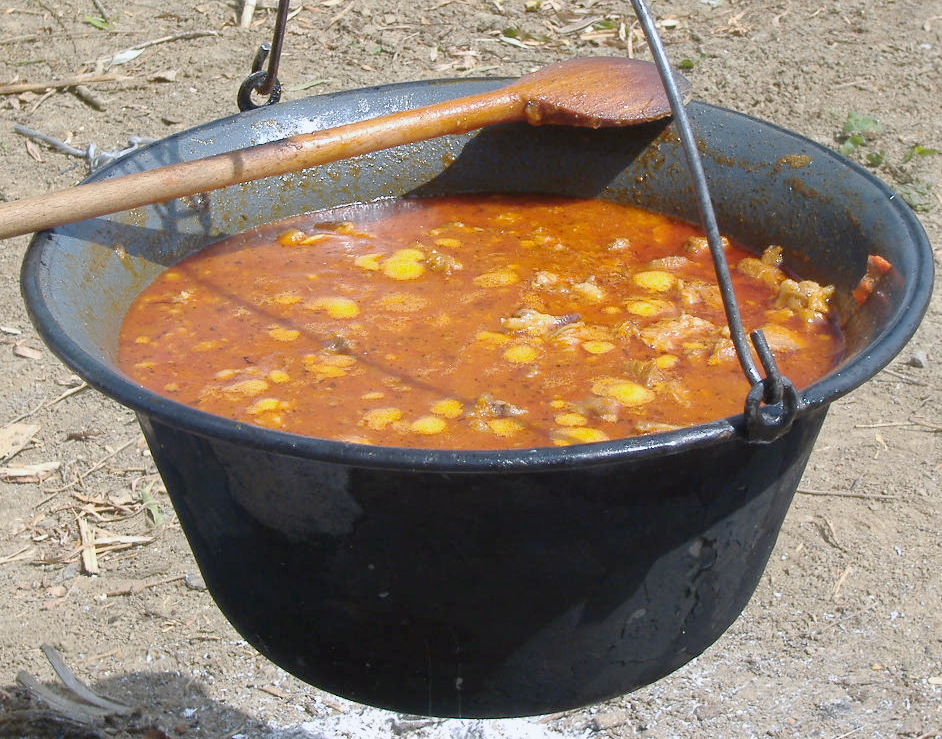 Classic goulash cooking outdoors in a traditional bogrács.
Welcome to FabulousFusionFood's Stew Recipes Page — Stews represent a combination of solid food ingredients that have been cooked in liquid and served in the resultant gravy. Ingredients can include any combination of vegetables and may include meat, especially tougher meats suitable for slow-cooking, such as beef, pork, venison, rabbit, lamb, poultry, sausages, and seafood. While water can be used as the stew-cooking liquid, stock is also common. A small amount of red wine or other alcohol is sometimes added for flavour. Seasonings and flavourings may also be added. Stews are typically cooked at a relatively low temperature (simmered, not boiled), allowing flavours to mingle.
Stews have been around almost nearly as long as humans have been cooking. All you need is a vessel to hold your ingredients and water and a means of heating that vessel. It can be as simple as a leather bag with stones heated in a fire dropped into it. So stews were almost certainly prepared during the Paleolithic and Neolithic periods, if not earlier. Once you have clay or metal pots you can prepare stews next to or set directly over a fire. Stews are low-maintenance cookery, generally not requiring that the cooking pot be observed continuously. The slow cooking is also ideal for tenderizing tougher cuts of meat (neck, shin, tail etc). As these also tend to be the most flavoursome parts of animals, this also means that stews can be extremely flavourful. Stews also pair well with the local staple: potatoes, rice, bread, yams, cassava etc.
Even in hunter-gatherer societies stews are useful in that the slow cooking can make the most of tough meat and it can be combined with foraged grains, leafy greens, nuts and starchy tubers to yield a flavourful, low maintenance and nutritious meal. With the advent of agriculture almost all grains are amenable to stewing and combining grains and legumes in a stew provides a ready way to gain all the essential amino acids that humans (particularly children) require.
The boiling process of making stews also helps sterilize the ingredients, killing harmful bacteria and viruses. It can also help neutralize harmful chemicals, such as the cyanogenic compounds in bitter cassava and helps reduce bitterness in leafy greens, making the food both safer to eat and more palatable. The addition of flavouring ingredients (fruit, spices, herbs) during the cooking process can also alter the flavours of stews, making them more palatable and more appealing. This is particularly the case when adding components with high umami content (certain fish, seaweed, cruciferous vegetables, beans, soy sauce, mushrooms etc).
It is little wonder that, taken globally, the list of stews presented on this site is a long one.
Some stews border on soups and the definition of whether a dish is a soup or a stew. A good example of this is Welsh cawl which can be served with more liquid as a soup or can be thickened as a stew and served with bread and/or potatoes. Most curries, due to their long, slow cooking and blend of ingredients can also be considered a subtype of stew.
Pretty much every culture on earth has a classic stew that's a major part of its cultural culinary repertoire. I have viewed and collected recipes for many of these on my travels. These and other classic stews from around the world are collected and presented here.
The alphabetical list of all the stew recipes on this site follows, (limited to 100 recipes per page). There are 2743 recipes in total:
Page 23 of 28
| Rosemary-scented Lamb Origin: Britain | Saka Saka du Mali (Malian Sweet Potato Leaf Sauce) Origin: Mali | Sauce Arachide de Burkina Faso (Burkinabe Peanut Sauce) Origin: Burkina Faso |
| Rostbraten Mit Pilzfulle (Roast Beef with Mushroom Stuffing) Origin: Germany | Saka-saka (Mutton and Cassava Leaf Stew) Origin: Guinea | Sauce aux Arachides (Guinean Peanut Sauce) Origin: Guinea |
| Rosto Origin: Gibraltar | Salade Kopto (Moringa Leaf Salad) Origin: Niger | Sauce aux Arachides du Tchad (Chadian Peanut Sauce) Origin: Chad |
| Rougail de Saucisse (Sausage Rougail) Origin: Reunion | Salmi Poulet Mauriticien (Chicken Mauritius) Origin: Mauritius | Sauce aux Champignons et Citron (Mushroom and Lemon Sauce) Origin: Congo |
| Rougail Saucisse (Sausage Rougail) Origin: Mauritius | Salmis de Faisan (Salmis of Pheasant) Origin: France | Sauce d'Adémé aux Fruits de Mer (Seafood with Adémé Sauce) Origin: Togo |
| Rougaille Boudin (Black Pudding in Tomato Sauce) Origin: Mauritius | Salmis de Palombe (Salmis of Pigeons) Origin: France | Sauce d'Arachide (Peanut Sauce) Origin: Benin |
| Roz bi Laban (Egyptian Rice Pudding) Origin: Egypt | Salmon Kalia in Panch Phoron Sauce Origin: India | Sauce Feuilles de Manioc Camerounaise (Cameroonian Cassava Leaf Sauce) Origin: Cameroon |
| Rukau Origin: Cook Islands | Salsa de Cacahuete con Pollo (Peanut Sauce with Chicken) Origin: Equatorial Guinea | Sauce Gbanbouda (Tô with Okra Sauce and Peanuts) Origin: Guinea |
| Rukau Origin: Tuvalu | Salsa de Espinacosas (Spinach Salsa) Origin: Equatorial Guinea | Sauce Gombo (Gombo Sauce) Origin: Guinea |
| Rukau Origin: Tokelau | Salsa di Pomodoro (Tomato Sauce) Origin: Italy | Sauce Gombo Origin: Niger |
| Rwanda Goat Pelau Origin: Rwanda | Salt Cod and Potatoes Origin: Bermuda | Sauce Gombo et Boeuf (Okra Sauce with Beef) Origin: Burkina Faso |
| Rwandan Beef Stew Origin: Rwanda | Saltah Origin: Yemen | Sauce Gombo Togolaise (Togolese Okra Sauce) Origin: Togo |
| Rwandan Chicken Origin: Rwanda | Saltfish Buljolde Origin: Antigua | Sauce Gombos Burkinabé (Burkinabe Okra Sauce) Origin: Burkina Faso |
| Rwandan Porridge Origin: Rwanda | Saltfish Buljolde Origin: British Virgin Islands | Sauce Koumrangan (Hibiscus Leaf Sauce) Origin: Chad |
| Rys Lumbard Stondyne (Sweet Rice and Egg Pudding) Origin: England | Salvadoran Pollo en Crema Origin: El Salvador | Sauce Légume Origin: Benin |
| Saak-er Ghanto Origin: Bangladesh | Samarkandskij Jagnenok (Samarkand Lamb) Origin: Uzbekistan | Sauce Moundourou (Moundourou Leaf Sauce) Origin: Chad |
| Saare jerk-sealiha (Island Jerk Pork) Origin: Dominica | Sambhar (Lentil Curry) Origin: India | Sauce Oseille (Sorrel Sauce) Origin: Burkina Faso |
| Saba Callaloo Origin: Saba | Samia' Metchou Peng Pa (Khmer Fish Stew with Lemongrass) Origin: Cambodia | Sauce sarzyne (Saracen Sauce) Origin: England |
| Saba Masala Chicken Origin: Saba | Samlor Machu Trey (Sweet and Sour Soup with Fish) Origin: Cambodia | Sauerbraten Origin: Germany |
| Saba Pigeon Pea Stew Origin: Saba | Samp Origin: eSwatini | Sauerbraten II (Soured Beef) Origin: Germany |
| Saba Rice and Black Beans Origin: Saba | Sancoche Origin: Trinidad | Sausage Ragu Origin: Britain |
| Saban Pot Origin: Saba | Sancochi di Galinja (Chicken Stew) Origin: Aruba | Sauté de cerf a la calédonienne (New Caledonian-Style Venison Sauté) Origin: New Caledonia |
| Sabat Moong Bhajji (Mung Bean Bhaji) Origin: India | Sancocho de siete carnes (Seven meat stew) Origin: Dominican Republic | Sautéed Collard Greens Origin: American |
| Sabzi Gutab (Green Gutab) Origin: Azerbaijan | Sancocho Dominicano (Dominican Stew) Origin: Dominican Republic | Savoury Chops Origin: Australia |
| Saffe (Mutton and Cassava Leaf Stew) Origin: Sierra Leone | Sao Tomean Calulu Origin: Sao Tome | Saws Rhython (Cockle Sauce) Origin: Welsh |
| Saffron Milk Cap Fricassee Origin: Britain | Sarapatel Origin: India | Scallops with Onion Cream Sauce Origin: Scotland |
| Saint jacques poêlées au lait de coco avec sa purée de patate douce (Scallops in Coconut Milk with Mashed Sweet Potatoes) Origin: Togo | Sarazener (Saracen) Origin: Germany | Schwalbennester (Bavarian Veal) Origin: Germany |
| Saint Kitts Stewed Saltfish Origin: Saint Kitts | Sarma (Stuffed Cabbage Leaves) Origin: Serbia | Schweinefleisch mit Wurzelgemüse und Äpfeln (Pork with Root Vegetables and Apples) Origin: Germany |
| Saint Lucia Lambi Soup with Dumplings Origin: Saint Lucia | Sarmale (Stuffed Cabbage Leaves) Origin: Romania | Schweinshaxe (Pork Hocks) Origin: Germany |
| Saint Lucian Bouillon Origin: Saint Lucia | Sarson Saag Gosht (Lamb and Rapeseed Greens Curry with Yoghurt) Origin: India | Schyconys with the Bruesse (Stewed Chicken) Origin: England |
| Saint Vincent Chicken Pelau Origin: Saint Vincent | Satan's Fantasy Chili Origin: American | Scotch Broth Origin: Scotland |
| Saint Vincent Pig Feet Souse Origin: Saint Vincent | Sathe Curry (Beef and Coconut Curry) Origin: Sri Lanka | Scotch Broth with Pepper Dulse Origin: Scotland |
| Saint-Martin Whelk Soup Origin: Saint-Martin | Satsabeli Bazha (Poultry in Walnut Sauce) Origin: Georgia | |
| Saka saka (Congolese Cassava Leaves) Origin: Congo | Sauce à l'Arachide Congolaise (Congolese Peanut Sauce) Origin: DR-Congo |
Page 23 of 28