FabulousFusionFood's Stew Recipes 20th Page
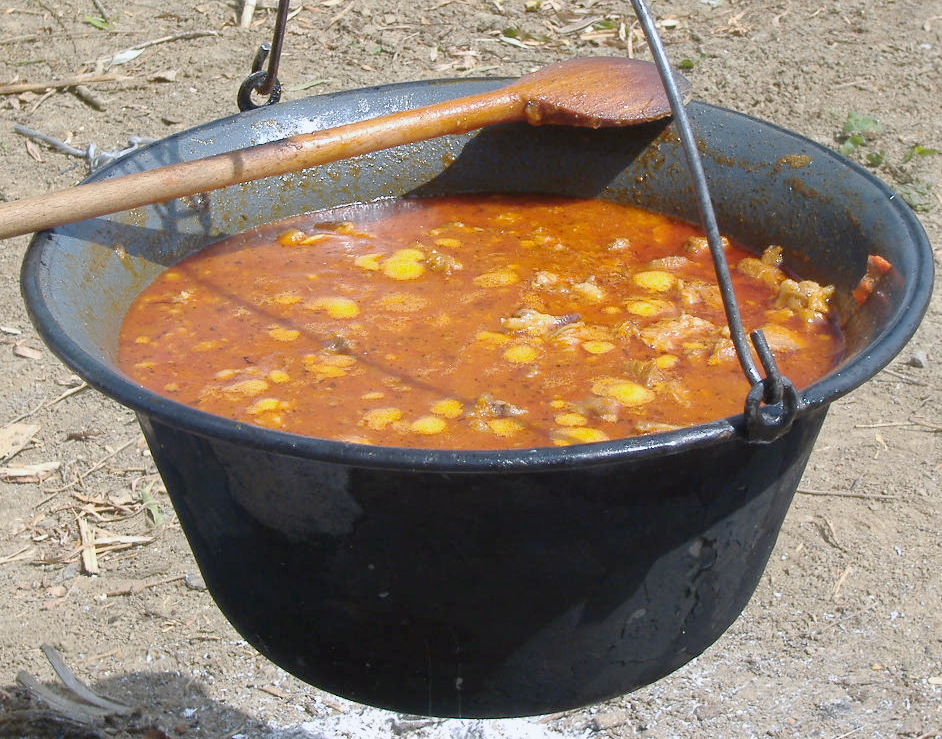 Classic goulash cooking outdoors in a traditional bogrács.
Welcome to FabulousFusionFood's Stew Recipes Page — Stews represent a combination of solid food ingredients that have been cooked in liquid and served in the resultant gravy. Ingredients can include any combination of vegetables and may include meat, especially tougher meats suitable for slow-cooking, such as beef, pork, venison, rabbit, lamb, poultry, sausages, and seafood. While water can be used as the stew-cooking liquid, stock is also common. A small amount of red wine or other alcohol is sometimes added for flavour. Seasonings and flavourings may also be added. Stews are typically cooked at a relatively low temperature (simmered, not boiled), allowing flavours to mingle.
Stews have been around almost nearly as long as humans have been cooking. All you need is a vessel to hold your ingredients and water and a means of heating that vessel. It can be as simple as a leather bag with stones heated in a fire dropped into it. So stews were almost certainly prepared during the Paleolithic and Neolithic periods, if not earlier. Once you have clay or metal pots you can prepare stews next to or set directly over a fire. Stews are low-maintenance cookery, generally not requiring that the cooking pot be observed continuously. The slow cooking is also ideal for tenderizing tougher cuts of meat (neck, shin, tail etc). As these also tend to be the most flavoursome parts of animals, this also means that stews can be extremely flavourful. Stews also pair well with the local staple: potatoes, rice, bread, yams, cassava etc.
Even in hunter-gatherer societies stews are useful in that the slow cooking can make the most of tough meat and it can be combined with foraged grains, leafy greens, nuts and starchy tubers to yield a flavourful, low maintenance and nutritious meal. With the advent of agriculture almost all grains are amenable to stewing and combining grains and legumes in a stew provides a ready way to gain all the essential amino acids that humans (particularly children) require.
The boiling process of making stews also helps sterilize the ingredients, killing harmful bacteria and viruses. It can also help neutralize harmful chemicals, such as the cyanogenic compounds in bitter cassava and helps reduce bitterness in leafy greens, making the food both safer to eat and more palatable. The addition of flavouring ingredients (fruit, spices, herbs) during the cooking process can also alter the flavours of stews, making them more palatable and more appealing. This is particularly the case when adding components with high umami content (certain fish, seaweed, cruciferous vegetables, beans, soy sauce, mushrooms etc).
It is little wonder that, taken globally, the list of stews presented on this site is a long one.
Some stews border on soups and the definition of whether a dish is a soup or a stew. A good example of this is Welsh cawl which can be served with more liquid as a soup or can be thickened as a stew and served with bread and/or potatoes. Most curries, due to their long, slow cooking and blend of ingredients can also be considered a subtype of stew.
Pretty much every culture on earth has a classic stew that's a major part of its cultural culinary repertoire. I have viewed and collected recipes for many of these on my travels. These and other classic stews from around the world are collected and presented here.
The alphabetical list of all the stew recipes on this site follows, (limited to 100 recipes per page). There are 2743 recipes in total:
Page 20 of 28
| Perch Benachin Origin: Gambia | Pink Leg of Lamb Origin: Turkey | Plat Tradicional Fula (Traditional Fulani Dish) Origin: Guinea-Bissau |
| Perdicem cum pluma (Sauce for Wood Pigeon or Partridge) Origin: Roman | Pinon au Dindon (Pinon with Turkey) Origin: Togo | Plays in Cynee (Plaice in Spiced Bread Sauce) Origin: England |
| Peri Peri Kari Camarão (Fiery Prawn Curry) Origin: Mozambique | Pintade à l'Afrique (African Guinea Fowl) Origin: Guinea | Plokkfiskur (Icelandic fish stew) Origin: Iceland |
| Peri-Peri Chicken with Peri-Peri Rice Origin: Mozambique | Pintade de Guinée (Guinean Guineafowl) Origin: Guinea | Plov S Mindalyom, Izyumom I Apelsinovoy Tsedroy (Fruit Pilaf) Origin: Georgia |
| Persian Lentils with Orange Juice and Angelica Origin: Iran | Pipián (Chicken in Peanut Sauce) Origin: Philippines | Point-and-kill Origin: Nigeria |
| Peruvian Goat Stew Origin: Peru | Pisam Adulteram Versatilem (Peas Turnover) Origin: Roman | Pois d'Angole (Pigeon Peas) Origin: Guadeloupe |
| Perys en Composte (Pears in Compote) Origin: England | Pisam coques (Peas in Herb Sauce) Origin: Roman | Poisson au Fúmbwa (Fish with Fumbwa) Origin: Central African Republic |
| Peson of Almayne (German Peas) Origin: England | Pisam Farsilem (Pressed Peas) Origin: Roman | Poisson au Lait de Coco (Fish in Coconut Milk) Origin: Cote dIvoire |
| Petit Salé with Winter Root Vegetables and Ceps Origin: Britain | Pisam Vitellianam sive fabam (Peas or Broad Beans Beans in a Herb Sauce) Origin: Roman | Poisson Fumé aux Gombos (Smoked Fish with Okra) Origin: Cameroon |
| Phaksha Pa Origin: Bhutan | Pisca Hasa (Fried Fish) Origin: Aruba | Poisson sauce Claire (Fish with Clear Sauce) Origin: Burkina Faso |
| Phaksha Paa (Bhutanese Pork with Chillies) Origin: Bhutan | Pisca Stoba (Fish Stew) Origin: Puerto Rico | Poisson Yassa Mauritanienne (Mauritanian Fish Yassa) Origin: Mauritania |
| Phane Stew Origin: Botswana | Pisces Zomoteganon II (Fish Stewed in its Own Juice) Origin: Roman | Poissons en sauce aux arachides (Fish in Groundnut Sauce) Origin: Gabon |
| Pheasant Stew with Whisky Origin: Scotland | Pisken Balyk (Boiled Fish) Origin: Kazakhstan | Pollo Alla Cacciatora (Sammarinese Chicken Cacciatore) Origin: San Marino |
| Phool gobhi Achari Origin: India | Pisupo Origin: Samoa | Pollo Borracho Chileano (Chilean Drunken Chicken) Origin: Chile |
| Picadillo Origin: Cuba | Pit Pit in Coconut Cream Origin: Papua New Guinea | Pollo con Salsa de Cacahuetes (Chicken with Peanut Sauce) Origin: Equatorial Guinea |
| Picadillo de Vainicas (Green Bean Picadillo) Origin: Costa Rica | Pit Pit in Coconut Cream Origin: Fiji | Pollo de Chocolate (Chocolate Chicken) Origin: Mexico |
| Picado à Madeirense (Beef Tips, Madeiran Style) Origin: Portugal | Pit Pit in Coconut Cream Origin: Niue | Pollo en Pinol Origin: El Salvador |
| Pick a Pepper Soup Origin: Equatorial Guinea | Pit Pit in Coconut Cream Origin: Papua | Pollo en Salsa Origin: Costa Rica |
| Pied de Veau aux Pois Chiches (Calf's Feet with Chickpeas) Origin: Burkina Faso | Pit Pit in Coconut Cream Origin: Samoa | Pollo Encebolladoaa (Chicken Smothered with Onions) Origin: El Salvador |
| Piezly Mukhat (Chickpea and Onion Stew) Origin: Tajikistan | Pit Pit in Coconut Cream Origin: Tonga | Pollo Guisado (Dominican Stewed Chicken) Origin: Dominican Republic |
| Pig Tail Bouillon with Dumplings Origin: Saint Lucia | Pit Pit in Coconut Cream Origin: Vanuatu | Pollo Guisado (Dominican Chicken Stew) Origin: Dominican Republic |
| Pigeon Breasts Origin: Scotland | Pit Pit in Coconut Cream Origin: Kiribati | Pollo Guisado (Salvadorean Chicken Stew) Origin: El Salvador |
| Pigeon Peas and Rice Origin: Anguilla | Pit Pit in Coconut Cream Origin: Federated States Micronesia | Pollo Mexicana (Chicken Mexicana) Origin: Mexico |
| Pigeons à la Chinois (Chinese Pigeons) Origin: France | Pit Pit in Coconut Cream Origin: Cook Islands | Polvo à São Tomé (Sao Tomean Octopus) Origin: Sao Tome |
| Pigeons aux Champignons (Pigeons with Mushrooms) Origin: France | Pit Pit in Coconut Cream Origin: New Caledonia | Polvo a Modo ze de Lino (Octopus Stew) Origin: Cape Verde |
| Pigeons Bonne Femme Origin: France | Pit Pit in Coconut Cream Origin: Wallis Futuna | Pondu Origin: Congo |
| Pigeons Chasseur Origin: France | Pit Pit in Coconut Cream Origin: Society Islands | Porc aux Choux de Chine (Pork with Chinese Leaf) Origin: Madagascar |
| Pilaf Rizi (Rice Pilaf) Origin: Cyprus | Pit Pit in Coconut Cream Origin: Marshall Islands | Porc Palmiste (Pork with Heart of Palm) Origin: Reunion |
| Pilafi Pourgouri (Crushed Wheat Pilaf) Origin: Cyprus | Pit Pit in Coconut Cream Origin: Marquesas Islands | Porc Wedi ei Bobi'n Araf (Slow-roast Pork) Origin: Welsh |
| Pilao (Comorian Pilau) Origin: Comoros | Pizza Rustica (Italian Easter Ham Pie) Origin: Ghana | Pork and Beans Origin: American |
| Pilao ou Riz au Poulet (Mahoran Chicken Pilau) Origin: Mayotte | Plantain and Coconut Soup Origin: Uganda | Pork and Yam Pepper Soup Origin: Nigeria |
| Pilao ou Riz au Poulet (Comorian Chicken Pilau) Origin: Comoros | Plantain Pilé à la Sauce d'Arachide (Crushed Plantains with Peanut Sauce) Origin: Cameroon | Pork Black Curry Origin: Sri Lanka |
| Pilau Mouton de Comores (Comorian Mutton Pilau) Origin: Comoros | Plasas (Sierra Leonean Chicken Peanut Stew) Origin: Sierra Leone | |
| Pilav Limon (Lemon Pasta Pilaf) Origin: Georgia | Plat Songhay (Songhay Dish) Origin: Mali |
Page 20 of 28