FabulousFusionFood's Society Islander Recipes Home Page
 The flag of French Polynesia.
Welcome to the summary page for FabulousFusionFood's Society Islander recipes, part of Oceania. This page provides links to all the Society Islander recipes presented on this site, with 17 recipes in total.
This is a continuation of an entire series of pages that will, I hope, allow my visitors to better navigate this site. As well as displaying recipes by name, country and region of origin I am now planning a whole series of pages where recipes can be located by meal type and main ingredient. This page gives a listing of all the Tahitian recipes added to this site.
Society Islander cuisine is a blend of traditional Polynesian and French culinary influences, featuring fresh seafood, tropical fruits, and local ingredients like coconut milk and taro. Popular dishes include poisson cru (raw fish marinated in coconut milk), suckling pig, and various desserts made with local fruit.
These recipes, for the major part, originate in the Society Islands. Otherwise they are fusion recipes with major Society Islander influences.
The Society Islands (French: Îles de la Société), officially Archipel de la Société (Tahitian: Tōtaiete mā) are an archipelago in the South Pacific Ocean that includes the major islands of Tahiti, Moʻorea, Raiatea, Bora Bora and Huahine. Politically, they are part of French Polynesia, an overseas country of the French Republic. Geographically, they form part of Polynesia.
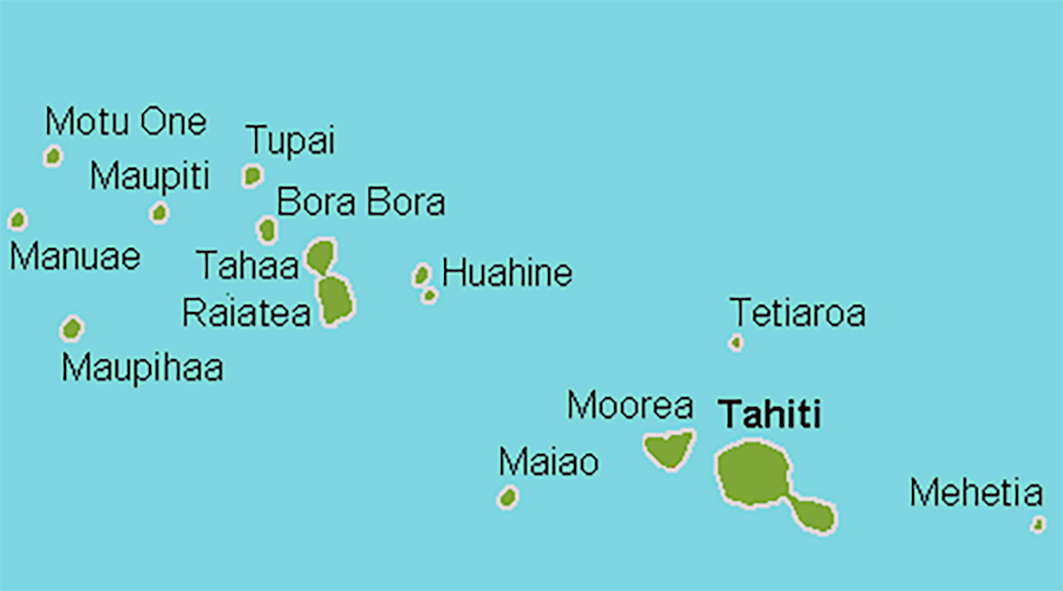 View of the society islands in relation to each otherThe first inhabitants arrived from Western Polynesia into the Society Islands sometime after 900 CE; some studies have proposed slightly later dates, ∼1025–1120 CE. Linguistic, biological and archaeological evidence supports a long migration from Southeast Asia via the Fijian, Samoan and Tongan Archipelagos using outrigger canoes that were up to twenty or thirty metres long and could transport families as well as domestic animals.
The islanders explain their origins in terms of an orally transmitted story. The feathered god Ta'aroa lay in his shell. He called out but no-one answered, so he went back into his shell, where he stayed for aeons. When he came out he changed his body into the multi-layered dome of the sky. Other parts of his body he transformed into Papa-fenua, the earth. Other parts he made into Te Tuma, the ata, or shadow of his phallus. Ta'aroa said, 'Cast your eyes on my phallus. Gaze upon it and insert it in the earth'. He came down to earth at 'Opoa in Havai'i' (now Ra'iatea), one of the most sacred places in the Society Islands. Other gods were created, and these ran directly into the time of the people. The high chiefs or ari'i rahi were descendants from the gods, reckoned to be forty generations previous. In their presence commoners showed respect by stripping to the waist. The high chiefs erected marae as places of worship.
The Society Islands are divided into the Windward Islands (Îles du Vent) and the Leeward Islands (Îles Sous-le-Vent):
Etymology: The term Society Islands was first used by Captain James Cook when he visited the Leeward Islands, a subgroup of six of the modern-day Society Islands, during his expedition to the south Pacific Ocean in 1769. It has been asserted that the name honors the Royal Society, the sponsor of his voyage, but this is disputed. Cook wrote in his journal:
To these six islands, [Raiatea, Tahaʻa, Bora Bora, Huahine, Tupai, and Maupiti], as they lie contiguous to each other, I gave the names of SOCIETY ISLANDS, but did not think it proper to distinguish them separately by any other names than those by which they were known to the natives.
Significant dishes include:
Poisson Cru Raw fish marinated in coconut milk and lime, often served as a starter.
Fafaru Fermented fish dish, known for its strong aroma, typically served with coconut milk.
Ahima'a Traditional cooking method using an underground oven for slow-cooked meals.
Po'e A sweet pudding made from fruits like banana or papaya, served with coconut milk.
Tama’ara’a A festive meal featuring various dishes cooked in an ahima'a.
This is a continuation of an entire series of pages that will, I hope, allow my visitors to better navigate this site. As well as displaying recipes by name, country and region of origin I am now planning a whole series of pages where recipes can be located by meal type and main ingredient. This page gives a listing of all the Tahitian recipes added to this site.
Society Islander cuisine is a blend of traditional Polynesian and French culinary influences, featuring fresh seafood, tropical fruits, and local ingredients like coconut milk and taro. Popular dishes include poisson cru (raw fish marinated in coconut milk), suckling pig, and various desserts made with local fruit.
These recipes, for the major part, originate in the Society Islands. Otherwise they are fusion recipes with major Society Islander influences.
The Society Islands (French: Îles de la Société), officially Archipel de la Société (Tahitian: Tōtaiete mā) are an archipelago in the South Pacific Ocean that includes the major islands of Tahiti, Moʻorea, Raiatea, Bora Bora and Huahine. Politically, they are part of French Polynesia, an overseas country of the French Republic. Geographically, they form part of Polynesia.
View of the society islands in relation to each otherThe islanders explain their origins in terms of an orally transmitted story. The feathered god Ta'aroa lay in his shell. He called out but no-one answered, so he went back into his shell, where he stayed for aeons. When he came out he changed his body into the multi-layered dome of the sky. Other parts of his body he transformed into Papa-fenua, the earth. Other parts he made into Te Tuma, the ata, or shadow of his phallus. Ta'aroa said, 'Cast your eyes on my phallus. Gaze upon it and insert it in the earth'. He came down to earth at 'Opoa in Havai'i' (now Ra'iatea), one of the most sacred places in the Society Islands. Other gods were created, and these ran directly into the time of the people. The high chiefs or ari'i rahi were descendants from the gods, reckoned to be forty generations previous. In their presence commoners showed respect by stripping to the waist. The high chiefs erected marae as places of worship.
The Society Islands are divided into the Windward Islands (Îles du Vent) and the Leeward Islands (Îles Sous-le-Vent):
| Windward Isalds | Leeward Islands |
|---|---|
| Mehetia | Huahine |
| Tahiti | Raiatea |
| Teti'aroa | Taha'a |
| Moorea | Bora Bora |
| Maiao | Tupai |
| Maupiti | |
| Mopelia | |
| Motu One | |
| Manuae |
Etymology: The term Society Islands was first used by Captain James Cook when he visited the Leeward Islands, a subgroup of six of the modern-day Society Islands, during his expedition to the south Pacific Ocean in 1769. It has been asserted that the name honors the Royal Society, the sponsor of his voyage, but this is disputed. Cook wrote in his journal:
To these six islands, [Raiatea, Tahaʻa, Bora Bora, Huahine, Tupai, and Maupiti], as they lie contiguous to each other, I gave the names of SOCIETY ISLANDS, but did not think it proper to distinguish them separately by any other names than those by which they were known to the natives.
Society Islander Cuisine:
Society Islander cuisine is a vibrant blend of traditional Polynesian and French culinary influences. It emphasizes fresh, local ingredients, particularly seafood, tropical fruit, and vegetables. The cuisine reflects the islands' rich cultural heritage and natural bounty.Significant dishes include:
Poisson Cru Raw fish marinated in coconut milk and lime, often served as a starter.
Fafaru Fermented fish dish, known for its strong aroma, typically served with coconut milk.
Ahima'a Traditional cooking method using an underground oven for slow-cooked meals.
Po'e A sweet pudding made from fruits like banana or papaya, served with coconut milk.
Tama’ara’a A festive meal featuring various dishes cooked in an ahima'a.
The alphabetical list of all the Society Islander recipes on this site follows, (limited to 100 recipes per page). There are 17 recipes in total:
Page 1 of 1
| Achard de pahua confit (Achard of Confit of Pahua) Origin: Tahiti | Miti Hue (Fermented Coconut Sauce) Origin: Tahiti | Poulet Fafa (Chicken with Taro Leaves) Origin: Tahiti |
| Chevrettes à la vanille et coco (Prawns in a coconut-vanilla sauce) Origin: Tahiti | Nems au poulet (Chicken Spring Rolls) Origin: Tahiti | Pua’atoro aux Pommes de Terre Rissolées (Corned Beef with Fried Potatoes) Origin: Tahiti |
| Curry de porc au taro tahitien (Tahitian Pork Curry with Taro) Origin: Tahiti | Pahua au curry (Curried Pahua) Origin: Tahiti | Tahin (Coconut Candy) Origin: Tahiti |
| Fafa (Taro Leaves with Coconut Cream) Origin: Tahiti | Pahua Taioro Origin: Tahiti | Taioro Origin: Tahiti |
| Fāfaru (Fermented Coconut Sauce) Origin: Tahiti | Po'e Origin: Tahiti | Tarte à la crème de noix de coco (Coconut Cream Pie) Origin: Tahiti |
| Fri Fri Origin: Tahiti | Poisson Cru (Tahitian Raw Fish Salad) Origin: Tahiti |
Page 1 of 1