FabulousFusionFood's Nut-based Recipes 19th Page
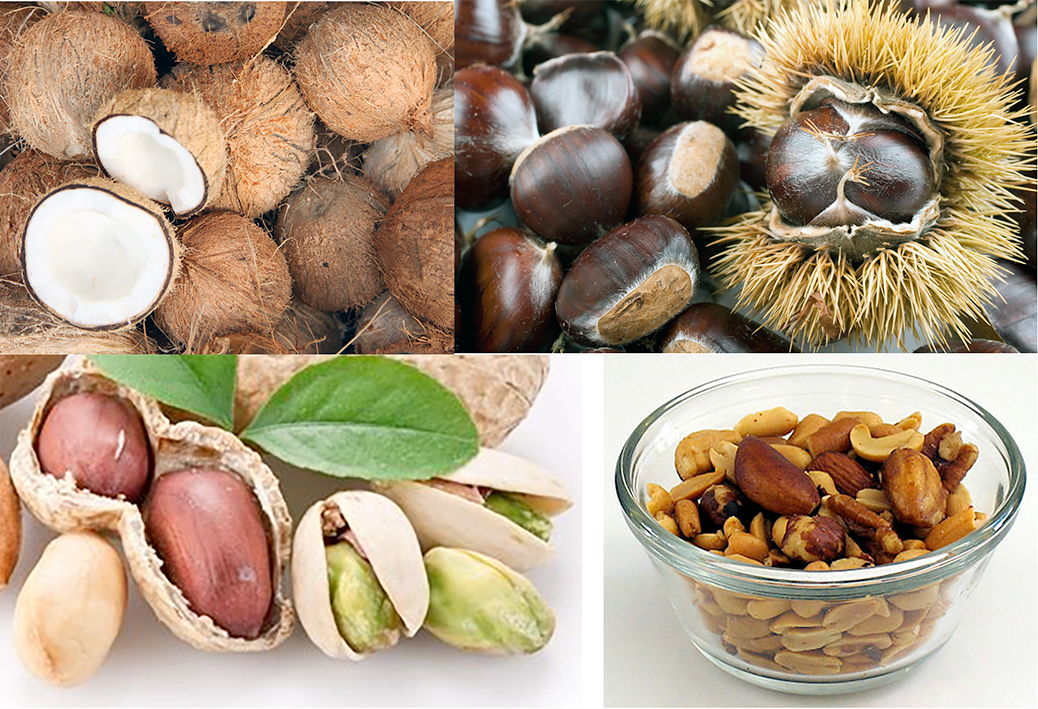 Different nuts. Clockwise: coconuts, sweet chestnuts, bowl of mixed nuts,
peanuts and pistachios.
Welcome to FabulousFusionFood's Nut-based Recipes Page —A nut is a fruit consisting of a hard or tough nutshell protecting a kernel which is usually edible. In general usage and in a culinary sense, many dry seeds are called nuts. In a botanical context, "nut" implies that the shell does not open to release the seed (indehiscent).
Most seeds come from fruit that naturally free themselves from the shell, but this is not the case in nuts such as hazelnuts, chestnuts, and acorns, which have hard shell walls and originate from a compound ovary. The general and original usage of the term is less restrictive, and many nuts (in the culinary sense), such as almonds, pistachios, and Brazil nuts, are not nuts in a botanical sense. Common usage of the term often refers to any hard-walled, edible kernel as a nut. Nuts are an energy-dense and nutrient-rich food source.
Botanically, a nut is a fruit with a woody pericarp developing from a syncarpous gynoecium. True nuts include, for example, chestnut, hazelnut and filbert. Culinarily, the term 'nut' is used much more widely, and includes examples of drupes (such as pecans and almonds) or seeds (such as pine nuts and peanuts).
Also widely known as nuts are dry drupes, which include pecans, almonds, macadamia (Macadamia integrifolia), candlenut (Aleurites moluccanus) and the water caltrop (Trapa bicornis). A drupe is an indehiscent fruit that has an outer fleshy part consisting of the exocarp, or skin, and mesocarp, or flesh, which surround a single pit or stone, the endocarp with a seed (kernel) inside. In a dry drupe, the outer parts dry up and the remaining husk is part of the ovary wall or pericarp, and the hard inner wall surrounding the seed represents the inner part of the pericarp.
Walnuts and hickories (Juglandaceae) have fruit that are difficult to classify. They are considered to be nuts under some definitions but are also referred to as drupaceous nuts.
In common use, a "tree nut" is, as the name implies, any nut coming from a tree. This most often comes up regarding food allergies; a person may be allergic specifically to peanuts (which are not tree nuts but legumes), whereas others may be allergic to the wider range of nuts that grow on trees.
The sweet potato arrived in Europe with the Columbian exchange. It is recorded, for example, in Elinor Fettiplace's Receipt Book, compiled in England in 1604.
Nuts are eaten by humans and wildlife. Because nuts generally have a high oil content, they are a significant energy source. Many seeds are edible by humans and used in cooking, eaten raw, sprouted, or roasted as a snack food, ground to make nut butters, or pressed for oil that is used in cooking and cosmetics.
Nuts used for food are a common source of food allergens. Reactions can range from mild symptoms to severe ones, a condition known as anaphylaxis, which can be life-threatening. The reaction is due to the release of histamine by the body in response to an allergen in the nuts, causing skin and other possible reactions. Many experts suggest that a person with an allergy to peanuts should avoid eating tree nuts, and vice versa.
The nuts linked to from this page are: acorn; almond; beech nuts; betel nut; brazil nut; bush mango; filbert; ginkgo nut; kola nut; candlenut; cashew; chestnut; coconut; hazelnut; macadamia; ogbono; palm nut; peanut; pecan; pine nut; pistachio; walnut.
The alphabetical list of all the nut-based recipes on this site follows, (limited to 100 recipes per page). There are 4197 recipes in total:
Page 19 of 42
| Indian Curry Paste Origin: Fusion | Ius album in copadiis (White Sauce for Choice Cuts II) Origin: Roman | Jamaican Jerk Seasoning Origin: Jamaica |
| Indian Dumpode Goose Origin: Anglo-Indian | Ius Candidum in Ansere Elixo (White Sauce for Boiled Goose) Origin: Roman | Jamaican Mango Cheesecake Origin: Jamaica |
| Indian-style pancakes with spiced Jersey Royals Origin: Fusion | Ius Candidum in Avem Elixam (White Sauce for a Boiled Bird) Origin: Roman | Jamaican Plantain Tarts Origin: Jamaica |
| Indonesian Curry Spice Paste Origin: Indonesia | Ius candidum in elixam (White Sauce for Boiled Meats) Origin: Roman | Jamaican Sea Moss Drink Origin: Jamaica |
| Indonesian Peanut Sauce Origin: Indonesia | Ius Frigidum in Aprum Elixum (Cold Sauce for Boiled Wild Boar) Origin: Roman | Jamaican Seafood Soup Origin: Jamaica |
| Indonesian Soufflé Omelette Origin: Indonesia | Ius Frigidum in Ovifero (Cold Sauce for Wild Sheep) Origin: Roman | Jamaican Spiced Plantains Origin: Jamaica |
| Indonesian-style Spicy Cod Origin: Fusion | Ius Frigidum in Porcellum Elixum (Cold Sauce for Boiled Suckling Pig) Origin: Roman | Jamaican Tutti Frutti Cake Origin: Jamaica |
| Injeolmi Bingsu (Korean Milk Ice Sorbet with Rice Cakes) Origin: Korea | Ius in Aprum Elixum (Sauce for Boiled Wild Boar) Origin: Roman | Japanese Baked Mitake Origin: Japan |
| Insal Nga Lapu Lapu (Grilled Grouper with Aubergine-prune Compote) Origin: Philippines | Ius in Cervo (Sauce for Venison) Origin: Roman | Japanese Curry Powder Origin: Japan |
| Insalata di Riso (Rice Salad) Origin: Italy | Ius in copadiis II (Sauce for Choice Cuts II) Origin: Roman | Japanese Curry Powder II Origin: Japan |
| Insanity Chilli Paste Origin: Fusion | Ius in copadiis III (Sauce for Choice Cuts III) Origin: Roman | Japanese Knotweed Frangipane Squares Origin: Britain |
| Iraqi Dolma Origin: Iraq | Ius in Mugile Salso (Sauce for Salted Grey Mullet) Origin: Roman | Japanese Knotweed Frangipane Tart Origin: Britain |
| Irish Apple Cake Origin: Ireland | Ius in Mullos Assos (Sauce for Baked Red Mullet) Origin: Roman | Java Chicken Origin: Fusion |
| Irish Carbonnade Origin: Ireland | Ius in Murena Elixa (Sauce for Poached Moray Eel) Origin: Roman | Jerk BBQ Sauce Origin: Jamaica |
| Irish Ginger Cake Origin: Ireland | Ius in Pisce Elixo (Sauce for Poached Fish) Origin: Roman | Jerusalem Artichoke and Kale Gratin Origin: Britain |
| Irish Plum Cake Origin: Ireland | Ius in Siluro, in Pelamyde et in Thynno Salsis (Sauce for Salt Sheatfish, Young Tuna, or Tuna Over a Year Old) Origin: Roman | Jerusalem Olive Oil Cake with Orange Marmalade and Almonds Origin: America |
| Irish Potato Cake Origin: Ireland | Ius in thynno elixo (Salt Tuna with Sauce) Origin: Roman | Jewelled Christmas Cake Origin: Britain |
| Irish Potato Pancakes Origin: Ireland | Jack O'Lantern Cheese Balls Origin: American | Johannisbeerkuchen (German Redcurrant Cake) Origin: Germany |
| Irish Rink Cake Origin: Ireland | Jacket Potato with Smoked Cod and Broccoli Filling Origin: Ireland | Johonjö Origin: Equatorial Guinea |
| Irish Stout Pudding with Whiskey Cream Origin: Ireland | Jackfruit Kofta Curry Origin: India | Jollof Rice with Chicken Beef and Ham Origin: Ghana |
| Irish Whiskey Syllabub Origin: Ireland | Jalfrezi Masala Origin: India | Jollof Rice with Lamb Origin: Mali |
| Irmik Helvasi (Semolina Halva) Origin: Turkey | Jam-filled Pound Cake Cupcakes with Peanut Butter Frosting Origin: American | Joutes of almannd mylk (Herb Pottage with Almond Milk) Origin: England |
| Iron Age Pork and Beans Origin: Ancient | Jamaican All-purpose Seasoning Origin: Jamaica | Judias Verdes con Salsa de Tomate (Green Beans in Tomato Sauce) Origin: Spain |
| Isi Ewu (Spiced Goat Head) Origin: Nigeria | Jamaican Coconut Rice Origin: Jamaica | Jugged Pigeons Origin: Britain |
| Isicia ex Sphondylis (Mussel Forcemeat) Origin: Roman | Jamaican Curried Jackfruit Origin: Jamaica | Jugo de Avena (Oat and Coconut Smoothie) Origin: Dominican Republic |
| Isicia Ova et Cerebella (Egg and Brain Sausages) Origin: Roman | Jamaican Curry Chicken with Coconut Rice Origin: Jamaica | Juk Juk (Sticky Rice Balls) Origin: Marshall Islands |
| Islay Loaf Origin: Scotland | Jamaican Curry Powder Origin: Jamaica | Jungle Curry Prawns Origin: Thailand |
| Isombe Origin: Rwanda | Jamaican Easter Bun Origin: Jamaica | Jus de Souchet (Tiger Nut Milk) Origin: Burkina Faso |
| Ispanaklı Kek (Spinach Cake) Origin: Turkey | Jamaican Fiery Spiced Pork Marinade Origin: Jamaica | K'naafeh (String Pastry) Origin: Lebanon |
| Israeli Halva Origin: Israel | Jamaican Hummingbird Cake Origin: Jamaica | Kabocha Squash and Kale Galette Origin: America |
| Italian Cake Christmas Pudding Origin: Fusion | Jamaican Jerk Chicken Origin: Jamaica | Kabritu Stoba (Stewed Kid Goat) Origin: Aruba |
| Italianate Warm Dandelion Salad Origin: British | Jamaican Jerk Jackfruit Origin: Jamaica | Kabritu Stobá (Goat Meat Stew) Origin: Saba |
| Iumbolls Origin: Britain | Jamaican Jerk Marinade Origin: Jamaica | |
| Iura Ferventia in Cervo (Hot Sauce for Venison) Origin: Roman | Jamaican Jerk Seasoning Origin: Jamaica |
Page 19 of 42