FabulousFusionFood's Nut-based Recipes 26th Page
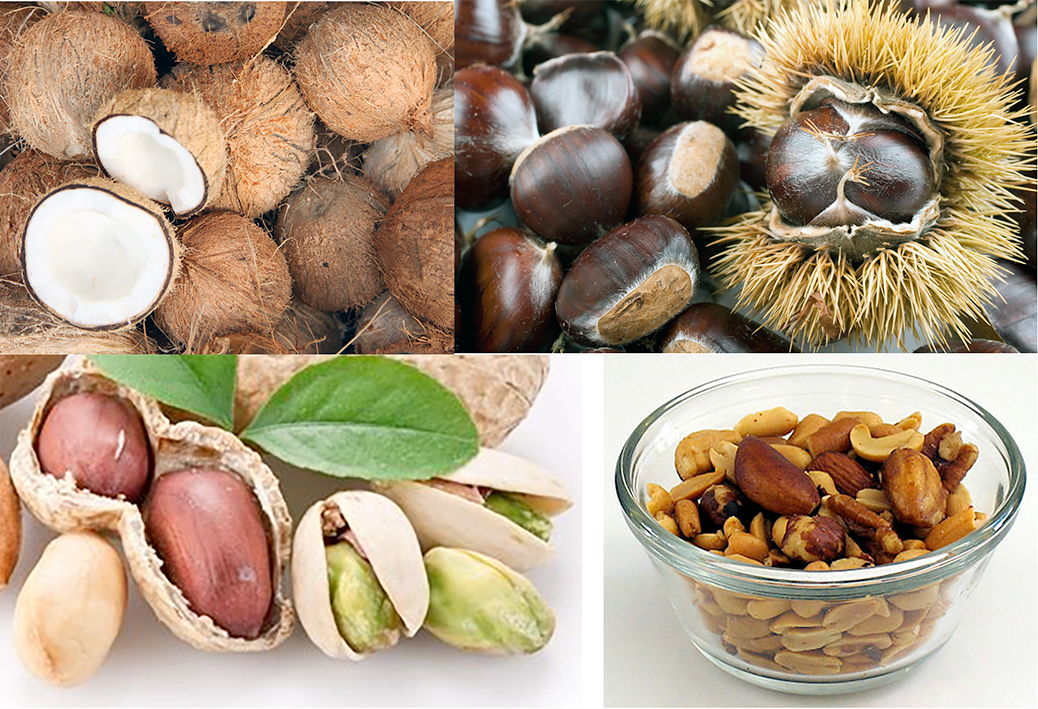 Different nuts. Clockwise: coconuts, sweet chestnuts, bowl of mixed nuts,
peanuts and pistachios.
Welcome to FabulousFusionFood's Nut-based Recipes Page —A nut is a fruit consisting of a hard or tough nutshell protecting a kernel which is usually edible. In general usage and in a culinary sense, many dry seeds are called nuts. In a botanical context, "nut" implies that the shell does not open to release the seed (indehiscent).
Most seeds come from fruit that naturally free themselves from the shell, but this is not the case in nuts such as hazelnuts, chestnuts, and acorns, which have hard shell walls and originate from a compound ovary. The general and original usage of the term is less restrictive, and many nuts (in the culinary sense), such as almonds, pistachios, and Brazil nuts, are not nuts in a botanical sense. Common usage of the term often refers to any hard-walled, edible kernel as a nut. Nuts are an energy-dense and nutrient-rich food source.
Botanically, a nut is a fruit with a woody pericarp developing from a syncarpous gynoecium. True nuts include, for example, chestnut, hazelnut and filbert. Culinarily, the term 'nut' is used much more widely, and includes examples of drupes (such as pecans and almonds) or seeds (such as pine nuts and peanuts).
Also widely known as nuts are dry drupes, which include pecans, almonds, macadamia (Macadamia integrifolia), candlenut (Aleurites moluccanus) and the water caltrop (Trapa bicornis). A drupe is an indehiscent fruit that has an outer fleshy part consisting of the exocarp, or skin, and mesocarp, or flesh, which surround a single pit or stone, the endocarp with a seed (kernel) inside. In a dry drupe, the outer parts dry up and the remaining husk is part of the ovary wall or pericarp, and the hard inner wall surrounding the seed represents the inner part of the pericarp.
Walnuts and hickories (Juglandaceae) have fruit that are difficult to classify. They are considered to be nuts under some definitions but are also referred to as drupaceous nuts.
In common use, a "tree nut" is, as the name implies, any nut coming from a tree. This most often comes up regarding food allergies; a person may be allergic specifically to peanuts (which are not tree nuts but legumes), whereas others may be allergic to the wider range of nuts that grow on trees.
The sweet potato arrived in Europe with the Columbian exchange. It is recorded, for example, in Elinor Fettiplace's Receipt Book, compiled in England in 1604.
Nuts are eaten by humans and wildlife. Because nuts generally have a high oil content, they are a significant energy source. Many seeds are edible by humans and used in cooking, eaten raw, sprouted, or roasted as a snack food, ground to make nut butters, or pressed for oil that is used in cooking and cosmetics.
Nuts used for food are a common source of food allergens. Reactions can range from mild symptoms to severe ones, a condition known as anaphylaxis, which can be life-threatening. The reaction is due to the release of histamine by the body in response to an allergen in the nuts, causing skin and other possible reactions. Many experts suggest that a person with an allergy to peanuts should avoid eating tree nuts, and vice versa.
The nuts linked to from this page are: acorn; almond; beech nuts; betel nut; brazil nut; bush mango; filbert; ginkgo nut; kola nut; candlenut; cashew; chestnut; coconut; hazelnut; macadamia; ogbono; palm nut; peanut; pecan; pine nut; pistachio; walnut.
The alphabetical list of all the nut-based recipes on this site follows, (limited to 100 recipes per page). There are 4197 recipes in total:
Page 26 of 42
| Mont Blanc Coco Antillais (Antillean Coconut Mont Blanc Cake) Origin: Saint Barthelemy | Mortis (Chicken Paté) Origin: Britain | Mulled Wine Cheesecake II Origin: Britain |
| Mont Blanc Coco Antillais (Antillean Coconut Mont Blanc Cake) Origin: Saint-Martin | Mortrews Blank (Meat in White Sauce) Origin: England | Mulled Wine Yule Stump Cake Origin: Britain |
| Mont Blanc Coco Antillais (Antillean Coconut Mont Blanc Cake) Origin: Guadeloupe | Mortrews of Fysche (Mortar-paste of Fish) Origin: England | Mulled Winter Fruit Crumble Origin: Britain |
| Mont Blanc Coco Antillais (Antillean Coconut Mont Blanc Cake) Origin: Martinique | Mother's Day Simnel Cupcakes Origin: Britain | Mulligatawny Soup Origin: Anglo-Indian |
| Mont Blanc Cupcakes Origin: Britain | Mother-in-law Masala Origin: South Africa | Mulligatawny Soup Origin: Britain |
| Mont Blancs Origin: France | Mousakkas (Cypriot Moussaka) Origin: Cyprus | Multi-grain Mix Origin: American |
| Montrose Cakes Origin: Scotland | Mousse à la noix de coco et coulis de mangue (Coconut Mousse and Mango Coulis) Origin: Senegal | Mumu Origin: Papua New Guinea |
| Montserratian Bread Pudding Origin: Montserrat | Mouton à l'Arachide (Lamb with Peanuts) Origin: Benin | Murgh Makhani (Butter Chicken) Origin: India |
| Montserratian Coconut Curry Chicken Origin: Montserrat | Moyo de Poulet Fume (Moyo of Smoked Chicken) Origin: Benin | Murrumbidgee Cake Origin: Australia |
| Montserratian Corn Soup Origin: Montserrat | Mozambique Peri-Peri Origin: Mozambique | Musakhan (Chicken with Sumac and Caramelized Onions) Origin: Syria |
| Montserratian Fisherman's Stew Origin: Montserrat | Mpotompoto (Ghanaian Yam Porridge) Origin: Ghana | Musakhan (Chicken with Sumac and Caramelized Onions) Origin: Jordan |
| Montserratian Jerk Seasoning Origin: Montserrat | Mrs Beeton Herodotus Pudding Origin: Britain | Musakhan (Chicken with Sumac and Caramelized Onions) Origin: Lebanon |
| Moo Shu Pork Origin: China | Mrs Beeton's Fish Forcemeat Origin: British | Musakhan (Chicken with Sumac and Caramelized Onions) Origin: Palestine |
| Mooli and Garlic Beef with Pine Nuts Origin: Australia | Mrs Black's Plum Pudding Origin: Scotland | Mushroom and Lesser Celandine Stroganoff Origin: Fusion |
| Moqueca de Camarão (Prawn Stew) Origin: Angola | Mshakiki (Comorian Kebabs) Origin: Comoros | Mushroom Bhaji Origin: Britain |
| Moqueca de Peixe (Braised Whole Fish) Origin: Guinea-Bissau | Mtedza (Peanut Puffs) Origin: Malawi | Mushroom Curry Origin: Britain |
| Moqueca de Pixe à Baiana (Grilled Fish, Baian Style) Origin: Brazil | Mtedza Butter (Peanut Butter) Origin: Malawi | Mushroom Cutlets with Walnut Sauce Origin: British |
| Mor Kulambu Origin: India | Mtedza Puffs Origin: Malawi | Mushroom Fricassee Origin: American |
| Morel Mattar Masala Origin: Fusion | Mtedza Stuffing (Peanut Stuffing) Origin: Malawi | Mushroom Masala Origin: India |
| Morels with Yellow Bell Peppers Origin: Britain | Muamba de Galinha (Chicken Muamba) Origin: Angola | Mushroom Stroganoff Origin: Britain |
| Morning Glory Muffins Origin: New Zealand | Muamba Nsusu (Congo Chicken Soup) Origin: Congo | Mushroom Tacos Origin: Britain |
| Moro de guandules con coco (Christmas Rice and Pigeon Peas) Origin: Dominican Republic | Mudda (Green Banana Dumplings) Origin: Norfolk Island | Musk Apple Cake Origin: Jewish |
| Moroccan Almond Stuffing Origin: Morocco | Mudda (Green Banana Dumplings) Origin: Pitcairn Islands | Mussel Hodi Origin: Sri Lanka |
| Moroccan Braised Lamb Origin: Morocco | Mughlai Beef Biriani Origin: India | Mustard Beef with Potato Gratin Origin: Australia |
| Moroccan Haroseth Origin: Morocco | Mughlai Lamb Biriani Origin: India | Mustard Pork Loin Chops with Butternut Squash Roast Origin: Britain |
| Moroccan Harost Balls with Dates, Sultanas and Nuts Origin: Morocco | Muhammara (Hot Pepper Dip) Origin: Syria | Muttai Kulambu (Tamil Nadu Egg Curry) Origin: India |
| Moroccan Lamb Couscous Origin: Morocco | Muhammara (Syrian Sweet Pepper Spread) Origin: Syria | Mutton and Coconut Cream Curry Origin: Fusion |
| Moroccan Orange Salad Origin: Morocco | Muhammara (Hot Pepper Dip) Origin: Lebanon | Mutton Broth Origin: Britain |
| Moroccan Rice Pudding Origin: Morocco | Muhogo ya andzi Na nyama (Cassava with Meat) Origin: Mayotte | Mutton Kulambu (Pondicherry Mutton Curry) Origin: India |
| Moroccan Spiced Olives Origin: Morocco | Mukbasa (Yemeni-style Roast Fish) Origin: Djibouti | Mutton Masala Origin: Sri Lanka |
| Moroccan-style Five-grain Pilaf Origin: African Fusion | Muland Saangi Ambat (Radish Pod Gravy) Origin: India | Mutton Rendang Origin: Indonesia |
| Morogo with Butternut Squash Origin: Botswana | Mullangi Sambar (White Radish Sambar) Origin: India | Mutton Rissole Origin: Britain |
| Morree (Mulberries) Origin: England | Mulled Mead Origin: Roman | |
| Mortarolo Origin: Italy | Mulled Wine Cheesecake Origin: Britain |
Page 26 of 42