FabulousFusionFood's Nut-based Recipes 36th Page
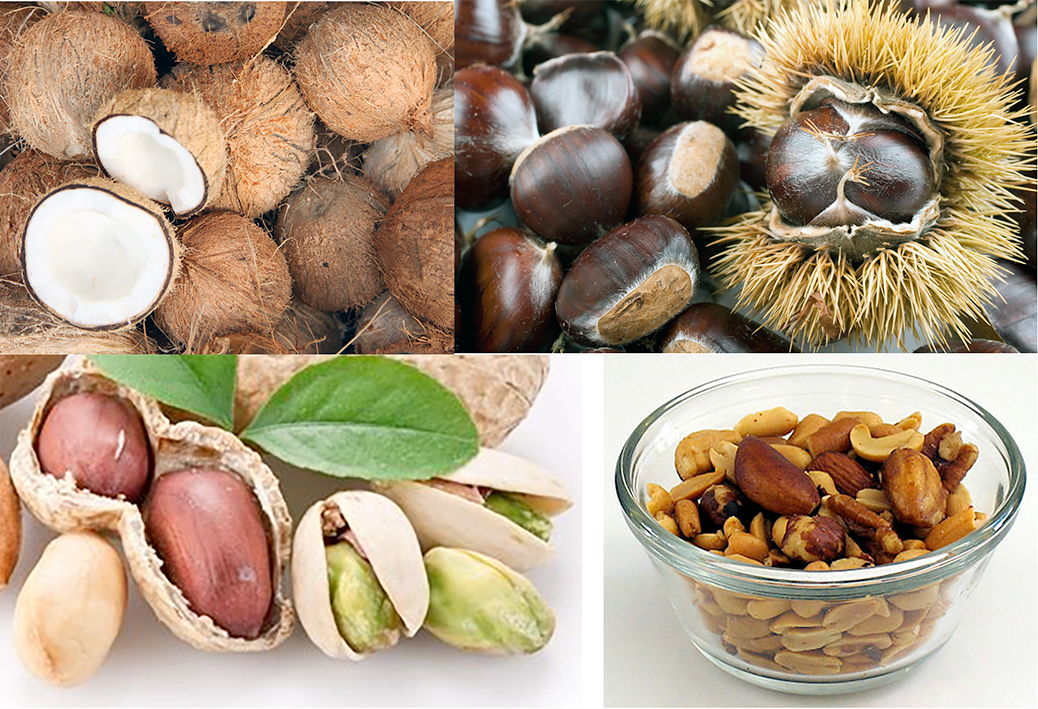 Different nuts. Clockwise: coconuts, sweet chestnuts, bowl of mixed nuts,
peanuts and pistachios.
Welcome to FabulousFusionFood's Nut-based Recipes Page —A nut is a fruit consisting of a hard or tough nutshell protecting a kernel which is usually edible. In general usage and in a culinary sense, many dry seeds are called nuts. In a botanical context, "nut" implies that the shell does not open to release the seed (indehiscent).
Most seeds come from fruit that naturally free themselves from the shell, but this is not the case in nuts such as hazelnuts, chestnuts, and acorns, which have hard shell walls and originate from a compound ovary. The general and original usage of the term is less restrictive, and many nuts (in the culinary sense), such as almonds, pistachios, and Brazil nuts, are not nuts in a botanical sense. Common usage of the term often refers to any hard-walled, edible kernel as a nut. Nuts are an energy-dense and nutrient-rich food source.
Botanically, a nut is a fruit with a woody pericarp developing from a syncarpous gynoecium. True nuts include, for example, chestnut, hazelnut and filbert. Culinarily, the term 'nut' is used much more widely, and includes examples of drupes (such as pecans and almonds) or seeds (such as pine nuts and peanuts).
Also widely known as nuts are dry drupes, which include pecans, almonds, macadamia (Macadamia integrifolia), candlenut (Aleurites moluccanus) and the water caltrop (Trapa bicornis). A drupe is an indehiscent fruit that has an outer fleshy part consisting of the exocarp, or skin, and mesocarp, or flesh, which surround a single pit or stone, the endocarp with a seed (kernel) inside. In a dry drupe, the outer parts dry up and the remaining husk is part of the ovary wall or pericarp, and the hard inner wall surrounding the seed represents the inner part of the pericarp.
Walnuts and hickories (Juglandaceae) have fruit that are difficult to classify. They are considered to be nuts under some definitions but are also referred to as drupaceous nuts.
In common use, a "tree nut" is, as the name implies, any nut coming from a tree. This most often comes up regarding food allergies; a person may be allergic specifically to peanuts (which are not tree nuts but legumes), whereas others may be allergic to the wider range of nuts that grow on trees.
The sweet potato arrived in Europe with the Columbian exchange. It is recorded, for example, in Elinor Fettiplace's Receipt Book, compiled in England in 1604.
Nuts are eaten by humans and wildlife. Because nuts generally have a high oil content, they are a significant energy source. Many seeds are edible by humans and used in cooking, eaten raw, sprouted, or roasted as a snack food, ground to make nut butters, or pressed for oil that is used in cooking and cosmetics.
Nuts used for food are a common source of food allergens. Reactions can range from mild symptoms to severe ones, a condition known as anaphylaxis, which can be life-threatening. The reaction is due to the release of histamine by the body in response to an allergen in the nuts, causing skin and other possible reactions. Many experts suggest that a person with an allergy to peanuts should avoid eating tree nuts, and vice versa.
The nuts linked to from this page are: acorn; almond; beech nuts; betel nut; brazil nut; bush mango; filbert; ginkgo nut; kola nut; candlenut; cashew; chestnut; coconut; hazelnut; macadamia; ogbono; palm nut; peanut; pecan; pine nut; pistachio; walnut.
The alphabetical list of all the nut-based recipes on this site follows, (limited to 100 recipes per page). There are 4197 recipes in total:
Page 36 of 42
| Seychelles Fish Curry II Origin: Seychelles | Sichuan Beef Stir-fry Origin: China | Smoky Mushroom and Chickpea Fajitas with Charred Spring Onion Salsa Origin: British |
| Seychellois Massalé Origin: Seychelles | Sicilian Lemon Polenta Cake Origin: Italy | Smothie à l'avocat (Avocado Smoothie) Origin: Mauritania |
| Sfenz (Libyan Hanukkah Doughnuts) Origin: Libya | Sidvudvu (Pumpkin Porridge) Origin: eSwatini | Snowball Cakes Origin: Britain |
| Sgoniau Bricyll a Chnau Ffrengig (Apricot and Walnut Scones) Origin: Welsh | Sierra Leone Rice Akara Origin: Sierra Leone | Sočni Kolač (Rich Cake) Origin: Bosnia |
| Shaah (Somalian Tea) Origin: Somalia | Sierra Leonean Pancakes Origin: Sierra Leone | Solachi Kadhi (Kokam Sauce) Origin: India |
| Shaaria (Fried Sweet Vermicelli) Origin: Sudan-a | Sierra Leonean Rice Bread Origin: Sierra Leone | Solomon Islands Style Rice Origin: Solomon Islands |
| Shacha Sauce Origin: China | Sierra Leonian Rice Bread Origin: Sierra Leone | Solomon Islands Tuna Curry Origin: Solomon Islands |
| Shacha Sauce Origin: Taiwan | Simaya Pashka (Easter Cheese Cake) Origin: Russia | Som Tam (Thai Green Papaya Salad) Origin: Thailand |
| Shahi Chicken Korma Origin: India | Simboro (Meat with Taro Leaves and Coconut Milk) Origin: Vanuatu | Sombi (Creamy Rice Pudding) Origin: Senegal |
| Shahi Murgh Korma (Royal Chicken Korma) Origin: India | Simnel Cake Origin: England | Somlah Machou Khmer (Sour Soup with Tomato and Lotus Roots) Origin: Cambodia |
| Shahi Paneer Origin: India | Simnel Cake 2 Origin: Britain | Somlar Kari Saek Mouan (Chicken Red Curry) Origin: Cambodia |
| Shalgham Korma (Turnip Curry) Origin: India | Simnel Cupcakes Origin: Britain | Sōngshǔ Yú (Squirrel Fish) Origin: China |
| Shamrock Sugar Biscuits Origin: Ireland | Simple Mole Poblano Origin: Mexico | Sopa de calabaza de invierno (Winter Squash Soup) Origin: Paraguay |
| Sharp Sauce Origin: Britain | Simple Prawn Laksa Origin: Fusion | Sopa de Caracol (Honduran Conch Soup) Origin: Honduras |
| Shattoo Water Origin: Dominica | Simple Suya Poussin Origin: African Fusion | Sopa di Bonchi Korá (Red Kidney Bean Soup) Origin: Aruba |
| Shawarma Spice and Paste Origin: Levant | Sint Eustatian Goat Water Origin: Sint Eustatius | Sopa di Bonchi Korá (Red Kidney Bean Soup) Origin: Bonaire |
| Sheer Khurma Origin: Indonesia | Sint Maarten Crab Backs Origin: Sint Maarten | Sopaipillas Origin: Chile |
| Shellfish Forcemeats Origin: Roman | Sint Maarten Pork Ribs Origin: Sint Maarten | Sopapillas Origin: American |
| Shemai (Sweet Vermicelli) Origin: Bangladesh | Sint Maarten Whelk Soup Origin: Sint Maarten | Sopi di Bonchi Korá (Red Kidney Bean Soup) Origin: Curacao |
| Shi San Xiang Fen (Thirteen Spice Powder) Origin: China | Skilpadjie (Afrikaans Faggots) Origin: South Africa | Sorbet coco guadeloupéen (Guadeloupean Coconut Sorbet) Origin: Guadeloupe |
| Shi Zi Tou (Lion’s Head Meatballs) Origin: China | Slaai (Swazi Avocado Slaw) Origin: eSwatini | Sorpotel Origin: India |
| Shiamali (Semolina Cakes) Origin: Cyprus | Sloe Gin and Blackberry Jelly Origin: Britain | Sorrel Pesto Origin: Italy |
| Shifa (Lebanese Lamb and Pine Nut Pizza) Origin: Lebanon | Slow Cooker Chicken Korma Origin: Britain | Soto Ayam Origin: Indonesia |
| Shito (Ghanaian Black Chilli Sauce) Origin: Ghana | Slow Cooker Duck and Potato Massaman Curry Origin: Britain | Soto Ayam Origin: Malaysia |
| Sholeh Zard (Persian Yellow Rice Pudding) Origin: Iran | Slow Cooker Vegetable Curry Origin: Britain | Soto Ayam Origin: Singapore |
| Shorba Origin: Sudan-a | Slow-cooked Ox Cheek Rendang Origin: Singapore | Soubise Purée Origin: France |
| Shorshe Chingri (Bengali Prawns and Sea Blite) Origin: Bangladesh | Slow-Cooker Pork and Apple Curry Origin: America | Soubise Sauce Origin: Britain |
| Shrikhand (Sweet Yoghurt with Saffron) Origin: India | Slow-roasted Lamb with Advieh Origin: Fusion | Soufflé Flan of St George's Mushrooms Origin: France |
| Shropshire Cakes Origin: England | Small Raised Mutton Pies Origin: Scotland | Soufflé Potatoes with Carrot and Asparagus Origin: Ireland |
| Shuizhu niurou (Spicy Water-boiled Beef) Origin: China | Smoked Fish Fisherman's Pie Origin: England | Souko Dounguouri (Meat Stew with White Beans) Origin: Niger |
| Shuku-shuku (Coconut Biscuits) Origin: Nigeria | Smoked Haddock Curry with Butter Beans Origin: Fusion | Soup à la Reine I Origin: British |
| Shuwa II Origin: Oman | Smoked Mackerel Pâté II Origin: Britain | Soup Joumou (Haitian Squash Soup) Origin: Haiti |
| Shwe Payon Thee Hin (Thai Vegan Pumpkin Curry) Origin: Thailand | Smoked Salmon and Haddock Pots Origin: Scotland | |
| Siberian Bird Cherry Cake Origin: Russia | Smoked Sausage and Bean Casserole Origin: Britain |
Page 36 of 42