FabulousFusionFood's Nut-based Recipes 32nd Page
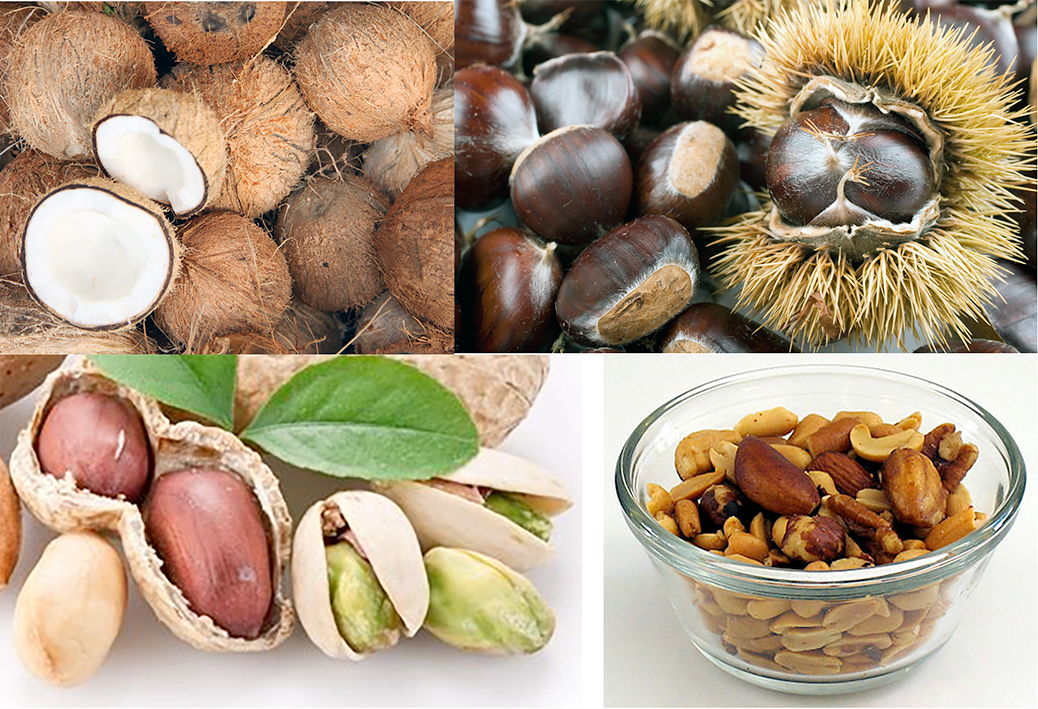 Different nuts. Clockwise: coconuts, sweet chestnuts, bowl of mixed nuts,
peanuts and pistachios.
Welcome to FabulousFusionFood's Nut-based Recipes Page —A nut is a fruit consisting of a hard or tough nutshell protecting a kernel which is usually edible. In general usage and in a culinary sense, many dry seeds are called nuts. In a botanical context, "nut" implies that the shell does not open to release the seed (indehiscent).
Most seeds come from fruit that naturally free themselves from the shell, but this is not the case in nuts such as hazelnuts, chestnuts, and acorns, which have hard shell walls and originate from a compound ovary. The general and original usage of the term is less restrictive, and many nuts (in the culinary sense), such as almonds, pistachios, and Brazil nuts, are not nuts in a botanical sense. Common usage of the term often refers to any hard-walled, edible kernel as a nut. Nuts are an energy-dense and nutrient-rich food source.
Botanically, a nut is a fruit with a woody pericarp developing from a syncarpous gynoecium. True nuts include, for example, chestnut, hazelnut and filbert. Culinarily, the term 'nut' is used much more widely, and includes examples of drupes (such as pecans and almonds) or seeds (such as pine nuts and peanuts).
Also widely known as nuts are dry drupes, which include pecans, almonds, macadamia (Macadamia integrifolia), candlenut (Aleurites moluccanus) and the water caltrop (Trapa bicornis). A drupe is an indehiscent fruit that has an outer fleshy part consisting of the exocarp, or skin, and mesocarp, or flesh, which surround a single pit or stone, the endocarp with a seed (kernel) inside. In a dry drupe, the outer parts dry up and the remaining husk is part of the ovary wall or pericarp, and the hard inner wall surrounding the seed represents the inner part of the pericarp.
Walnuts and hickories (Juglandaceae) have fruit that are difficult to classify. They are considered to be nuts under some definitions but are also referred to as drupaceous nuts.
In common use, a "tree nut" is, as the name implies, any nut coming from a tree. This most often comes up regarding food allergies; a person may be allergic specifically to peanuts (which are not tree nuts but legumes), whereas others may be allergic to the wider range of nuts that grow on trees.
The sweet potato arrived in Europe with the Columbian exchange. It is recorded, for example, in Elinor Fettiplace's Receipt Book, compiled in England in 1604.
Nuts are eaten by humans and wildlife. Because nuts generally have a high oil content, they are a significant energy source. Many seeds are edible by humans and used in cooking, eaten raw, sprouted, or roasted as a snack food, ground to make nut butters, or pressed for oil that is used in cooking and cosmetics.
Nuts used for food are a common source of food allergens. Reactions can range from mild symptoms to severe ones, a condition known as anaphylaxis, which can be life-threatening. The reaction is due to the release of histamine by the body in response to an allergen in the nuts, causing skin and other possible reactions. Many experts suggest that a person with an allergy to peanuts should avoid eating tree nuts, and vice versa.
The nuts linked to from this page are: acorn; almond; beech nuts; betel nut; brazil nut; bush mango; filbert; ginkgo nut; kola nut; candlenut; cashew; chestnut; coconut; hazelnut; macadamia; ogbono; palm nut; peanut; pecan; pine nut; pistachio; walnut.
The alphabetical list of all the nut-based recipes on this site follows, (limited to 100 recipes per page). There are 4197 recipes in total:
Page 32 of 42
| Potsticker Dumplings Origin: China | Prawn Biryani Origin: India | Pumpkin Bread Origin: American |
| Potted Anchovies Origin: British | Prawn Caldine Origin: India | Pumpkin Brownies Origin: Britain |
| Potted Morecambe Bay Shrimps Origin: England | Prawn Laksa Origin: Malaysia | Pumpkin Cake Origin: Liberia |
| Potted Woodlice Origin: Britain | Prawn Laksa Origin: Cocos Islands | Pumpkin Cheesecake Origin: Britain |
| Poulet à l'Arachide (Chicken with Peanuts) Origin: Burkina Faso | Prawn Pasanda Origin: Britain | Pumpkin Chelsea Buns Origin: Britain |
| Poulet à L'Indienne (Comoran Chicken Curry) Origin: Comoros | Prawn Powder Origin: Anglo-Indian | Pumpkin Croquettes Origin: Fusion |
| Poulet à la Farine de Maïs (Chicken with Maize Meal Porridge) Origin: Togo | Prawn, Mangetout and Cashew Nut Stir-fry Origin: Australia | Pumpkin Crunch Origin: American |
| Poulet à la N'Gatietro (Chicken in the Manner of N'Gatietro) Origin: Cote dIvoire | Preiselbeere Sahnetorte (Cowberry Cream Cake) Origin: Germany | Pumpkin Dumplings Origin: American |
| Poulet à la Noix de Coco et aux Arachides (Chicken with Coconut and Peanuts) Origin: Gabon | Pressure Cooker Chicken Korma Origin: Fusion | Pumpkin Fudge Origin: American |
| Poulet au Beurre de Cacahuète (Chicken with Peanut Butter) Origin: Senegal | Pressure Cooker Chocolate Peanut Cheesecake Origin: American | Pumpkin Hummus Origin: American |
| Poulet au Coco (Chicken with Coconut) Origin: Comoros | Pressure Cooker Coconut Lamb Curry Origin: Britain | Pumpkin Muffins Origin: American |
| Poulet au Coco Antillaise (Martinican coconut chicken) Origin: Martinique | Pressure Cooker Curried Beef Stew Origin: South Africa | Pumpkin Nutmeg Dinner Rolls Origin: American |
| Poulet aux Arachides à la Togolaise (Chicken with Peanuts, Togo Fashion) Origin: Togo | Pressure Cooker Curried Squash Origin: Fusion | Pumpkin Pie Bars Origin: American |
| Poulet aux Arachides de Niger (Chicken with Peanuts, Niger Style) Origin: Niger | Pressure Cooker Massaman Beef Curry Origin: Britain | Pumpkin Pie Blintzes Origin: American |
| Poulet aux Bananes Plantains (Chicken with Plantains) Origin: Cameroon | Pressure Cooker Pumpkin Cheesecake Origin: American | Pumpkin Pie Crumble Origin: Britain |
| Poulet aux Bananes Plantains (Chicken with Plantains) Origin: Madagascar | Pressure Cooker Thai Red Curry Origin: Britain | Pumpkin Pie Spice Origin: American |
| Poulet aux Maniocs (Chicken with Cassava) Origin: DR-Congo | Pressure Cooker Vegetable and Coconut Curry Origin: Fusion | Pumpkin Pilhi Origin: Pitcairn Islands |
| Poulet Bami Calédonien (New Caledonian Chicken Bami) Origin: New Caledonia | Prik Gaeng Panang (Panang Red Curry Paste) Origin: Thailand | Pumpkin Pizza Origin: American |
| Poulet Colombo Origin: French Guiana | Prosciutto-wrapped Chicken Thigh with Mushroom Marsala Sauce Origin: Britain | Pumpkin Skin Chutney Origin: Anglo-Indian |
| Poulet Créole (Creole Chicken) Origin: Mauritius | Pudina Chutney (Indian Mint Chutney) Origin: India | Pumpkin Spice Cookies Origin: American |
| Poulet de Comores (Comorian Chicken) Origin: Comoros | Pudina Chutney (Mint Chutney) Origin: India | Pumpkin with Nilgiri Sauce Origin: India |
| Poulet de Guinée (Guinean Chicken) Origin: Guinea | Pudina tal-Hobz (Maltese Bread Pudding) Origin: Malta | Pumpkin, Goat's Cheese and Kale Tart with Three-cornered Leeks Origin: Britain |
| Poulet Fafa (Chicken with Taro Leaves) Origin: Tahiti | Puding Torta (Pudding Cake) Origin: North Macedonia | Pumpkin, Goat's Cheese and Kale Tart Origin: Britain |
| Poulet Fafa (Chicken with Taro Leaves) Origin: Wallis Futuna | Puerto Rican Tembleque (Quaking Coconut Pudding) Origin: Puerto Rico | Punch Coco (Coconut Punch) Origin: Comoros |
| Poulet Kédjénou (Kédjénou Chicken) Origin: Cote dIvoire | Puffball Patties Origin: Britain | Pur Fayte Ypocras (To Make Hippocras) Origin: England |
| Poulet Nyembwe Origin: Gabon | Pulë me Arra (Chicken with Walnuts) Origin: Albania | Purée d'Aubergines (Aubergine Purée) Origin: Rwanda |
| Poulet Tunisienne (Tunisian Chicken) Origin: Tunisia | Puli Pithe Origin: India | Purée d'Oseille (Hibiscus Leaf Purée) Origin: Chad |
| Poulet Yassa (Chicken Yassa) Origin: Gambia | Pulled Pork Tacos Origin: America | Pure Chocolate Smoothie Origin: American |
| Poulet Yassa (Chicken Yassa) Origin: Guinea-Bissau | Pullum Numidicum (Numidian Guinea Fowl) Origin: Roman | Puri (Indian Balloon Bread) Origin: India |
| Poulet Yassa Malienne (Malian Chicken Yassa) Origin: Mali | Pullus Vardanus (Chicken à la Varus) Origin: Roman | Putóg bhán (Irish White Pudding) Origin: Ireland |
| Poullaille farcie (Stuffed Poultry) Origin: France | Pumpes (Pork Meatballs) Origin: England | Pwdin Bara (Bread Pudding) Origin: Welsh |
| Pourcelet farci (Stuffed Suckling Pig) Origin: France | Pumpkin and Banana Bread Origin: England | Pwdin Bara Marmalêd (Marmalade Bread and Butter Pudding) Origin: Welsh |
| Po’e de Plátanos (Rapa Nui Banana Po'e) Origin: Easter Island | Pumpkin and Orange Cake with Cashew Cream Origin: Britain | |
| Prawn Balti Origin: Britain | Pumpkin and Tomato Soup Origin: West Africa |
Page 32 of 42