FabulousFusionFood's Nut-based Recipes 29th Page
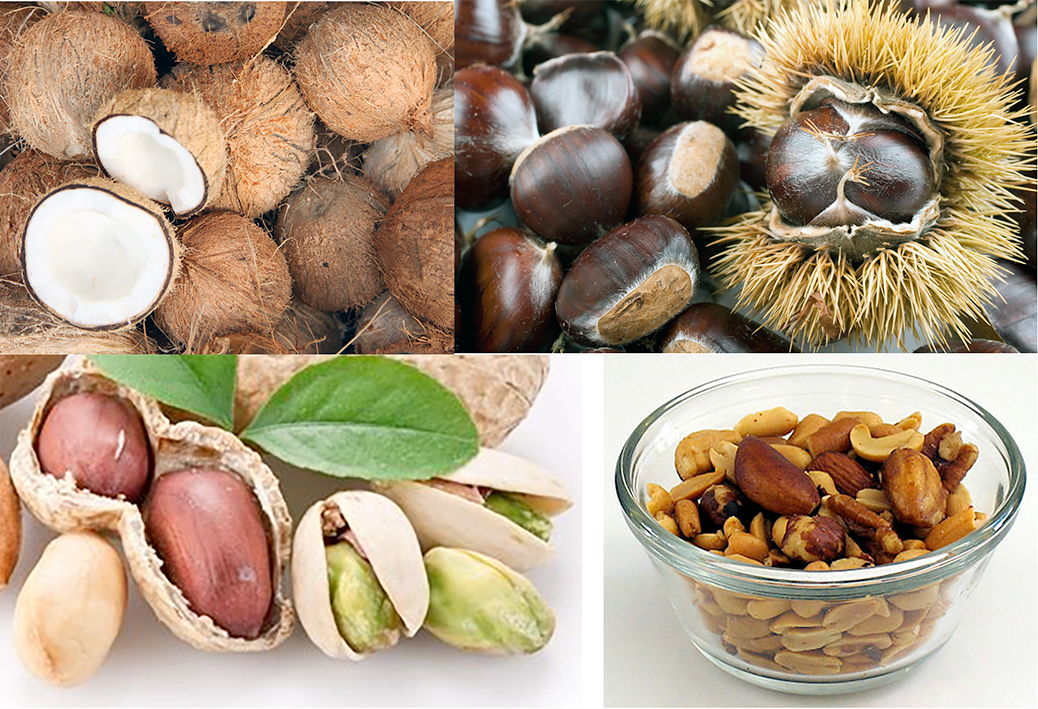 Different nuts. Clockwise: coconuts, sweet chestnuts, bowl of mixed nuts,
peanuts and pistachios.
Welcome to FabulousFusionFood's Nut-based Recipes Page —A nut is a fruit consisting of a hard or tough nutshell protecting a kernel which is usually edible. In general usage and in a culinary sense, many dry seeds are called nuts. In a botanical context, "nut" implies that the shell does not open to release the seed (indehiscent).
Most seeds come from fruit that naturally free themselves from the shell, but this is not the case in nuts such as hazelnuts, chestnuts, and acorns, which have hard shell walls and originate from a compound ovary. The general and original usage of the term is less restrictive, and many nuts (in the culinary sense), such as almonds, pistachios, and Brazil nuts, are not nuts in a botanical sense. Common usage of the term often refers to any hard-walled, edible kernel as a nut. Nuts are an energy-dense and nutrient-rich food source.
Botanically, a nut is a fruit with a woody pericarp developing from a syncarpous gynoecium. True nuts include, for example, chestnut, hazelnut and filbert. Culinarily, the term 'nut' is used much more widely, and includes examples of drupes (such as pecans and almonds) or seeds (such as pine nuts and peanuts).
Also widely known as nuts are dry drupes, which include pecans, almonds, macadamia (Macadamia integrifolia), candlenut (Aleurites moluccanus) and the water caltrop (Trapa bicornis). A drupe is an indehiscent fruit that has an outer fleshy part consisting of the exocarp, or skin, and mesocarp, or flesh, which surround a single pit or stone, the endocarp with a seed (kernel) inside. In a dry drupe, the outer parts dry up and the remaining husk is part of the ovary wall or pericarp, and the hard inner wall surrounding the seed represents the inner part of the pericarp.
Walnuts and hickories (Juglandaceae) have fruit that are difficult to classify. They are considered to be nuts under some definitions but are also referred to as drupaceous nuts.
In common use, a "tree nut" is, as the name implies, any nut coming from a tree. This most often comes up regarding food allergies; a person may be allergic specifically to peanuts (which are not tree nuts but legumes), whereas others may be allergic to the wider range of nuts that grow on trees.
The sweet potato arrived in Europe with the Columbian exchange. It is recorded, for example, in Elinor Fettiplace's Receipt Book, compiled in England in 1604.
Nuts are eaten by humans and wildlife. Because nuts generally have a high oil content, they are a significant energy source. Many seeds are edible by humans and used in cooking, eaten raw, sprouted, or roasted as a snack food, ground to make nut butters, or pressed for oil that is used in cooking and cosmetics.
Nuts used for food are a common source of food allergens. Reactions can range from mild symptoms to severe ones, a condition known as anaphylaxis, which can be life-threatening. The reaction is due to the release of histamine by the body in response to an allergen in the nuts, causing skin and other possible reactions. Many experts suggest that a person with an allergy to peanuts should avoid eating tree nuts, and vice versa.
The nuts linked to from this page are: acorn; almond; beech nuts; betel nut; brazil nut; bush mango; filbert; ginkgo nut; kola nut; candlenut; cashew; chestnut; coconut; hazelnut; macadamia; ogbono; palm nut; peanut; pecan; pine nut; pistachio; walnut.
The alphabetical list of all the nut-based recipes on this site follows, (limited to 100 recipes per page). There are 4197 recipes in total:
Page 29 of 42
| Paifala (Pineapple and Coconut Pasties) Origin: American Samoa | Paneer Lababdar Origin: India | Party Cupcakes Origin: Britain |
| Pakistani Chicken Biryani Origin: Pakistan | Paneer Makhani Origin: India | Pasanda Sauce Origin: Britain |
| Palandi Origin: Sri Lanka | Paneer Makhanwala Origin: India | Pashka Origin: Russia |
| Palandy Origin: Sri Lanka | Paneer Maza (Chilli Paneer) Origin: India | Pasilla Mole Origin: Britain |
| Palauan Fish Soup Origin: Palau | Paneer Pasanda Origin: India | Paska Babka (Easter Babka) Origin: Belarus |
| Palaver 'Sauce' Origin: West Africa | Paneer Sukka Origin: India | Paska Babka (Easter Babka) Origin: Russia |
| Palaver Chicken Origin: Ghana | Paneer Tikka Masala Origin: India | Paska Babka (Easter Babka) Origin: Ukraine |
| Palestinian Meat Stuffing Origin: Palestine | Panettone Origin: Italy | Paska Bobka (Polish Easter Bread) Origin: Poland |
| Palm Soup Base #2 Origin: Liberia | Panforte Origin: Italy | Paskalya Çöreği (Turkish Easter Bread) Origin: Turkey |
| Palusami (Corned Beef, Taro Greens and Coconut Milk) Origin: Solomon Islands | Panforte II Origin: Italy | Paskha (Russian Easter Cheesecake) Origin: Russia |
| Palusami Origin: Fiji | Pangiallo romano (Roman Christmas Cake) Origin: Italy | Passatelli in Brodo (Passatelli in Broth) Origin: Italy |
| Palusami (Coconut Cream and Tinned Meat in Taro Leaves) Origin: Nauru | Pangiallo romano (Roman Christmas Cake) Origin: Vatican City | Passatelli in Brodo (Passatelli in Broth) Origin: San Marino |
| Palusami Origin: Samoa | Pani Popo (Bread Rolls Cooked in Coconut Milk) Origin: Samoa | Passion Cake Origin: Britain |
| Palusami (Coconut Cream and Onion in Taro Leaves) Origin: Samoa | Pani Popo (Bread Rolls Cooked in Coconut Milk) Origin: American Samoa | Passover Banana Sponge Cake Origin: Jewish |
| Palusami (Corned Beef, Taro Greens and Coconut Milk) Origin: Tuvalu | Panjeeri (Nuts, Seeds and Tree Sap Snack) Origin: Pakistan | Passover Matzoh Pudding Origin: Jewish |
| Palusami (Coconut Cream and Onion in Taro Leaves) Origin: Tuvalu | Panjiri Origin: India | Pastai Briwgig a Llugaeorn (Pork Mince and Cranberry Mini Pies) Origin: Welsh |
| Palusami (Corned Beef, Taro Greens and Coconut Milk) Origin: Kiribati | Pansotti di Rapallo (Pansotti with Walnut Sauce) Origin: Italy | Pastai Briwgig Eidion a Nionod (Leek and Caerphilly Cheese Crumble Tart) Origin: Welsh |
| Palusami Origin: American Samoa | Pão de Cacau (Chocolate Loaf) Origin: Sao Tome | Pastai Cig Llo (Veal Pie) Origin: Welsh |
| Palusami (Coconut Cream and Onion in Taro Leaves) Origin: Wallis Futuna | Pão Doce Origin: Sao Tome | Pastai Cig oen Cymraeg a Phwmpen (Welsh Lamb and Marrow Pie) Origin: Welsh |
| Palusami (Corned Beef, Taro Greens and Coconut Milk) Origin: Marshall Islands | Papas de Mandioca (Cassava Porridge) Origin: Mozambique | Pastai Cwnhingen (Rabbit Pie) Origin: Welsh |
| Palusami II Origin: Kiribati | Papaya and Orange Soup Origin: Anguilla | Pastai Ystumllwynarth (Oystermouth Pie) Origin: Welsh |
| Pamplona de Puerco (Barbecued Stuffed, Rolled Pork) Origin: Uruguay | Papaya Chicken and Coconut Milk Origin: Solomon Islands | Pastel De Choclo (Corn Pudding) Origin: Argentina |
| Pampoenkokies (Christmas Fruit Fritters) Origin: South Africa | Papaya Pudding Origin: Aruba | Pašticada (Croatian Beef Stew) Origin: Croatia |
| Pan Haggis Origin: Scotland | Papeeta Kari (Green Papaya Curry) Origin: India | Pastiera Napoletana (Naples Easter Cakes) Origin: Italy |
| Pan Puddings Origin: Scotland | Papuan Banana Cake Origin: Papua New Guinea | Pastilla (Moroccan Meat Pie) Origin: Morocco |
| Pan-fried Megrim Sole with Creamed Spinach Origin: Britain | Papuan Banana Cake Origin: Papua | Pastilla au Poulet (Chicklen Pastilla) Origin: Morocco |
| Pan-fried Turbot with Summer Truffle Sauce Origin: Britain | Paradise Cake Origin: Scotland | Patiala Chicken Curry Origin: India |
| Panang Curry Paste Origin: Thailand | Paradise Slice Origin: Scotland | Patina Cotidiana II (Everyday Casserole II) Origin: Roman |
| Pane della colomba di Pasqua (Italian Easter Dove Bread) Origin: Italy | Parcha Bozbash (Lamb Soup with Chestnuts and Quince) Origin: Armenia | Patina Versatilis (Upside-down Dish) Origin: Roman |
| Paneer Butter Masala Origin: India | Parcha Bozbash II (Lamb Soup with Chestnuts, Quince, and Prunes) Origin: Georgia | Patina Versatilis Vice Dulci (Nut Custard Turnover) Origin: Roman |
| Paneer Capsicum Curry Origin: India | Parmentier de Canard (Duck Parmentier) Origin: France | Patinam Apicianam (Apician Casserole) Origin: Roman |
| Paneer Kofta Origin: India | Parsley Pesto Origin: Saint Pierre | Patinam ex Lacte (Milk Casserole) Origin: Roman |
| Paneer Korma Origin: Britain | Parsnip and Apples Origin: Ireland | |
| Paneer Lababdar Origin: India | Parthade Curry Origin: India |
Page 29 of 42