FabulousFusionFood's Nut-based Recipes 24th Page
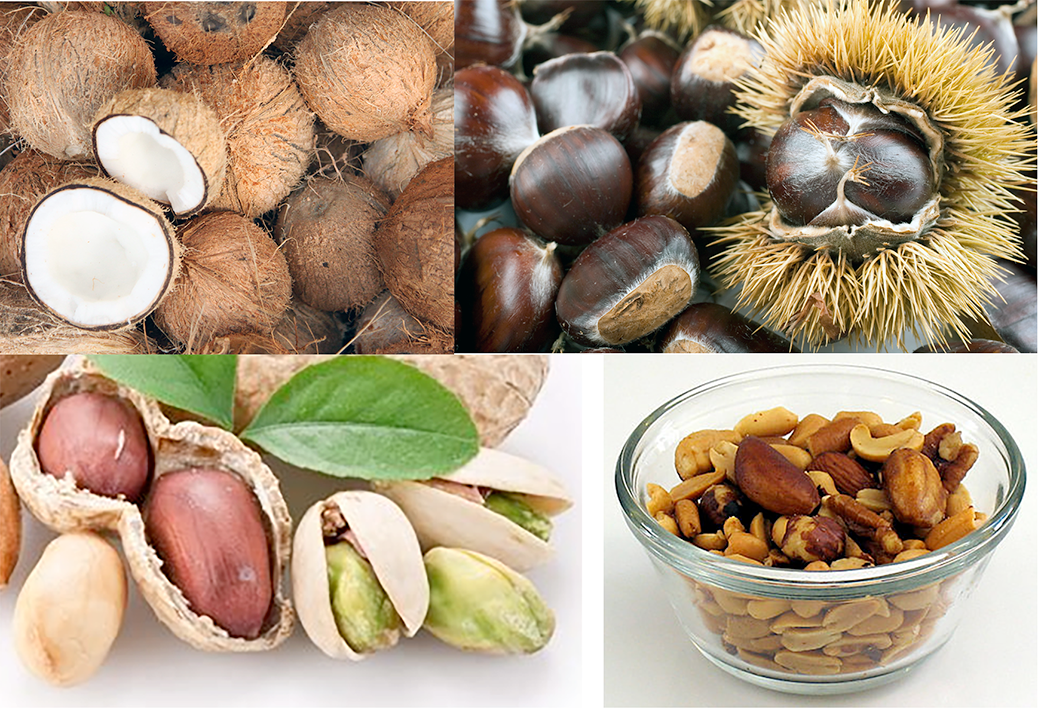 Different nuts. Clockwise: coconuts, sweet chestnuts, bowl of mixed nuts,
peanuts and pistachios.
Welcome to FabulousFusionFood's Nut-based Recipes Page —A nut is a fruit consisting of a hard or tough nutshell protecting a kernel which is usually edible. In general usage and in a culinary sense, many dry seeds are called nuts. In a botanical context, "nut" implies that the shell does not open to release the seed (indehiscent).
Most seeds come from fruit that naturally free themselves from the shell, but this is not the case in nuts such as hazelnuts, chestnuts, and acorns, which have hard shell walls and originate from a compound ovary. The general and original usage of the term is less restrictive, and many nuts (in the culinary sense), such as almonds, pistachios, and Brazil nuts, are not nuts in a botanical sense. Common usage of the term often refers to any hard-walled, edible kernel as a nut. Nuts are an energy-dense and nutrient-rich food source.
Botanically, a nut is a fruit with a woody pericarp developing from a syncarpous gynoecium. True nuts include, for example, chestnut, hazelnut and filbert. Culinarily, the term 'nut' is used much more widely, and includes examples of drupes (such as pecans and almonds) or seeds (such as pine nuts and peanuts).
Also widely known as nuts are dry drupes, which include pecans, almonds, macadamia (Macadamia integrifolia), candlenut (Aleurites moluccanus) and the water caltrop (Trapa bicornis). A drupe is an indehiscent fruit that has an outer fleshy part consisting of the exocarp, or skin, and mesocarp, or flesh, which surround a single pit or stone, the endocarp with a seed (kernel) inside. In a dry drupe, the outer parts dry up and the remaining husk is part of the ovary wall or pericarp, and the hard inner wall surrounding the seed represents the inner part of the pericarp.
Walnuts and hickories (Juglandaceae) have fruit that are difficult to classify. They are considered to be nuts under some definitions but are also referred to as drupaceous nuts.
In common use, a "tree nut" is, as the name implies, any nut coming from a tree. This most often comes up regarding food allergies; a person may be allergic specifically to peanuts (which are not tree nuts but legumes), whereas others may be allergic to the wider range of nuts that grow on trees.
The sweet potato arrived in Europe with the Columbian exchange. It is recorded, for example, in Elinor Fettiplace's Receipt Book, compiled in England in 1604.
Nuts are eaten by humans and wildlife. Because nuts generally have a high oil content, they are a significant energy source. Many seeds are edible by humans and used in cooking, eaten raw, sprouted, or roasted as a snack food, ground to make nut butters, or pressed for oil that is used in cooking and cosmetics.
Nuts used for food are a common source of food allergens. Reactions can range from mild symptoms to severe ones, a condition known as anaphylaxis, which can be life-threatening. The reaction is due to the release of histamine by the body in response to an allergen in the nuts, causing skin and other possible reactions. Many experts suggest that a person with an allergy to peanuts should avoid eating tree nuts, and vice versa.
The nuts linked to from this page are: acorn; almond; beech nuts; betel nut; brazil nut; bush mango; filbert; ginkgo nut; kola nut; candlenut; cashew; chestnut; coconut; hazelnut; macadamia; ogbono; palm nut; peanut; pecan; pine nut; pistachio; walnut.
The alphabetical list of all the nut-based recipes on this site follows, (limited to 100 recipes per page). There are 4626 recipes in total:
Page 24 of 47
| Lamb Curry with Winter Vegetables and Spinach Origin: Fusion | Lebanese-style Braaied Fruit Salad Origin: South Africa | Liberian Sour Milk Origin: Liberia |
| Lamb Flaps Origin: Papua New Guinea | Leber Knödelsuppe (Liver Dumpling Soup) Origin: Liechtenstein | Libyan Camel Meatballs Origin: Libya |
| Lamb Rogan Josh Origin: India | Leche Frys in Lentoun (Almond Milk Fruit Pie) Origin: England | Lime Pickle Origin: India |
| Lamb Rogan Josh Origin: Britain | Leche Lumbard (Lombardy Cream) Origin: England | Lincolnshire Haslet Origin: England |
| Lamb shish with olive and walnut tahini Origin: Britain | Leftover Porridge Muffins Origin: Scotland | Linden Fruit Coffee Origin: American |
| Lamb Stew with Chestnuts and Pomegranates Origin: Georgia | Leftover Turkey and Chickpea Curry Origin: Fusion | Linguine with saffron, roasted garlic, herb butter and hazelnuts Origin: Britain |
| Lamb Tagine Pie Origin: Fusion | Leftover Turkey Fricassee Origin: Scotland | Linzer Torte Origin: Germany |
| Lamb Tarkari (Lamb Yoghurt Curry) Origin: Nepal | Leftovers Butter Turkey Origin: Britain | Llwynau Cig Oen Rhost (Roast Saddle of Welsh Lamb) Origin: Welsh |
| Lamb's Head Origin: British | Leftovers Stir-fry with Green Papaya Origin: American | Llysiau Pob (Roast Vegetables) Origin: Welsh |
| Lamb's Lettuce Pesto Origin: Britain | Leftovers Turkey Curry Origin: America | Lobio Supi (Red Bean Soup) Origin: Georgia |
| Lamb's Sweetbreads, Larded, and Asparagus Origin: British | Lemon Chilli Chicken Origin: Cocos Islands | Lobster Croquets Origin: Britain |
| Lammfärsfyllda squashbåtar (Lamb-stuffed Squash Boats) Origin: Sweden | Lemon Curd Tassie Origin: American | Lobster Cutlets Origin: British |
| Lampara Curry Origin: Sri Lanka | Lemon Myrtle Coconut Rice Origin: Fusion | Lobster Quenelles Origin: British |
| Lao Tam Som (Lao Green Papaya Salad) Origin: Laos | Lemon Nut Loaf Origin: New Zealand | Lobster Soup Origin: British |
| Laplap Origin: Vanuatu | Lemon Pepper Sea Bass Origin: Fusion | Locro Argentino (Beef and Hominy Stew) Origin: Argentina |
| Laska Origin: Malaysia | Lemon Pistachio Snacking Cake Origin: Britain | Locro de papa (Ecuadorian potato and cheese soup) Origin: Ecuador |
| Last-minute Mincemeat Christmas Cake Origin: Britain | Lemon Prawn Pâté Origin: British | Locro de Zapallo Origin: Peru |
| Lauki Kofta Curry (Bottle Gourd Kofta Curry) Origin: India | Lemongrass Curry Origin: Cambodia | Lomo de Cerdo Relleno (Stuffed Pork Loin) Origin: Spain |
| Launceston Cake Origin: Britain | Lenticulam de castaneis (Lentils and Chestnuts) Origin: Roman | Longan Tong Sui (Snow Fungus Dessert Soup) Origin: China |
| Lawves (Walnut Fudge) Origin: Uzbekistan | Lentil and Hazelnut Burgers Origin: Britain | Lonumirus (Maldives Chilli Sambal) Origin: Maldives |
| Layer Cake Origin: Britain | Lentil Curry with Japanese Knotweed and Sweet Potatoes Origin: Fusion | Lorne Sausage Origin: Scotland |
| Layered Trifle Loaf Origin: Britain | Lentil Curry with Rhubarb and Sweet Potatoes Origin: Fusion | Loseyns in Fysch Day (Lozenge Cakes for Fish Day) Origin: England |
| Lazania sto Fourno (Oven-baked Cypriot Lasagne) Origin: Cyprus | Lentil Hashwa Origin: UAE | Loubia bil Luz (Green Beans with Almonds) Origin: Algeria |
| Lazeez Lauki (Tasty Stuffed Bottle Gourd) Origin: India | Leporem Farsum (Stuffed Hare) Origin: Roman | Lū (Baked Taro Leaf Parcels) Origin: Tonga |
| Le Chao Men (New Caledonian Chaw Mein) Origin: New Caledonia | Leporem Farsum (Stuffed Hare) Origin: Roman | Lū (Baked Taro Leaf Parcels) Origin: Wallis Futuna |
| Le Galapian Origin: Monaco | Leporem Isiciatum (Hare Forcemeat) Origin: Roman | Lu Pulu (Corned Beef and Onion in Taro Leaves) Origin: Tonga |
| Le gâteau nantais (Nantes cake) Origin: France | Leshes fryed in Lenton (Fried Cakes for Lent) Origin: England | Lucaniae (Lucanian Sausages) Origin: Roman |
| Le Goundja (Fish with Aubergines and Cassava Leaves) Origin: Central African Republic | Lesser Celandine Potato Salad Origin: British | Lumbuli assi ita fiunt (Stuffed Kidneys or Testicles) Origin: Roman |
| Le Me Tsolola Origin: Comoros | Lièvre fumé à l'odika (Smoked Rabbit with Ogbono) Origin: Gabon | Lupis (Sticky Rice Rolls with Palm Sugar Syrup) Origin: Indonesia |
| Le molleux au chocolat (Chocolate Fudge Cake) Origin: France | Liberian Cassava Bread Origin: Liberia | Lupulu (Coconut Cream and Onion in Taro Leaves) Origin: Tonga |
| Le Ndolé Camerounais (Cameroonian Ndolé) Origin: Cameroon | Liberian Cornbread II Origin: Liberia | Luwombo () Origin: Uganda |
| Le Vitréais, le gâteau aux pommes de Vitré (Vitré Apple Cake) Origin: France | Liberian Rice Bread Origin: Liberia | Lychee Spice Smoothie Origin: American |
| Leamington Sauce Origin: British | Liberian Rice Bread II Origin: Liberia | |
| Lebanese Sabaa Baharat Origin: Lebanon | Liberian Shortbread Origin: Liberia |
Page 24 of 47