FabulousFusionFood's Nut-based Recipes 17th Page
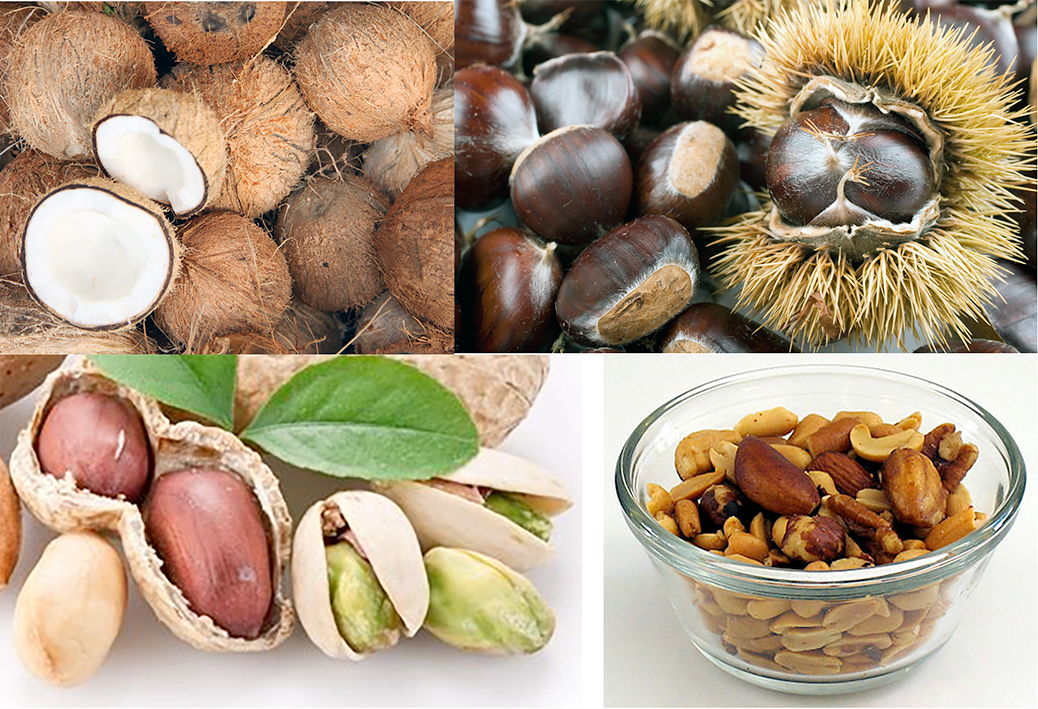 Different nuts. Clockwise: coconuts, sweet chestnuts, bowl of mixed nuts,
peanuts and pistachios.
Welcome to FabulousFusionFood's Nut-based Recipes Page —A nut is a fruit consisting of a hard or tough nutshell protecting a kernel which is usually edible. In general usage and in a culinary sense, many dry seeds are called nuts. In a botanical context, "nut" implies that the shell does not open to release the seed (indehiscent).
Most seeds come from fruit that naturally free themselves from the shell, but this is not the case in nuts such as hazelnuts, chestnuts, and acorns, which have hard shell walls and originate from a compound ovary. The general and original usage of the term is less restrictive, and many nuts (in the culinary sense), such as almonds, pistachios, and Brazil nuts, are not nuts in a botanical sense. Common usage of the term often refers to any hard-walled, edible kernel as a nut. Nuts are an energy-dense and nutrient-rich food source.
Botanically, a nut is a fruit with a woody pericarp developing from a syncarpous gynoecium. True nuts include, for example, chestnut, hazelnut and filbert. Culinarily, the term 'nut' is used much more widely, and includes examples of drupes (such as pecans and almonds) or seeds (such as pine nuts and peanuts).
Also widely known as nuts are dry drupes, which include pecans, almonds, macadamia (Macadamia integrifolia), candlenut (Aleurites moluccanus) and the water caltrop (Trapa bicornis). A drupe is an indehiscent fruit that has an outer fleshy part consisting of the exocarp, or skin, and mesocarp, or flesh, which surround a single pit or stone, the endocarp with a seed (kernel) inside. In a dry drupe, the outer parts dry up and the remaining husk is part of the ovary wall or pericarp, and the hard inner wall surrounding the seed represents the inner part of the pericarp.
Walnuts and hickories (Juglandaceae) have fruit that are difficult to classify. They are considered to be nuts under some definitions but are also referred to as drupaceous nuts.
In common use, a "tree nut" is, as the name implies, any nut coming from a tree. This most often comes up regarding food allergies; a person may be allergic specifically to peanuts (which are not tree nuts but legumes), whereas others may be allergic to the wider range of nuts that grow on trees.
The sweet potato arrived in Europe with the Columbian exchange. It is recorded, for example, in Elinor Fettiplace's Receipt Book, compiled in England in 1604.
Nuts are eaten by humans and wildlife. Because nuts generally have a high oil content, they are a significant energy source. Many seeds are edible by humans and used in cooking, eaten raw, sprouted, or roasted as a snack food, ground to make nut butters, or pressed for oil that is used in cooking and cosmetics.
Nuts used for food are a common source of food allergens. Reactions can range from mild symptoms to severe ones, a condition known as anaphylaxis, which can be life-threatening. The reaction is due to the release of histamine by the body in response to an allergen in the nuts, causing skin and other possible reactions. Many experts suggest that a person with an allergy to peanuts should avoid eating tree nuts, and vice versa.
The nuts linked to from this page are: acorn; almond; beech nuts; betel nut; brazil nut; bush mango; filbert; ginkgo nut; kola nut; candlenut; cashew; chestnut; coconut; hazelnut; macadamia; ogbono; palm nut; peanut; pecan; pine nut; pistachio; walnut.
The alphabetical list of all the nut-based recipes on this site follows, (limited to 100 recipes per page). There are 4197 recipes in total:
Page 17 of 42
| Grannat Chop Origin: Sierra Leone | Grilled Coconut Crab Origin: Tuvalu | Gurnard Curry Origin: Britain |
| Gratin Christophine (Chayote Gratin) Origin: Guadeloupe | Grima Fish Curry Origin: Kenya | Gustato pro Ovis (Sauce for Eggs) Origin: Roman |
| Gratin Dauphinoise Origin: France | Grissniuys (Beestings Pudding) Origin: Manx | Gutti Vankaya (Stuffed Brinjal Curry) Origin: India |
| Gratin de Couac (Couac Gratin) Origin: French Guiana | Ground Elder Layered Pancakes Origin: British | Gutweed Salad with Fennel and Orange Origin: Britain |
| Gratin de galettes aux crevettes (Gratin of Pancakes with Prawns and Mushrooms) Origin: France | Ground Elder Quiche Origin: Britain | Guyana Black Cake Origin: Guyana |
| Gratin de mangue à la noix de coco (Gratin of Mango with Coconut) Origin: France | Gruel of almanndes (Gruel of Almonds) Origin: England | Guyana Black Pudding Origin: Guyana |
| Gratin de pommes de terre des Antilles (Antilles Potato Gratin) Origin: Guadeloupe | Gruyau (A Gruel of Husked Barley) Origin: France | Guyana White Pudding Origin: Guyana |
| Green Apple Curry Origin: Sri Lanka | Guai Daun Singlong Tumbuk (Grilled Fish with Greens) Origin: Sumatra | Guyanese Cook-up Rice and Peas Origin: Guyana |
| Green Beans in Coconut Sauce Origin: Fusion | Guam Chicken Curry Origin: Guam | Guyanese Crab Callaloo Origin: Guyana |
| Green Coconut Chutney Origin: India | Guatita (Ecuadorian Tripe Stew) Origin: Ecuador | Guyanese Metemgee Origin: Guyana |
| Green Fig and Saltfish Origin: Saint Lucia | Gudaí (Goody) Origin: Ireland | Habichuelas Con Dulce (Dominican Sweet Beans) Origin: Dominican Republic |
| Green Fish Curry Origin: Fusion | Guernsey Gâche (Fruit Bread Loaf) Origin: Guernsey | Haddock Supper Origin: Ireland |
| Green Gooseberry Sauce Origin: Britain | Guiana Black Cake Origin: French Guiana | Haggis Origin: Scotland |
| Green Lentils with Wild Garlic Mustard Pesto Origin: Britain | Guiana Rice and Peas Origin: French Guiana | Haggis and Pork Sausages with Mash and Red Wine Onion Gravy Origin: Scotland |
| Green Mealie Soup Origin: South Africa | Guinea Fowl Pudding Origin: Scotland | Hakka Salt-baked Chicken Origin: China |
| Green Papaya Curry with Fresh Coconut Origin: Pitcairn Islands | Guinea Fowl with Coconut Cream Origin: Zimbabwe | Halawa Tahiniya (Sesame Seed Paste Halva) Origin: Egypt |
| Green Pea and Liver Curry Origin: Sri Lanka | Guinean Avocado Sauce Origin: Equatorial Guinea | Halawa Yaqtin (Pumpkin Halwa) Origin: Middle East |
| Green Pistachio Muffins (Green Pistachio Muffins) Origin: American | Guinean Fish Grill with Three Sauces Origin: Equatorial Guinea | Halibut with Pine Nut and Parmesan Crust Origin: Britain |
| Green Tea Smoothie Origin: Britain | Guinean Spinach Sauce Origin: Equatorial Guinea | Halloween Cheesecake Origin: Britain |
| Green Tomato Mincemeat Origin: Canada | Guinness Cake Origin: Ireland | Halloween Fudge Origin: Canada |
| Grenada Breadfruit Soup Origin: Grenada | Guisado de Caranguejo (Crab Stew) Origin: Mozambique | Halo-halo Origin: Philippines |
| Grenada Callaloo Soup Origin: Grenada | Guisado del Inca (Inca Stew) Origin: Peru | Haloua Origin: Mayotte |
| Grenada Curry Goat Origin: Grenada | Gujarati-style Monkfish Curry Origin: Fusion | Haluwa (Carrot Sweetmeat) Origin: Tanzania |
| Grenada Curry Powder Origin: Grenada | Gulab Jamun Origin: India | Halva Origin: Lebanon |
| Grenada Green Seasoning Origin: Grenada | Gulab Jamun Cheesecake Origin: India | Halva de Floarea Soarelui (Sunflower Seed Paste Halva) Origin: Romania |
| Grenada Oil Down Origin: Grenada | Gulai Ikan Karibia (Caribbean Fish Stew) Origin: Turks Caicos | Halvah with Butter Origin: Albania |
| Grenada Rice and Peas Origin: Grenada | Gulai Kambing (Sumatran Goat Curry) Origin: Martinique | Ham and Broccoli Stuffed Potatoes Origin: Ireland |
| Grenadan Dumplings Origin: Grenada | Gulai Lemak (Beef Spicy Stew) Origin: Indonesia | Hamantaschen (Tricorn Purim Pastries) Origin: Israel |
| Grenadian Coconut Curry Chicken Origin: Grenada | Gulha (Fried Fish Balls) Origin: Maldives | Hami (Fermented Coconut Sauce) Origin: Tonga |
| Grenadian Nutmeg Chicken Curry Origin: Grenada | Gulha Riha (Maldives Fish Ball Curry) Origin: Maldives | Hares in Talbotes (Hares in Hare-blood Sauce) Origin: England |
| Grenadian Pelau Origin: Grenada | Gumdrop Fruit Cake Origin: Canada | Harina de Maiz (Dominican Cornmeal Porridge) Origin: Dominican Republic |
| Griláž (Caramel Nut Wafers) Origin: Slovakia | Gummadikaya Majjiga Pulusu (White Pumpkin Yogurt Stew) Origin: India | Harvest Soup Origin: American |
| Grilled Beef Tenderloin with Red Wine and Pistachios Origin: American | Gungo Rice and Peas Origin: Jamaica | |
| Grilled Coconut Crab Origin: Federated States Micronesia | Gunpowder Mash Stuffed Potato Skins Origin: British |
Page 17 of 42