FabulousFusionFood's Nut-based Recipes 11th Page
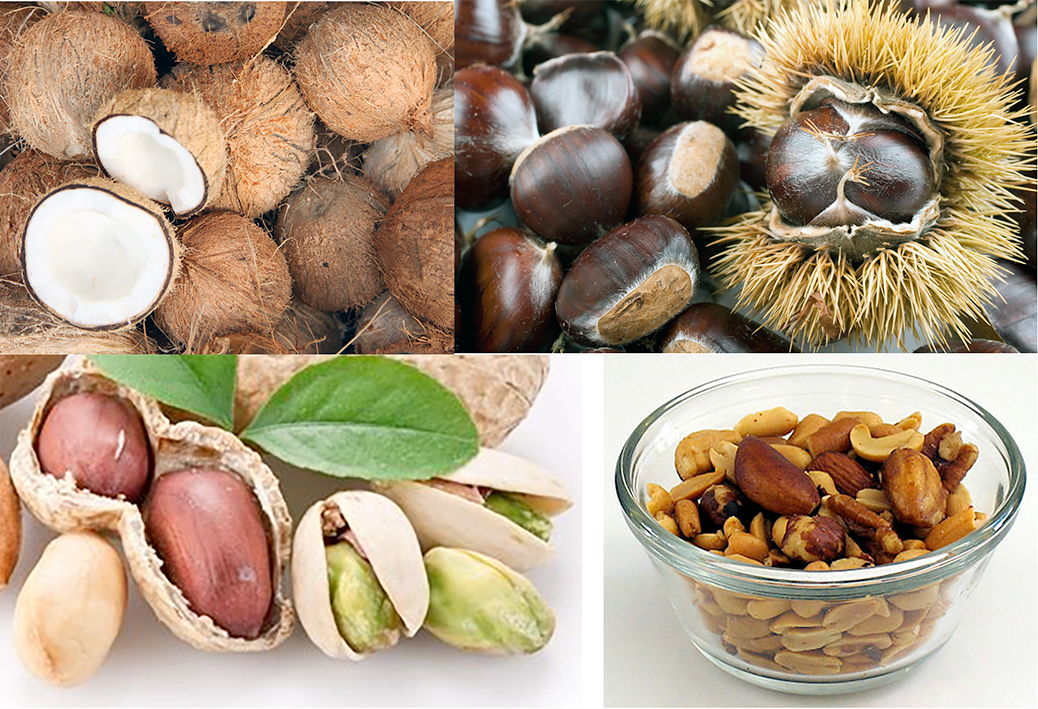 Different nuts. Clockwise: coconuts, sweet chestnuts, bowl of mixed nuts,
peanuts and pistachios.
Welcome to FabulousFusionFood's Nut-based Recipes Page —A nut is a fruit consisting of a hard or tough nutshell protecting a kernel which is usually edible. In general usage and in a culinary sense, many dry seeds are called nuts. In a botanical context, "nut" implies that the shell does not open to release the seed (indehiscent).
Most seeds come from fruit that naturally free themselves from the shell, but this is not the case in nuts such as hazelnuts, chestnuts, and acorns, which have hard shell walls and originate from a compound ovary. The general and original usage of the term is less restrictive, and many nuts (in the culinary sense), such as almonds, pistachios, and Brazil nuts, are not nuts in a botanical sense. Common usage of the term often refers to any hard-walled, edible kernel as a nut. Nuts are an energy-dense and nutrient-rich food source.
Botanically, a nut is a fruit with a woody pericarp developing from a syncarpous gynoecium. True nuts include, for example, chestnut, hazelnut and filbert. Culinarily, the term 'nut' is used much more widely, and includes examples of drupes (such as pecans and almonds) or seeds (such as pine nuts and peanuts).
Also widely known as nuts are dry drupes, which include pecans, almonds, macadamia (Macadamia integrifolia), candlenut (Aleurites moluccanus) and the water caltrop (Trapa bicornis). A drupe is an indehiscent fruit that has an outer fleshy part consisting of the exocarp, or skin, and mesocarp, or flesh, which surround a single pit or stone, the endocarp with a seed (kernel) inside. In a dry drupe, the outer parts dry up and the remaining husk is part of the ovary wall or pericarp, and the hard inner wall surrounding the seed represents the inner part of the pericarp.
Walnuts and hickories (Juglandaceae) have fruit that are difficult to classify. They are considered to be nuts under some definitions but are also referred to as drupaceous nuts.
In common use, a "tree nut" is, as the name implies, any nut coming from a tree. This most often comes up regarding food allergies; a person may be allergic specifically to peanuts (which are not tree nuts but legumes), whereas others may be allergic to the wider range of nuts that grow on trees.
The sweet potato arrived in Europe with the Columbian exchange. It is recorded, for example, in Elinor Fettiplace's Receipt Book, compiled in England in 1604.
Nuts are eaten by humans and wildlife. Because nuts generally have a high oil content, they are a significant energy source. Many seeds are edible by humans and used in cooking, eaten raw, sprouted, or roasted as a snack food, ground to make nut butters, or pressed for oil that is used in cooking and cosmetics.
Nuts used for food are a common source of food allergens. Reactions can range from mild symptoms to severe ones, a condition known as anaphylaxis, which can be life-threatening. The reaction is due to the release of histamine by the body in response to an allergen in the nuts, causing skin and other possible reactions. Many experts suggest that a person with an allergy to peanuts should avoid eating tree nuts, and vice versa.
The nuts linked to from this page are: acorn; almond; beech nuts; betel nut; brazil nut; bush mango; filbert; ginkgo nut; kola nut; candlenut; cashew; chestnut; coconut; hazelnut; macadamia; ogbono; palm nut; peanut; pecan; pine nut; pistachio; walnut.
The alphabetical list of all the nut-based recipes on this site follows, (limited to 100 recipes per page). There are 4197 recipes in total:
Page 11 of 42
| Čokoladna Orah Torta (Chocolate Walnut Cake) Origin: Croatia | Corn and Chicken Soup Origin: China | Crème de Corossol (Soursop Cream) Origin: Senegal |
| Čokoladna Orah Torta (Chocolate Walnut Cake) Origin: Macedonia | Corn and Rice Bread Origin: Angola | Crème de Corossol Glacée (Soursop Cream Ice Cream) Origin: Senegal |
| Čokoládové lanýže (Czech Chocolate Truffles) Origin: Czech | Cornelian Cherry Sauce Origin: British | Crème Renversée à la Noix de Coco (Coconut Caramel Custard) Origin: Senegal |
| Colcannon Origin: Ireland | Cornish Black Cake Origin: England | Crème Verde Origin: France |
| Colcannon Soup Origin: Ireland | Cornish Carrot Cake Origin: England | Crêpe Aux Poires Et Aux Amandes Effilees (Pear and Almond filled Crêpes) Origin: France |
| Cold Bruet (Cold Brewet) Origin: England | Cornish Chicken Curry Origin: England | Crêpes aux myrtilles (Bilberry Crêpes) Origin: France |
| Collard Greens with Coconut Milk Origin: East Africa | Cornish Clotted Cream Rice Pudding Origin: England | Crab Fried Rice Origin: China |
| Collegiate Pudding Origin: British | Cornish Junket Origin: Britain | Crabs (Marshallese Coconut Crab) Origin: Marshall Islands |
| Collegiate Pudding Origin: British | Cornish Nettle Soup Origin: England | Cranberry Bundt Cake Origin: America |
| Collumella's Moretum Origin: Roman | Cornish Pig's Head Pudding Origin: England | Cranberry Eggnog Muffins (Cranberry Eggnog Muffins) Origin: American |
| Colomba Pasquale (Easter Dove) Origin: Italy | Cornish Pollack Curry Origin: England | Cranberry Mincemeat Origin: Britain |
| Colombo d'Agneau à la Mauricienne (Mauritian-style Colombo of Lamb) Origin: Mauritius | Cornish Rock Cakes Origin: England | Cranberry Orange Quickbread Origin: American |
| Colombo de Martinique Origin: Martinique | Cornish Saffron Cake Origin: England | Cranberry Sauce Origin: American |
| Colourful Vegetarian Kebabs Origin: Britain | Cornish Salt Pork Origin: England | Cranberry, Fig and Almond Mincemeat with Dates Origin: Britain |
| Comadore (Fruit Pie Delicacies) Origin: England | Cornish Sole Curry with Cauliflower Rice Origin: England | Cranberry-pecan Cinnamon Rolls Origin: Britain |
| Comfiture de Noix de Coco (Coconut Preserve) Origin: Senegal | Cornish Store Cake Origin: England | Cream Cheese Filled Cupcakes Origin: American |
| Comorian Coconut Curry Chicken Origin: Comoros | Cornish Tea Biscuits Origin: England | Cream Delight with Whiskey Origin: Ireland |
| Comorian Pilaou Origin: Comoros | Cornish Tea Treat Buns Origin: England | Cream of Cheese Soup Origin: American |
| Compota de Uvas con Crujiente de Boniato (Grape Compote with Crispy Sweet Potato) Origin: Spain | Cornish Wine Cake Origin: England | Cream of Chestnut Soup Origin: Britain |
| Conch Curry Coconut Banana Chowder Origin: Aruba | Cornmeal Porridge Origin: Jamaica | Cream of Mushroom Soup Origin: Britain |
| Concombre cuit à l'indienne (Indian-style Cooked Cucumber) Origin: France | Cornulete Vanilate (Romanian Walnut Crescents) Origin: Romania | Cream of Peanut Soup Origin: Uganda |
| Confiture de Coco (Coconut Jam) Origin: Martinique | Cotagrys (Cockatrice) Origin: England | Cream of Puffball Soup Origin: Britain |
| Confiture de Coco (Coconut Jam) Origin: Saint Barthelemy | Country Pork Terrine Origin: England | Cream of Salsify Soup Origin: Britain |
| Confiture de Tamarin (Tamarind Jam) Origin: Senegal | Courges avec des arachides (Squash with Peanuts) Origin: Gabon | Creamed Alexanders Root Origin: Britain |
| Congolese Chicken with Peanuts Origin: Congo | Courgette and Carrot Cake Origin: British | Creamed Ground Elder Origin: Britain |
| Congrejo al Coco (Coconut Crab) Origin: Ecuador | Courgette Charlotte with Veal Sweetbreads and Ceps Origin: Andorra | Creamed Onions Origin: American |
| Conkies Origin: Bahamas | Courgette Halwa Origin: Fusion | Creamed Swedes Origin: Britain |
| Conkies Origin: Guyana | Couscouma Origin: Comoros | Creamed Sweet Potatoes with Carrots and Turnips Origin: American |
| Connates Origin: England | Couscous alla Trapanese Origin: Italy | Creamed Turnips Origin: American |
| Contrichop Origin: Equatorial Guinea | Couscous de Timbuktu Origin: Mali | Creamy Chestnut Soup Origin: France |
| Conynges in Gravey (Rabbits in Gravy) Origin: England | Couscous with Dried Fruit, Nuts and Cinnamon Origin: Morocco | Creamy Lemon Blancmange Origin: Britain |
| Coorg Chicken Masala Origin: India | Cowl Bysk (Bisque Broth) Origin: England | Creamy Peanut Toffee Origin: Britain |
| Copycat Duncan Hines White Cake Origin: American | Cozonac (Romanian Sweet Bread) Origin: Romania | |
| Coq au Vin Origin: France | Crâme Glacée au Beurre d'Arachide (Peanut Butter Ice Cream) Origin: Senegal |
Page 11 of 42