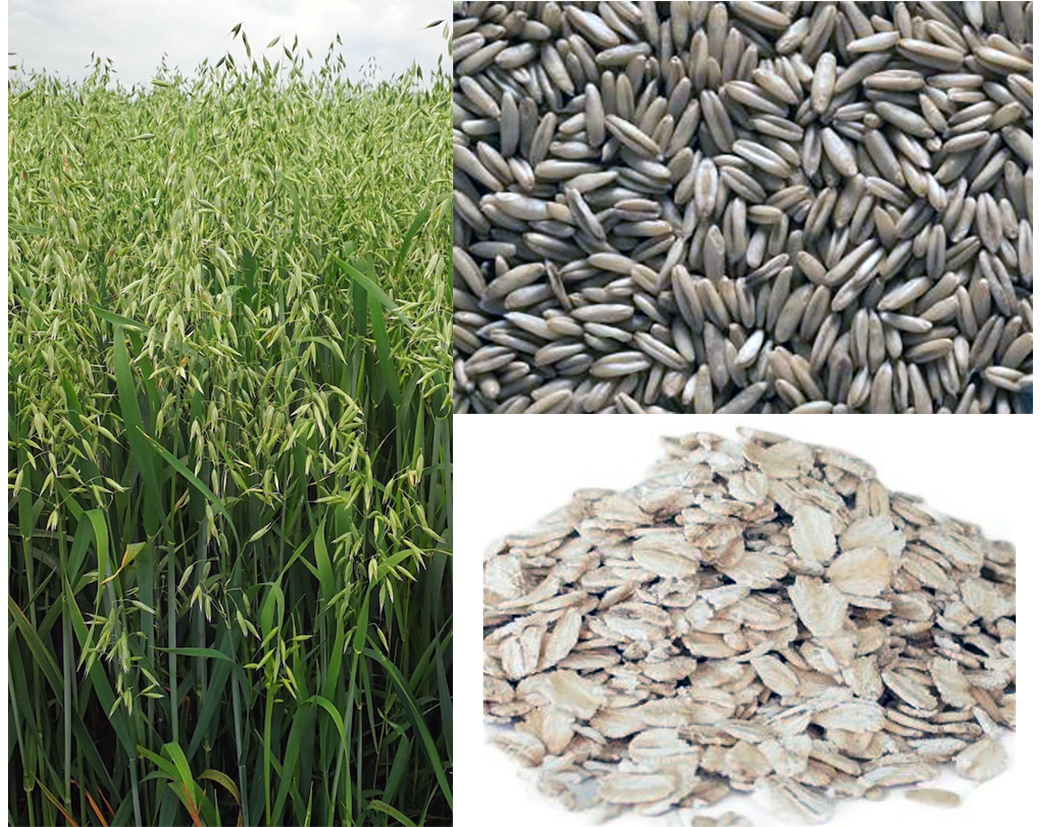
 Green oat plants in the field (left) mature oat grains (top) and
a mound of rolled oats (bottom).
Welcome to the summary page for FabulousFusionFood's Cook's Guide entry for Oats along with all the recipes employing Oats presented on this site, with 518 recipes in total.
This is a continuation of an entire series of pages that will, I hope, allow my visitors to better navigate this site. As well as displaying recipes by name, country and region of origin I am now planning a whole series of pages where recipes can be located by meal type and main ingredient. This page gives a listing of all the Oats recipes added to this site.
These recipes, all contain Oats as a major wild food ingredient.
Avena sativa the oat plant (sometimes called the common oat) is a species of cereal grass in the Pooidae subfamily of the BOP clade of true grasses. It is grown as a fodder crop and for its seed, which is known by the same name (usually in the plural). Oats appear to have been domesticated as a secondary crop, as their seeds resembled those of other cereals closely enough for them to be included by early cultivators. Oats tolerate cold winters less well than cereals such as wheat, barley, and rye, but need less summer heat and more rain, making them important in areas such as Northwest Europe that have cool, wet summers. They can tolerate low-nutrient and acid soils. Oats grow thickly and vigorously, allowing them to outcompete many weeds, and compared to other cereals are relatively free from diseases.
Oats are used for human consumption as oatmeal, including as steel cut oats or rolled oats. Global production is dominated by Canada and Russia; global trade is a small part of production, most of the grain being consumed within the producing countries. Oats are a nutrient-rich food associated with lower blood cholesterol and reduced risk of human heart disease when consumed regularly. One of the most common uses of oats is as livestock feed; the crop can also be grown as groundcover and ploughed in as a green manure.
The oat is a tall stout grass, a member of the family Poaceae; it can grow to a height of 1.8 metres. The leaves are long, narrow, and pointed, and grow upwards; they can be some 15 to 40 centimetres in length, and around 5 to 15 millimetres in width. Leaf blades emerge first from nodes in the stalk, then the sheath. New leaves grow upwards on nodes further from the ground, leaves on the old nodes gradually brown and wilt. Roots are fibrous, mostly in the uppermost 0.3 metres of the soil (though some may penetrate as deep as 1.5 metres, and develop from a crown at the soil surface. When seeds are dense, they make only one or two hollow stems (culms), but when spaced out may make 10 to 30 culms.
At the top of the stem, the plant branches into a loose cluster or panicle of about 10–75 spikelets. While they tend to self pollinate, 1-2% may outcross. There are 7-9 nodes, with one leaf at each node and hollow internodes. These contain the wind-pollinated flowers, which mature into the oat seeds or grains. Botanically the grain is a caryopsis, as the wall of the fruit is fused on to the actual seed. Like other cereal grains, the caryopsis contains the outer husk or bran, the starchy food store or endosperm which occupies most of the seed, and the protein-rich germ which if planted in soil can grow into a new plant.
Phylogenetic analysis using molecular DNA and morphological evidence places the oat genus Avena in the Pooideae subfamily. That subfamily includes the cereals wheat, barley, and rye; they are in the Triticeae tribe, while Avena is in the Poeae, along with grasses such as Briza and Agrostis. The wild ancestor of Avena sativa and the closely related minor crop — A. byzantina — is A. sterilis, a naturally hexaploid wild oat,
Genomic study suggests that the hulled variety and the naked variety A. sativa var. nuda diverged around 51,200 years ago, long before domestication. This implies that the two varieties were domesticated independently.
Oats are thought to have emerged as a secondary crop. This means that they are derived from what was considered a weed of the primary cereal domesticates such as wheat. They survived as a Vavilovian mimic by having grains that Neolithic people found hard to distinguish from the primary crop.
Oats were cultivated for some thousands of years before they were domesticated. A granary from the Pre-Pottery Neolithic, about 11,400 to 11,200 years ago in the Jordan Valley in the Middle East contained a large number of wild oat grains (120,000 seeds of A. sterilis). The find implies intentional cultivation. Domesticated oat grains first appear in the archaeological record in Europe around 3000 years ago
Oats are annual plants best grown in temperate regions. They tolerate cold winters less well than wheat, rye, or barley; they are harmed by sustained cold below −7°C. They have a lower summer heat requirement and greater tolerance of (and need for) rain than the other cereals mentioned, so they are particularly important in areas with cool, wet summers, such as Northwest Europe.
Harvested oats go through multiple stages of milling. The first stage is cleaning, to remove seeds of other plants, stones and any other extraneous materials. Next is de-hulling to remove the indigestible bran, leaving the seed or 'groat'. Heating denatures enzymes in the seed that would make it go sour or rancid; the grain is then dried to minimise the risk of spoilage by bacteria and fungi. There may follow numerous stages of cutting or grinding the grain, depending on which sort of product is required. For oatmeal (oat flour), the grain is ground to a specified fineness. For home use such as making porridge, oats are often rolled flat to make them quicker to cook.
When used in foods, oats are most commonly rolled or crushed into oatmeal or ground into fine oat flour. Oatmeal is chiefly eaten as porridge, but may also be used in a variety of baked goods, such as oatcakes (which may be made with coarse steel-cut oats for a rougher texture), oatmeal cookies and oat bread. Oats are an ingredient in many cold cereals, in particular muesli and granola; the Quaker Oats Company introduced instant oatmeal in 1966. Oats are also used to produce milk substitutes ('oat milk').
In Britain, oats are sometimes used for brewing beer, such as oatmeal stout where a percentage of oats, often 30%, is added to the barley for the wort. Oatmeal caudle, made of ale and oatmeal with spices, was a traditional British drink and a favourite of Oliver Cromwell.
This is a continuation of an entire series of pages that will, I hope, allow my visitors to better navigate this site. As well as displaying recipes by name, country and region of origin I am now planning a whole series of pages where recipes can be located by meal type and main ingredient. This page gives a listing of all the Oats recipes added to this site.
These recipes, all contain Oats as a major wild food ingredient.
Avena sativa the oat plant (sometimes called the common oat) is a species of cereal grass in the Pooidae subfamily of the BOP clade of true grasses. It is grown as a fodder crop and for its seed, which is known by the same name (usually in the plural). Oats appear to have been domesticated as a secondary crop, as their seeds resembled those of other cereals closely enough for them to be included by early cultivators. Oats tolerate cold winters less well than cereals such as wheat, barley, and rye, but need less summer heat and more rain, making them important in areas such as Northwest Europe that have cool, wet summers. They can tolerate low-nutrient and acid soils. Oats grow thickly and vigorously, allowing them to outcompete many weeds, and compared to other cereals are relatively free from diseases.
Oats are used for human consumption as oatmeal, including as steel cut oats or rolled oats. Global production is dominated by Canada and Russia; global trade is a small part of production, most of the grain being consumed within the producing countries. Oats are a nutrient-rich food associated with lower blood cholesterol and reduced risk of human heart disease when consumed regularly. One of the most common uses of oats is as livestock feed; the crop can also be grown as groundcover and ploughed in as a green manure.
The oat is a tall stout grass, a member of the family Poaceae; it can grow to a height of 1.8 metres. The leaves are long, narrow, and pointed, and grow upwards; they can be some 15 to 40 centimetres in length, and around 5 to 15 millimetres in width. Leaf blades emerge first from nodes in the stalk, then the sheath. New leaves grow upwards on nodes further from the ground, leaves on the old nodes gradually brown and wilt. Roots are fibrous, mostly in the uppermost 0.3 metres of the soil (though some may penetrate as deep as 1.5 metres, and develop from a crown at the soil surface. When seeds are dense, they make only one or two hollow stems (culms), but when spaced out may make 10 to 30 culms.
At the top of the stem, the plant branches into a loose cluster or panicle of about 10–75 spikelets. While they tend to self pollinate, 1-2% may outcross. There are 7-9 nodes, with one leaf at each node and hollow internodes. These contain the wind-pollinated flowers, which mature into the oat seeds or grains. Botanically the grain is a caryopsis, as the wall of the fruit is fused on to the actual seed. Like other cereal grains, the caryopsis contains the outer husk or bran, the starchy food store or endosperm which occupies most of the seed, and the protein-rich germ which if planted in soil can grow into a new plant.
Phylogenetic analysis using molecular DNA and morphological evidence places the oat genus Avena in the Pooideae subfamily. That subfamily includes the cereals wheat, barley, and rye; they are in the Triticeae tribe, while Avena is in the Poeae, along with grasses such as Briza and Agrostis. The wild ancestor of Avena sativa and the closely related minor crop — A. byzantina — is A. sterilis, a naturally hexaploid wild oat,
Genomic study suggests that the hulled variety and the naked variety A. sativa var. nuda diverged around 51,200 years ago, long before domestication. This implies that the two varieties were domesticated independently.
Oats are thought to have emerged as a secondary crop. This means that they are derived from what was considered a weed of the primary cereal domesticates such as wheat. They survived as a Vavilovian mimic by having grains that Neolithic people found hard to distinguish from the primary crop.
Oats were cultivated for some thousands of years before they were domesticated. A granary from the Pre-Pottery Neolithic, about 11,400 to 11,200 years ago in the Jordan Valley in the Middle East contained a large number of wild oat grains (120,000 seeds of A. sterilis). The find implies intentional cultivation. Domesticated oat grains first appear in the archaeological record in Europe around 3000 years ago
Oats are annual plants best grown in temperate regions. They tolerate cold winters less well than wheat, rye, or barley; they are harmed by sustained cold below −7°C. They have a lower summer heat requirement and greater tolerance of (and need for) rain than the other cereals mentioned, so they are particularly important in areas with cool, wet summers, such as Northwest Europe.
Harvested oats go through multiple stages of milling. The first stage is cleaning, to remove seeds of other plants, stones and any other extraneous materials. Next is de-hulling to remove the indigestible bran, leaving the seed or 'groat'. Heating denatures enzymes in the seed that would make it go sour or rancid; the grain is then dried to minimise the risk of spoilage by bacteria and fungi. There may follow numerous stages of cutting or grinding the grain, depending on which sort of product is required. For oatmeal (oat flour), the grain is ground to a specified fineness. For home use such as making porridge, oats are often rolled flat to make them quicker to cook.
When used in foods, oats are most commonly rolled or crushed into oatmeal or ground into fine oat flour. Oatmeal is chiefly eaten as porridge, but may also be used in a variety of baked goods, such as oatcakes (which may be made with coarse steel-cut oats for a rougher texture), oatmeal cookies and oat bread. Oats are an ingredient in many cold cereals, in particular muesli and granola; the Quaker Oats Company introduced instant oatmeal in 1966. Oats are also used to produce milk substitutes ('oat milk').
In Britain, oats are sometimes used for brewing beer, such as oatmeal stout where a percentage of oats, often 30%, is added to the barley for the wort. Oatmeal caudle, made of ale and oatmeal with spices, was a traditional British drink and a favourite of Oliver Cromwell.
The alphabetical list of all Oats recipes on this site follows, (limited to 100 recipes per page). There are 518 recipes in total:
Page 1 of 6
| 'Marmalade on toast' porridge Origin: Britain | Bangladeshi Goat Curry Origin: Bangladesh | Brik à la Viande (Algerian Meat Turnovers) Origin: Algeria |
| Afghan Kofta Curry Origin: Afghanistan | Bannock Origin: Scotland | Brochettes Burkinabé (Spiced Lamb Kebabs) Origin: Burkina Faso |
| Afia Efere (White Soup) Origin: Nigeria | Bannock Origin: Scotland | Brotchan Roi (Leek and Oatmeal Broth) Origin: Ireland |
| Air Fryer Blueberry Baked Oats Origin: Britain | Bara Ceirch (Welsh Oatcakes) Origin: Welsh | Brown Oatmeal Bread Origin: Britain |
| Air Fryer Oat Biscuits Origin: Britain | Bara Ceirch Lafwr Sych (Dried Laver Oatcakes) Origin: Welsh | Brunei Satay Origin: Brunei |
| Air Fryer Oaty Banana Blueberry Muffins Origin: Britain | Bara Cnau Pecan a Llugaeron (Pecan Nut and Cranberry Bread) Origin: Welsh | Bruschetta Bara Lawr Brecwast (Breakfast Laverbread Bruschetta) Origin: Welsh |
| Aliter Haedinam sive Agninam Excaldatam (Roast Kid or Lamb) Origin: Roman | Bara Gwenith a Cheirch Sylfaenol (Basic Wheat and Oat Bread) Origin: Welsh | Bucellae cum Lacte Caprino (Bred Morsels with Goats' Milk) Origin: Roman |
| Aliter Haedinam sive Agninam Excaldatam (Stew of Kid or Lamb) Origin: Roman | Bara Lawr (Laver Bread) Origin: Welsh | Buckwheat Kasha Origin: Ukraine |
| Aliter Haedinam sive Agninam Excaldatam (Stew of Kid or Lamb, Another Way) Origin: Roman | Bara Lawr (Laverbread) Origin: Welsh | Buckwheat Kasha Origin: Kazakhstan |
| Aliter Haedum sive Agnum Assum (Roast Kid or Lamb, Another Way) Origin: Roman | Bara Sur Ceich (Oatmeal Soda Bread) Origin: Welsh | Burundi Brochettes Origin: Burundi |
| Aliter Haedus sive Agnus Syringiatus (Boned Suckling Kid or Lamb, Another Way) Origin: Roman | Bares de Arequipe (Arequipe Bars) Origin: Colombia | Buttermilk Baking Mix Origin: America |
| Aliter Ofellas (Roast Morsels, Another Way) Origin: Roman | Basto and Suugo Origin: Somalia | Byrger Ffa (Bean Burger) Origin: Welsh |
| Anglo-Saxon Honey Oat Cakes Origin: England | Basto and Suugo Origin: Djibouti | Byrgers Bara Lawr (Laver Bread Burgers) Origin: Welsh |
| Antiguan Curry Goat Origin: Antigua | Bedfordshire Biscuits Origin: England | Cabri aux Gombos et Patates Douces (Goat with Okra and Sweet Potatoes) Origin: Senegal |
| Antiguan Rice and Peas Origin: Antigua | Beninese Goat Stew Origin: Benin | Cabri farci, façon afar (Stuffed Goat, Afar Style) Origin: Djibouti |
| ANZAC Biscuits Origin: New Zealand | Berreen Giar Vanninagh (Manx Short Cake) Origin: Manx | Cabri Massalé (Kid Goat Massala) Origin: Reunion |
| Apple and Peanut Butter Soup Origin: American | Berry Cherry Crumble Origin: Britain | Cabrito com Inhame (Kid Goat with Yam) Origin: Cape Verde |
| Apple and Potato Cake Origin: Ireland | Beurre Rouge (Red Butter) Origin: Guadeloupe | Cacen Blât Caws Coch, Afalau a Mwayar Duon (Welsh Red Leicester Apple and Blackberry Crumble Pie) Origin: Welsh |
| Apple Butter Squares Origin: American | Bhindi Gosht (Pakistani Mutton and Okra Curry) Origin: Pakistan | Cachupa Rica Origin: Cape Verde |
| Arbroath Smokies Origin: Scotland | Bhojpur Mutton Curry Origin: India | Cachupa Rica II Origin: Cape Verde |
| Artolaganon (Fried Savoury Pasta) Origin: Roman | Bisgedi Ceirch (Oat Biscuits) Origin: Welsh | Calalou (Beninese Callaloo) Origin: Benin |
| Artolaganon II (Leavened Flatbread) Origin: Roman | Bisgedi Ceirch a Sbelt (Oat and Spelt Biscuits) Origin: Welsh | Caldeiraa de Cabrito (Goat Meat Stew) Origin: Mozambique |
| Aruban Curried Goat Origin: Aruba | Bisgedi Ceirch Euraidd (Golden Oat Biscuits) Origin: Welsh | Camarão na Abóbora (Prawns in Pumpkin Shells) Origin: Mozambique |
| Aruban Curry Goat Origin: Aruba | Bisgedi Gele (Gele Biscuits) Origin: Welsh | Cameroon Lamb Curry Origin: Cameroon |
| Atholl Brose Origin: Scotland | Black Liver Pudding Origin: Ireland | Cameroonian Jollof Rice Origin: Cameroon |
| Börek Sauvage (Wild Greens Börek) Origin: France | Blanquette de Poisson au Breton Kari (Fish Blanquette with Breton Kari) Origin: France | Capretto al Forno (Oven-roasted Kid Goat) Origin: Italy |
| Bahamian Crab and Rice Origin: Saint Barthelemy | Blossom-stuffed Pork Tenderloin Origin: American | Cari Massale de Cabri (Goat Curry) Origin: Reunion |
| Bajan Curry Goat Origin: Barbados | Bolo de Carne (Brazilian Rolled Meatloaf) Origin: Brazil | Carne de Cebra Grealhado (Barbecued Goat Meat) Origin: Guinea-Bissau |
| Bajan Curry Powder Origin: Barbados | Bottle Masala Meatball Curry Origin: India | Carrot Cake Oat Bars Origin: Britain |
| Baked Date Oatmeal Origin: Fusion | Boyndie Broth Origin: Scotland | Carrot cake pancakes Origin: Britain |
| Balti Tandoori Keema Origin: Britain | Breakfast Pancakes Origin: Britain | Cassava Leaf Stew Origin: Sierra Leone |
| Banana and Chestnut Crumble Origin: Britain | Brecwast Bara Lawr (Laver Bread Breakfast) Origin: Welsh | Cassava Life Origin: Sierra Leone |
| Banana and Chia Date Cookies Origin: American | Brewet of Almayn (Bruet of Almonds) Origin: England | |
| Banana Flapjacks Origin: Britain | Bricher Muesli Origin: Switzerland |
Page 1 of 6