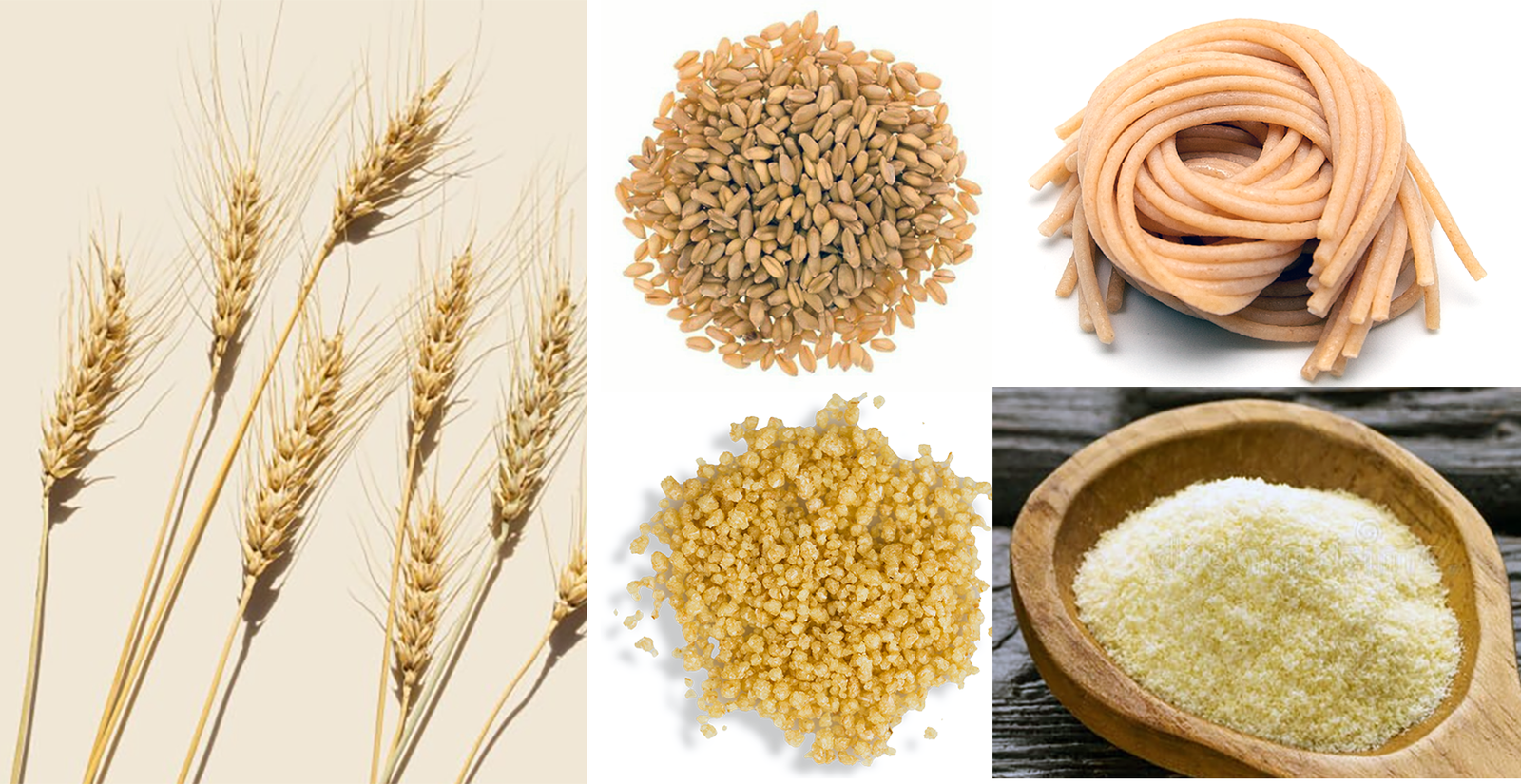
 Ripe ears of durum wheat (left), grains of durum wheat and durum
wheat spaghetti (top row), durum wheat couscous and durum wheat
semolina (bottom row).
Welcome to the summary page for FabulousFusionFood's Cook's Guide entry for Durum and Freekeh along with all the recipes employing Durum and Freekeh presented on this site, with 252 recipes in total.
This is a continuation of an entire series of pages that will, I hope, allow my visitors to better navigate this site. As well as displaying recipes by name, country and region of origin I am now planning a whole series of pages where recipes can be located by meal type and main ingredient. This page gives a listing of all the Durum and Freekeh recipes added to this site.
These recipes, all contain Durum and Freekeh as a major wild food ingredient.
Durum, also called pasta wheat or macaroni wheat (Triticum durum or Triticum turgidum subsp. durum), is a tetraploid species of wheat. It is the second-most cultivated species of wheat after common wheat, although it represents only 5 to 8% of global wheat production. It was developed by artificial selection of the domesticated emmer wheat strains formerly grown in Central Europe and the Near East around 7000 BC, which developed a naked, free-threshing form. Like emmer, durum is awned (with bristles). It is the predominant wheat grown in the Middle East.
Some authorities synonymize 'durum' and Triticum turgidum whereas others reserve the term 'durum' for Triticum turgidum subsp. durum. The grain classification for durum is typically based on the hard vitreous kernel (HVK) count.
Durum in Latin means 'hard'. The species is the hardest of all wheats regarding its resistance of the grain to milling, in particular of the starchy endosperm, causing dough made from its flour to be weak or 'soft'.
Durum is a tetraploid wheat, having four sets of chromosomes for a total of 28, unlike hard red winter and hard red spring wheats, which are hexaploid (six sets of chromosomes) for a total of 42.
Durum originated through intergeneric hybridization and polyploidization involving two diploid (having two sets of chromosomes) grass species: T. urartu (2n=2x=14, AA genome) and a B-genome diploid related to Aegilops speltoides (2n=2x=14, SS genome) and is thus an allotetraploid (having four sets of chromosomes, from unlike parents) species.
Commercially produced dry pasta, or pasta secca, is made almost exclusively from durum semolina. Most homemade fresh pastas also use durum or a combination of soft and hard wheats. Its hardness makes it favourable for semolina and pasta and less practical for flour, which requires more work to mill than with hexaploid wheats such as common bread wheats.
Husked but unground, or coarsely ground, it is used to produce the semolina in the couscous of North Africa and the Levant. It is also used for Levantine dishes such as tabbouleh, kashk, kibbeh, bitfun, and the bulgur for pilafs. In North African and Levantine cuisines, it forms the basis of many soups, gruels, stuffings, puddings, and pastries. When ground as fine as flour, it is used for making bread. In the Middle East, it is used for flat, round breads, and in Europe and elsewhere, it can be used for pizza or torte. In South Asia, Bombay rava is used widely for puddings and flatbreads.
The use of wheat to produce pasta was described as early as the 10th century by Ibn Wahshīya of Cairo. The North Africans called the product itrīya, from which Italian sources derived the term tria (or aletría in the case of Spanish sources) during the 15th century.
Most of the durum grown today is amber durum, the grains of which are amber-colored due to the extra carotenoid pigments and are larger than those of other types of wheat. Durum has a yellow endosperm, which gives pasta its color. When durum is milled, the endosperm is ground into a granular product called semolina. Semolina made from durum is used for premium pastas and breads. Notably, semolina is also one of the only flours that are purposely oxidized for flavor and color. Red durum is grown for use mostly in livestock feed.
The cultivation of durum generates greater yield than other wheats in areas of low precipitation. Good yields can be obtained by irrigation, but this is rarely done. Durum is one of the most important food crops in West Asia. Although the variety of the wheat there is diverse, it is not extensively grown there, thus it must be imported. West amber durum produced in Canada is used mostly for semolina/pasta, but some is also exported to Italy for bread production.
Durum is subject to four processes: cleaning, tempering, milling, and purifying. First, durum is cleaned to remove foreign material and shrunken and broken kernels. Then, it is tempered to a desired moisture content, toughening the seed coat for efficient separation of bran and endosperm. Durum milling is a complex procedure involving repetitive grinding and sieving. Proper purifying results in maximum semolina yield and the least amount of bran powder.
To produce bread, durum is ground into flour, which is mixed with water to produce dough. The quantities mixed vary, depending on the acidity of the mixture. To produce fluffy bread, the dough is mixed with yeast and lukewarm water, heavily kneaded to form a gas-retaining gluten network, and then fermented for hours, producing CO2 bubbles held in the gluten.
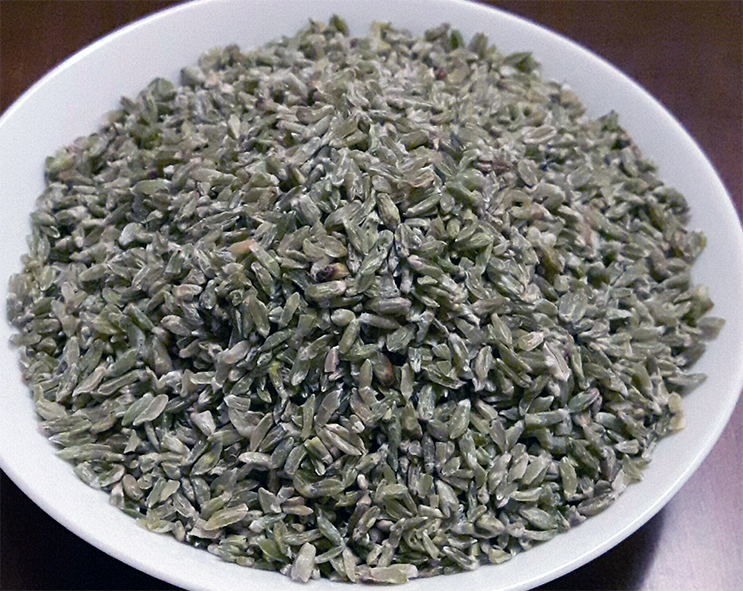
Freekeh (sometimes spelled frikeh) or farik (Arabic: فريكة / ALA-LC: farīkah; pronounced free-kah /ˈfɹiːkə/) is a cereal food made from green durum wheat (Triticum turgidum var. durum) that is roasted and rubbed to create its flavour. It is an ancient dish derived from Levantine and North African cuisines, remaining popular in many countries of the eastern Mediterranean Basin, where wheat was first domesticated.
Freekeh is the name for the wheat grain prepared in a specific way. Harvested while still green and the seeds still soft, it is piled and sun-dried, and then carefully set alight such that only the straw and chaff burn, with the grain protected by its high water content. This roasted wheat is then threshed, winnowed and sun-dried again to achieve a uniform flavour, texture, and colour, and make it suitable for long-term storage. The threshing or rubbing of the burnt chaff off of the grains is what gives this food its name, from the Arabic word farīk or "rubbed". The dried berries can also be cracked into smaller pieces that resemble green bulgur.
Traces of wild wheat berries of the emmer variety used to make bread were found in a hearth at a Natufian site in the Levant, and dated to 14,000 years ago. The variety of wheat used to make freekeh, Triticum turgidum was domesticated around 10,000 years ago in the same general region. A subspecies of this durum wheat is grown globally today, primarily to make semolina for pasta, as it is a hard grain, less suited to producing fine flour; and this is the same grain used to make freekeh
The term freekeh is derived from the Arabic verb, farik, meaning "to rub", nodding towards the process by which it is produced, which involves rubbing the chaff off of the burnt wheat berries against a winnowing tray, known in Arabic as the ghorbal/ghurbal. It is a labor intensive process, as due to the immaturity of the grain at the time of picking, the chaff does not easily separate from the berry, and a second rubbing against coiled flat baskets made from the previous years' harvest is also undertaken.
Freekeh is mentioned in an early thirteenth-century Baghdad cookbook as farīkiyya. In that recipe, meat is fried in oil and braised with water, salt, and cinnamon bark. Then, dried coriander is stirred in with young wheat ('freekeh') and is cooked. Finally, the meal is served with cumin, cinnamon, and fresh lamb tail fat. This is a luxurious recipe with such cookbooks generally written to prepare dishes for the wealthy and royalty, whereas freekeh was most commonly consumed as a staple of the common people.
In Egyptian cuisine, freekeh is served as ḥamām bi’l-ferīk, which is pigeon stuffed with freekeh (ducks are also used[12]). Freekeh is also prepared in Egypt with onion and tomato, and sometimes with chicken. Shūrbat farīk bi’l-mukh is a freekeh and bone marrow soup from Tunisia. Freeket lahma, a green wheat pilaf dish with roasted lamb, spring peas, and pine nuts, comes from Jordan, and shūrba al-farīk is a soup with green wheat and chicken.[1][13] Chicken stuffed with freekeh is a traditional dish found in several Arab countries.
In Turkey, freekeh is known as firik, and a pilaf dish based on freekeh, called firik pilavı, is found in traditional Southern Anatolian cuisine. It may be combined with bulgur; legumes such as chickpeas and various herbs and spices, and sometimes meat, may be added. With the influx of millions of Syrian refugees since 2011, firik is available in markets all over Turkey.[20]
In Palestine, a variety of freekeh pilaf is made with lamb, onion, olive oil, raisins, dried cherry plums, almonds, pine nuts, black pepper, cinnamon, cumin, and salt. Freekeh is also served in a soup along with chickpeas and meat (beef or chicken).[21][22] In the Galilee region, freekeh and other wheats are a staple, especially among Druze and Bedouins, as opposed to rice.
This is a continuation of an entire series of pages that will, I hope, allow my visitors to better navigate this site. As well as displaying recipes by name, country and region of origin I am now planning a whole series of pages where recipes can be located by meal type and main ingredient. This page gives a listing of all the Durum and Freekeh recipes added to this site.
These recipes, all contain Durum and Freekeh as a major wild food ingredient.
Durum, also called pasta wheat or macaroni wheat (Triticum durum or Triticum turgidum subsp. durum), is a tetraploid species of wheat. It is the second-most cultivated species of wheat after common wheat, although it represents only 5 to 8% of global wheat production. It was developed by artificial selection of the domesticated emmer wheat strains formerly grown in Central Europe and the Near East around 7000 BC, which developed a naked, free-threshing form. Like emmer, durum is awned (with bristles). It is the predominant wheat grown in the Middle East.
Some authorities synonymize 'durum' and Triticum turgidum whereas others reserve the term 'durum' for Triticum turgidum subsp. durum. The grain classification for durum is typically based on the hard vitreous kernel (HVK) count.
Durum in Latin means 'hard'. The species is the hardest of all wheats regarding its resistance of the grain to milling, in particular of the starchy endosperm, causing dough made from its flour to be weak or 'soft'.
Durum is a tetraploid wheat, having four sets of chromosomes for a total of 28, unlike hard red winter and hard red spring wheats, which are hexaploid (six sets of chromosomes) for a total of 42.
Durum originated through intergeneric hybridization and polyploidization involving two diploid (having two sets of chromosomes) grass species: T. urartu (2n=2x=14, AA genome) and a B-genome diploid related to Aegilops speltoides (2n=2x=14, SS genome) and is thus an allotetraploid (having four sets of chromosomes, from unlike parents) species.
Commercially produced dry pasta, or pasta secca, is made almost exclusively from durum semolina. Most homemade fresh pastas also use durum or a combination of soft and hard wheats. Its hardness makes it favourable for semolina and pasta and less practical for flour, which requires more work to mill than with hexaploid wheats such as common bread wheats.
Husked but unground, or coarsely ground, it is used to produce the semolina in the couscous of North Africa and the Levant. It is also used for Levantine dishes such as tabbouleh, kashk, kibbeh, bitfun, and the bulgur for pilafs. In North African and Levantine cuisines, it forms the basis of many soups, gruels, stuffings, puddings, and pastries. When ground as fine as flour, it is used for making bread. In the Middle East, it is used for flat, round breads, and in Europe and elsewhere, it can be used for pizza or torte. In South Asia, Bombay rava is used widely for puddings and flatbreads.
The use of wheat to produce pasta was described as early as the 10th century by Ibn Wahshīya of Cairo. The North Africans called the product itrīya, from which Italian sources derived the term tria (or aletría in the case of Spanish sources) during the 15th century.
Most of the durum grown today is amber durum, the grains of which are amber-colored due to the extra carotenoid pigments and are larger than those of other types of wheat. Durum has a yellow endosperm, which gives pasta its color. When durum is milled, the endosperm is ground into a granular product called semolina. Semolina made from durum is used for premium pastas and breads. Notably, semolina is also one of the only flours that are purposely oxidized for flavor and color. Red durum is grown for use mostly in livestock feed.
The cultivation of durum generates greater yield than other wheats in areas of low precipitation. Good yields can be obtained by irrigation, but this is rarely done. Durum is one of the most important food crops in West Asia. Although the variety of the wheat there is diverse, it is not extensively grown there, thus it must be imported. West amber durum produced in Canada is used mostly for semolina/pasta, but some is also exported to Italy for bread production.
Durum is subject to four processes: cleaning, tempering, milling, and purifying. First, durum is cleaned to remove foreign material and shrunken and broken kernels. Then, it is tempered to a desired moisture content, toughening the seed coat for efficient separation of bran and endosperm. Durum milling is a complex procedure involving repetitive grinding and sieving. Proper purifying results in maximum semolina yield and the least amount of bran powder.
To produce bread, durum is ground into flour, which is mixed with water to produce dough. The quantities mixed vary, depending on the acidity of the mixture. To produce fluffy bread, the dough is mixed with yeast and lukewarm water, heavily kneaded to form a gas-retaining gluten network, and then fermented for hours, producing CO2 bubbles held in the gluten.
Freekeh (sometimes spelled frikeh) or farik (Arabic: فريكة / ALA-LC: farīkah; pronounced free-kah /ˈfɹiːkə/) is a cereal food made from green durum wheat (Triticum turgidum var. durum) that is roasted and rubbed to create its flavour. It is an ancient dish derived from Levantine and North African cuisines, remaining popular in many countries of the eastern Mediterranean Basin, where wheat was first domesticated.
Freekeh is the name for the wheat grain prepared in a specific way. Harvested while still green and the seeds still soft, it is piled and sun-dried, and then carefully set alight such that only the straw and chaff burn, with the grain protected by its high water content. This roasted wheat is then threshed, winnowed and sun-dried again to achieve a uniform flavour, texture, and colour, and make it suitable for long-term storage. The threshing or rubbing of the burnt chaff off of the grains is what gives this food its name, from the Arabic word farīk or "rubbed". The dried berries can also be cracked into smaller pieces that resemble green bulgur.
Traces of wild wheat berries of the emmer variety used to make bread were found in a hearth at a Natufian site in the Levant, and dated to 14,000 years ago. The variety of wheat used to make freekeh, Triticum turgidum was domesticated around 10,000 years ago in the same general region. A subspecies of this durum wheat is grown globally today, primarily to make semolina for pasta, as it is a hard grain, less suited to producing fine flour; and this is the same grain used to make freekeh
The term freekeh is derived from the Arabic verb, farik, meaning "to rub", nodding towards the process by which it is produced, which involves rubbing the chaff off of the burnt wheat berries against a winnowing tray, known in Arabic as the ghorbal/ghurbal. It is a labor intensive process, as due to the immaturity of the grain at the time of picking, the chaff does not easily separate from the berry, and a second rubbing against coiled flat baskets made from the previous years' harvest is also undertaken.
Freekeh is mentioned in an early thirteenth-century Baghdad cookbook as farīkiyya. In that recipe, meat is fried in oil and braised with water, salt, and cinnamon bark. Then, dried coriander is stirred in with young wheat ('freekeh') and is cooked. Finally, the meal is served with cumin, cinnamon, and fresh lamb tail fat. This is a luxurious recipe with such cookbooks generally written to prepare dishes for the wealthy and royalty, whereas freekeh was most commonly consumed as a staple of the common people.
In Egyptian cuisine, freekeh is served as ḥamām bi’l-ferīk, which is pigeon stuffed with freekeh (ducks are also used[12]). Freekeh is also prepared in Egypt with onion and tomato, and sometimes with chicken. Shūrbat farīk bi’l-mukh is a freekeh and bone marrow soup from Tunisia. Freeket lahma, a green wheat pilaf dish with roasted lamb, spring peas, and pine nuts, comes from Jordan, and shūrba al-farīk is a soup with green wheat and chicken.[1][13] Chicken stuffed with freekeh is a traditional dish found in several Arab countries.
In Turkey, freekeh is known as firik, and a pilaf dish based on freekeh, called firik pilavı, is found in traditional Southern Anatolian cuisine. It may be combined with bulgur; legumes such as chickpeas and various herbs and spices, and sometimes meat, may be added. With the influx of millions of Syrian refugees since 2011, firik is available in markets all over Turkey.[20]
In Palestine, a variety of freekeh pilaf is made with lamb, onion, olive oil, raisins, dried cherry plums, almonds, pine nuts, black pepper, cinnamon, cumin, and salt. Freekeh is also served in a soup along with chickpeas and meat (beef or chicken).[21][22] In the Galilee region, freekeh and other wheats are a staple, especially among Druze and Bedouins, as opposed to rice.
The alphabetical list of all Durum and Freekeh recipes on this site follows, (limited to 100 recipes per page). There are 252 recipes in total:
Page 1 of 3
| Acorn Flour Tagliatelle Origin: Italy | Chorba Beïda (Algerian White Soup) Origin: Algeria | Fresh Puffball Mushroom Ragú Origin: Britain |
| Air Fryer Couscous Two Ways Origin: Britain | Chorizo and Spinach Linguine Origin: American | Gâteau de Semoule aux Agrumes (Semolina and Citrus Cake) Origin: Mali |
| Al-Aïch (Chicken, Beans and Couscous) Origin: Mauritania | Couscous à la Nigérienne (Niger-style Couscous) Origin: Niger | Güschgle-Knöpfle (Güshgle-style Button Noodles) Origin: Liechtenstein |
| Algerian Beghrir (Honeycomb Pancakes) Origin: Algeria | Couscous alla Trapanese Origin: Italy | Galettes de couac à la sauce tomate (Couac pancakes with tomato sauce) Origin: French Guiana |
| Algerian Saffron and Raisin Couscous Origin: Algeria | Couscous d'Orge à la Sauce Blanche (Barley Couscous with White Sauce) Origin: Algeria | Galifoto Origin: Togo |
| Aliter cucurbitas frictas tritas (Purée of Squash) Origin: Roman | Couscous de Fonio au Poulet (Fonio Couscous with Chicken) Origin: Togo | Galifoto aux Tomates Origin: Togo |
| Apple Kesari with Nutmeg Origin: India | Couscous et Sauce Tomate (Couscous with Tomato Sauce) Origin: Burkina Faso | Garba (Cassava Fried Tuna) Origin: Cote dIvoire |
| Asharbal Leebia (Libyan Soup 2) Origin: Libya | Couscous with Camel Origin: Mauritania | Gari Piñon Origin: Togo |
| Attiéké et Aloko Poisson (Attiéké and Plantain with Fish) Origin: Cote dIvoire | Couscous with Dried Fruit, Nuts and Cinnamon Origin: Morocco | Gâteau de couac à la noix de coco (Cassava Semolina and Coconut Cake) Origin: French Guiana |
| Aurangabadi Naan Qaliya Origin: India | Couscous with Mushroom Ragout Origin: Britain | Gnocchi alla Puttanesca al Forno (Puttanesca Baked Gnocchi) Origin: Italy |
| Avgolemono (Egg and Lemon Soup) Origin: Greece | Cozido à Madeirense Origin: Portugal | Gnocchi di semolino alla romana (Roman-Style Semolina Gnocchi) Origin: Vatican City |
| Bahamian Baked Macaroni and Cheese Origin: Bahamas | Crostata di Marmellata (Italian Jam Tart) Origin: Italy | Godrogodro (Coconut Pudding with Vanilla and Sweet Spices) Origin: Madagascar |
| Barbecued Kibbeh Origin: African Fusion | Crostata di Marmellata (Italian Jam Tart) Origin: Italy | Gooseberry and Strawberry Tart Origin: Britain |
| Basbousa Origin: Somalia | Curried Prawn Noodle Soup with Stevia Origin: Fusion | Graneam Triticeam sic Facito (Prepare Wheat Porridge This Way) Origin: Roman |
| Basbousa Origin: India | Dégué (Couscous and Yoghurt Dessert) Origin: Mali | Gratin de Couac (Couac Gratin) Origin: French Guiana |
| Basic Microwave Couscous Origin: Britain | Déguè II Origin: Senegal | Gulab Jamun Origin: Pakistan |
| Beetroot Tagliatelle Origin: Italy | Domatossoupa (Tomato Soup) Origin: Greece | Harira Origin: Djibouti |
| Berkoukes Origin: Algeria | Dracula's Revenge Origin: American | Hlalem (Pasta with Beans) Origin: Tunisia |
| Bolinhos de Najita (Najita Balls) Origin: Mozambique | Duck with Marmalade Origin: Scotland | Hlelim (Pasta, Meat and Vegetable Soup) Origin: Tunisia |
| Breakfast Koskosi Origin: Egypt | Egyptian Basboosa (Semolina Cake) Origin: Egypt | Home-made Eggless Pasta (Pasta Senza Uova) Origin: Italy |
| Brestiau Cyw Iâr gyda Phasta Lemwn a Sbigoglys (Chicken Breasts with Lemon and Spinach Pasta) Origin: Welsh | Egyptian Basbousa Origin: Egypt | Honey Orange Koskosi Origin: Egypt |
| Briks Dayouls (Dayoul Pastry Sheets) Origin: Algeria | English Muffins Origin: English | Irmik Helvasi (Semolina Halva) Origin: Turkey |
| Bucatini all'Amatriciana Origin: Italy | Escudella i Carn D'olla Origin: Andorra | Khobz Ftir (Algerian Flatbread) Origin: Algeria |
| Buttery Herbed Couscous Origin: Fusion | Fajita-style Pasta Origin: Fusion | Koshari (Lentils, Pasta and Rice) Origin: Egypt |
| Caakiri Origin: West Africa | Farka (Couscous Breakfast) Origin: Tunisia | Kosksu bil-Ful (Couscous with Broad Beans) Origin: Malta |
| Cacen Byrbryd Mwyar Duon mewn Ffrïwr Aer (Blackberry Air Fryer Snacking Cake) Origin: Welsh | Fettucine Alfredo Origin: Italy | Kuindiong (South Sudanese Semolina Pudding) Origin: South Sudan |
| Canelones Origin: Spain | Fettucine alla Papiana (Papal Ham and Cream Carbonara) Origin: Vatican City | Lakh (Sweet Millet Porridge) Origin: Senegal |
| Canelones Origin: Andorra | Fiddlehead Pasta Primavera Origin: American | Lasagne al Forno Origin: Italy |
| Carlin Pea Ragu Origin: Britain | Fillet of Salmon with Green Couscous Origin: Fusion | Le Kissar Origin: Chad |
| Chakri Origin: Gambia | Focaccia Barese Origin: Italy | Lemon Couscous Cake Origin: African Fusion |
| Chakri (Gambian Dessert Couscous) Origin: Gambia | Freekeh and Oat Porridge with Crisp Fried Egg Origin: Australia | Lentil, Pasta and Vegetable Soup Origin: Britain |
| Chestnut Fazzoletti Origin: Italy | Freekeh Mansaf Origin: Syria | Liberian Rice Bread Origin: Liberia |
| Chia Seed Couscous Origin: Fusion | Freekeh Mfalfaleh (Palestinian Freekeh Pilaf) Origin: Palestine | |
| Chicken Stellette Soup Origin: Italy | Freekeh Pilaf Origin: Levant |
Page 1 of 3