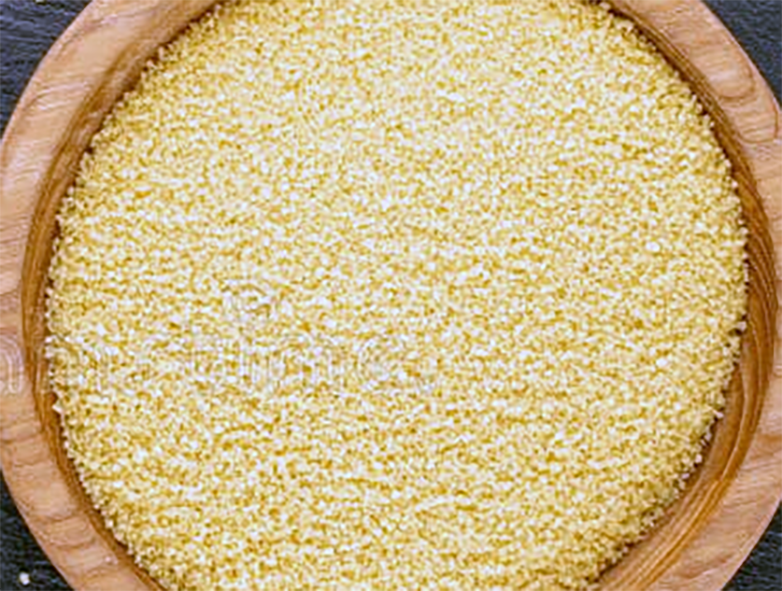
 Grains of couscous in a wooden bowl..
Welcome to the summary page for FabulousFusionFood's Cook's Guide entry for Couscous along with all the recipes employing Couscous presented on this site, with 73 recipes in total.
This is a continuation of an entire series of pages that will, I hope, allow my visitors to better navigate this site. As well as displaying recipes by name, country and region of origin I am now planning a whole series of pages where recipes can be located by meal type and main ingredient. This page gives a listing of all the Couscous recipes added to this site.
These recipes, all contain Couscous as a major wild food ingredient.
Couscous (Tamazight: ⵙⴽⵙⵓ seksu or ⴽⵙⴽⵙⵓ keskesu), is a traditional North African dish of small steamed granules of rolled semolina that is often served with a stew spooned on top. Pearl millet, teff, sorghum, bulgur, and other cereals are often cooked in much the same way in West Africa, and the resulting dishes are sometimes called couscous in English, French, and Hassaniya Arabic.
Couscous is a staple food throughout the Maghrebi cuisines of Algeria, Tunisia, Mauritania, Morocco, and Libya. It is also commonly served in Senegal and Mauritania. It was integrated into French and European cuisine at the beginning of the twentieth century, through the French colonial empire and the Pieds-Noirs of Algeria.
The word 'couscous' (alternately cuscus or kuskus) was first noted in early 17th century French, from Arabic kuskus, from kaskasa 'to pound', and is probably of Berber origin. The term seksu is attested in various Berber varieties such as Kabyle and Riffian, while Saharan Berber varieties such as Touareg and Ghadames have a slightly different form, keskesu. This widespread geographical dispersion of the term strongly suggests its local Berber origin, lending further support to its likely Berber roots The Berber root *KS means 'well formed, well rolled, rounded'. Numerous names and pronunciations for couscous exist around the world.
However, Arabic name kuskūs, first recorded in the 13th century in Al-Andalus, can be better explained from Latin adjective *coscosus. The Latin noun coscus had an ancient Mediterranean origin, and referred to small rounded or curved objects, and hence to small animals such as worms, ants, termites and woodworms. This word coscus and its variant cossus appear in Latin veterinary treatises and in glossaries, and might have been very common in North Africa, and perhaps also in southern Spain. Therefore, *coscosus meant ‘full of worms’, also in a metaphorical sense referring to this dish of granules or rolled semolina. In medieval Spanish, the word cozcucho, from Andalusi Arabic, is recorded in the 13th century, and alcuzcuzu, alcuzcuçu, cuzcuz and other variants referred since the first half of the 15th century to this dish considered typical of Moors and Moriscos. This same dish was also called formigos, hormigos and hormiguillos (‘resembling ants’) from the 15th century onwards in a metaphorical sense, since the original meaning of cuzcuz had not been lost.
It is unclear when couscous forst originated. Objects that may be couscoussiers have been found at Tichitt culture sites in southern Mauritania dated to 700-400 BCE, where millet was grown and perhaps made into couscous. Food historian Lucie Bolens believes couscous originated millennia ago, during the reign of Masinissa in the ancient kingdom of Numidia in present-day Algeria. Traces of cooking vessels akin to couscoussiers have been found in graves from the 3rd century BC, from the time of the Berber kings of Numidia, in Kabylia, Algeria. Cooking utensils that closely resemble couscoussiers dating back to the 9th century were found in Tiaret, Algeria. Couscoussiers dating back to the 12th century were found in the ruins of Igiliz, located in the Sous valley of Morocco.
In the 12th century, Maghrebi cooks were preparing dishes of non-mushy grains by stirring flour with water to create light, round balls of couscous dough that could be steamed.
The historian Maxime Rodinson found three recipes for couscous from the 13th century Arabic cookbook Kitab al-Wusla ila al-Habib, written by an Ayyubid author, and the anonymous Arabic cooking book Kitab al tabikh and Ibn Razin al-Tujibi's Fadalat al-khiwan also contain recipes. Ibn Battuta described a couscous made from fonio in the Niger river valley in the 14th century. Millet couscous was one of the main staple foods of Senegambia until at least the 19th century.
Couscous is believed to have been spread among the inhabitants of the Iberian Peninsula by the Berber dynasties of the 13th century, though it is no longer found in traditional Spanish or Portuguese cuisine. In modern-day Trapani, Sicily, the dish is still made to the medieval recipe of Andalusian author Ibn Razin al-Tujibi (see the recipe for couscous alla Trapanese for how to prepare). Ligurian families that moved from Tabarka to Sardinia brought the dish with them to Carloforte in the 18th century.
Couscous is traditionally made from semolina, the hardest part of the grain of durum wheat (the hardest of all forms of wheat), which resists the grinding of the millstone. The semolina is sprinkled with water and rolled with the hands to form small pellets, sprinkled with dry flour to keep them separate, and then sieved. Any pellets that are too small to be finished granules of couscous fall through the sieve and are again rolled and sprinkled with dry semolina and rolled into pellets. This labor-intensive process continues until all the semolina has been formed into tiny couscous granules. In the traditional method of preparing couscous, groups of people come together to make large batches over several days, which are then dried in the sun and used for several months. Handmade couscous may need to be rehydrated as it is prepared; this is achieved by a process of moistening and steaming over stew until the couscous reaches the desired light and fluffy consistency.
In some regions, couscous is made from farina or coarsely ground barley or pearl millet. In modern times, couscous production is largely mechanized, and the product is sold worldwide. This couscous can be sauteed before it is cooked in water or another liquid. Properly cooked couscous is light and fluffy, not gummy or gritty.
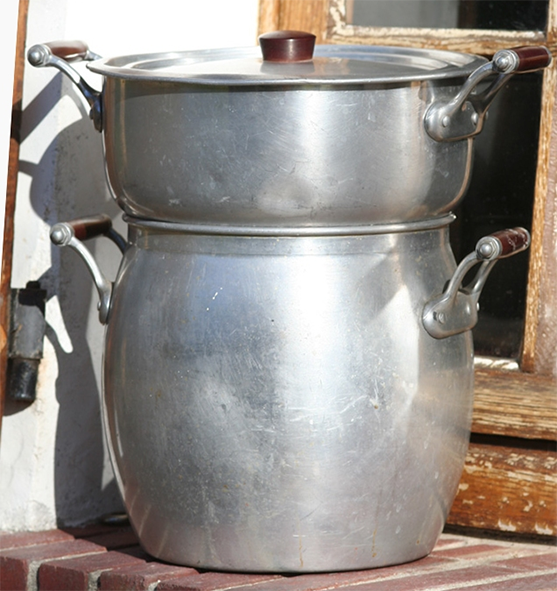
Traditionally, North Africans use a food steamer (called a taseksut in the Berber language, a كِسْكَاس kiskas in Arabic or a couscoussier in French). The base is a tall metal pot shaped like an oil jar, where the meat and vegetables are cooked as a stew. On top of the base, a steamer sits where the couscous is cooked, absorbing the flavours from the stew. The steamer's lid has holes around its edge so steam can escape. It is also possible to use a pot with a steamer insert. If the holes are too big, the steamer can be lined with damp cheesecloth.
The couscous that is sold in most Western grocery stores is usually pre-steamed and dried. It is typically prepared by adding 1.5 measures of boiling water or stock to each measure of couscous and then leaving it covered tightly for about five minutes. Pre-steamed couscous takes less time to prepare than regular couscous, most dried pasta, or dried grains (such as rice).
Couscous proper is about 2 mm in diameter, but there also exists a larger variety (3 mm more) known as berkoukes, as well as an ultra-fine version (around 1 mm). In Morocco, Algeria, Tunisia, and Libya, it is generally served with vegetables (carrots, potatoes, and turnips) cooked in a spicy or mild stock or stew, usually with some meat (generally, chicken, lamb, or mutton).
In the Sahel, couscous made from pearl millet or sorghum is a very popular, traditional staple food. It is frequently prepared with okra or baobab leaves mixed in to improve digestibility and texture. Couscous can also be mixed with yogurt to create Chakery, a dessert or snack.
Attiéké, a staple food in Côte d'Ivoire and surrounding regions of West Africa, is made from granulated grated cassava.
Dambou is a couscous-like dish from Niger. It may be made from semolina for special occasions but is often made with rice, millet, or other grain. Moringa leaves are traditionally included in the dish. In France, this Nigerien dish has been adapted as a specific variant (called couscous aux épinards) of the Maghreb-style couscous commonly found there, often using spinach in place of the moringa.
Fregula is a type of pasta from Sardinia. It is similar to North African Berkoukes and Middle Eastern Moghrabieh. Fregula comes in varying sizes but typically consists of semolina dough rolled into balls 2–3 mm in diameter and toasted in an oven.
Kouskousaki (Κουσκουσάκι (in Greek) or kuskus (in Turkish) is a pasta from Greece and Turkey, that is boiled and served with cheese and walnuts.
Maftoul, a Palestinian variety of couscous that is made with bulgur.
Wusu-Wusu is a couscous that is prepared out of fonio in the Hausa region of Nigeria, Benin, Togo and Ghana.
This is a continuation of an entire series of pages that will, I hope, allow my visitors to better navigate this site. As well as displaying recipes by name, country and region of origin I am now planning a whole series of pages where recipes can be located by meal type and main ingredient. This page gives a listing of all the Couscous recipes added to this site.
These recipes, all contain Couscous as a major wild food ingredient.
Couscous (Tamazight: ⵙⴽⵙⵓ seksu or ⴽⵙⴽⵙⵓ keskesu), is a traditional North African dish of small steamed granules of rolled semolina that is often served with a stew spooned on top. Pearl millet, teff, sorghum, bulgur, and other cereals are often cooked in much the same way in West Africa, and the resulting dishes are sometimes called couscous in English, French, and Hassaniya Arabic.
Couscous is a staple food throughout the Maghrebi cuisines of Algeria, Tunisia, Mauritania, Morocco, and Libya. It is also commonly served in Senegal and Mauritania. It was integrated into French and European cuisine at the beginning of the twentieth century, through the French colonial empire and the Pieds-Noirs of Algeria.
The word 'couscous' (alternately cuscus or kuskus) was first noted in early 17th century French, from Arabic kuskus, from kaskasa 'to pound', and is probably of Berber origin. The term seksu is attested in various Berber varieties such as Kabyle and Riffian, while Saharan Berber varieties such as Touareg and Ghadames have a slightly different form, keskesu. This widespread geographical dispersion of the term strongly suggests its local Berber origin, lending further support to its likely Berber roots The Berber root *KS means 'well formed, well rolled, rounded'. Numerous names and pronunciations for couscous exist around the world.
However, Arabic name kuskūs, first recorded in the 13th century in Al-Andalus, can be better explained from Latin adjective *coscosus. The Latin noun coscus had an ancient Mediterranean origin, and referred to small rounded or curved objects, and hence to small animals such as worms, ants, termites and woodworms. This word coscus and its variant cossus appear in Latin veterinary treatises and in glossaries, and might have been very common in North Africa, and perhaps also in southern Spain. Therefore, *coscosus meant ‘full of worms’, also in a metaphorical sense referring to this dish of granules or rolled semolina. In medieval Spanish, the word cozcucho, from Andalusi Arabic, is recorded in the 13th century, and alcuzcuzu, alcuzcuçu, cuzcuz and other variants referred since the first half of the 15th century to this dish considered typical of Moors and Moriscos. This same dish was also called formigos, hormigos and hormiguillos (‘resembling ants’) from the 15th century onwards in a metaphorical sense, since the original meaning of cuzcuz had not been lost.
It is unclear when couscous forst originated. Objects that may be couscoussiers have been found at Tichitt culture sites in southern Mauritania dated to 700-400 BCE, where millet was grown and perhaps made into couscous. Food historian Lucie Bolens believes couscous originated millennia ago, during the reign of Masinissa in the ancient kingdom of Numidia in present-day Algeria. Traces of cooking vessels akin to couscoussiers have been found in graves from the 3rd century BC, from the time of the Berber kings of Numidia, in Kabylia, Algeria. Cooking utensils that closely resemble couscoussiers dating back to the 9th century were found in Tiaret, Algeria. Couscoussiers dating back to the 12th century were found in the ruins of Igiliz, located in the Sous valley of Morocco.
In the 12th century, Maghrebi cooks were preparing dishes of non-mushy grains by stirring flour with water to create light, round balls of couscous dough that could be steamed.
The historian Maxime Rodinson found three recipes for couscous from the 13th century Arabic cookbook Kitab al-Wusla ila al-Habib, written by an Ayyubid author, and the anonymous Arabic cooking book Kitab al tabikh and Ibn Razin al-Tujibi's Fadalat al-khiwan also contain recipes. Ibn Battuta described a couscous made from fonio in the Niger river valley in the 14th century. Millet couscous was one of the main staple foods of Senegambia until at least the 19th century.
Couscous is believed to have been spread among the inhabitants of the Iberian Peninsula by the Berber dynasties of the 13th century, though it is no longer found in traditional Spanish or Portuguese cuisine. In modern-day Trapani, Sicily, the dish is still made to the medieval recipe of Andalusian author Ibn Razin al-Tujibi (see the recipe for couscous alla Trapanese for how to prepare). Ligurian families that moved from Tabarka to Sardinia brought the dish with them to Carloforte in the 18th century.
Couscous is traditionally made from semolina, the hardest part of the grain of durum wheat (the hardest of all forms of wheat), which resists the grinding of the millstone. The semolina is sprinkled with water and rolled with the hands to form small pellets, sprinkled with dry flour to keep them separate, and then sieved. Any pellets that are too small to be finished granules of couscous fall through the sieve and are again rolled and sprinkled with dry semolina and rolled into pellets. This labor-intensive process continues until all the semolina has been formed into tiny couscous granules. In the traditional method of preparing couscous, groups of people come together to make large batches over several days, which are then dried in the sun and used for several months. Handmade couscous may need to be rehydrated as it is prepared; this is achieved by a process of moistening and steaming over stew until the couscous reaches the desired light and fluffy consistency.
In some regions, couscous is made from farina or coarsely ground barley or pearl millet. In modern times, couscous production is largely mechanized, and the product is sold worldwide. This couscous can be sauteed before it is cooked in water or another liquid. Properly cooked couscous is light and fluffy, not gummy or gritty.
Traditionally, North Africans use a food steamer (called a taseksut in the Berber language, a كِسْكَاس kiskas in Arabic or a couscoussier in French). The base is a tall metal pot shaped like an oil jar, where the meat and vegetables are cooked as a stew. On top of the base, a steamer sits where the couscous is cooked, absorbing the flavours from the stew. The steamer's lid has holes around its edge so steam can escape. It is also possible to use a pot with a steamer insert. If the holes are too big, the steamer can be lined with damp cheesecloth.
The couscous that is sold in most Western grocery stores is usually pre-steamed and dried. It is typically prepared by adding 1.5 measures of boiling water or stock to each measure of couscous and then leaving it covered tightly for about five minutes. Pre-steamed couscous takes less time to prepare than regular couscous, most dried pasta, or dried grains (such as rice).
Couscous proper is about 2 mm in diameter, but there also exists a larger variety (3 mm more) known as berkoukes, as well as an ultra-fine version (around 1 mm). In Morocco, Algeria, Tunisia, and Libya, it is generally served with vegetables (carrots, potatoes, and turnips) cooked in a spicy or mild stock or stew, usually with some meat (generally, chicken, lamb, or mutton).
In the Sahel, couscous made from pearl millet or sorghum is a very popular, traditional staple food. It is frequently prepared with okra or baobab leaves mixed in to improve digestibility and texture. Couscous can also be mixed with yogurt to create Chakery, a dessert or snack.
Similar Foods
Attiéké, a staple food in Côte d'Ivoire and surrounding regions of West Africa, is made from granulated grated cassava.
Dambou is a couscous-like dish from Niger. It may be made from semolina for special occasions but is often made with rice, millet, or other grain. Moringa leaves are traditionally included in the dish. In France, this Nigerien dish has been adapted as a specific variant (called couscous aux épinards) of the Maghreb-style couscous commonly found there, often using spinach in place of the moringa.
Fregula is a type of pasta from Sardinia. It is similar to North African Berkoukes and Middle Eastern Moghrabieh. Fregula comes in varying sizes but typically consists of semolina dough rolled into balls 2–3 mm in diameter and toasted in an oven.
Kouskousaki (Κουσκουσάκι (in Greek) or kuskus (in Turkish) is a pasta from Greece and Turkey, that is boiled and served with cheese and walnuts.
Maftoul, a Palestinian variety of couscous that is made with bulgur.
Wusu-Wusu is a couscous that is prepared out of fonio in the Hausa region of Nigeria, Benin, Togo and Ghana.
The alphabetical list of all Couscous recipes on this site follows, (limited to 100 recipes per page). There are 73 recipes in total:
Page 1 of 1
| Air Fryer Couscous Two Ways Origin: Britain | Couscous et Sauce Tomate (Couscous with Tomato Sauce) Origin: Burkina Faso | MBoume au Néverdaye (Senegalese Fish, Peanut and Cassava Stew with Millet Couscous) Origin: Senegal |
| Al-Aïch (Chicken, Beans and Couscous) Origin: Mauritania | Couscous with Camel Origin: Mauritania | Moroccan Almond Stuffing Origin: Morocco |
| Algerian Saffron and Raisin Couscous Origin: Algeria | Couscous with Dried Fruit, Nuts and Cinnamon Origin: Morocco | Moroccan Beef with Honey-spiced Couscous Origin: Fusion |
| Attiéké Origin: Cote dIvoire | Couscous with Mushroom Ragout Origin: Britain | Moroccan Lamb Couscous Origin: Morocco |
| Attiéké de Poisson (Attieke with Fried Fish) Origin: Cote dIvoire | Cozido à Madeirense Origin: Portugal | Moroccan Spiced Lamb Shanks Origin: Morocco |
| Attiéké du Mali (Malian Attiéké) Origin: Mali | Cuscuz de Moçambique (Mozambican Couscous) Origin: Mozambique | Moroccan-style Fish and Couscous Parcels Origin: Fusion |
| Attiéké et Aloko Poisson (Attieke and Fish Aloko) Origin: Niger | Dégué (Couscous and Yoghurt Dessert) Origin: Mali | Nutty Moroccan Couscous Origin: Morocco |
| Attiéké Origin: Cote dIvoire | Dal'aa M'amra B'kaskou Watmar (Shoulder of Lamb with Couscous and Date Stuffing) Origin: Morocco | Piment d'Attiéké (Pepper Sauce for Attiéké) Origin: Cote dIvoire |
| Attiéké et Aloko Poisson (Attiéké and Plantain with Fish) Origin: Cote dIvoire | Dambou (Rice Couscous with Moringa) Origin: Niger | Ptitim (Israeli Couscous) Origin: Israel |
| Aurangabadi Naan Qaliya Origin: India | Déguè II Origin: Senegal | Salat Tangiers Origin: Morocco |
| Barbecued Kibbeh Origin: African Fusion | Djouka de Fonio (Fonio Couscous with Vegetables) Origin: Mali | Salmon and Couscous en Papillote Origin: Britain |
| Basic Microwave Couscous Origin: Britain | Duck with Marmalade Origin: Scotland | Sierra Leonean Style Couscous Origin: Sierra Leone |
| Bassi (Malian Couscous) Origin: Mali | Fögnè Sourtinaadi (Fonio Couscous with Meatballs in Tomato Sauce) Origin: Guinea | Spicy Prawns and Green Lentils Origin: Fusion |
| Beef Koftas with Fruity Couscous Origin: Morocco | Farka (Couscous Breakfast) Origin: Tunisia | Sweet Koskosi Dessert (Egyptian Sweet Couscous Dessert) Origin: Egypt |
| Breakfast Koskosi Origin: Egypt | Fillet of Salmon with Green Couscous Origin: Fusion | Thiéré Bassi (Millet Couscous Stew) Origin: Senegal |
| Buttery Herbed Couscous Origin: Fusion | Foubey (Millet Couscous with Moringa) Origin: Niger | Thiacri Senegalaise Origin: Senegal |
| Caakiri Origin: West Africa | Garba (Cassava Fried Tuna) Origin: Cote dIvoire | Thiacry Origin: Senegal |
| Chakri Origin: Gambia | Honey Orange Koskosi Origin: Egypt | Thiéré ak Mboum (Couscous with Moringa Sauce) Origin: Senegal |
| Chakri (Gambian Dessert Couscous) Origin: Gambia | Honey-spice Couscous Origin: Fusion | Thiéré ak sow Origin: Senegal |
| Chia Seed Couscous Origin: Fusion | Kosksu bil-Ful (Couscous with Broad Beans) Origin: Malta | Thiéré Bassi Salté (Couscous with Meat and Tomato Sauce) Origin: Senegal |
| Couscous à la Nigérienne (Niger-style Couscous) Origin: Niger | Latchiri Kössan (Maize Couscous with Curdled Milk) Origin: Guinea | Tunisian Chicken and Pumpkin Couscous Origin: Libya |
| Couscous alla Trapanese Origin: Italy | Lemon Couscous Cake Origin: African Fusion | Tunisian Vegetable Couscous Origin: Tunisia |
| Couscous d'Orge à la Sauce Blanche (Barley Couscous with White Sauce) Origin: Algeria | Libyan Lamb Couscous Origin: Libya | West African Couscous Origin: West Africa |
| Couscous de Fonio au Poulet (Fonio Couscous with Chicken) Origin: Togo | Masfouf bin Narine (Couscous and Nut Dessert) Origin: Tunisia | |
| Couscous de Timbuktu Origin: Mali |
Page 1 of 1