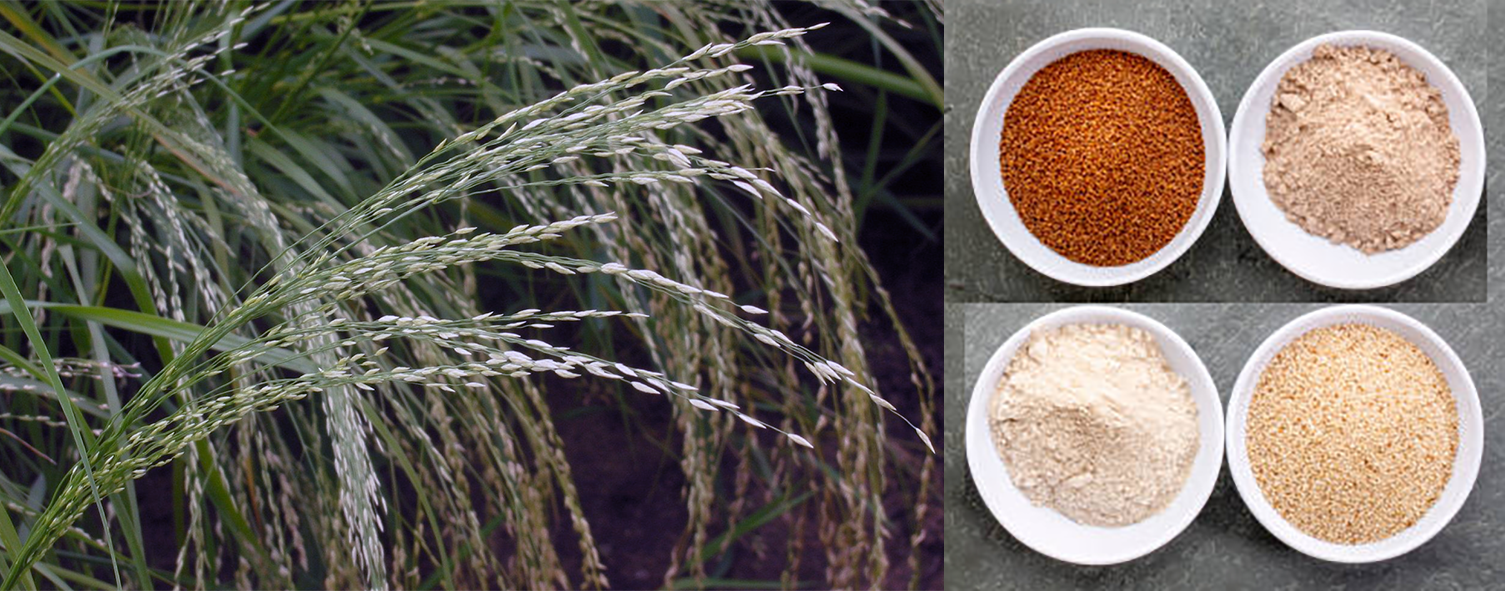
 Teff grass bearing grains (left), flur colours of harvested teff
grains (right).
Welcome to the summary page for FabulousFusionFood's Cook's Guide entry for Teff along with all the recipes employing Teff presented on this site, with 1 recipes in total.
This is a continuation of an entire series of pages that will, I hope, allow my visitors to better navigate this site. As well as displaying recipes by name, country and region of origin I am now planning a whole series of pages where recipes can be located by meal type and main ingredient. This page gives a listing of all the Teff recipes added to this site.
These recipes, all contain Teff as a major wild food ingredient.
Eragrostis teff (known as teff or Willians lovegrass) is an annual species of lovegrass native to Eritrea and Ethiopia, where it originated in the highlands of both countries. It has been cultivated for its edible seeds, also called teff, since at least 1000 BCE and possibly as long ago as 4000 BCE. It is one of Ethiopia and Eritrea’s most important staple crops. As a modern crop, it is low-yielding and susceptible to lodging; the tef shoot fly is a major pest.
Eragrostis tef is a self pollinated tetraploid annual cereal grass. Teff is a C4 plant, which allows it to more efficiently fix carbon in drought and high temperatures, and is an intermediate between a tropical and temperate grass. The name teff is thought to originate from the Amharic word ጠፋ teffa, which means '(it is) lost'. This probably refers to its tiny seeds, which have a diameter smaller than 1mm. Teff is a fine-stemmed, tufted grass with large crowns and many tillers. Its roots are shallow, but develop a massive fibrous rooting system. The plant height varies depending on the cultivation variety and the environmental conditions.
As with many ancient crops, teff is quite adaptable; in particular, it can be cultivated both in dry environments and in wet conditions on marginal soils. Teff is one of the most important cereals in Ethiopia and Eritrea. It is grown for its edible seeds and also for its straw to feed cattle. The seeds are very small, about a millimetre in length, and a thousand grains weigh approximately 0.3g. They can have a colour from a white to a deep reddish brown.[5] Teff is similar to millet and quinoa in cooking, but the seed is much smaller and cooks faster, using less fuel.
Teff is believed to have originated in Ethiopia between 4000 BCE and 1000 BCE. Genetic evidence points to E. pilosa as the most likely wild ancestor. A 19th-century identification of teff seeds from an ancient Egyptian site is now considered doubtful; the seeds in question (no longer available for study) are more likely of E. aegyptiaca, a common wild grass in Egypt.
Teff is harvested 2–6 months after sowing, when the vegetative parts start to turn yellow. If teff is harvested past its maturation, seeds will fall off, especially in windy or rainy weather conditions. In Ethiopia, harvest lasts from November to January; harvest is usually done manually, with sickles. Farmers cut the plants at the soil surface, pile them up in the field and transport them to the threshing area. Teff is traditionally threshed by using animals walking on the harvest. Alternatively, some farmers rent threshing machines used for other cereals. The seeds are easy to store, as they are resistant to most pests during storage. Teff seeds can stay viable several years if direct contact with humidity and sun is avoided.
Teff is a multipurpose crop which has a high importance for the Ethiopian diet and culture. In Ethiopia, teff provides two-thirds of the daily protein intake. It is not only important for human nutrition, but also as fodder for livestock, or as building material. Teff is the main ingredient to prepare injera, a sourdough-risen flatbread. During meals, it is often eaten with meat or ground pulses. Sometimes it is also eaten as porridge. Moreover, teff can be used to prepare alcoholic drinks, called arak'e or katikalla or beer, called t'ella or fersso. Finally, due to its high mineral content, teff is also mixed with soybeans, chickpeas or other grains to manufacture baby foods.
Farmers in Ethiopia believe that consumers prefer white teff over darker varieties. As a nutritious fodder, teff is used to feed ruminants in Ethiopia and horses in the US. It is a source of animal feed, especially during the dry season, and it is often preferred over straw from other cereals. Teff grass can be used as a construction material when mixed with mud to plaster the walls of local grain storage facilities.
This is a continuation of an entire series of pages that will, I hope, allow my visitors to better navigate this site. As well as displaying recipes by name, country and region of origin I am now planning a whole series of pages where recipes can be located by meal type and main ingredient. This page gives a listing of all the Teff recipes added to this site.
These recipes, all contain Teff as a major wild food ingredient.
Eragrostis teff (known as teff or Willians lovegrass) is an annual species of lovegrass native to Eritrea and Ethiopia, where it originated in the highlands of both countries. It has been cultivated for its edible seeds, also called teff, since at least 1000 BCE and possibly as long ago as 4000 BCE. It is one of Ethiopia and Eritrea’s most important staple crops. As a modern crop, it is low-yielding and susceptible to lodging; the tef shoot fly is a major pest.
Eragrostis tef is a self pollinated tetraploid annual cereal grass. Teff is a C4 plant, which allows it to more efficiently fix carbon in drought and high temperatures, and is an intermediate between a tropical and temperate grass. The name teff is thought to originate from the Amharic word ጠፋ teffa, which means '(it is) lost'. This probably refers to its tiny seeds, which have a diameter smaller than 1mm. Teff is a fine-stemmed, tufted grass with large crowns and many tillers. Its roots are shallow, but develop a massive fibrous rooting system. The plant height varies depending on the cultivation variety and the environmental conditions.
As with many ancient crops, teff is quite adaptable; in particular, it can be cultivated both in dry environments and in wet conditions on marginal soils. Teff is one of the most important cereals in Ethiopia and Eritrea. It is grown for its edible seeds and also for its straw to feed cattle. The seeds are very small, about a millimetre in length, and a thousand grains weigh approximately 0.3g. They can have a colour from a white to a deep reddish brown.[5] Teff is similar to millet and quinoa in cooking, but the seed is much smaller and cooks faster, using less fuel.
Teff is believed to have originated in Ethiopia between 4000 BCE and 1000 BCE. Genetic evidence points to E. pilosa as the most likely wild ancestor. A 19th-century identification of teff seeds from an ancient Egyptian site is now considered doubtful; the seeds in question (no longer available for study) are more likely of E. aegyptiaca, a common wild grass in Egypt.
Teff is harvested 2–6 months after sowing, when the vegetative parts start to turn yellow. If teff is harvested past its maturation, seeds will fall off, especially in windy or rainy weather conditions. In Ethiopia, harvest lasts from November to January; harvest is usually done manually, with sickles. Farmers cut the plants at the soil surface, pile them up in the field and transport them to the threshing area. Teff is traditionally threshed by using animals walking on the harvest. Alternatively, some farmers rent threshing machines used for other cereals. The seeds are easy to store, as they are resistant to most pests during storage. Teff seeds can stay viable several years if direct contact with humidity and sun is avoided.
Teff is a multipurpose crop which has a high importance for the Ethiopian diet and culture. In Ethiopia, teff provides two-thirds of the daily protein intake. It is not only important for human nutrition, but also as fodder for livestock, or as building material. Teff is the main ingredient to prepare injera, a sourdough-risen flatbread. During meals, it is often eaten with meat or ground pulses. Sometimes it is also eaten as porridge. Moreover, teff can be used to prepare alcoholic drinks, called arak'e or katikalla or beer, called t'ella or fersso. Finally, due to its high mineral content, teff is also mixed with soybeans, chickpeas or other grains to manufacture baby foods.
Farmers in Ethiopia believe that consumers prefer white teff over darker varieties. As a nutritious fodder, teff is used to feed ruminants in Ethiopia and horses in the US. It is a source of animal feed, especially during the dry season, and it is often preferred over straw from other cereals. Teff grass can be used as a construction material when mixed with mud to plaster the walls of local grain storage facilities.
The alphabetical list of all Teff recipes on this site follows, (limited to 100 recipes per page). There are 1 recipes in total:
Page 1 of 1
| Teff Injeera Origin: Ethiopia |
Page 1 of 1