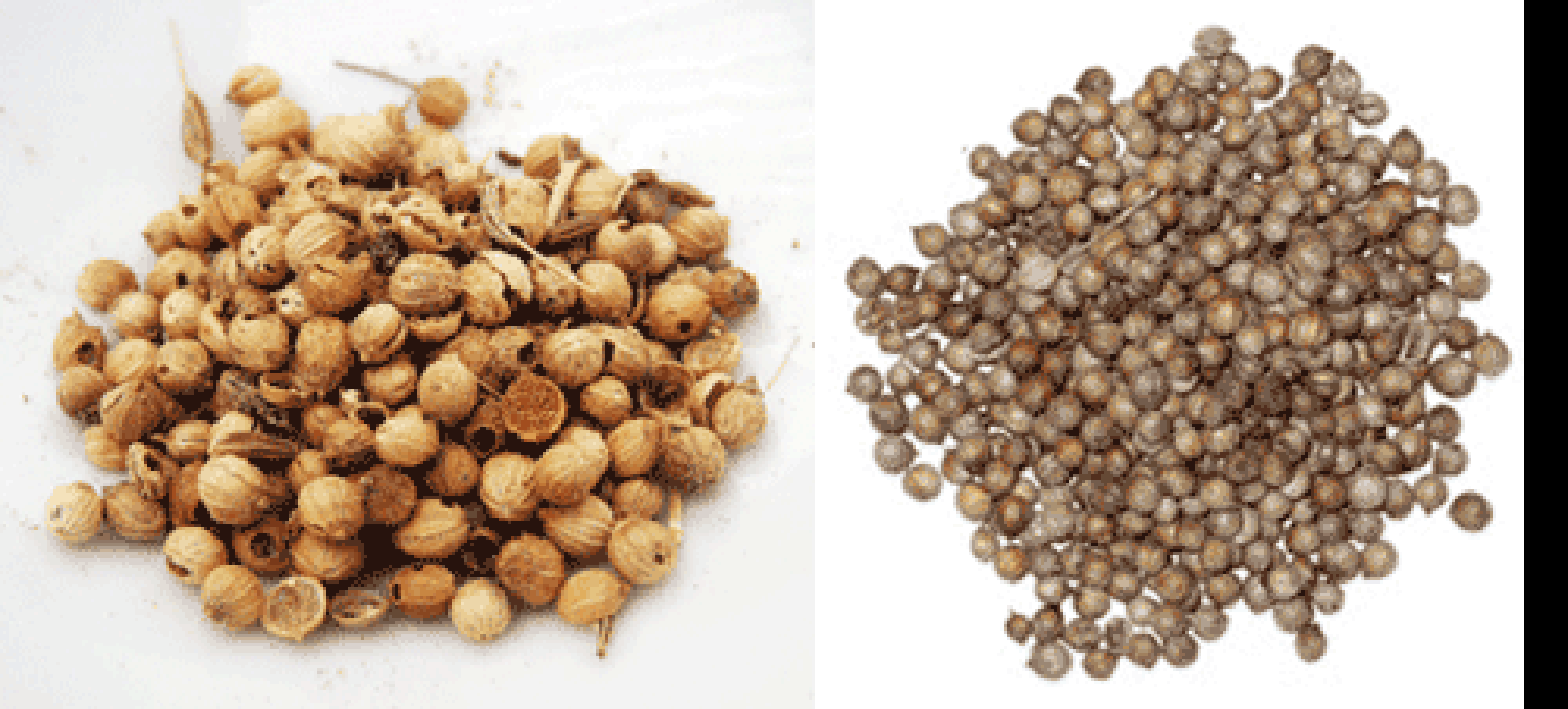
 Coriander seeds showing light (left) and dark (right) forms.
Welcome to the summary page for FabulousFusionFood's Cook's Guide entry for Coriander along with all the recipes employing Coriander presented on this site, with 1944 recipes in total.
This is a continuation of an entire series of pages that will, I hope, allow my visitors to better navigate this site. As well as displaying recipes by name, country and region of origin I am now planning a whole series of pages where recipes can be located by meal type and main ingredient. This page gives a listing of all the Coriander recipes added to this site.
These recipes, all contain Coriander as a major wild food ingredient.
Coriander (called Cilantro in North America) is the plant Coriandrum sativum which is an annual herb of the family Apiaceae (also known as Umbelliferae). As such it is a member of a huge family that contains carrots, cumin, caraway and fennel. Coriander is native to southwestern Asia west to north Africa. It is a soft, hairless, foetid plant growing to 50 cm tall. The leaves are variable in shape, broadly lobed at the base of the plant, and slender and feathery higher on the flowering stems. The flowers are borne in small umbrella-like umbels that mature into globular dry fruits some 3–5mm in diameter. The name coriander ultimately derives from the Greek corys (beadbug) and the terminal -ander (resembling) and refers to the supposed similarity of the scent of the crushed leaves to the odour of beadbugs.
Unlike most of the other umbelliferae coriander is unusual in that all part of the plant is edible (dried fruit, leaves and stalks and even the roots). The plant can be grown throughout much of the world and will even grow from seed in Britain if given a sunny spot and sufficient water. The spice component of this plant correspond to the dried fruit that are commonly referred to as coriander seeds (or simply just coriander). They have a lemony citrus flavour when crushed, due to the presence of the terpenes linalool and pinene. It is also described as warm, nutty, spicy, and orange-flavoured. It is most common to encounter the fruit in the dried state, though they can also be eaten green. Ground coriander seeds are a major component of most curry powders and is used as a flavouring ingredient in certain Belgian-style beers.
Coriander seed will keep for up to a year and should be toasted lightly before use (as this enhances the flavour). It should then be ground in a coffee grinder or with a pestle and mortar before use. Outside of Asia, coriander seed is an important spice for sausages in Germany and South Africa. In Russia and Central Europe coriander seed is an occasional ingredient in rye bread as an alternative to caraway. Coriander is thought to have been introduced into Britain by the Romans as a preservative for meat and it was used extensively in Medieval cookery due to it's ability to mask the flavour of tainted meat. Interestingly, coriander was one of the first spices brought to the North American colonies in the 1670s and was probably one of the first spices cultivated by the early settlers.
This is a continuation of an entire series of pages that will, I hope, allow my visitors to better navigate this site. As well as displaying recipes by name, country and region of origin I am now planning a whole series of pages where recipes can be located by meal type and main ingredient. This page gives a listing of all the Coriander recipes added to this site.
These recipes, all contain Coriander as a major wild food ingredient.
Coriander (called Cilantro in North America) is the plant Coriandrum sativum which is an annual herb of the family Apiaceae (also known as Umbelliferae). As such it is a member of a huge family that contains carrots, cumin, caraway and fennel. Coriander is native to southwestern Asia west to north Africa. It is a soft, hairless, foetid plant growing to 50 cm tall. The leaves are variable in shape, broadly lobed at the base of the plant, and slender and feathery higher on the flowering stems. The flowers are borne in small umbrella-like umbels that mature into globular dry fruits some 3–5mm in diameter. The name coriander ultimately derives from the Greek corys (beadbug) and the terminal -ander (resembling) and refers to the supposed similarity of the scent of the crushed leaves to the odour of beadbugs.
Unlike most of the other umbelliferae coriander is unusual in that all part of the plant is edible (dried fruit, leaves and stalks and even the roots). The plant can be grown throughout much of the world and will even grow from seed in Britain if given a sunny spot and sufficient water. The spice component of this plant correspond to the dried fruit that are commonly referred to as coriander seeds (or simply just coriander). They have a lemony citrus flavour when crushed, due to the presence of the terpenes linalool and pinene. It is also described as warm, nutty, spicy, and orange-flavoured. It is most common to encounter the fruit in the dried state, though they can also be eaten green. Ground coriander seeds are a major component of most curry powders and is used as a flavouring ingredient in certain Belgian-style beers.
Coriander seed will keep for up to a year and should be toasted lightly before use (as this enhances the flavour). It should then be ground in a coffee grinder or with a pestle and mortar before use. Outside of Asia, coriander seed is an important spice for sausages in Germany and South Africa. In Russia and Central Europe coriander seed is an occasional ingredient in rye bread as an alternative to caraway. Coriander is thought to have been introduced into Britain by the Romans as a preservative for meat and it was used extensively in Medieval cookery due to it's ability to mask the flavour of tainted meat. Interestingly, coriander was one of the first spices brought to the North American colonies in the 1670s and was probably one of the first spices cultivated by the early settlers.
The alphabetical list of all Coriander recipes on this site follows, (limited to 100 recipes per page). There are 1944 recipes in total:
Page 1 of 20
| Aaloo Gosht (Mutton Curry with Potatoes) Origin: Pakistan | Ajlouke et Potiron (Pumpkin Dip) Origin: Tunisia | Aliter patina de aparagis (A Dish of Asparagus, Another Way) Origin: Roman |
| Aam Ka Meetha Achaar (Sweet Mango Chutney) Origin: India | Ak-Ni Korma Origin: India | Aliter Patina de Asparagis II (A Dish of Asparagus, Another Way II) Origin: Roman |
| Abobora de Camarao (Prawn Abobora) Origin: Angola | Akutekarsh (Chicken with Nut Sauce) Origin: Abkhazia | Aliter Sala cattabia (Another Cattanian Salad) Origin: Roman |
| Accras Origin: Trinidad | Al Machboos (Emirati Spiced Rice With Chicken) Origin: UAE | Aliter Sepias (Cuttlefish, Another Way) Origin: Roman |
| Achaari Jhinga (Indian Pickled Prawns) Origin: India | Al Mechoui (Spit-roasted Baby Lamb) Origin: Mauritania | Aliter Sphondylos (Parsnips, Another Way) Origin: Roman |
| Achapa (Walnut Lobio) Origin: Abkhazia | Al Mechoui (Spit-roasted Baby Lamb) Origin: Western Sahara | Aliter Sphondylos III (Parsnips, Another Way III) Origin: Roman |
| Achari Murgh (Achari Chicken) Origin: Britain | Al-Aïch (Chicken, Beans and Couscous) Origin: Mauritania | Aliter tisanam (Barley Soup, Another Way) Origin: Roman |
| Achari Roast Chicken Origin: Pakistan | Aliater ius in mullos assos (Red Mullet in Fennel and Mint Sauce) Origin: Roman | Aliter Tubera II (Truffles, Another Way II) Origin: Roman |
| Adana Kebab Origin: Turkey | Alicam vel sucum tisanae (Spelt or Barley Gruel) Origin: Roman | Aliter Tubera IV (Truffles, Another Way IV) Origin: Roman |
| Adjarian Khachapuri (Georgian Cheese Pies) Origin: Georgia | Aliter carduos (Artichokes with Herbs) Origin: Roman | Almôndegas com Molho de Caril (Portuguese Meatball Curry) Origin: Portugal |
| Adjika (Abkhazian Paprika Sauce) Origin: Abkhazia | Aliter Coliclos I (Sprouts, Another Way, I) Origin: Roman | Aloo Anardana Origin: India |
| Adjika II (Paprika Sauce) Origin: Abkhazia | Aliter Coliclos II (Stalks, Another Way, II) Origin: Roman | Aloo Chaat (Savoury Potato Snack) Origin: India |
| Advieh (Iranian Spice Mix) Origin: Iran | Aliter Coliclos III (Stalks, Another Way, III) Origin: Roman | Aloo Dhaniya (Balti Potatoes and Coriander) Origin: India |
| Advieh Ash (Persian Soup Spice Blend) Origin: Iran | Aliter Coliclos IV (Stalks, Another Way, IV) Origin: Roman | Aloo Gobi Origin: Britain |
| Advieh Khoresh (Persian Stew Blend) Origin: Iran | Aliter Coliclos V (Stalks, Another Way, V) Origin: Roman | Aloo Kari (Curried Potatoes) Origin: India |
| Advieh Mahi (Persian Fish Spice Blend) Origin: Iran | Aliter Conchiclam Sic Facies (Legumes, Another Way, Are Made Thus) Origin: Roman | Aloo ki Bhujia (Pakistani Potato Curry) Origin: Pakistan |
| Advieh Torshi (Persian Pickle Spice Blend) Origin: Iran | Aliter Fungi Farnei (Tree Mushrooms, Another Way) Origin: Roman | Aloo Masala (Potato Masala) Origin: India |
| Advieh-spiced Roast Chicken Origin: Fusion | Aliter haedinam sive agninam excaldatam (Lamb Stew) Origin: Roman | Aloo Muttar Origin: Britain |
| Afelia (Pork Marinated in Wine) Origin: Cyprus | Aliter Haedinam sive Agninam Excaldatam (Stew of Kid or Lamb) Origin: Roman | Aloo Paratha (Flatbread with a Spicy Potato Stuffing) Origin: India |
| Afghan Kofta Curry Origin: Afghanistan | Aliter Haedinam sive Agninam Excaldatam (Stew of Kid or Lamb, Another Way) Origin: Roman | Aloo Paratha (Potato-stuffed Paratha) Origin: India |
| Afghan Roast Chicken Spice Blend Origin: Afghanistan | Aliter in Apro II (Wild Boar, Another Way II) Origin: Roman | Aloo Sabzi Kari (Potato Curry) Origin: India |
| Afghan-spiced Roast Chicken Origin: Afghanistan | Aliter in Grue vel Qnate Elixa (Sauce for Boiled Crane or Duck, Another Way II) Origin: Roman | Alter Haedinam Sive Agninam Excaldatam (Steamed Lamb) Origin: Roman |
| Afghani Chicken Curry Origin: Pakistan | Aliter in Gruem vel Anatem Elixam (Sauce for Boiled Crane or Duck, Another Way) Origin: Roman | Alu Achari Origin: India |
| African Fish Curry Powder Origin: West Africa | Aliter Ius Alexandrinum in Pisce Asso (Another Alexandrine Sauce for Baked Fish) Origin: Roman | Alu ko Achhar (Potatoes with Split Peas) Origin: Nepal |
| Agnum Simplicem (Plain Lamb) Origin: Roman | Aliter Ius Alexandrinum in Pisce Asso II (Another Alexandrine Sauce for Baked Fish II) Origin: Roman | Alu Tarkari (Potato Curry) Origin: Nepal |
| Aguají (Plantain Soup) Origin: Dominican Republic | Aliter Ius in Mullos Assos (Another Sauce for Baked Red Mullet) Origin: Roman | Ambasha Origin: Ethiopia |
| Aioan Chua Noeung Phset Kretni (Stir-fried Chicken with Mushrooms) Origin: Cambodia | Aliter Ius in Murena Assa II (Sauce for Grilled Moray Eel, Another Way II) Origin: Roman | Ambotic Origin: Mozambique |
| Air Fryer Aloo Bread Pakora Origin: Britain | Aliter Ius in Murena Elixa II (Another, Sauce for Poached Moray Eel II) Origin: Roman | Amchar Masala Origin: Trinidad |
| Air Fryer Lamb Koftas Origin: Britain | Aliter Ius in Pisce Elixo (Another Sauce for Poached Fish) Origin: Roman | Amchar Masala Origin: Trinidad |
| Air Fryer Sausage Rolls Origin: Britain | Aliter ius in pisce elixo (Sauce for Poached Fish, Another Way) Origin: Roman | Anadl y Ddraig (Dragon's Breath) Origin: Welsh |
| Air-fryer Fajitas Origin: Britain | Aliter Ius in Pisce Elixo II (Another Sauce for Poached Fish II) Origin: Roman | Anardana Gosht (Lamb Curry with Pomegranate) Origin: India |
| Ají Criollo (Ecuadorian Hot Sauce) Origin: Ecuador | Aliter Lenticulam (Lentils, Another Way) Origin: Roman | Anardana Jheenga (Pomegranate-flavoured Prawns) Origin: India |
| Ají de Tamarillo (Ecuadorian Tree Tomato Hot Sauce) Origin: Ecuador | Aliter Leporem ex Suo Iure (Another, Hare in its Own Gravy) Origin: Roman | |
| Aji Verde (Spicy Peruvian Green Sauce) Origin: Peru | Aliter Mullos (Red Mullets, Another Way) Origin: Roman |
Page 1 of 20