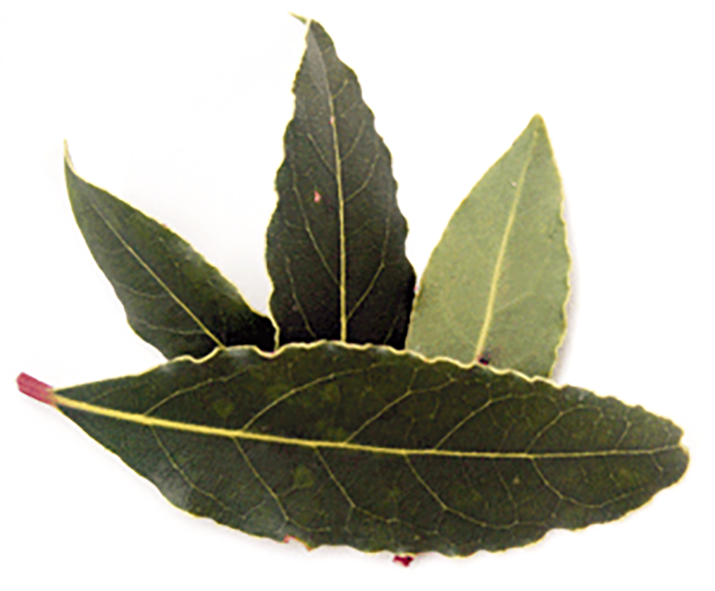
 Fresh bay leaves
from Laurus
nobilis.
Fresh bay leaves
from Laurus
nobilis.
Welcome to the summary page for FabulousFusionFood's Herb guide to Bayleaves along with all the Bayleaves containing recipes presented on this site, with 941 recipes in total.
This is a continuation of an entire series of pages that will, I hope, allow my visitors to better navigate this site. As well as displaying recipes by name, country and region of origin I am now planning a whole series of pages where recipes can be located by meal type and main ingredient. This page gives information about Bayleaves and a listing of all the Bayleaves-based recipes added to this site.
These recipes, all contain Bayleaves as a major herb flavouring.
As their name suggests, Bayleaves (or bay leaves) are the leaves of Bay or Laurel tree (Laurus nobilis) a member of the Lauraceae or laurel family of trees. Originally native to Asia Minor, it is now widespread around the Mediterranean and can be grown in relatively frost-free regions of more northerly climes (but it does not tolerate prolonged frost very well).
The whole leaf is used in many European cuisines (most notably Mediterranean cooking) where they are commonly used to flavour soups, stews, meat, seafood, and vegetable dishes as well as for the creation of stocks such as the classic French bouillabaisse and bouillon. Generally the dried leaves are added whole to a dish and are removed before serving.
The essential oil of the leaves is predominantly composed of 1,8 cineol (50%), with eugenol, acetyl eugenol, methyl eugenol, α- and β-pinene, phellandrene, linalool, geraniol and terpineol found in lesser quantities. It should be noted that the taste of fresh bay leaves is fairly mild and they only really develop their full pungency some ten days or more after being picked and dried. The distinctive, rather bitter, taste of bay leaves is, to a large extent, due to the high levels of the essential oil, eugenol, found in the leaves. Just about any meat-based sauce such as spaghetti sauce or chili or any meat stew can be enhanced by adding a few dried bay leaves whilst cooking.
The English name, 'laurel' is derived from the Latin laurus which may, itself be derived from the proto-Indo-European root *Deru (oak tree cf Ancient Greek drys [δρῦς] and Welsh derw both meaning oak [the Latin 'l' frequently corresponds to 'd' in Indo-European root words]). Originally the oak was the tree of Zeus, though later this became the laurel tree, hence the association between them. The other English name 'bay leaf' (Middle English baye, Old French baie) is ultimately derived from the Latin bacca (literally 'berry') and originally referred to the fruit of the bay tree, which the Romans commonly used as a spice.
The recipes given below contain bayleaves as an important or dominant component. However, you can also access all the recipes on this site that contain bayleaves as an ingredient.
This is a continuation of an entire series of pages that will, I hope, allow my visitors to better navigate this site. As well as displaying recipes by name, country and region of origin I am now planning a whole series of pages where recipes can be located by meal type and main ingredient. This page gives information about Bayleaves and a listing of all the Bayleaves-based recipes added to this site.
These recipes, all contain Bayleaves as a major herb flavouring.
As their name suggests, Bayleaves (or bay leaves) are the leaves of Bay or Laurel tree (Laurus nobilis) a member of the Lauraceae or laurel family of trees. Originally native to Asia Minor, it is now widespread around the Mediterranean and can be grown in relatively frost-free regions of more northerly climes (but it does not tolerate prolonged frost very well).
The whole leaf is used in many European cuisines (most notably Mediterranean cooking) where they are commonly used to flavour soups, stews, meat, seafood, and vegetable dishes as well as for the creation of stocks such as the classic French bouillabaisse and bouillon. Generally the dried leaves are added whole to a dish and are removed before serving.
The essential oil of the leaves is predominantly composed of 1,8 cineol (50%), with eugenol, acetyl eugenol, methyl eugenol, α- and β-pinene, phellandrene, linalool, geraniol and terpineol found in lesser quantities. It should be noted that the taste of fresh bay leaves is fairly mild and they only really develop their full pungency some ten days or more after being picked and dried. The distinctive, rather bitter, taste of bay leaves is, to a large extent, due to the high levels of the essential oil, eugenol, found in the leaves. Just about any meat-based sauce such as spaghetti sauce or chili or any meat stew can be enhanced by adding a few dried bay leaves whilst cooking.
The English name, 'laurel' is derived from the Latin laurus which may, itself be derived from the proto-Indo-European root *Deru (oak tree cf Ancient Greek drys [δρῦς] and Welsh derw both meaning oak [the Latin 'l' frequently corresponds to 'd' in Indo-European root words]). Originally the oak was the tree of Zeus, though later this became the laurel tree, hence the association between them. The other English name 'bay leaf' (Middle English baye, Old French baie) is ultimately derived from the Latin bacca (literally 'berry') and originally referred to the fruit of the bay tree, which the Romans commonly used as a spice.
The recipes given below contain bayleaves as an important or dominant component. However, you can also access all the recipes on this site that contain bayleaves as an ingredient.
The alphabetical list of all Bayleaves recipes on this site follows, (limited to 100 recipes per page). There are 941 recipes in total:
Page 1 of 10
| Accent Herbs Origin: Caribbean | Bacalhau com Batatas (Salt Cod with Potatoes) Origin: Portugal | Bengali Fish and Potato Curry Origin: Bangladesh |
| Adobong Pato a la Moja (Duck Adobo with Pineapple and Dates) Origin: Philippines | Bachalu à Gomes (Salt Cod with Potatoes) Origin: Angola | Bengali Mustard Tlapia Origin: Bangladesh |
| Afghan Kofta Curry Origin: Afghanistan | Bacwn Berw a Saws Persli (Boiled Bacon and Parsley Sauce) Origin: Welsh | Bengali Turkey Curry Origin: Britain |
| African Chicken (Macanese One-pan Chicken Curry) Origin: Macau | Bagels with Halibut Cheeks Origin: Greenland | Bergens Fiskesuppe (Bergen Fish Soup) Origin: Norway |
| Ailes de raie sauce au beurre noir (Skate wings with black butter sauce) Origin: France | Bahamian Crab and Rice Origin: Saint Barthelemy | Bermuda Fish Chowder Origin: Bermuda |
| Air Fryer Liver and Sausage Curry Origin: Britain | Baingan Musallam (Mughlai Style Aubergine in Rich Tomato Gravy) Origin: India | Bermuda Fish Chowder II Origin: Bermuda |
| Ajiaco Criollo (Cuban Creole Stew) Origin: Cuba | Bajan Curry Powder Origin: Barbados | Beshbarmak (Meat and Pasta Dish) Origin: Kazakhstan |
| Aliter in Apro (Wild Boar, Another Way) Origin: Roman | Bakalca (Slovenian Lamb Stew) Origin: Slovenia | Beshbarmak (Grilled Tamarind Fish) Origin: Kazakhstan |
| Aliter in Echino (Sauce for Sea Urchin) Origin: Roman | Baked Celeriac with Wild Mushrooms and Cobnut Relish Origin: Britain | Beshbarmak (Meat and Pasta Dish) Origin: Kyrgyzstan |
| Aliter In Echino (Sea Urchin, Another Way) Origin: Roman | Baked Salmon Origin: Canada | Bhindi Chicken Curry Origin: Bangladesh |
| Aliter Laseratum (Another Hing Sauce) Origin: Roman | Balšica tava (Veal in Royal Sauce) Origin: Montenegro | Bhojpur Mutton Curry Origin: India |
| Almejas à la Marinera (Marinated Clams) Origin: Spain | Balnamoon Skink Origin: Ireland | Bhuna Kedgeree Origin: Anglo-Indian |
| Alubias Blancas Con Almejas (White Beans with Clams) Origin: Spain | Balti Garam Masala Origin: India | Bhutanese Red Rice Origin: Bhutan |
| Améijoas (Clams in Beer) Origin: Mozambique | Bamies Yiahni (Okra with Tomato Sauce) Origin: Cyprus | Bhutanese Red Rice Origin: Bhutan |
| Andhra Kodi Kura (Andhra Chicken Curry) Origin: India | Bangladeshi Beef Shatkora Origin: Bangladesh | Bigos (Polish Hunter's Stew) Origin: Poland |
| Angolan Prego no Pão (Angolan Prego Rolls) Origin: Angola | Bangladeshi Goat Curry Origin: Bangladesh | Bigos (Lithuanian Hunter's Stew) Origin: Lithuania |
| Antiguan Green Seasoning Origin: Antigua | Barbacoa Origin: Mexico | Bihari Lamb Curry Origin: India |
| Antiguan Seasoned Rice Origin: Antigua | Barbecued Leg of Lamb with Olives Origin: Australia | BIR Lamb Rogan Josh Origin: Britain |
| Apple, Chestnut and Mugwort Stuffing for Roast Goose Origin: Britain | Barszcz Wigilijny (Polish Christmas Eve Borscht) Origin: Poland | BIR-style Bombay Aloo Origin: Britain |
| Apple, Cider and Onion Soup Origin: Britain | Basanti Pulao (Bengali Pilau Rice) Origin: India | Biryani Masala Origin: Pakistan |
| Apricot and Bergamot Chicken Origin: Britain | Basic Cajun Jambalaya Origin: Cajun | Bistecca di San Marino (Steak San Marino) Origin: San Marino |
| Arni Kappamas (Lamb and Potatoes Cooked in Tomato Sauce) Origin: Cyprus | Beanpot Chowder Origin: Britain | Black Eyed Beans Jambalaya Recipe Origin: American |
| Arni Souvla (Skewered Lamb) Origin: Cyprus | Bébélé (Tripe and Plantain Stew) Origin: Guadeloupe | Bo-Kaap Kerrie Poeier (Cape Malay Curry Powder) Origin: South Africa |
| Arroz Con Pollo (Costa Rican Arroz con Pollo) Origin: Costa Rica | Beef and Cabbage Soup Origin: Britain | Bobotie (Curried Meat Loaf) Origin: South Africa |
| Arroz Con Pollo Panameño (Panamanian Arroz con Pollo) Origin: Panama | Beef and Pistachio Terrine Origin: Britain | Boeuf Bourguignon Origin: France |
| Aruba Chicken Origin: Aruba | Beef and Potato Soup Origin: South Africa | Boeuf en Daube Origin: France |
| Asado Negro Origin: Venezuela | Beef in Bitter Origin: Britain | Boiled Collar of Bacon with Creamy Mustard Sauce Origin: Ireland |
| Aspic Jelly Origin: Britain | Beef in Stout Origin: Ireland | Boiled Ham Origin: Britain |
| Atún con Pimientos y Tomate (Tuna with Chillies and Tomatoes) Origin: Spain | Beef Mechado Origin: Philippines | Bonava (Mauritanian Lamb Stew) Origin: Mauritania |
| Aurangabadi Naan Qaliya Origin: India | Beef Rendang Origin: Indonesia | Bonito con Cebolla y Tomate (Bonito with Onion and Tomato Sauce) Origin: Spain |
| Béchamel Sauce Origin: France | Beef Stock Origin: Britain | Bori Bori Origin: Paraguay |
| Bột Cary (Vietnamese Curry Powder) Origin: Vietnam | Beet Kvass Origin: Poland | Bosanski Lonac (Bosnian Pot Stew) Origin: Bosnia |
| Bacalao Encebollado con Almendras al Estilo Canario (Cod with Onions and Almonds, Canary Style) Origin: Spain | Belfast Potted Herring Origin: Northern Ireland | |
| Bacalhau à Brás (Salt Cod, Potatoes and Eggs) Origin: Portugal | Bengali Chicken Curry Origin: India |
Page 1 of 10