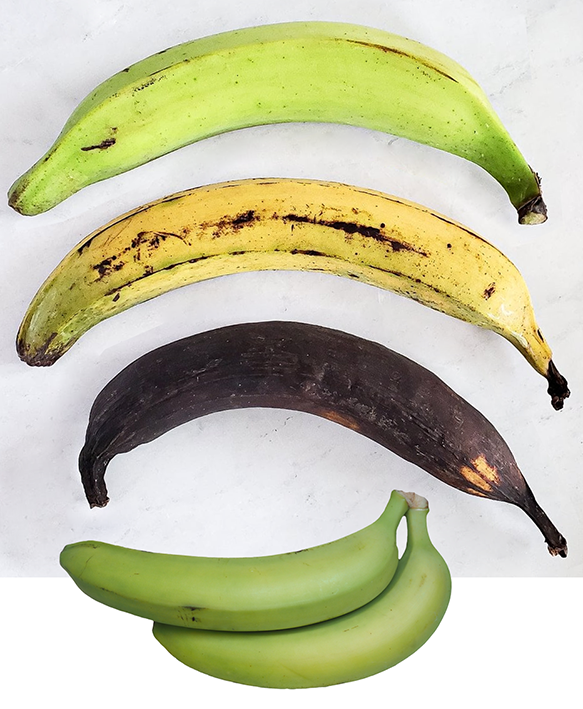
 Plantains in various states of ripeness and green bananas.
Welcome to the summary page for FabulousFusionFood's Cook's Guide entry for Bananas and Plantains along with all the trcipes employing Bananas and Plantains presented on this site, with 448 recipes in total.
This is a continuation of an entire series of pages that will, I hope, allow my visitors to better navigate this site. As well as displaying recipes by name, country and region of origin I am now planning a whole series of pages where recipes can be located by meal type and main ingredient. This page gives a listing of all the Bananas and Plantains recipes added to this site.
These recipes, all contain Bananas and Plantains as a major wild food ingredient.
Musa is one of three genera in the family Musaceae. The genus includes 83 fruit species of flowering plants producing edible bananas and plantains (also known as cooking bananas). Though they grow as high as trees, banana and plantain plants are not woody and their apparent "stem" is made up of the bases of the huge leaf stalks. Thus, they are technically gigantic herbaceous plants.
Banana plants are among the largest extant herbaceous plants, some reaching up to 9m in height or 18m in the case of Musa ingens. The large herb is composed of a modified underground stem (rhizome), a false trunk or pseudostem formed by the basal parts of tightly rolled leaves, a network of roots, and a large flower spike. A single leaf is divided into a leaf sheath, a contracted part called a petiole, and a terminal leaf blade. The false trunk is an aggregation of leaf sheaths; only when the plant is ready to flower does a true stem grow up through the sheath. At the end of this stem, a peduncle forms (with M. ingens having the second-longest peduncle known, exceeded only by Agave salmiana), bearing many female flowers protected by large purple-red bracts. The extension of the stem (the rachis) continues growth downward, where terminal male flowers grow. The leaves originate from a pseudostem and unroll to show a leaf blade with two lamina halves
Bananas have a green skin when unripe. While plantains remain green all the way, many varieties change their skin to a yellow, orange or reddish colour as they ripen.
During the late Middle Ages, international trade brought bananas to Europe, which created the need for a name. In the 11th century, Medieval Latin innovated a term musa: this was most likely the latinization of the Arabic name for the fruit, mawz (موز). Thus, the 11th-century Arabic encyclopedia The Canon of Medicine, which was translated to Latin in medieval times and well known in Europe, shows a correspondence between Arabic mauz and Latin musa. Muz is also the Turkish, Persian, and Somali name for the fruit.
According to linguist Mark Donohue and archaeologist Tim Denham, the ultimate origin of the Latinized form musa is in the Trans–New Guinea languages, where certain cultivars of bananas are known under a form *muku. From there, the term was borrowed into the Austronesian languages of the area, and migrated across Asia, via the Dravidian languages of India, into Persian, Greek, and Arabic as a Wanderwort:
A number of distinct groups of plants bearing edible fruit have been developed from species of Musa. In English, fruits which are sweet and used for dessert are usually called "bananas", whereas starchier varieties used for cooking are called "plantains", but these terms do not have any botanical significance. By far the largest and now the most widely distributed group of cultivated bananas is derived from section Musa, particularly M. acuminata and M. balbisiana, either alone or in various hybrid combinations. The next but much smaller group is derived from members of section Callimusa (previously classified as Australimusa) and is restricted in importance to Polynesia. Of even more restricted importance are small groups of hybrids from Papua New Guinea; a group from section Musa to which M. schizocarpa has also contributed, and a group of hybrids between section Musa and section Callimusa.
Banana and plantains are the fourth most produced food globally surpassed only by the staple crops of rice, wheat and maize.
When the Linnaean binomial system was abandoned for cultivated bananas, an alternate genome-based system for the nomenclature of edible bananas in section Musa was devised. Thus, the plant previously known by the "species" name Musa cavendishii became Musa (AAA Group) 'Dwarf Cavendish'. The "new" name shows clearly that 'Dwarf Cavendish' is a triploid, with three sets of chromosomes, all derived from Musa acuminata, which is designated by the letter "A". When Musa balbisiana is involved, the letter "B" is used to denote its genome. Thus, the cultivar 'Rajapuri' may be called Musa (AAB Group) 'Rajapuri'. 'Rajapuri' is also a triploid, expected to have two sets of chromosomes from Musa acuminata and one from Musa balbisiana. In the genome of edible bananas from section Musa, combinations such as AA, BB, ABB, BBB and even AAAB can be found.
In addition to the edible fruit, the flowers can be eaten cooked, and the heart of the plant (like heart of palm) can be eaten raw or cooked. Additionally, the rootstocks and leaf sheaths of some species can be cooked and eaten. The leaves are used in several cultures as cooking wrappers, such as for Puerto Rican pasteles or Indonesian pepes, and for food plating.
A banana is an elongated, edible fruit that is botanically a berry produced by several kinds of large treelike herbaceous flowering plants in the genus Musa. In some countries, cooking bananas are called plantains, distinguishing them from dessert bananas. The fruit is variable in size, color and firmness, but is usually elongated and curved, with soft flesh rich in starch covered with a peel, which may have a variety of colors when ripe. It grows upward in clusters near the top of the plant. Almost all modern edible seedless (parthenocarp) cultivated bananas come from two wild species – Musa acuminata and Musa balbisiana, or their hybrids.
Musa species are native to tropical Indomalaya and Australia; they were probably domesticated in New Guinea. They are grown in 135 countries, primarily for their fruit, and to a lesser extent to make banana paper and textiles, while some are grown as ornamental plants. The world's largest producers of bananas in 2022 were India and China, which together accounted for approximately 26% of total production. Bananas are eaten raw or cooked in recipes varying from curries to banana chips, fritters, fruit preserves, or simply baked or steamed.
In regions such as North America and Europe, Musa fruits offered for sale can be divided into small sweet "bananas" eaten raw when ripe as a dessert, and large starchy "plantains" or cooking bananas, which do not have to be ripe. Linnaeus made this distinction when naming two "species" of Musa. Members of the "plantain subgroup" of banana cultivars, most important as food in West Africa and Latin America, correspond to this description, having long pointed fruit. They are described by Ploetz et al. as 'true' plantains, distinct from other cooking bananas.
The cooking bananas of East Africa belong to a different group, the East African Highland bananas. Further, small farmers in Colombia grow a much wider range of cultivars than large commercial plantations do, and in Southeast Asia—the centre of diversity for bananas, both wild and cultivated—the distinction between "bananas" and "plantains" does not work. Many bananas are used both raw and cooked. There are starchy cooking bananas which are smaller than those eaten raw. The range of colours, sizes and shapes is far wider than in those grown or sold in Africa, Europe or the Americas.
True plantains are a group of cultivars of the genus Musa (bananas and plantains) placed in the African Plantain subgroup of the AAB chromosome group. Although 'AAB' and 'true plantain' are often used interchangeably, plantains are the most popular varieties among the AABs. The term "plantain" can refer to all the banana cultivars normally eaten after cooking rather than raw (see cooking banana), or it can refer to members of other subgroups of Musa cultivars such as the Pacific plantains, although in Africa little to no distinction is made between the two since both are commonly cooked. True plantains are divided into four groups based on their bunch type: French, French Horn, False Horn and Horn plantains.
For other starchy staples see the entries on potatoes, sweet potatoes, yams, taro/eddoes/cocoyam, tannia, cassava, green banana/plantain and breadfruit.
This is a continuation of an entire series of pages that will, I hope, allow my visitors to better navigate this site. As well as displaying recipes by name, country and region of origin I am now planning a whole series of pages where recipes can be located by meal type and main ingredient. This page gives a listing of all the Bananas and Plantains recipes added to this site.
These recipes, all contain Bananas and Plantains as a major wild food ingredient.
Musa is one of three genera in the family Musaceae. The genus includes 83 fruit species of flowering plants producing edible bananas and plantains (also known as cooking bananas). Though they grow as high as trees, banana and plantain plants are not woody and their apparent "stem" is made up of the bases of the huge leaf stalks. Thus, they are technically gigantic herbaceous plants.
Banana plants are among the largest extant herbaceous plants, some reaching up to 9m in height or 18m in the case of Musa ingens. The large herb is composed of a modified underground stem (rhizome), a false trunk or pseudostem formed by the basal parts of tightly rolled leaves, a network of roots, and a large flower spike. A single leaf is divided into a leaf sheath, a contracted part called a petiole, and a terminal leaf blade. The false trunk is an aggregation of leaf sheaths; only when the plant is ready to flower does a true stem grow up through the sheath. At the end of this stem, a peduncle forms (with M. ingens having the second-longest peduncle known, exceeded only by Agave salmiana), bearing many female flowers protected by large purple-red bracts. The extension of the stem (the rachis) continues growth downward, where terminal male flowers grow. The leaves originate from a pseudostem and unroll to show a leaf blade with two lamina halves
Bananas have a green skin when unripe. While plantains remain green all the way, many varieties change their skin to a yellow, orange or reddish colour as they ripen.
During the late Middle Ages, international trade brought bananas to Europe, which created the need for a name. In the 11th century, Medieval Latin innovated a term musa: this was most likely the latinization of the Arabic name for the fruit, mawz (موز). Thus, the 11th-century Arabic encyclopedia The Canon of Medicine, which was translated to Latin in medieval times and well known in Europe, shows a correspondence between Arabic mauz and Latin musa. Muz is also the Turkish, Persian, and Somali name for the fruit.
According to linguist Mark Donohue and archaeologist Tim Denham, the ultimate origin of the Latinized form musa is in the Trans–New Guinea languages, where certain cultivars of bananas are known under a form *muku. From there, the term was borrowed into the Austronesian languages of the area, and migrated across Asia, via the Dravidian languages of India, into Persian, Greek, and Arabic as a Wanderwort:
A number of distinct groups of plants bearing edible fruit have been developed from species of Musa. In English, fruits which are sweet and used for dessert are usually called "bananas", whereas starchier varieties used for cooking are called "plantains", but these terms do not have any botanical significance. By far the largest and now the most widely distributed group of cultivated bananas is derived from section Musa, particularly M. acuminata and M. balbisiana, either alone or in various hybrid combinations. The next but much smaller group is derived from members of section Callimusa (previously classified as Australimusa) and is restricted in importance to Polynesia. Of even more restricted importance are small groups of hybrids from Papua New Guinea; a group from section Musa to which M. schizocarpa has also contributed, and a group of hybrids between section Musa and section Callimusa.
Banana and plantains are the fourth most produced food globally surpassed only by the staple crops of rice, wheat and maize.
When the Linnaean binomial system was abandoned for cultivated bananas, an alternate genome-based system for the nomenclature of edible bananas in section Musa was devised. Thus, the plant previously known by the "species" name Musa cavendishii became Musa (AAA Group) 'Dwarf Cavendish'. The "new" name shows clearly that 'Dwarf Cavendish' is a triploid, with three sets of chromosomes, all derived from Musa acuminata, which is designated by the letter "A". When Musa balbisiana is involved, the letter "B" is used to denote its genome. Thus, the cultivar 'Rajapuri' may be called Musa (AAB Group) 'Rajapuri'. 'Rajapuri' is also a triploid, expected to have two sets of chromosomes from Musa acuminata and one from Musa balbisiana. In the genome of edible bananas from section Musa, combinations such as AA, BB, ABB, BBB and even AAAB can be found.
In addition to the edible fruit, the flowers can be eaten cooked, and the heart of the plant (like heart of palm) can be eaten raw or cooked. Additionally, the rootstocks and leaf sheaths of some species can be cooked and eaten. The leaves are used in several cultures as cooking wrappers, such as for Puerto Rican pasteles or Indonesian pepes, and for food plating.
A banana is an elongated, edible fruit that is botanically a berry produced by several kinds of large treelike herbaceous flowering plants in the genus Musa. In some countries, cooking bananas are called plantains, distinguishing them from dessert bananas. The fruit is variable in size, color and firmness, but is usually elongated and curved, with soft flesh rich in starch covered with a peel, which may have a variety of colors when ripe. It grows upward in clusters near the top of the plant. Almost all modern edible seedless (parthenocarp) cultivated bananas come from two wild species – Musa acuminata and Musa balbisiana, or their hybrids.
Musa species are native to tropical Indomalaya and Australia; they were probably domesticated in New Guinea. They are grown in 135 countries, primarily for their fruit, and to a lesser extent to make banana paper and textiles, while some are grown as ornamental plants. The world's largest producers of bananas in 2022 were India and China, which together accounted for approximately 26% of total production. Bananas are eaten raw or cooked in recipes varying from curries to banana chips, fritters, fruit preserves, or simply baked or steamed.
In regions such as North America and Europe, Musa fruits offered for sale can be divided into small sweet "bananas" eaten raw when ripe as a dessert, and large starchy "plantains" or cooking bananas, which do not have to be ripe. Linnaeus made this distinction when naming two "species" of Musa. Members of the "plantain subgroup" of banana cultivars, most important as food in West Africa and Latin America, correspond to this description, having long pointed fruit. They are described by Ploetz et al. as 'true' plantains, distinct from other cooking bananas.
The cooking bananas of East Africa belong to a different group, the East African Highland bananas. Further, small farmers in Colombia grow a much wider range of cultivars than large commercial plantations do, and in Southeast Asia—the centre of diversity for bananas, both wild and cultivated—the distinction between "bananas" and "plantains" does not work. Many bananas are used both raw and cooked. There are starchy cooking bananas which are smaller than those eaten raw. The range of colours, sizes and shapes is far wider than in those grown or sold in Africa, Europe or the Americas.
True plantains are a group of cultivars of the genus Musa (bananas and plantains) placed in the African Plantain subgroup of the AAB chromosome group. Although 'AAB' and 'true plantain' are often used interchangeably, plantains are the most popular varieties among the AABs. The term "plantain" can refer to all the banana cultivars normally eaten after cooking rather than raw (see cooking banana), or it can refer to members of other subgroups of Musa cultivars such as the Pacific plantains, although in Africa little to no distinction is made between the two since both are commonly cooked. True plantains are divided into four groups based on their bunch type: French, French Horn, False Horn and Horn plantains.
For other starchy staples see the entries on potatoes, sweet potatoes, yams, taro/eddoes/cocoyam, tannia, cassava, green banana/plantain and breadfruit.
The alphabetical list of all Bananas and Plantains recipes on this site follows, (limited to 100 recipes per page). There are 448 recipes in total:
Page 1 of 5
| Aadun Origin: Nigeria | Authentic Mole Poblano Origin: Mexico | Banana Lumpia Origin: Federated States Micronesia |
| Accra Banana Peanut Cake Origin: Ghana | Avocado Banana Berry Smoothie Origin: American | Banana Muffins Origin: Britain |
| Agatoke (Plantain and Vegetable Porridge) Origin: Burundi | Bahama Mama Smoothie Origin: American | Banana Peel and Black-eyed Bean Stew Origin: Tanzania |
| Agidi (Fermented Cornflour Pudding) Origin: Nigeria | Bajan Curry Goat Origin: Barbados | Banana Peel Flour Origin: South Africa |
| Agidi Jollof Origin: Nigeria | Bajan Sunday Breakfast Origin: Barbados | Banana Peel Flour Pancakes Origin: France |
| Aguají (Plantain Soup) Origin: Dominican Republic | Baked Banana Pudding Origin: Uganda | Banana Pineapple Bread Origin: Nauru |
| Air Fryer Banana Bread Origin: Britain | Baked Bananas Origin: Britain | Banana Pineapple Bread Origin: Hawaii |
| Air Fryer Green Banana Plantain Chips Origin: Fusion | Baked Bananas Gabon Origin: Gabon | Banana Porridge Origin: Jamaica |
| Air Fryer Oaty Banana Blueberry Muffins Origin: Britain | Baked Beans Salad Origin: Namibia | Banana Sizzles Origin: Britain |
| Ajiaco Criollo (Cuban Creole Stew) Origin: Cuba | Baked Date Oatmeal Origin: Fusion | Banana Smoothie Origin: American |
| Ajvar (Aubergine and Pepper Dip) Origin: Serbia | Baked Tropical Fruit Pudding Origin: Malawi | Banana Soufflé Origin: Lesotho |
| Akwadu (Baked Bananas with Lemon Juice and Coconut) Origin: Equatorial Guinea | Bakwan Jagung (Indonesian Corn Fritters) Origin: Indonesia | Banana Soup Origin: Malawi |
| Alcapurrias de Jueyes (Crab-Stuffed Fritters) Origin: Puerto Rico | Banana Akara Origin: Sierra Leone | Banana Stobá (Stewed Plantains) Origin: Curacao |
| Alloco de Cameroun (Cameroonian Alloco) Origin: Cameroon | Banana and Chestnut Crumble Origin: Britain | Banana-nut Quick Mix Muffins Origin: American |
| Aloco Camerounais (Cameroonian Aloco) Origin: Cameroon | Banana and Chia Date Cookies Origin: American | Bananas with Split Green Peas Origin: Rwanda |
| Aloko Origin: Cote dIvoire | Banana and Chickpea Vegan Sheek Kebab Origin: Britain | Banane au Caramel (Caramel Bananas) Origin: Senegal |
| Alu Kesel (Sri Lankan Ash Plantain Curry) Origin: Sri Lanka | Banana and Corn Casserole Origin: eSwatini | Bananes Farci (Stuffed Bananas) Origin: Wallis Futuna |
| Amashaza mu gitoke (Peas with Plantains) Origin: Uganda | Banana and Dulce de Leche Cupcakes Origin: American | Bananes Pessés (Refried Plantains) Origin: Haiti |
| American Samoan Poi (Mashed Bananas with Coconut Cream) Origin: American Samoa | Banana and Peanut Butter Ice Cream Origin: American | Bananes Plantain au Gari (Plantains with Gari) Origin: Togo |
| Amour Caché (Hidden Love Cake) Origin: Martinique | Banana Cake Origin: American | Banani Loko (Aloko with Chilli Sauce) Origin: Guinea |
| Ampesi with Kontomire Stew Origin: Ghana | Banana Cheesecake Origin: American | Bandeja Paisa (Paisa Platter) Origin: Colombia |
| Angu de Banana (Banana Mash) Origin: Sao Tome | Banana Chocolate Cupcakes Origin: American | Banoffee Pie Origin: Britain |
| Anguilla Fried Plantains Origin: Anguilla | Banana Coconut Muffins (Banana Coconut Muffins) Origin: American | Barbecued Bananas Origin: American |
| Antiguan Curry Butter Prawns with Plantain Grits Origin: Antigua | Banana Cream Pie with Banana Cracker Crust Origin: American | Barramundi in banana leaf Origin: Marshall Islands |
| Apple and Carrot Quencher Origin: American | Banana Curry Chutney Origin: South Africa | Basto and Suugo Origin: Somalia |
| Apple Pie Smoothie Origin: American | Banana den Forno (Baked Bananas) Origin: Aruba | Basto and Suugo Origin: Djibouti |
| Arroz a la Cubana (Cuban-style Rice) Origin: Philippines | Banana Dulce de Leche Ice Cream Origin: Britain | Batabate Origin: Mayotte |
| Arroz Integral com Mantiega de Amendoim e Bananas (Brown Rice with Peanut Mantiega and Bananas) Origin: Angola | Banana Flapjacks Origin: Britain | Beans and Bananas Origin: Burundi |
| Aruba Chicken Origin: Aruba | Banana Fudge Cake Origin: American | Bébélé (Tripe and Plantain Stew) Origin: Guadeloupe |
| Asaro II (Yam Porridge) Origin: Nigeria | Banana Ice Cream Origin: Britain | Bebotok Sapi (Indonesian Meatloaf) Origin: Indonesia |
| Attiéké et Aloko Poisson (Attieke and Fish Aloko) Origin: Niger | Banana Ice Cream II Origin: Britain | Beignets de Banane au Lait de Coco (Banana Fritters with Coconut Milk) Origin: Togo |
| Attiéké et Aloko Poisson (Attiéké and Plantain with Fish) Origin: Cote dIvoire | Banana Ketchup Origin: Jamaica | Beignets de Banane Malienne (Malian Banana Fritters) Origin: Mali |
| Aunu Senebre Origin: Papua | Banana Lassi Origin: India | |
| Aunu Senebre Origin: Papua New Guinea | Banana leaf mackerel Origin: Sri Lanka |
Page 1 of 5