FabulousFusionFood's Milk-based Recipes 11th Page
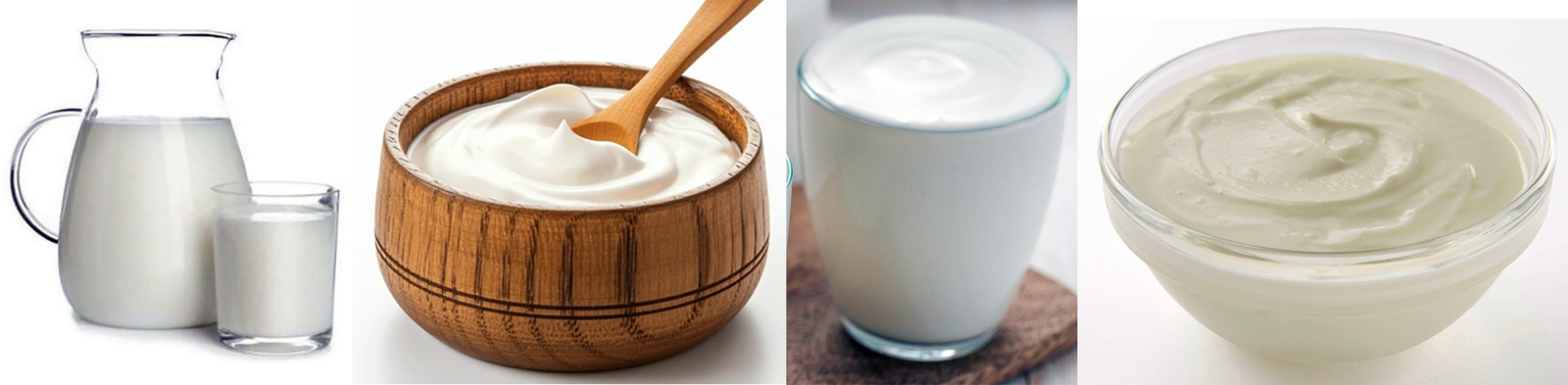 Milk, cream, kefir and yoghurt.
Welcome to FabulousFusionFood's Milk-based Recipes Page — The recipes presented here are all based on milk or cream and its derivative, yoghurt as an ingredient base. Biologically, milk is is a white liquid food produced by the mammary glands of mammals. It is the primary source of nutrition for young mammals (including breastfed human infants) before they are able to digest solid food. Milk contains many nutrients, including calcium and protein, as well as lactose and saturated fat. Immune factors and immune-modulating components in milk contribute to milk immunity. Early-lactation milk, which is called colostrum, contains antibodies and immune-modulating components that strengthen the immune system against many diseases. There are two distinct categories of milk consumption: all infant mammals drink milk directly from their mothers' bodies, and it is their primary source of nutrition; and humans obtain milk from other mammals for consumption by humans of all ages, as one component of a varied diet.
In many cultures, especially in the West, humans continue to consume milk beyond infancy, using the milk of other mammals (especially cattle, goats and sheep) as a food product. Initially, the ability to digest milk was limited to children as adults did not produce lactase, an enzyme necessary for digesting the lactose in milk. People therefore converted milk to curd, cheese, and other products to reduce the levels of lactose. Thousands of years ago, a chance mutation spread in human populations in northwestern Europe that enabled the production of lactase in adulthood. This mutation allowed milk to be used as a new source of nutrition which could sustain populations when other food sources failed. Milk is processed into a variety of products such as cream, butter, yogurt, kefir, ice cream and cheese.
Humans first learned to consume the milk of other mammals regularly following the domestication of animals during the Neolithic Revolution or the development of agriculture. This development occurred independently in several global locations from as early as 9000–7000 BC in Mesopotamia to 3500–3000 BC in the Americas. People first domesticated the most important dairy animals – cattle, sheep and goats – in Southwest Asia, although domestic cattle had been independently derived from wild aurochs populations several times since
Aside from cattle, many kinds of livestock provide milk used by humans for dairy products. These animals include water buffalo, goat, sheep, camel, donkey, horse, reindeer and yak.
Milk is an emulsion or colloid of butterfat globules within a water-based fluid that contains dissolved carbohydrates and protein aggregates with minerals. Because it is produced as a food source for the young, all of its contents provide benefits for growth. The principal requirements are energy (lipids, lactose, and protein), biosynthesis of non-essential amino acids supplied by proteins (essential amino acids and amino groups), essential fatty acids, vitamins and inorganic elements, and water.
Cream is a dairy product composed of the higher-fat layer skimmed from the top of milk before homogenization. In un-homogenized milk, the fat, which is less dense, eventually rises to the top. In the industrial production of cream, this process is accelerated by using centrifuges called "separators". In many countries, it is sold in several grades depending on the total butterfat content. It can be dried to a powder for shipment to distant markets, and contains high levels of saturated fat.
Buttermilk is a fermented dairy drink. Traditionally, it was the liquid left behind after churning butter out of cultured cream. As most modern butter in Western countries is not made with cultured cream but uncultured sweet cream, most modern buttermilk in Western countries is cultured separately. It is common in warm climates where unrefrigerated milk sours quickly. Buttermilk can be drunk straight, and it can also be used in cooking. In making soda bread, the acid in buttermilk reacts with the raising agent, sodium bicarbonate, to produce carbon dioxide which acts as the leavening agent. Buttermilk is also used in marination, especially of chicken and pork.
Kefir (/kəˈfɪər/ kə-FEER; alternative spellings: kephir or kefier; Russian: кефир [kʲɪˈfʲir]; Karachay-Balkar: гыпы) is a fermented milk drink similar to a thin yogurt or ayran that is made from kefir grains, a specific type of mesophilic symbiotic culture. It is prepared by inoculating the milk of cows, goats, or sheep with kefir grains. Kefir is a common breakfast, lunch or dinner drink consumed in countries of western Eurasia. Kefir is consumed at any time of the day, such as alongside European pastries like zelnik (zeljanica), burek and banitsa/gibanica, as well as being an ingredient in cold soups.
Yoghurt from Ottoman Turkish: یوغورت, romanized: yoğurt; also spelled yogurt, yogourt or yoghourt) is a food produced by bacterial fermentation of milk. Fermentation of sugars in the milk by these bacteria produces lactic acid, which acts on milk protein to give yogurt its texture and characteristic tart flavour. Cow's milk is most commonly used to make yogurt. Milk from water buffalo, goats, ewes, mares, camels, and yaks is also used to produce yogurt. The milk used may be homogenized or not. It may be pasteurized or raw. Each type of milk produces substantially different results. Yogurt is produced using a culture of Lactobacillus delbrueckii subsp. bulgaricus and Streptococcus thermophilus bacteria. Other lactobacilli and bifidobacteria are sometimes added during or after culturing yoghurt.
The alphabetical list of all the milk-based recipes on this site follows, (limited to 100 recipes per page). There are 2750 recipes in total:
Page 11 of 28
| Flan de Maracuyá y Coco (Passionfruit and Coconut Flan) Origin: Mexico | Fruit and Spice Soda Bread Origin: Ireland | Garoobey Origin: Djibouti |
| Flan Mexicano (Mexican Flan) Origin: Mexico | Fruit Bonnag Origin: Manx | Gateau Ayisyen (Haitian Cake) Origin: Haiti |
| Flans de potiron (Pumpkin Flans) Origin: Saint Pierre | Fruit Ice Cream Origin: British | Gateau de Fonio au Caramel (Fonio Cake with Caramel) Origin: Senegal |
| Flaounes II (Easter Cheese Cakes) Origin: Cyprus | Fruit Scones Origin: Britain | Gâteau des patates douces (Sweet-potato Cake) Origin: Saint-Martin |
| Flaxseed Smoothie Origin: American | Fruit Smoothie with Ginseng Origin: American | Gâteau du Matin Breton (Breton Morning Cake) Origin: France |
| Flija (Layered Pancake) Origin: Albania | Fruited Soda Bread Origin: Britain | Gâteau Michel (Michel's cake) Origin: Saint Pierre |
| Flourless Chocolate Cake Origin: Britain | Fruity Banana Smoothie Origin: American | Gateaux de Fonio (Fonio Muffins) Origin: Mali |
| Fluffy American Pancakes with Assorted Toppings Origin: America | Fruity Chicken Curry Origin: India | Gazpacho Smoothie Origin: American |
| Fluffy Mashed Alexanders Root Origin: Britain | Fruity Pancake Traybake Origin: Britain | Gebne Mankoushe (Lebanese Cheese Pizza) Origin: Lebanon |
| Fluffy Mashed Swedes Origin: Britain | Fuchsia Berry Scones Origin: Britain | Gentse Waterzooi Origin: Belgium |
| Foamy Sauce Origin: Scotland | Fudge Frosting Origin: American | Gerudderten (Boiled Potatoes with Bacon and Sour Milk) Origin: Luxembourg |
| Foil-baked Chicken with English Mace Origin: Britain | FuFu de Paris Origin: Cameroon | Ghanaian Ripe Plantain Ice Cream Origin: Ghana |
| Fondé de Mil (Millet Porridge) Origin: Senegal | Fumbyree (Shelled Barley Porridge) Origin: Manx | Gibanica (Cheese Strudel Pie) Origin: Serbia |
| Forfarshire Barley Meal Scones Origin: Scotland | Fura Gero da Nono Origin: Nigeria | Gibraltar Caramel Flan Origin: Gibraltar |
| Forloren Hare (Danish Meatloaf) Origin: Denmark | Gâteau de Crêpes à l'Ananas (Millefeuille of Pancakes and Caramelized Pineapple) Origin: France | Giliø kava (Acorn Coffee) Origin: Lithuania |
| Forshmak (Georgian Minced Meat Soufflé) Origin: Georgia | Gâteau de Semoule aux Agrumes (Semolina and Citrus Cake) Origin: Mali | Ginger Beurre Blanc Origin: France |
| Francatelli Bread Sauce Origin: Britain | Gâteau marbré chocolat poire (Marbled Chocolate Yoghurt Cake) Origin: France | Ginger Passion Fruit Trifle Origin: Britain |
| Francatelli's Allemande Sauce Origin: Britain | Gâteau Mont Blanc Origin: France | Gingerbread Men Cheesecake Origin: Britain |
| Francatelli's Yorkshire Pudding Origin: Britain | Güschgle-Knöpfle (Güshgle-style Button Noodles) Origin: Liechtenstein | Gingerbread Mincemeat Cupcakes with Salted Caramel Icing Origin: Britain |
| Freekeh Mansaf Origin: Syria | Gajar Ka Halwa (Carrot Halwa) Origin: India | Girdle Scones Origin: Ireland |
| French Flummery Origin: France | Gajjar Barfi (Carrot Fudge) Origin: India | Glacé Fruit Triem Origin: South Africa |
| Fresh Fig Compote Origin: Britain | Gala Apple Smoothie Origin: American | Glace à la noix de coco (Coconut Ice-Cream) Origin: French Guiana |
| Fresh Fruit Smoothie Origin: American | Gala Apricot Cheesecake Origin: Britain | Glace bretonne au caramel beurre salé (Breton Ice Cream) Origin: France |
| Fresh Pear Shortcake Origin: Britain | Galidossi Origin: Togo | Glace de Banane á la Mamadou (Mamadou's Banana Glace) Origin: Senegal |
| Fresh Pumpkin Pie Origin: American | Gambas ou langoustines au pastis (Prawns or Langoustines with Pastis) Origin: Monaco | Glazed Canella Scones Origin: Britain |
| Fresh Raspberry Frozen Yoghurt Origin: American | Gari Biscuits Origin: Ghana | Glazed Lemon Cheesecake Origin: American |
| Fresh Strawberry Frozen Yoghurt Origin: American | Gari Dossi Origin: Togo | Glazed Orange Cheesecake Origin: American |
| Fried Bakes Origin: Saint Lucia | Gari Snack Origin: Nigeria | Gloucester Pancakes Origin: England |
| Fried Conch Fritters Origin: Turks Caicos | Garlic and Chives Sauce Origin: Fusion | Gluecks-Schweinchen (German New Year Good Luck Pig Buns) Origin: Germany |
| Fried Crabmeat Flautas Origin: American | Garlic and Olive Oil Mash Origin: Ireland | Gluten-free Brownie Mix Origin: British |
| Fried Lamb's Kidneys with Guinness and Mushroom Sauce Origin: Ireland | Garlic and Yoghurt Sauce Origin: Turkey | Gluten-free Pancakes Origin: Britain |
| Frikadeller (Danish Meatballs) Origin: Denmark | Garlic Naan Origin: India | Gluten-free Tea Scones Origin: Scotland |
| Frikkadel Curry Origin: South Africa | Garlic Naan Bread Origin: India | |
| Frosted Walnut Cake Origin: American | Garlic Naan Bread Origin: South Africa |
Page 11 of 28