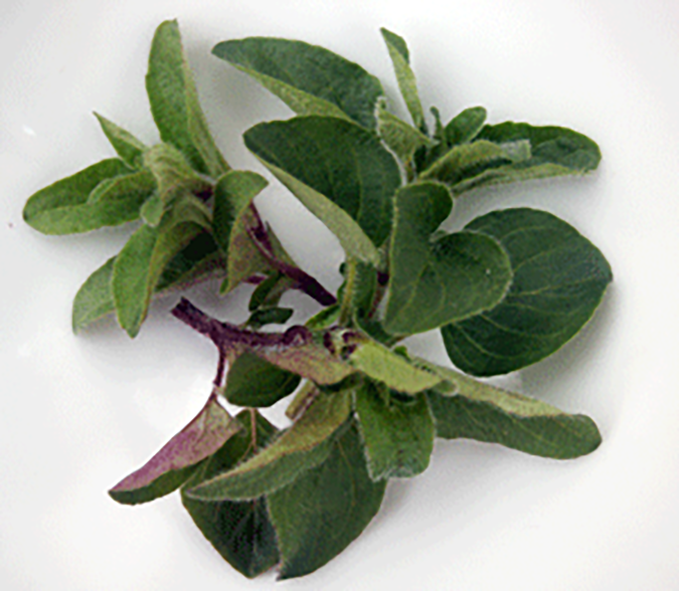
 Sprigs of oregano
Origanum
vulgare.
Sprigs of oregano
Origanum
vulgare.
Welcome to the summary page for FabulousFusionFood's Herb guide to Oregano along with all the Oregano containing recipes presented on this site, with 461 recipes in total.
This is a continuation of an entire series of pages that will, I hope, allow my visitors to better navigate this site. As well as displaying recipes by name, country and region of origin I am now planning a whole series of pages where recipes can be located by meal type and main ingredient. This page gives information about Oregano and a listing of all the Oregano-based recipes added to this site.
These recipes, all contain Oregano as a major herb flavouring.
Oregano (sometimes also known as Pot Marjoram and Wild Marjoram), Origanum vulgare is a perennial herb of the Lamiaceae (mint) family. The plant grows to about 30 cm tall with leaves up to 4cm long. The name itself derives from the Greek origanon [ὀρίγανον], a compound of oros [ὄρος] “mountain” + the verb ganousthai [γανοῦσθαι] “delight in”. Oregano leaves can be used both dried and fresh, however, unlike most other herbs dried oregano leaves are actually more flavourful than the fresh leaves.
The leaves have an aromatic, warm and slightly bitter taste and the stronger the flavour the herb the better its quality. The herb is an essential component of both Greek and Italian cuisine and it is a critical component of the tomato sauce used as pizza topping. It should also be noted that oregano has antimicrobial activity and can be used as a food preservative. This herb also has high antioxidant activity and its use can prevent other foods from turning colour.
The flavour of oregano is highly-variable, with Greek Oregano typically being the most pungent and aromatic. Overall, the flavour is aromatic and warm but with a slight bitter overtone that marries well with the sweetness of tomatoes. The best quality of oregano is so strong that is almost numbs the tongues. However, modern cultivars that are adapted to more northerly climes tend to be slightly unsatisfactory in flavour. Unlike most other herbs the flavour of oregano intensifies on drying, which is why these cultivars are better used dried rather than fresh.
The leaves typically contain up to 4% essential oil that typically contains variable amounts of the phenolic compounds carvacrol and thymol. The essential oil also contains a variety of monoterpene hydrocarbons, with limonene, terpinene, ocimene, caryophyllene, β-bisabolene and p-cymene) and monoterpene alcohols (linalool, 4-terpineol having been identified.
Several species of the genus Origanum used as herbs are all native to the Mediterranean region of Europe, with Origanum vulgare (not with pan-European distribution), Origanum onites (Greek oregano, native to Greece and Asia Minor) andOriganum heracleoticum (native to Italy, the Balkan Peninsula and Western Asia) being, culinarily, the most important. Though Greek Oregano is typically considered to be the most intense in flavour, in reality, there is little difference between the various species and climate, season and soil type has a much larger effect on the flavour rather than the exact species. There is also a golden-leaved cultivar of Origanum vulgare which has a flavour intermediate between oregano and marjoram. One further species is of note, Dittany of Crete Origanum dictamnus which is only found on the island of Crete and has its own entry in this guide.
The English name oregano ultimately derives from the Green origanon [ὀρίγανον] which may be a compound of oros [ὄρος] (mountain), and the verb ganousthai [γανοῦσθαι] (delight in) denoting oregano's preference for growing on rocky slopes as high elevations in its native Mediterranean.
The recipes given below contain oregano as an important or dominant component. However, you can also access all the recipes on this site that contain oregano as an ingredient.
This is a continuation of an entire series of pages that will, I hope, allow my visitors to better navigate this site. As well as displaying recipes by name, country and region of origin I am now planning a whole series of pages where recipes can be located by meal type and main ingredient. This page gives information about Oregano and a listing of all the Oregano-based recipes added to this site.
These recipes, all contain Oregano as a major herb flavouring.
Oregano (sometimes also known as Pot Marjoram and Wild Marjoram), Origanum vulgare is a perennial herb of the Lamiaceae (mint) family. The plant grows to about 30 cm tall with leaves up to 4cm long. The name itself derives from the Greek origanon [ὀρίγανον], a compound of oros [ὄρος] “mountain” + the verb ganousthai [γανοῦσθαι] “delight in”. Oregano leaves can be used both dried and fresh, however, unlike most other herbs dried oregano leaves are actually more flavourful than the fresh leaves.
The leaves have an aromatic, warm and slightly bitter taste and the stronger the flavour the herb the better its quality. The herb is an essential component of both Greek and Italian cuisine and it is a critical component of the tomato sauce used as pizza topping. It should also be noted that oregano has antimicrobial activity and can be used as a food preservative. This herb also has high antioxidant activity and its use can prevent other foods from turning colour.
The flavour of oregano is highly-variable, with Greek Oregano typically being the most pungent and aromatic. Overall, the flavour is aromatic and warm but with a slight bitter overtone that marries well with the sweetness of tomatoes. The best quality of oregano is so strong that is almost numbs the tongues. However, modern cultivars that are adapted to more northerly climes tend to be slightly unsatisfactory in flavour. Unlike most other herbs the flavour of oregano intensifies on drying, which is why these cultivars are better used dried rather than fresh.
The leaves typically contain up to 4% essential oil that typically contains variable amounts of the phenolic compounds carvacrol and thymol. The essential oil also contains a variety of monoterpene hydrocarbons, with limonene, terpinene, ocimene, caryophyllene, β-bisabolene and p-cymene) and monoterpene alcohols (linalool, 4-terpineol having been identified.
Several species of the genus Origanum used as herbs are all native to the Mediterranean region of Europe, with Origanum vulgare (not with pan-European distribution), Origanum onites (Greek oregano, native to Greece and Asia Minor) and
The English name oregano ultimately derives from the Green origanon [ὀρίγανον] which may be a compound of oros [ὄρος] (mountain), and the verb ganousthai [γανοῦσθαι] (delight in) denoting oregano's preference for growing on rocky slopes as high elevations in its native Mediterranean.
The recipes given below contain oregano as an important or dominant component. However, you can also access all the recipes on this site that contain oregano as an ingredient.
The alphabetical list of all Oregano recipes on this site follows, (limited to 100 recipes per page). There are 461 recipes in total:
Page 1 of 5
| Accent Herbs Origin: Caribbean | Antipasto Rice Origin: Italy | Breadfruit Chips Origin: Pitcairn Islands |
| Achiote Paste Origin: Mexico | Arni Gemisto me Horta ke Feta (Leg of Lamb Stuffed with Greens and Feta) Origin: Greece | Breadfruit Chips Origin: Wallis Futuna |
| Achiote Paste Origin: Nicaragua | Arroz a la Cubana (Cuban-style Rice) Origin: Philippines | Breadfruit Crisps Origin: Saint Lucia |
| Adobo Seasoning Origin: Britain | Asado Negro Origin: Venezuela | Bulgarian Beef and Potato Moussaka Origin: Bulgaria |
| Adobo Valentine Lamb Origin: American | Assaturas in collare (Of Roast Neck) Origin: Roman | Cajun Bean and Potato Stew Origin: America |
| African All Purpose Seasoning Origin: Nigeria | Avocado Leaf Chimichurri Origin: Fusion | Cajun Blackening Spices Origin: Cajun |
| Aguají (Plantain Soup) Origin: Dominican Republic | Bachalu à Gomes (Salt Cod with Potatoes) Origin: Angola | Cajun Chili Pork Origin: Cajun |
| Air Fryer Bolognese Sauce Origin: Britain | Badia Sazon Completa (Badia Complete Seasoning) Origin: Chile | Cajun Dynamite Dust Origin: Cajun |
| Air Fryer Leftover Bolognese Pizza Origin: Britain | Bajan Sunday Breakfast Origin: Barbados | Cajun Rustic Rub Origin: Cajun |
| Air Fryer Sausage Rolls Origin: Britain | Bamijas, Ulcinj Style (Ulcinj style Okra) Origin: Montenegro | Cajun Spicy Barbecued Chicken Origin: American |
| Air Fryer Tater Tots from Scratch Origin: America | Barbecue Seasoning Origin: American | Caldo de Mondongo (Tripe Soup) Origin: Ecuador |
| Air Fryer Tomato or Marinara Sauce Origin: Britain | Barbecue Spice Rub Origin: Botswana | Calzone Origin: Italy |
| Alitas de pollo picante (Spicy Chicken Wings) Origin: Ecuador | Barbecued Flank Steak with Chimichurri Sauce Origin: American | Camarones Guisados (Stewed Prawns) Origin: Puerto Rico |
| Aliter Assaturas (Another Sauce for Roast Meat) Origin: Roman | Barbecued Portobello Burgers Origin: American | Canadian Halifax Donair Origin: Canada |
| Aliter Bulbos (Bulbs, Another Way) Origin: Roman | Bayou Blast Seasoning Origin: Cajun | Caponata Origin: Italy |
| Aliter Bulbos (Bulbs, Another Way II) Origin: Roman | Beef Burritos Origin: America | Carne Guisada (Puerto Rican Stewed Beef) Origin: Puerto Rico |
| Aliter cucurbitas frictas tritas (Purée of Squash) Origin: Roman | Beef Enchiladas Origin: Britain | Carne Mechada Origin: Venezuela |
| Aliter Gruem vel Anatem (Crane or Duck, Another Way) Origin: Roman | Beef in Adobo Sauce Origin: America | Carne Recheada com Farofa (Meat Stuffed with Farofa) Origin: Brazil |
| Aliter holus molle (Celery Purée) Origin: Roman | Beef Picadillo Origin: Dominican Republic | Carnitas (Mexican Pulled Pork) Origin: Mexico |
| Aliter in Apro II (Wild Boar, Another Way II) Origin: Roman | Beyaz Peynirli Yumurta (Eggs with Feta Cheese) Origin: Turkey | Cazuela Chilena (Chilean Cazuela) Origin: Chile |
| Aliter in Apro III (Wild Boar, Another Way III) Origin: Roman | Big Bowl Chili Origin: American | Cazuela de Mariscos Chilena (Chilean Seafood Cazuela) Origin: Chile |
| Aliter in Gruem vel Anatem Elixam (Sauce for Boiled Crane or Duck, Another Way) Origin: Roman | Black Bean Huevos Rancheros Origin: Mexico | Ceviche de Atum (Tuna Ceviche) Origin: Brazil |
| Aliter in Vitulina Elixa (Sauce for Boiled Veal, Another Way) Origin: Roman | Blackened Tuna Origin: Fusion | Chanterelle and Shiitake Black Bean Chili with Sour Cherries Origin: American |
| Aliter ius candidum in elixam (Another White Sauce for Boiled Meats) Origin: Roman | Boboli Pizza Crust Origin: Italy | Char-grilled Bream Origin: Britain |
| Aliter Ius Frigidum in Aprum Elixum (Cold Sauce for Boiled Wild Boar, Another Way) Origin: Roman | Bolivian Salteñas Origin: Bolivia | Charquicán (Traditional Chilean Stew) Origin: Chile |
| Aliter Ius in Mugile Salso (Another Sauce for Salted Grey Mullet) Origin: Roman | Booshala Origin: Assyria | Cherchem Origin: Mauritania |
| Aliter Mullos (Red Mullets, Another Way) Origin: Roman | Botswanan Cabbage Origin: Botswana | Chicharron de Cerdo (Dominican Pork Crackling) Origin: Dominican Republic |
| Aliter tisanam (Barley Soup, Another Way) Origin: Roman | Braaied Coffee-spiced Steak Origin: South Africa | Chicken Thigh and Wallfish Paella Origin: British |
| Anguilla Wet Rub Origin: Anguilla | Braised Greek-style Lamb Chops Origin: Fusion | Chili Seasoning Mix Origin: American |
| Anticuchos Picantes (Spicy Kebabs) Origin: Mexico | Braised Monkfish Provençal Origin: Fusion | Chili with Beans Origin: American |
| Antiguan Curry Powder Origin: Antigua | Brazilian-style barbecue beef skewers Origin: Brazil | Chimichurri Origin: Argentina |
| Antiguan Jerk Seasoning Origin: Antigua | Breadfruit Chips Origin: Nauru | Chimichurri Origin: Uruguay |
| Antiguan Tomato Sauce Origin: Antigua | Breadfruit Chips Origin: Palau | |
| Antipasto Chef's Salad Origin: Britain | Breadfruit Chips Origin: Tuvalu |
Page 1 of 5